- Interim Update 20th July 2016
Copyright
Reminder
The commentaries that appear at TSI
may not be distributed, in full or in part, without our written permission.
In particular, please note that the posting of extracts from TSI commentaries
at other web sites or providing links to TSI commentaries at other web
sites (for example, at discussion boards) without our written permission
is prohibited.
We reserve the right to immediately
terminate the subscription of any TSI subscriber who distributes the TSI
commentaries without our written permission.
Early signs of an
"inflation" wave
When the 'shocking' news hit the
wires that the UK had voted to leave the EU, the gold price rocketed
upward and senior stock indices such as the S&P500 (SPX) tanked. This was
a typical and predictable knee-jerk reaction to the news. When the panic
subsided after a couple of days and speculators came to terms with the
reality that "Brexit" was nothing to be afraid of (as long as you weren't
a politician or bureaucrat relying on an expansion of EU powers), the
senior stock indices quickly recouped their news-related losses. However,
the gold price not only retained all of its news-related gains, it
actually managed a new high for the year before commencing a downward
correction. This rather strange performance by the gold market could be an
early warning of an important shift in the financial markets.
The
ability of gold to make new highs for the year in the face of strength in
the broad stock market is part of a shift that got underway shortly after
the SPX bottomed in February. Gold had benefited from the increasing risk
aversion associated with the December-February stock-market decline, but
after the stock market reversed upward on 11th February the gold market
remained in its nascent upward trend.
To further explain, based on
how the gold and stock markets generally traded relative to each other
over the past few years it would have been normal if February's upward
reversal in the stock market had been accompanied by the resumption of
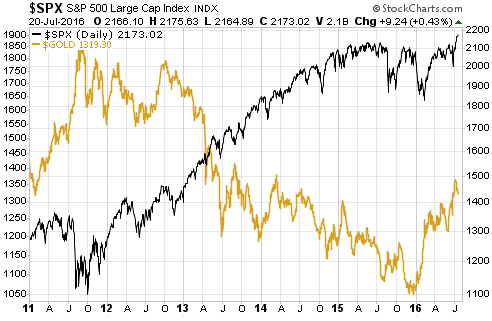
gold's cyclical bear market. We are referring to the fact that, as
illustrated by the following chart, from April of 2011 through to February
of 2016 the stock and gold markets trended in opposite directions most of
the time. Instead, when the stock market reversed upward in February the
US$ gold price traded sideways for a while before resuming the advance
that began in December
It's too soon to tell if what we've seen from the gold and stock
markets over the past few months is part of a new major trend or just a
short-term divergence from the relationship of the past few years. After
all, there were other multi-month periods over the past five years when
the stock and gold markets rallied together, but in each case the inverse
relationship subsequently reasserted itself. We just wanted to highlight
the possibility that the financial world has entered a 1-3 year period
during which the overarching correlation between gold and equities is
positive.
A 1-3 year period during which the stock and gold markets
rally together seems to require inflation expectations that are low and
rising, that is, a general expectation that there will be more
"inflation", but not so much that it creates a major problem.
No "Brexit" after all?
There are hints that the UK's
government is backsliding with regard to its commitment, following the
recent referendum, to get the UK out of the European Union (EU).
We
certainly aren't experts on British politics, so perhaps we are misreading
the situation. However, Theresa May, the country's new Prime Minister,
recently stated that Article 50 of the Lisbon Treaty (the article that
must be 'triggered' to formally begin the separation negotiations) would
not be triggered until after Brexit has Scotland's backing. Since the
Scottish people as a group are very much against Brexit, this is akin to
saying that Brexit will probably not happen.
For Britain's sake,
hopefully we are misreading the situation. Staying in the EU after having
voted to leave would be worse than having voted to stay. It would indicate
that the referendum was a charade.
The Stock Market
The US
The S&P500 Index (SPX) moved a little further into new-high territory over
the first three days of this week. There is no evidence that a major top
is close at hand or that a substantial downward trend is about to begin,
but a 1-2 week decline/consolidation is likely from whatever high is made
this week.
We will be interested to see if there's enough strength
in the overall market prior to the start of a correction to push the Dow
Transportation Average (TRAN) above resistance.
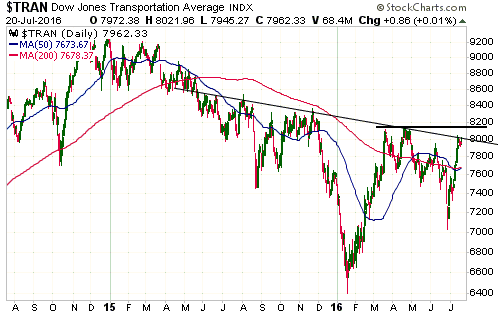
TRAN has trend-line
resistance very near its current price, but the most important nearby
resistance is defined by the April high (8150). An ability to close above
this resistance, even if only for a single day, would remove a bearish
non-confirmation -- one of the few remaining pieces of evidence supporting
the short-term bearish case.
The performance of market internals during the coming 1-2 week
decline/consolidation should be informative. For example, it would be
reasonable to expect that if a near-term decline does NOT result in a
large increase in the number of individual stocks making new 12-month lows
then it will be followed by rally to new SPX highs.
Gold and the Dollar
Gold
The Fundamentals
It's appropriate
to reprint the following comments from the 4th July Weekly Update, because
they explain why the gold market has weakened of late:
"Today's
gold-bullish fundamental backdrop has a lot to do with the expected
actions of the Fed. This is because in addition to influencing inflation
expectations and nominal bond yields, the Fed's expected moves on the
interest rate front now directly affect the relative strength of the
banking sector (bank stocks now get a boost when the expected level of the
Fed Funds (FF) rate rises due to the fact that the Fed now implements
hikes in the Funds rate by increasing the interest rate it pays the banks
on their reserves).
The expected actions of the Fed have undergone
an extraordinary change since early-June. Since then not only has the
market given up on a Fed rate hike over the remainder of 2016, it now
expects that the Fed will essentially be on hold until at least 2018! We
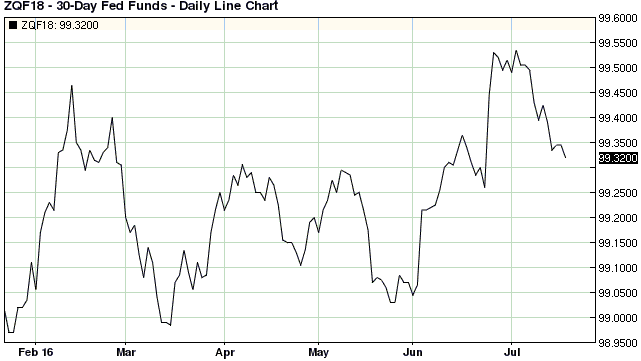
know this because the following chart of the January-2018 Fed Funds
Futures (FFF) contract shows that the expected level of the FF rate in
January-2018 is 0.51% (the FF rate implied by the futures contract is 100
minus the futures price), which is only about 0.13% above the current FF
rate. To put it another way, the market currently thinks that there is no
chance of a Fed rate hike over the remainder of 2016 and that there will,
at MOST, be a single 0.25% rate hike during the course of 2017."
After showing a chart of the January-2018 FFF contract, we went on to
say:
"What makes the change in the expected actions of the Fed
so extraordinary is that it happened in parallel with no net change in the
stock market and no significant deterioration in the economy (the economy
is lacklustre, but no more so today than a month ago). The fact that there
appears to be minimal justification for the change of the past few weeks
means that there is the potential for a quick change in the opposite
direction. All it would possibly take to set such a change in motion is a
stronger-than-expected employment report (the next monthly employment
report will be published on Friday 8th July) or an upside breakout by the
S&P500 Index.
We therefore view the fundamental backdrop as
currently being skewed in gold's favour, but in such a way that it would
take a relatively small change in the data to tip the balance from bullish
to bearish."
Since then we've had a stronger-than-expected
employment report AND an upside breakout by the S&P500 Index. As
illustrated by the updated chart of the January-2018 FFF contract
displayed below, this has caused a small but significant shift in market
expectations regarding the actions of the Fed. The huge quantity of
traders known as 'the market' now collectively believes that there is a
100% chance of at least one 0.25% Fed rate hike by the end of next year
and a 25% chance of two 0.25% Fed rate hikes by the end of next year.
Furthermore (but not indicated on the following chart), after being
totally convinced three weeks ago that there would be no Fed rate hikes
this year 'the market' is now assigning a roughly 50% probability to a
rate hike before year-end.
The recent shift in the expected actions of the Fed hasn't been
sufficient to tip the fundamental backdrop to gold-bearish. It's now best
described as gold-neutral. However, it would probably take only a small
additional increase in market expectations regarding the Fed's targeted
interest rate to push the fundamental backdrop into gold-bearish
territory.
It certainly isn't normal for minor changes in
expectations regarding the Fed Funds rate to have a meaningful effect on
gold's true fundamentals, but it's happening now. This is because the
entire financial world has come to be dominated by monetary policy.
The Price Action
It's not just
the fundamental backdrop that is being influenced to an unusually-large
degree by guesses regarding future monetary policy. Also of significance
is that gold's price action since February of this year has been dominated
by speculators in the futures market and these speculators have, as a
group, been buying/selling in response to small changes in the expected
actions of the Fed. Of particular relevance, the build-up of the
largest-ever speculative net-long position in gold futures was mostly
fueled by the belief that the Fed would take no further actions to tighten
monetary conditions for a very long time to come. Anything that calls this
belief into question is therefore going to provoke some speculative
long-liquidation.
There has obviously been some speculative
long-liquidation over the past two weeks. The amount hasn't yet been
sufficient to do much 'technical' damage, but an early warning signal was
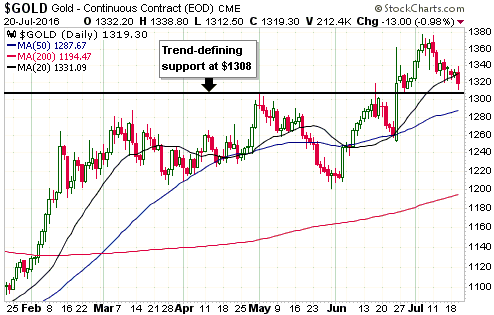
generated on Wednesday 20th July. The early warning signal was a daily
close below the 20-day MA following four consecutive trading days on which
this MA was successfully tested.
Trend-defining support for the
short-term and the intermediate-term trends lies at US$1308. This support
needs to be breached on a daily closing basis to signal a downward
reversal of the short-term trend and on a weekly closing basis to signal a
downward reversal of the intermediate-term trend.
Gold Stocks
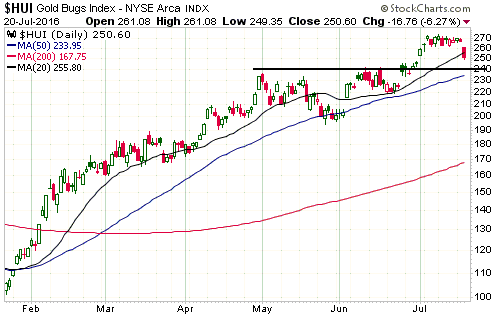
The HUI's recent price action has
been unusual. It peaked in early-July and then moved sideways in a very
narrow range for nine days. A sideways move that follows a large rally
will typically end via an extension of the rally; however, this type of
sideways move usually doesn't last as long as nine days. As all of our
readers are undoubtedly aware, the unusually-long sideways move ended in a
sharp decline on Wednesday 20th July.
As is the case with gold
bullion, Wednesday's decline didn't do much damage to the HUI's chart but
it did result in a daily close below the 20-day MA. It should therefore be
viewed as an early warning that a more serious correction -- more serious,
that is, than anything we've seen over the past 6 months -- has begun.
Trend-defining support for the HUI lies at 235-240. If this support is
breached on a daily closing basis it will probably mean that a multi-month
top is in place.
It is worth mentioning that even if the senior gold-stock indices (the
HUI and the XAU) have peaked for the year, many junior gold-mining stocks
will probably make new highs for the year over the next couple of months.
At least, that's what happened during 2001-2010 following
intermediate-term peaks in the gold-stock indices.
The
Currency Market
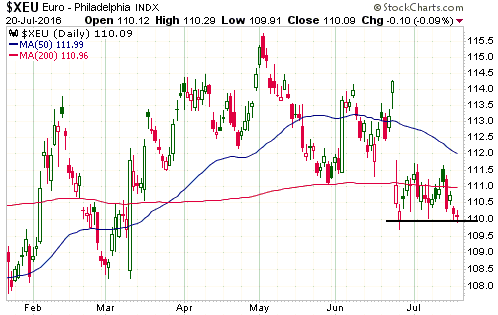
The Dollar Index has finally broken above
its 200-day MA and the top of its post-Brexit trading range, but the euro
hasn't yet managed to break below the bottom of its post-Brexit range. We
expect that it will do so in the near future.
Updates on Stock Selections
Notes: 1) To review the complete list of current TSI stock selections, logon at
http://www.speculative-investor.com/new/market_logon.asp
and then click on "Stock Selections" in the menu. When at the Stock
Selections page, click on a stock's symbol to bring-up an archive of
our comments on the stock in question. 2) The Small Stock Watch List is
located at http://www.speculative-investor.com/new/smallstockwatch.html
 New
TSI stock selection: Alkane Resources (ASX: ALK, USOTC: ANLKY). Shares:
497M. Recent price: A$0.215
New
TSI stock selection: Alkane Resources (ASX: ALK, USOTC: ANLKY). Shares:
497M. Recent price: A$0.215
We've been keeping an eye on
ALK since it was brought to our attention by a TSI reader a few months
ago. It appeared to offer good value, but the story was complex and
involved commodity markets (rare earths and other specialty metals) that
we didn't understand. We still don't have a good understanding of the
commodity markets that will ultimately be the difference between ALK being
a huge success or dead money, but we no longer view such an understanding
as a prerequisite for having a very positive opinion of the stock's
prospects. There are two reasons, the first (and foremost) of which is
that the current market cap assigns zero value to the company's
potentially-high-value "specialty metals" project. The second is that
people who do understand the markets for specialty metals have given their
stamp of approval to ALK's associated project.
ALK's most important
asset is the Dubbo Zirconia Project (DZP) located in central New South
Wales (Australia). This project hosts a large mineral resource comprising
various REEs (Rare Earth Elements), Zirconium, Niobium and Hafnium. For
discussion purposes we'll lump these elements together under the
"specialty metals" label, but the markets (the end uses and global supply
situations) of each element are different.
A feasibility-level
engineering study completed in August of last year estimated an IRR and
NPV of 17.5% and US$1B, resp., near current commodity prices. Furthermore,
the DZP is fully-permitted and construction-ready. However, the
engineering study also estimated an initial capex of almost US$1B. The
initial capex probably represents an insurmountable obstacle at current
commodity prices, but the project could well be 'financeable' at higher
commodity prices.
We noted, above, that ALK's "specialty metals"
project is currently being assigned no value by the stock market. We say
this because in addition to the development-stage DZP, ALK has other
assets with a combined value of more than its current A$100M market cap.
These assets are A$30M of cash and a gold mine with 70K-ounces/year of
profitable production.
ALK's Tomingley gold project, which is also
located in central New South Wales, has a short mine life and should
therefore be assigned a relatively low valuation, but the present
valuation is unreasonably low considering what has happened to the prices
of gold and gold-mining equities over the past 12 months. Based on the
valuations being assigned to other Australia-based gold miners with
relatively short mine lives and similar operating costs (Tomingley's AISC
is around US$940/oz), we estimate fair value for the Tomingley project to
be US$90M (A$120M).
By our reckoning, therefore, ALK has assets in
addition to the DZP that are worth roughly A$150M, or 50% more than the
company's current market cap. That's why we don't need a good
understanding of the "specialty metals" markets to figure out that ALK's
risk/reward is very attractive. We can be confident that the DZP has
significant value and we can be certain that it doesn't have negative
value.
We also noted above that people who do understand the
markets for specialty metals have given their stamp of approval to the
DZP. This comment was in reference to a
detailed report put out by Hallgarten and Co. early this week.
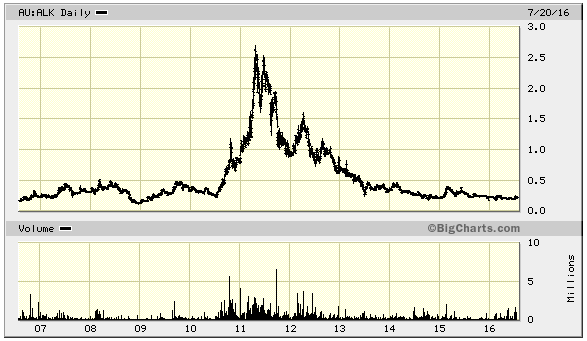
The following chart shows the massive (1000%+) rise in ALK's stock price
during 2010-2011. This was in response to the bubble in REE prices
fostered by China's government. The bursting of the REE bubble, which was
also fostered by China's government, caused ALK to lose all of its gains.
It was an incredible round trip, not just for ALK but for all listed
companies involved in the REE mining space. The difference is that most of
the stocks that flew to great heights during the 2010-2011 REE bubble have
since disappeared, whereas ALK has continued to move its project forward
and is well positioned to benefit from a likely future improvement in
commodity prices.
The following chart also shows that ALK's stock
price has essentially flat-lined near the bottom of its 10-year range
since the beginning of this year. This suggests that the current price is
a relatively low-risk entry point. Higher prices for "specialty metals"
and perhaps a lot of patience will be needed for new investors to achieve
large profits, but buyers near today's price of A$0.21-$0.22 are unlikely
to lose much money. The worst case is probably that the stock continues to
do what it has been doing for the past 6 months, which is nothing.
The most efficient place to trade ALK is on the Australian Stock
Exchange (ASX), but the stock can also be traded Over-The-Counter (OTC) in
the US as an American Depository Receipt (ADR) under the symbol
ANLKY. One
ADR is equivalent to 10 ordinary shares.
We always recommend
AGAINST trading on the US OTC markets, but if you do attempt to trade
ANLKY you should place a limit order that corresponds closely with the
latest price on the ASX. For example, with ALK priced at A$0.22 on the ASX
and an A$/US$ exchange rate of 0.75, the correct price for ANLKY would be
about US$1.65 (10*A$0.22 converted to US$).
Chart Sources
Charts appearing in today's commentary
are courtesy of:
http://stockcharts.com/index.html
http://www.barchart.com/
http://bigcharts.marketwatch.com/