|
- Interim Update 20th August 2014
Copyright
Reminder
The commentaries that appear at TSI
may not be distributed, in full or in part, without our written permission.
In particular, please note that the posting of extracts from TSI commentaries
at other web sites or providing links to TSI commentaries at other web
sites (for example, at discussion boards) without our written permission
is prohibited.
We reserve the right to immediately
terminate the subscription of any TSI subscriber who distributes the TSI
commentaries without our written permission.
Monetary
Inflation Update
The US monetary inflation rate edges higher
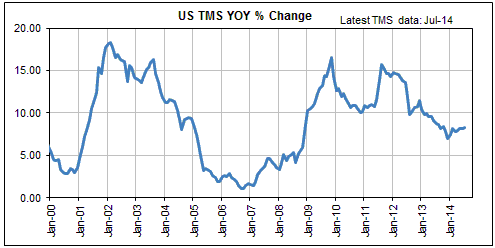
The year-over-year (YOY) growth rate of US True Money Supply (TMS)
has been gradually rising since the end of last year. Specifically,
the TMS growth rate bottomed at 7% last December and based on the
latest monthly data (the latest data is for July) is now at 8.27%, a
9-month high. The rebound doesn't look significant on the following
chart, but it is made significant by the fact that it has occurred
in parallel with the Fed's "tapering". The Fed has been scaling down
its so-called monetary accommodation since early this year, but
monetary conditions in the US are easier today than they were just
prior to the start of this scaling-down process.
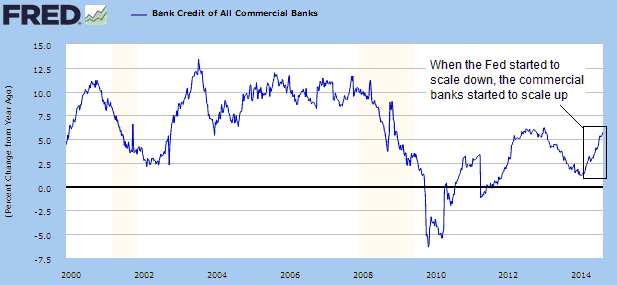
As explained in previous commentaries, the US monetary inflation
rate has edged higher concurrently with the Fed's "tapering" because
at around the same time that the Fed began to scale down its money
pumping, the US commercial banking industry began to ramp up the
pace at which it expands credit. Note that an expansion of
commercial bank credit usually boosts the money supply because it
usually involves lending new money into existence or monetising
securities.
The following chart shows the rebound in the year-over-year rate of
bank credit growth -- from 1.2% at the beginning of 2014 to 5.7% as
of 6th August.
When assessing monetary conditions it's important to consider what
the central bank is doing AND what the private banks are doing.
Don't assume that monetary conditions are getting tighter just
because the central bank is 'pulling-in the reins', and don't assume
that monetary conditions are getting easier just because the central
bank is cutting interest rates and/or monetising assets.
2014's surprising (from our perspective) sharp increase in the pace
of commercial-bank credit expansion is probably the main reason for
the US stock market's ability to extend its upward trend into the
third quarter of the year. It is also probably responsible for
pushing the earliest possible starting date of the next US recession
into 2015.
China monetary inflation rate stable at relatively low level
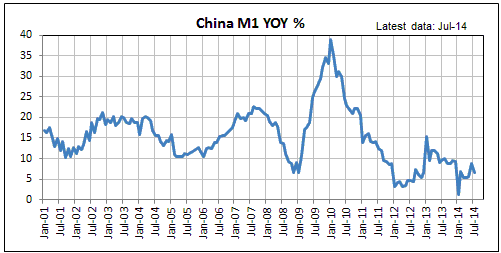
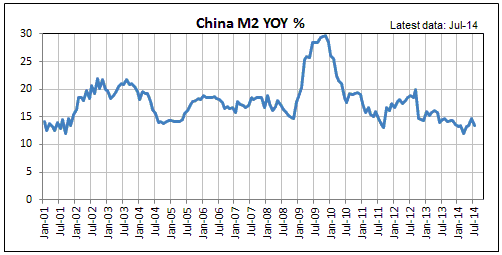
We don't have access to the information needed to calculate China's
True Money Supply (TMS), so we have to make do with the M1 and M2
money supply figures reported by the People's Bank of China (we
suspect that in China's case M1 is close to TMS, but we don't know
for sure). Charts of the YOY rates of growth for China's M1 and M2
are displayed below.
China's M1 growth rate dropped to a 14+ year low in January of this
year. It has since rebounded, but remains well below its long-term
average. China's M2 growth rate has oscillated in the 12%-15% range
over the past year. This rate of monetary expansion would be high
for any developed country, but it is below average for China.
Based on the way that China's monetary aggregates have moved in the past, it is
reasonable to expect that the small rebounds in M1 and M2 from their lows of the
past 7 months will continue until at least the end of this year. In other words,
regardless of the fact that China's credit market is a train wreck waiting to
happen, monetary conditions look set to get a little easier in China over the
months ahead.
The Stock Market
Our thinking over the past month has been that the three most
plausible US stock market scenarios were, in order of increasing probability:
1. The market is setting up for a September-October crash.
2. The market is experiencing a normal (roughly 10%) correction within a bull
market.
3. The market is gradually rolling over into a long-term decline.
Scenario 1 (the lowest-probability outcome) has been eliminated by the market
action of the past three days. The reason is that the stock market never crashes
immediately after making a new multi-year high (crashes are set up by a process
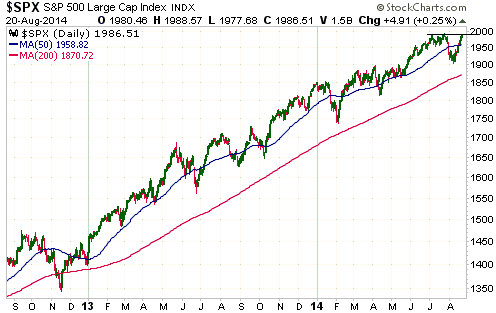
that takes at least 2 months). At this stage the S&P500 Index (SPX) has done no
more than test its July high (see chart below), but it is likely to spike to a
marginal new high within the next couple of trading days. Moreover, the
NASDAQ100 Index (NDX) and the NASDAQ Composite Index have just made new
multi-year highs.
The third scenario remains the most likely, given that the new NASDAQ index
highs have been accompanied by a relatively small number of new 52-week highs
among individual NASDAQ-traded stocks. An increasingly narrow advance is a
bull-market-ending characteristic.
The second scenario is still plausible, as a marginal new high can occur within
an overall 'corrective' process.
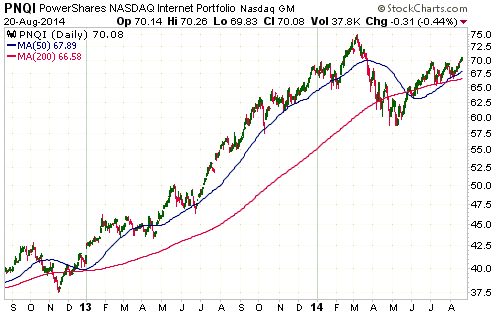
It will be worth paying close attention to PNQI, a proxy for internet and social
media stocks, over the next few weeks. The reason involves "death crosses",
"golden crosses", and the fact that PNQI has been a leader to both the upside
and the downside over the past two years.
As pointed out numerous times in TSI commentaries over the years, contrary to
popular opinion and its name a "death cross" (the 50-day MA crossing from above
to below the 200-day MA) will often be a short-term BULLISH signal. In fact, a
"death cross" is probably the most reliable short-term bullish signal there is.
The first reason is that when a market in a long-term upward trend experiences a
significant correction, the end of the correction will often roughly coincide
with a "death cross". The second reason is that when a market commences a
long-term or intermediate-term downward trend, the first decline from the peak
will often end at around the time of a "death cross". However, there is a nuance
regarding the "death cross" that COULD come into play for PNQI within the next
few weeks. We are referring to the situation where a market has a) declined far
enough from a multi-year high to create a "death cross", with the "death cross"
marking a short-term bottom as usual, b) rebounded to a lower high, but far
enough to push the 50-day MA back above the 200-day MA and thus create a "golden
cross", and c) turned around and fallen far enough to create a second "death
cross". In this situation it is reasonable to interpret the second "death cross"
as a bearish omen.
The following daily chart shows that PNQI has just completed the first two
stages of the above-described process, having fallen far enough to generate a
"death cross" and having subsequently rebounded enough to generate a "golden
cross". If, over the weeks ahead, it reverses downward from below its March-2014
peak and experiences another "death cross", the cross would be a bearish signal.
Gold and the Dollar
Gold
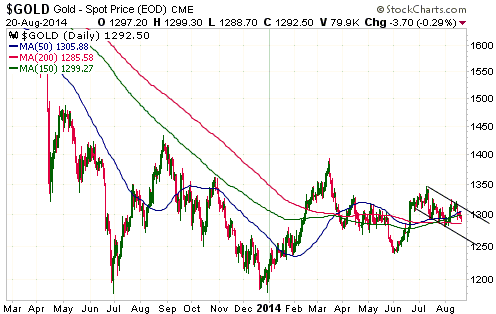
Gold's daily price moves over the past few weeks have been so small that it
doesn't make sense to attribute them to any fundamental developments. All we are
seeing is minor fluctuations in sentiment. Wednesday's small decline, for
example, appeared to be a minor reaction in speculative sentiment to a hint from
the Fed that the next rate-hiking cycle could begin earlier than previously
expected. Yes, it could begin earlier. It could also begin later. The Fed
actually has no clue as to when it will start raising its targeted interest
rate, because what it does in the future will depend on what happens to the
financial markets and the economic data in the future. Moreover, the starting
date of the Fed's next rate-hiking campaign is irrelevant to gold's
intermediate-term price trend. The important interest-rate-related
considerations for gold are the real interest rate, the yield curve, and credit
spreads.
The price action over the final two trading days of this week will be
interesting, because time is running out for the short-term gold bears. Gold
could revisit the low-$1280s and could even spike down to around $1270, perhaps
in response to the SPX moving to a marginal new high, but the key will be where
it closes the week. As long as gold manages to end this week above support in
the low-$1280s, the stage will be set for a rally to begin next week.
Gold Stocks
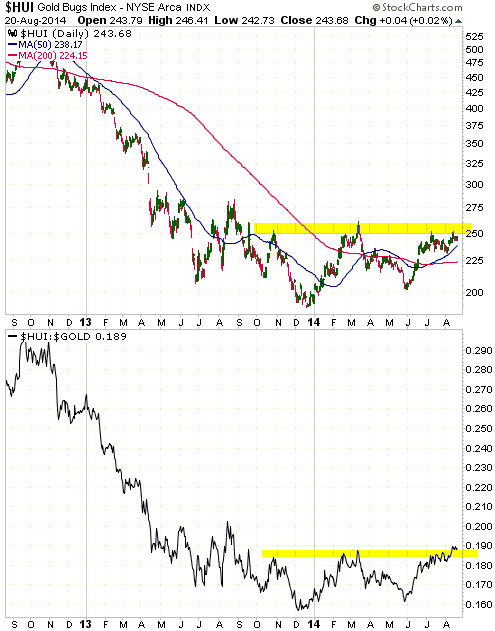
We see nothing in the HUI's recent price action for 'long' gold-stock traders to
be worried about. There could be some additional consolidation over the next few
days, but it looks to us like the basing pattern is almost complete. As depicted
by the top section of the following chart, the top of the base lies at 250-260.
The bottom section of the following chart shows one reason to be confident that
we are dealing with a long-term basing pattern at the beginning of a cyclical
bull market and not a lengthy consolidation within a continuing cyclical bear
market. We are referring to the fact that the HUI/gold ratio has already moved
above the top of its base.
The Currency Market
This is the fourth week in a row that the Dollar Index has traded above
resistance at 81.5 during the week. The previous three weeks it failed to
achieve a weekly close above 81.5. Will it manage to do so this week?
Time will obviously tell, but considering the strength of the past two days we
will be surprised if it doesn't.
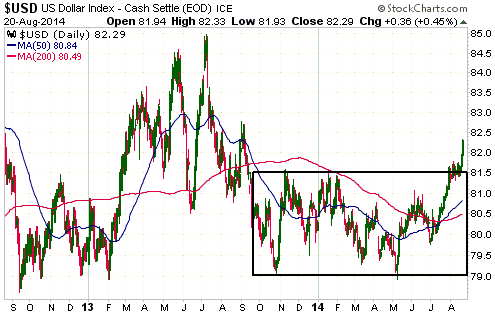
The implications of a weekly close above 81.5 by the Dollar Index will be
discussed if it happens, but include:
1) The foreign exchange market would become gold-bearish. On balance, however,
the fundamental backdrop would remain bullish for gold.
2) Our view that a cyclical bull market in commodities has begun would be called
into question, because US$ weakness is an integral part of this view.
3) The stage would be set for a multi-week pullback to the 50-day MA or a little
lower, due to the mini upside blow-off prompted by the obvious confirmation of
strength.
Updates
on Stock Selections
Notes: 1) To review the complete list of current TSI stock selections, logon at
http://www.speculative-investor.com/new/market_logon.asp
and then click on "Stock Selections" in the menu. When at the Stock
Selections page, click on a stock's symbol to bring-up an archive of
our comments on the stock in question. 2) The Small Stock Watch List is
located at http://www.speculative-investor.com/new/smallstockwatch.html
 Timmins
Gold (TGD), a 120K-oz/yr Mexico-based gold producer, was added to the TSI Stocks
List via an
email sent to subscribers earlier this week. A daily chart of TGD is
displayed below. Timmins
Gold (TGD), a 120K-oz/yr Mexico-based gold producer, was added to the TSI Stocks
List via an
email sent to subscribers earlier this week. A daily chart of TGD is
displayed below.
With TGD having edged below its 50-day MA it's possible that the correction will
continue down to the 200-day MA in the low-US$1.40s, but we don't like the
chances of it trading that low. For TGD to get that low with no company-specific
bearish news, the gold-mining sector will probably have to get much weaker than
we expect. Consequently, considering the attractive valuation we think it makes
sense to take an initial position near the current price in the low-US$1.70s.
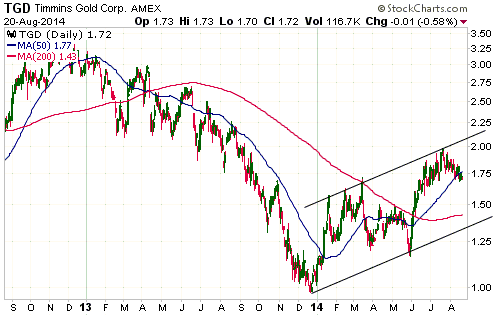
Chart Sources
Charts appearing in today's commentary
are courtesy of:
http://stockcharts.com/index.html
http://research.stlouisfed.org/

|









