|
- Interim Update 20th October 2010
Copyright
Reminder
The commentaries that appear at TSI
may not be distributed, in full or in part, without our written permission.
In particular, please note that the posting of extracts from TSI commentaries
at other web sites or providing links to TSI commentaries at other web
sites (for example, at discussion boards) without our written permission
is prohibited.
We reserve the right to immediately
terminate the subscription of any TSI subscriber who distributes the TSI
commentaries without our written permission.
China and the Anti-Realists
There
is much gnashing of teeth by the realists and celebrating by the
Keynesians over the possibility that the Fed will soon embark on
another round of "quantitative easing". The anticipation of faster
inflation of the US$ supply has put downward pressure on interest rates
and caused the speculative juices to flow more freely in the commodity
and equity markets. The Keynesians, who believe that economic
depressions are caused by a mysterious decline in "animal spirits" and
that everything would be just fine if we would simply return to
borrowing, spending and partying as if it were 2006, are therefore
getting their wish. The realists, however, understand that thanks to
the excessive borrowing and misdirected spending of the boom years
there are now huge imbalances in the economy that must be corrected
before a genuine recovery can begin, and that artificially-stimulated
borrowing and spending will only add to the imbalances by wasting more
valuable resources; in other words, they understand that the problems
are real and cannot be made to disappear by conjuring more money out of
nothing or by using some other means to foster more of a "devil may
care" attitude within the collective mind of the public.
Strangely, though, many people who are realists when it comes to the US
are anti-realists when it comes to China. Via the application of sound
theory and logic they are able to see that almost all the actions being
taken and proposed by US policy-makers will weaken the US economy, and
yet they ignore the same theory and logic when forming opinions about
China's economic prospects. China, they tell us, is going to go from
strength to strength while the US morphs into a shadow of its former
self.
A problem with the idea that China will continue its steep upward trend
while the US economy shrinks or stagnates is that an important sector
of China's economy is almost totally reliant on being able to sell
products to the US. The irrepressible China bulls counter that if the
US economy goes into an extended funk then domestic Chinese demand will
take up the slack, but this makes no sense on a number of levels. For
starters, if the Chinese manufacturers that currently export to the US
could make a profit by selling their products locally then that's what
they would already be doing (why go to the trouble and expense of
shipping products across the Pacific Ocean if you can generate a
reasonable return by selling them in your backyard?). For seconds, the
US market for the sorts of consumer goods that are exported by China is
many times larger than the market inside China. The relative sizes of
the markets will change over the long term, but in the mean time a lot
of manufacturing companies in China will find that they are geared up
to make products that cannot be sold. This is an example of the classic
"Austrian" mismatch between production and consumption that often
arises in response to rapid monetary inflation and artificially low
interest rates. It's not that there is insufficient aggregate demand
(as the Keynesians like to claim in their misguided efforts to
encourage even more inflation and an expanded role for the government);
it's that long-term investments were based on consumer spending
patterns that prove to be unsustainable because they are artifacts of a
credit bubble.
Unfortunately, having a manufacturing sector propped-up by
unsustainable consumption trends is not the only major problem facing
China's economy. As discussed in previous commentaries and as
documented by many other analysts, China is immersed in a fully-fledged
real estate investment bubble. There are some interesting facts about
China's real estate bubble and the associated mal-investment, including
pictures of a completely empty Chinese city (Ordos) that was originally
built to cater for 1.5M inhabitants, in the slide presentation delivered by Vitaliy Katsenelson at Casey's Gold and Resource Summit.
One of the indicators that China is an economic accident waiting to
happen is the rapid rate at which the country's money supply has been
rising. The monetary inflation rate was already at nosebleed levels
prior to 2008, but was accelerated by China's monetary authorities in
response to the global financial crisis. The total supply of Yuan is
now more than 50% higher than it was just two years ago. With the
effects of inflation spreading from the asset markets to the markets
for basic consumer goods and labour, China's economic commandants
became sufficiently concerned earlier this week to push interest rates
upward for the first time in three years.
That China's economy continues to maintain the outward appearance of
strength, despite a burgeoning inflation problem and mal-investment on
an unprecedented scale, is testament to the extraordinary degree of
control that China's government exerts over the banking system and the
amount of borrowing/lending. Due to this control, insolvent banks
continue to lend aggressively to insolvent State-owned companies, which
use the borrowed funds to build impressive factories, office buildings
and shopping centres, many of which are under-utilised and loss-making.
Eventually, the proverbial chickens will come home to roost (China's
bubble will burst). Best to be positioned so as not to get hurt when
that happens.
Volatility
Prior
to this week, the overall financial market action since late August had
been characterised by a lack of volatility. There is no evidence, yet,
that the market trends of the past two months have changed, but
volatility has obviously begun to increase. This could be the prelude
to some important trend changes.
The Stock Market
We
mentioned, above, that it's a good idea to be positioned in a way that
you won't get hurt when the 'China bubble' bursts. This means not being
loaded to the gills with investments that will tank when the China
growth story unravels. It doesn't mean betting against the China growth
story. Betting on the collapse of any bubble is problematic because
bubbles always remain inflated for a lot longer than expected, but the
danger in trying to time the collapse becomes even greater when
non-market forces are as powerful as they are in China.
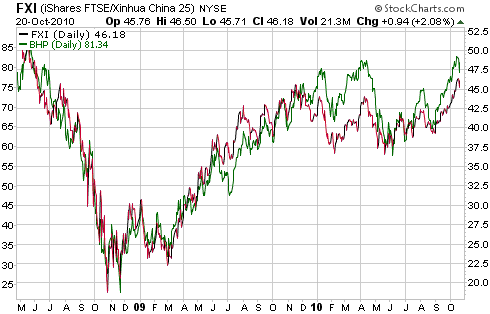
The big-cap miners of industrial metals are examples of investments
that will tank when China's leadership can no longer find ways to
postpone a major corrective process. As evidence we cite the following
chart comparison of FXI (a proxy for the Chinese stock market) and BHP
(the world's largest miner of industrial metals).
The Bank of China's
decision to boost interest rates on loans and savings deposits early
this week was widely reported as being the cause of Tuesday's sharp
downturns in equity and commodity markets. It could well have been a
contributing factor, but evidence that trends were about to be
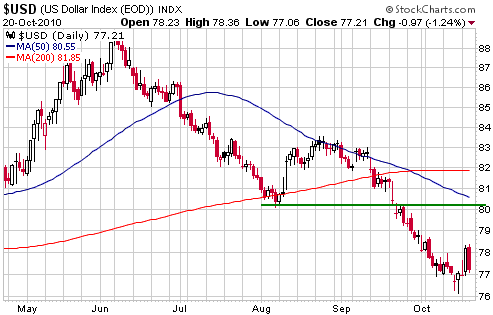
interrupted initially appeared last Friday when the Dollar Index
experienced an "outside up" day after first dropping to a new low for
the year. Also, we find it interesting that China's rate hike
supposedly caused a global stock market swoon, and yet it didn't cause
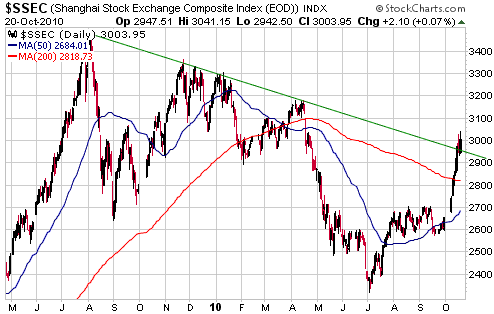
any weakness in China's own stock market. In fact, the following chart
shows that the Shanghai Stock Exchange Composite Index (SSEC) broke out
to the upside on Tuesday!
Many financial
journalists labour under the false impression that today's market
action is always a response to today's news. Consequently, whenever
there's a sharp decline they look for news that can be interpreted as
'bad' to explain it.
The boring reality is that by the end of last week the upward trends in
equities and commodities, and the associated downward trend in the US$,
had become very stretched. This made the markets acutely vulnerable to
near-term reversals of fortune.
Gold and
the Dollar
Gold and Silver
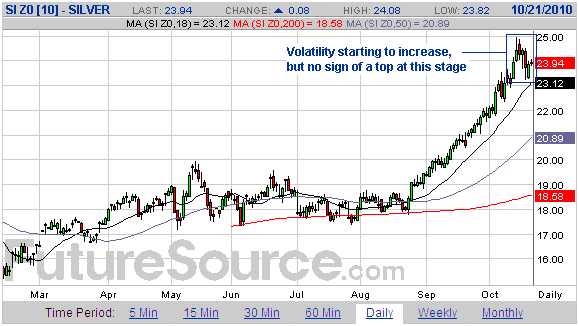
Gold and silver have finally begun to correct. This gives the bears
some hope, but a 1-3 week correction is all that's likely to happen at
this time. Based on strong seasonal patterns, new highs are likely
before the end of next month.
One problem with seasonal patterns is that they don't always work.
Also, the more times a pattern repeats in a financial market the more
confident traders become that it will repeat in the future and, due to
the contrary nature of the market, the greater the chance that it WON'T
repeat. We suspect that gold's seasonal pattern will 'work' again this
year and that an important top won't be in place until December at the
earliest, but if it's not going to work we will quickly see the
evidence in the price action of silver.
As we've noted in the past, silver doesn't keep you guessing for long
after it has reached an important top. Instead, within a few days of
the peak it usually suffers a single-day decline of at least 7-10%.
As has been the case in almost all markets, volatility has just picked
up in the silver market. However, this week's increase in silver's
volatility has been nowhere near as great as it would have been if an
important top had just been put in place.
Gold Stocks
From the email sent to subscribers after Tuesday's trading session:
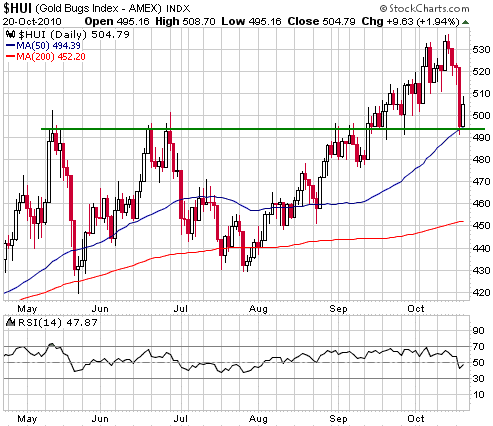
"The expected correction in the gold sector has obviously begun.
As noted in the latest
Weekly Update, the HUI has good support in the 490s defined by the
50-day moving average (currently at 493) and the May-June peaks. This
support was tested on Tuesday, so even though a downward correction has
only just begun it could already be almost complete. However, as also
noted in the Weekly Update a spike down to 480 wouldn't surprise us.
Our guess is that the correction will end within two weeks at not far below Tuesday's low."
The following daily chart shows the support we were referring to.
The odds are in favour of the HUI trading to new highs before the end of November.
Currency Market Update
Tuesday should be considered a preview of what will happen to the US$
when commodity and equity prices commence their next intermediate-term
declines.
The Dollar Index gave up almost all of Tuesday's gains when commodity
and equity prices rebounded on Wednesday. As a result, this week's
action hasn't signaled a trend change. It has, however, most likely
signaled that the period of ultra-low volatility has ended, and as
mentioned earlier in today's report this could be a prelude to some
important trend changes.
Update
on Stock Selections
(Notes: 1) To review the complete list of current TSI stock selections, logon at http://www.speculative-investor.com/new/market_logon.asp
and then click on "Stock Selections" in the menu. When at the Stock
Selections page, click on a stock's symbol to bring-up an archive of
our comments on the stock in question. 2) The Small Stock Watch List is
located at http://www.speculative-investor.com/new/smallstockwatch.html)
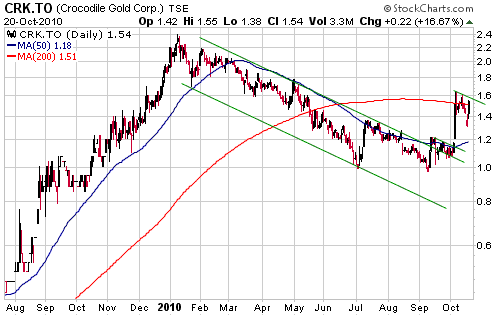
 Crocodile Gold (TSX: CRK). Shares: 203M issued, 237M fully diluted. Recent price: C$1.54 Crocodile Gold (TSX: CRK). Shares: 203M issued, 237M fully diluted. Recent price: C$1.54
In Stock Selection Update #61,
emailed to subscribers after Tuesday's trading session, we advised that
we were exiting PEZ.TO for a profit of around 180% in response to the
takeover bid for the company, and that we were adding CRK.TO to the TSI
Stocks List. CRK's chart is displayed below.
Unfortunately, CRK
issued a press release to report a good drilling result prior to the
start of trading on Wednesday. When combined with the increase in
demand prompted by our write-up and the market-wide rebound, this made
it difficult to buy the stock near the price at which we added it to
the TSI List. The stock still offers good value after Wednesday's 17%
price rise, but to maximise return and minimise risk it is important
not to chase any stock. There will always be other buying opportunities.
Dominion Mining (ASX: DOM). Shares: 104M issued, 111M fully diluted. Recent price: A$3.16
It was announced after the close of trading on Tuesday that Kingsgate
Consolidated (ASX: KCN) has made an all-stock offer to acquire DOM (the
offer is 0.31 KCN shares for every DOM share). Based on stock prices at
the time of the announcement, the offer valued DOM at A$3.63/share.
This represented a 33% premium, but half the premium evaporated on
Wednesday due to a sharp decline in KCN's stock price.
We aren't thrilled about exiting DOM at its current price, but we don't
really have a choice because from now on DOM will trade in synch with
KCN and we aren't interested in KCN. We have therefore removed DOM from
the TSI List and recorded a small profit of 15% including dividends
(based on Wednesday's closing price of A$3.16 and our February-2010
entry at A$2.80).
Of the ASX-listed stocks that we follow, at current prices we think RSG is the best candidate for new buying.
Batero Gold (TSXV: BAT). Shares: 41M issued, 55M fully diluted. Recent price: C$2.05
BAT is a small Colombia-based gold explorer that we wrote up in the
28th July Interim Update. We are bullish on this company's prospects,
but it is too small and too 'early-stage' to be a member of the TSI
Stocks List. It is yet to report its first drilling result, but the
historical data provided by the previous owner of its flagship project
suggest multi-million-ounce potential. In addition, its management is
'top notch'.
The stock has done better than expected since its late-July IPO,
despite not reporting any important new developments. There is
obviously a good deal of anticipation as to what the company will
achieve in the future, and the Colombia location hasn't hurt (Colombia
being the 'flavour of the year' in the realm of mining-related
speculation).
Even though some bullish future developments are now factored into the
stock price, substantial upside potential remains. Furthermore, the
recently completed C$1.60/share equity financing was quickly
over-subscribed and revealed considerable institutional interest in the
stock. This suggests to us that unless something unexpected and
untoward happens, the stock won't do any worse from here than drop back
to the $1.60s.
A pullback to around C$1.70 would create a new buying opportunity for risk-tolerant speculators.
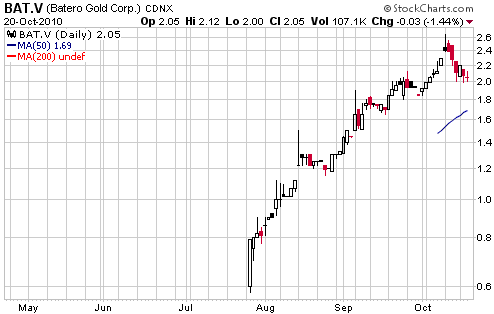
Chart Sources
Charts appearing in today's commentary
are courtesy of:
http://stockcharts.com/index.html
http://www.futuresource.com/

|