|
- 20 November, 2002
The US
Stock Market
Overview
The current market environment reminds
us more of the manic 1998-2000 environment every day. Between October-1998
and September-2000, knowledge was a dangerous thing. The less you understood
about the fundamentals the more money you could make because the companies
whose stocks were rising the fastest were the ones with the worst future
profit-making potential. We were, at the time, prepared to trade these
stocks because the major trend was up and business momentum was up (business
momentum, here, refers to the popular metric of the day, which evolved
during the mania from mundane considerations such as price/earnings ratios
and price/sales ratios to more creative measures such as price-to-page-hits
and the number of PhDs employed by the company per billion dollars of market
cap). In fact, at this time 3 years ago the TSI Stock Selections List was
dominated by tech and internet stocks in the same way that gold stocks
currently dominate the list.
We aren't, however, prepared to jump
into the current crop of absurdly-priced market favourites, even for a
short-term trade. This is because the market's technical situation is poor
(the major trend is down and the quality of the advance has not been good)
and business momentum is down. Furthermore, with leading indicators pointing
towards a further slowdown in economic growth next year the probability
of business momentum improving during the coming 6-12 months is low.
The evidence might change and if it
did we would certainly consider taking a more positive view towards the
overall market. However, any sustainable improvement in the economic backdrop
would likely favour the stocks of commodity producers over, for example,
financial, tech or retail stocks. Despite everything that has happened
in the world over the past year the CRB Index is only about 2% below its
2000 peak and about 13% below its 1996 peak. A move above the 1996 peak
would provide confirmation that the primary trend for commodities had turned
bullish. Considering that the stocks of many commodity producers are priced
as though the current commodity rally is a counter-trend move in a bear
market, a moderate gain in commodity prices from here would probably lead
to a sharp upward re-valuation of the stocks of the commodity producers.
Reality Check
The semiconductor equipment companies
are NOT early-cycle stories. These companies sell the equipment that the
chipmakers use to manufacture computer chips. However, chipmakers such
as Intel, Micron and Taiwan Semiconductor have excess capacity and won't
need much in the way of new equipment until the demand for computer chips
has been rising for some considerable time. Currently, though, the demand
for chips is not rising and won't begin to rise until there is a marked
pickup in the demand for computers. But, according to Microsoft and Dell
the demand for computers is flat and presently shows no signs of turning
higher. An upturn in the business of the semiconductor equipment companies
is, therefore, probably at least 12-18 months away. And yet, the stocks
of these companies have been at the forefront of the October-November rally.
While the absurdly overpriced semiconductor
stocks with bleak prospects have been rocketing higher, anything to do
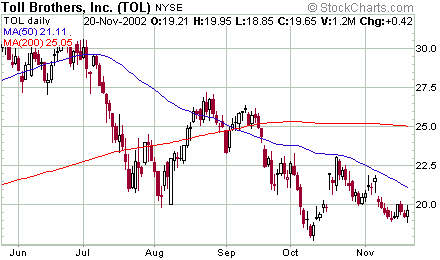
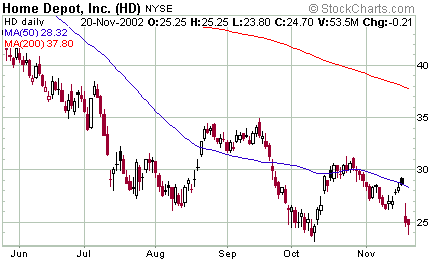
with home building or home improvement has shown few signs of life. For
example, the below charts of Toll Brothers (a homebuilder) and Home Depot
(the largest home-improvement retailer) show that both of these stocks
are near their October lows. The Home Depot (HD) stock price plunged on
Tuesday after the company confirmed that its growth rate was slowing, but
at its current level there is very little growth factored into the stock
(HD has an unleveraged balance sheet, a price/earnings ratio of about 16
and a price/sales ratio of about 1). Toll Brothers (TOL) is currently trading
at a price/earnings ratio of 6.5 and a price/sales ratio of 0.6, so the
market appears to be saying that TOL's business is going to shrink.
What is wrong with this picture? Simply
that the housing industry has supported the economy in two important ways
over the past year. Firstly, rising house prices have offset the negative
wealth effect related to the decline in the stock market. Secondly, rising
house prices combined with falling interest rates have allowed home-owners
to increase their mortgage debt and thus increase their spending. If this
support is in the process of collapsing, as the performances of HD, TOL
and other housing-related stocks suggest, then the US economy is going
to be extremely weak next year and the semiconductor stocks are even more
over-priced than they appear at first glance.
Current Market Situation
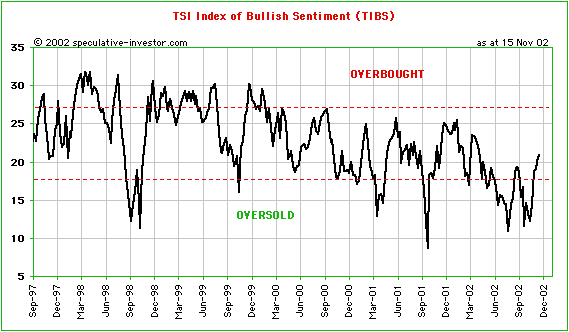
Below is a chart showing the TSI Index
of Bullish Sentiment (TIBS), a weighted index of 6 different sentiment
indicators. The chart shows that sentiment is now significantly more bullish
than it was at the August peak even though the market has gone almost nowhere
over the past month and the S&P500 Index is still 5% below its August
high.
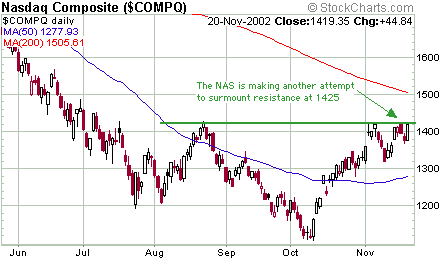
The rise in bullishness over the past
few weeks has no doubt been related more to the surge in the prices of
some tech stocks than to the performance of the overall market. For some
time now the NASDAQ Composite has been threatening to breakout to the upside
(see chart below). And, on Wednesday, the NASDAQ100 Index closed at a new
recovery high (above the August peak) while the stock price of Cisco closed
above its 200-day moving average for the first time since February.
As mentioned in the latest Weekly Update
we don't think that an upside breakout at this time would hold any great
significance beyond the very short-term. It would, however, generate a
lot of enthusiasm and probably lead to an important peak within a few days
of the breakout occurring. In this case we expect that a breakout above
resistance would shake out most of the remaining weak-handed 'shorts' and
set the stage for the next decline.
If you don't already own a bearish
position on the market, such as the QQQ put options we've suggested (the
QQQ June-2003 $20 puts - QAV RS-E) or the Prudent Bear Fund, then it would
be reasonable to purchase an initial position now. However, if you already
have a position there isn't a lot to be gained by adding to it now. We
expect the rally to fail soon, but would prefer to wait and see what happens
with the on-going probing of resistance before taking any further action.
Gold and
the Dollar
The US$ and US Bonds
As far as we can tell there isn't much
correlation between the US Dollar's exchange value and long-term US interest
rates, at least in the medium-term. Sometimes bonds will trend in the same
direction as the Dollar and at other times they will trend in opposite
directions. For example, bonds and the US$ trended higher together for
several months leading up to August 1998, at which point the US$ tanked
while bonds continued to push higher. Bonds then peaked and turned lower
in October of 1998. At the same time the US$ bottomed and turned higher.
Over the past 20 years there are several
examples of US T-Bonds rallying while the US$ fell, so it is wrong to think
that a falling Dollar will necessarily lead to higher interest rates. One
of the best of these examples occurred during 1985-1987. The US$ made a
long-term peak in March of 1985 and then lost half its value, in terms
of the Swiss Franc, in less than 3 years. During the first 15 months of
the Dollar's decline from its March-1985 peak the US T-Bond rallied (long-term
interest rates fell). In fact, it wasn't until after the Dollar had been
falling for about 2 years, in the process losing about 40% of its value,
that the US bond market really began to come under pressure.
The below chart compares the performance
of the US$ and US T-bonds during the 1985-1987 period. Note that the bond-yield
section of the chart has an inverted scale, so as shown the chart reflects
the direction of the bond price. Just for fun we've also included the Barrons
Gold Mining Index in the chart comparison.
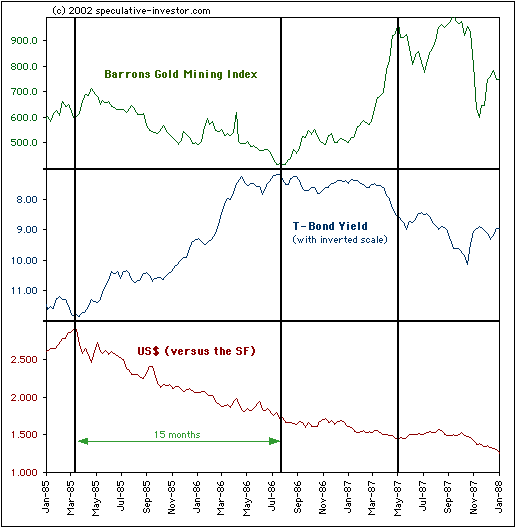
Between March of 1985 and July of 1986
(15 months), bonds rallied as the US$ fell. Bonds then peaked and spent
several months trading sideways near their highs before collapsing in April
of 1987. Based on what was happening in other markets it appears that bonds
were able to ignore a falling dollar up to the point where the falling
dollar started to generate fear of inflation.
Note that gold stocks bottomed when
bonds peaked and accelerated higher in 1987 when bonds accelerated lower.
Gold stocks were, in actual fact, moving with the yield spread (when bonds
turned lower in July of 1986 the yield spread - the T-Bond yield minus
the T-Bill yield - began to widen).
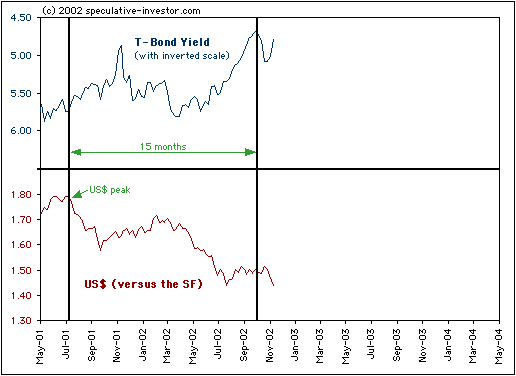
Interestingly, we have just experienced
another 15-month period (July 2001 to October 2002) during which bonds
rallied while the Dollar fell (see chart below). At this stage we don't
know whether the early-October high in bonds will turn out to be a long-term
peak or just an interim peak, but if bonds fail to make a new high over
the coming month or so then the current dollar-bond situation will look
a lot like 1986. However, it doesn't matter whether or not the recent period
during which bonds rallied while the US$ fell turns out to be exactly the
same length as the 1985-1986 period. What does matter is that bonds can
continue to rally in parallel with a falling US$ for as long as the falling
dollar is not perceived to be creating an inflation problem. Furthermore,
once the falling dollar is perceived to be creating an inflation
problem we should not only see bond prices start to trend lower, we should
also see a very powerful advance in the gold sector.
Using yourself as a sentiment indicator
There were times during May and September
when there was almost uniform exuberance expressed in the media with regard
to gold's short-term prospects. It seemed that the gold price was about
to blast higher, leaving the 325-330 resistance-area in the dust. This
exuberance was a sign of a short-term peak.
In addition to monitoring how the financial
news media portrays the prospects of a particular investment, try using
your own emotions as an indicator of the prevailing sentiment. Remember
how you felt at what turned out to be important tops and bottoms in the
past and use this information to gauge market sentiment in the future.
For example, if you were long gold stocks and were bubbling over with excitement
at the thought of much higher prices near the top in late May, or if you
were enticed to buy near the top, take note for future reference. Similarly,
if you were pressured into selling near the bottom in July or were too
afraid to do any buying at that time, also take note of how you felt. You
may find that your own feelings are an excellent contrary indicator!
Sometimes people who correctly identify
that sentiment has reached a bullish extreme refuse to do any selling because
they are worried that prices are about to rocket higher. Certainly, at
important tops there will never be any shortage of analysts explaining
why prices are on their way to the moon. However, if you do sell when exuberance
reaches what appears to be a short-term peak and the price then moves considerably
higher, it doesn't matter. When Bernard Baruch, one of the most successful
speculators of all time, was asked how he was able to make so much money
in the stock market he said "I always sold too early".
Current Market Situation
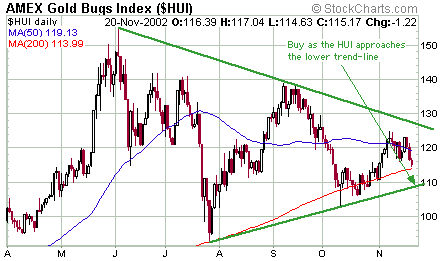
In the latest Weekly Update we included
a chart of the HUI showing what we consider to be the two most likely outcomes
for gold stocks over the next several months. Both projected outcomes involved
the HUI dropping to near its medium-term uptrend-line (currently around
110) before breaking upwards out of its consolidation pattern. We also
mentioned that we would be buyers of gold stocks if the HUI did make the
anticipated drop to its trend-line.
Below are 6-month charts of the HUI
and the XAU. We plan to do some more buying when the HUI trades below 113
and/or the XAU trades below 62. For those who don't already have a sizeable
position in gold stocks, it would be reasonable to do some buying now.

Amongst the juniors (where most new
buying should be focused) the stocks we like the most at current prices
are, in no particular order, Golden Star Resources (AMEX: GSS), Cumberland
Resources (TSX: CBD), American Bonanza (TSX: BZA), Silverado Gold (OTCBB:
SLGLF), and Red Back Mining (ASX: RBK). Amongst the majors we prefer the
large South African producers (HGMCY, GFI and AU). We suggest steering
clear of the highly-priced North American majors such as MDG and GG.
Over the past few months our view has
been that silver would drop back to at least $4.20 and perhaps as far as
$4.00 before a sustainable advance would begin. There has been nothing
in silver's recent price action to indicate that this view is wrong, but
the recent price action of silver stocks has been constructive. It was
around this time last year that we turned bullish on silver for the main
reason that the prices of silver stocks were diverging, in a positive way,
from the price of the metal. There are signs that a similar situation might
be developing now. We plan to review silver and silver stocks in the next
Weekly Update.
Update
on Stock Selections
Copper/coal producer MIM Holdings (ASX:
MIM) was up 22% in Australian trading today after the company confirmed
that it was in talks with Xstrata Plc with regard to a "friendly" takeover
of MIM by Xstrata. No offer has yet been made and the talks might lead
to nothing, but the announcement has effectively put MIM in play. If you
don't already own MIM then don't buy it now, but if you already own it
then we suggest holding. If a deal is done we expect that it would be priced
significantly above today's closing price of A$1.52.
Russian company Norilsk Nickel is going
to buy a 51% stake in Stillwater Mining (NYSE: SWC) at US$7.50/share. The
idea of being a minority shareholder in a company controlled by Norilsk
doesn't appeal to us, so we will exit SWC today. We will use the average
price during the first half-hour of trading for record purposes.
Chart Sources
Charts used in today's commentary were
taken from the following web sites:
http://stockcharts.com/index.html

|









