|
- Interim Update 21st July 2010
Copyright
Reminder
The commentaries that appear at TSI
may not be distributed, in full or in part, without our written permission.
In particular, please note that the posting of extracts from TSI commentaries
at other web sites or providing links to TSI commentaries at other web
sites (for example, at discussion boards) without our written permission
is prohibited.
We reserve the right to immediately
terminate the subscription of any TSI subscriber who distributes the TSI
commentaries without our written permission.
The "Decade Cycle" Update
In
our 5th August 2009 commentary we discussed the strong tendency for one
of the most dominant investment themes of a decade to make a 'blow-off
top' during the final few months of the '9' year or the first half of
the '0' year. At that time we thought that the best candidates for a
2009-2010 speculative bubble peak were gold, the currencies (a blow-off
move to the downside in the US$ and corresponding blow-off moves to the
upside in the euro, SF, A$ and C$), government debt, and China. Of
these, we thought that gold and the currencies were the LEAST likely
prospects, our reasoning being that the US$ had most likely bottomed
back in April of 2008 and that gold's long-term bull market probably
still had at least a few years left to run (major upside blow-offs
usually don't occur until the very ends of long-term trends). In other
words, we viewed the 'China story' and government debt as the two most
likely candidates for "bubble of the decade".
Then, in our 16th December 2009 update on the "Decade Cycle", we wrote:
"The probabilities
haven't changed much since August. For example, while it is not yet
possible to completely rule out gold and the currencies, with the US$
showing signs of having just bottomed above its 2008 low and with gold
pulling back in a healthy way there is a low probability of
trend-ending blow-off moves in these markets. The 'China story'
(China's asset markets and the general idea that China is set to
dominate the global economy for many years to come) remains a
reasonable candidate for a major speculative peak, but we think the
front-runner is the government debt market."
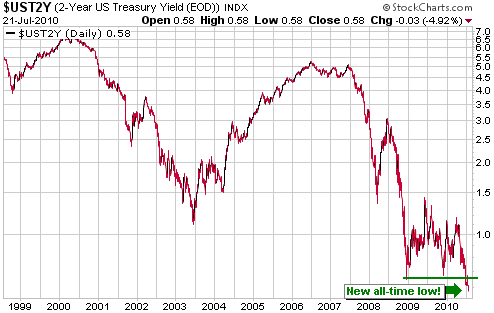
Thanks to a drop to a new all-time low by the yield on the US 2-year
Treasury Note (as illustrated below), the government debt market has
since stretched its lead and is now by far the most likely candidate
for "bubble of the past decade". If equity and commodity prices trend
lower to an October-November low as currently anticipated then interest
rates could remain at ultra-depressed levels for a few more months, but
we expect that by this time next year a major upward trend in interest
rates (a major downward trend in the prices of US government debt
securities) will be underway.
If evidence of a major upward trend in interest rates has not emerged
by this time next year it will probably mean that the Fed has decided
not to use monetary inflation as a weapon against economic weakness.
This would be a surprising turn of events given the dearly held views
of the current Fed Chairman.
As far as the new
decade's major trends are concerned, our views haven't changed.
Specifically, we continue to believe that the most important rising
trends will be those of gold and "alternative energy", and that the
most important downward trend will be in government debt. Also, this is
a good time to reiterate the following: the historical record suggests
that the first markets to make new 52-week highs after October of 2010
will be the most likely candidates for 5-10 year bullish trends,
whereas the first markets to make new 52-week lows after October of
2010 will be good candidates for 5-10 year bearish trends. Therefore,
regardless of what we THINK is going to happen over the course of this
decade, we should take heed of which markets are first to make new
52-week extremes after October of this year.
Puzzling confidence in China
In
TSI commentaries over the past three years we have expressed our
puzzlement that some analysts who correctly diagnosed the US credit
bubble and its inevitable outcome are bullish on China. Given that
these analysts were able to identify the widespread mal-investment and
consequent destruction of wealth wrought by the US credit-fueled boom
that ended in 2007, why are they unable to see that something similar
is happening in China? And why are they sensible enough to take the
economic statistics reported by the US government with the proverbial
grain of salt, and yet accept almost everything China's government says
at face value?
Similar sentiments to our own were expressed in a recent article at http://www.zerohedge.com/article/musings-china-and-japan. Here's an excerpt:
"What really amazes me is
how people who would not trust the US or European governments to do
their laundry, have unconditional faith in Chinese government
involvement in its very complex economy.
The Chinese government
brainwashes its people the same way the Russians and Soviets
brainwashed theirs: by controlling and censuring media. So I understand
when Chinese people who live in China speak highly of their leaders --
they are brainwashed (I have experienced this first-hand). However, I
am amazed that the Chinese government has been able to brainwash people
who reside outside of China.
No, an economy in large
part controlled by the state is not superior to ours. Greater control
over their economy allows the Chinese government to pull the economy
out of recession a lot faster than in the democratic countries, but
there is no free lunch. Their actions will just lead to greater
excesses and imbalances down the road."
We agree with the bulk of this article, but not all of it. We take
issue, for example, with the comment that overcapacity is deflationary.
"Overcapacity" isn't deflationary; it is an inevitable effect of an
inflation-fueled boom. The parts of the economy in which the greatest
amounts of mal-investment occurred during the boom will naturally end
up with too much capacity relative to sustainable demand and will
eventually experience declining prices (or, at least, downward pressure
on prices), but inflation and deflation are economy-wide phenomena
determined by changes in the money supply. Due to China's rapid
monetary inflation, downward pressure on some prices will be associated
with upward pressure on others.
Lastly, note the comment in the final paragraph about the possibility
of China's government introducing another multi-hundred-billion-dollar
stimulus package over the next few months. We mentioned in our 7th July
commentary that it would be important to stay alert for evidence of a
Chinese government policy shift from 'tightening' to 'easing', because
such a policy shift would, amongst other things, probably lead to an
upward trend reversal in the prices of industrial commodities. The
announcement of another large "stimulus" package -- which hasn't
happened yet, but could happen if asset and commodity prices fall over
the months ahead -- would constitute such evidence.
The Stock Market
Relentless Spin
Governments and central banks always devote a lot of time and energy to
'spinning' the latest economic developments in ways that best fit their
respective agendas, but these days the spin is more relentless and
concerted than usual; especially in the US. Also, the spin has
sometimes changed from one day to the next in order to best suit the
legislation currently under consideration. For example, one day the US
Administration is talking-up the 'economic recovery' and the number of
jobs that were supposedly created by their "stimulus" programs, and the
next day they are citing the extreme difficulty of finding a job --
mentioning, for instance, that there are an average of 5 applicants for
every job on offer -- in an effort to encourage the immediate passage
of a bill extending unemployment benefits. Which is it? Is the economy
headed steadily along the recovery path or is the employment situation
becoming increasingly dire?
The mainstream press almost never picks up on the contradictions,
exaggerations and distortions contained within the 'spin'. Instead, it
has no memory whatsoever and/or no desire to uncover inconsistencies by
comparing what is currently being said to the economic data and what
has previously been said. For a classic example of an absence of memory
and/or lack of commitment to the facts, look at the way most mainstream
financial reporters hang on Bernanke's every word as if he knows
something about the US economy's future. Bernanke's assessment of the
US economy's situation and likely future direction has been about as
wrong as it could be, every step of the way. And yet he is still
treated as if he were a veritable fountain of economic knowledge and
foresight.
Current Market Situation
In the US stock market, Monday's price action was neutral, Tuesday's
was bullish and Wednesday's was bearish. On the whole, nothing of
significance happened over the first three days of this week.
We have mentioned that periods of strength in the broad stock market
could be used to accumulate bearish positions in FCX (the world's
largest listed copper producer) and/or EWZ (a proxy for the Brazilian
stock market), either as hedges or speculations. We continue to expect
that FCX and EWZ will be relatively weak over the next three months,
especially if/when the senior US stock indices break to new lows for
the year. However, hedgers and speculators should be prepared to exit
bearish positions if the market proves to be stronger than anticipated.
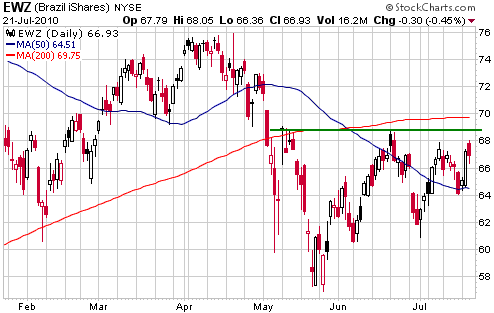
For example, the following chart shows that EWZ has important lateral
resistance at $69 and resistance defined by its 200-day moving average
at $69.75, meaning that a daily close above $70 by EWZ could reasonably
be used as a protective stop for bets against the Brazilian market.
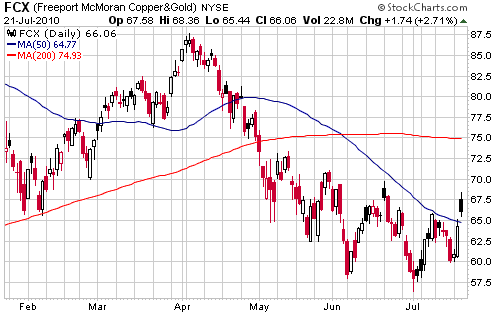
With FCX, the most
logical place for a 'stop' is not clear-cut. This is because FCX has
just moved above its 50-day moving average and is presently still a
long way below its 200-day moving average (see chart below).
Given that FCX rocketed higher at the beginning of trading on Wednesday
and then gave up the bulk of its gains, we think that a reasonable
tactic would be to exit bearish positions in the stock if it closes
above Wednesday's intra-day high of $68.36.
By the way, in our
own accounts there are currently no Brazil-related or FCX bearish
positions. We purchased FCX put options and BZQ (a leveraged fund that
moves inversely to the Brazilian stock market) as hedges during the
first half of April, and then exited these hedges on 6th May (the day
of the "flash crash"). We have since chosen not to re-establish
FCX/Brazil bearish positions, but have, instead, attempted to mitigate
downside risk in our portfolio via put options on silver, silver stocks
and the A$. We have done this because our exposure to the broad stock
market and industrial commodities is small in comparison with our
exposure to gold/silver-related investments and the main commodity
currencies (the A$ and the C$). In other words, this time around we
have opted for a more direct hedge.
Gold and
the Dollar
Gold and Silver
Silver has generally been weak relative to gold over the past 2.5
years, which is as it should be during an economic bust. As a result of
this relative weakness it now has a more precarious chart pattern than
does gold.
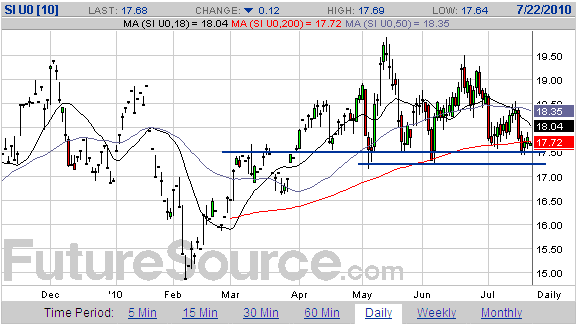
As illustrated by the following daily chart, the September silver
futures contract ended Wednesday's session just above support that
extends from $17.50 down to $17.20. A break below this support is
likely within the next few weeks.
There's a good chance that silver will fall to its February low of $15
within the next three months, but probably not much further than that.
As discussed below, a repeat of H2-2008 is not likely during the second
half of this year.
Gold Stocks
A 2008-style crash on the horizon?
Due to the price action and the fact that the goings-on of 2008 are
still fresh in their minds, some pundits are now forecasting another
all-encompassing crash that causes the gold sector to plunge along with
everything else. Our opinion is that there is a good chance of prices
moving lower over the next three months, but a 2008-style crash is a
very unlikely outcome.
Market crashes are sentiment-driven and rare. A crash only becomes
possible after valuations have become very high and sentiment has
become very bullish, but in most cases the combination of high
valuations and rampant optimism is not followed by a crash. To get a
crash there also has to be a rapid change in sentiment in the form of a
sudden realisation that the future will likely be a lot different to
the version of the future currently discounted by the market. One
reason not to fret over the potential for a crash at this time is that
market sentiment is presently nowhere near an extreme.
You may recall that at this time in 2008 the financial world was
dominated by fear of inflation and widespread belief that the
Bernanke-led Fed was going to destroy the US$. This translated into a
$140/barrel oil price (oil was the favourite anti-dollar trade at the
time), a Market Vane bullish consensus in the 80s for gold and the
euro, and a Market Vane bullish consensus in the 20s for the Dollar
Index. Today, however, sentiment can best be described as exceedingly
neutral. The general public has become disillusioned and has greatly
reduced its involvement in the financial markets, leaving the markets
to be dominated by short-term trading professionals who aren't strongly
committed to any particular outcome. The collective indifference of
today's market participants is evidenced by a Market Vane bullish
consensus of around 50 for both the Dollar Index and the euro, and a
bullish consensus of around 60 for gold.
For owners of gold stocks, another reason not to be overly concerned
about the possibility of a 2008-style crash in the near future is that
the valuations of the major and mid-tier gold stocks (the stocks that
dominate the indices) are much lower now than they were two years ago.
The general improvement in gold-stock valuations is indicated by the
fact that the HUI is now roughly the same as it was in July of 2008
while the gold/CRB ratio is now approximately double what it was back
then. This means that today's stock prices are about the same, but
today's profit margins are much higher.
Current Market Situation
We expect that the HUI will work its way back to its February low
within the next three months, but each of the near-term scenarios
mentioned in the latest Weekly Update remains in play. In other words,
the price action over the first three days of this week didn't
eliminate the possibility that a multi-week decline to the February low
is already underway or the possibility that there will be several weeks
of 'choppy' price action prior to the start of a meaningful decline.
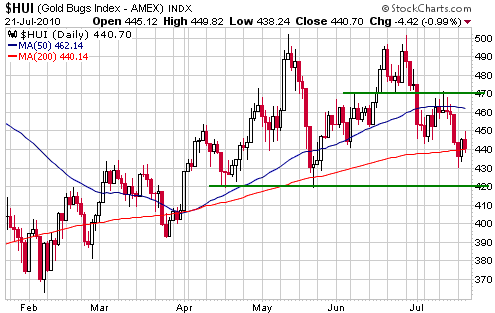
The HUI's most important nearby resistance is 470 and its most
important nearby support is at 420. A daily close below 420 would be a
clear sign that a decline to the February low was in progress.
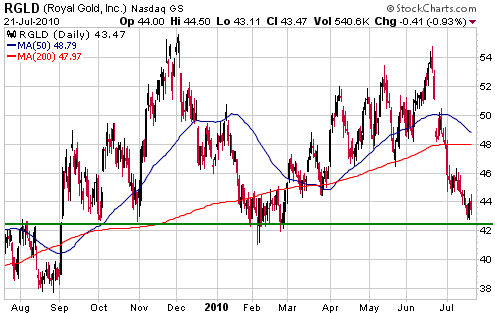
The following chart
shows that Royal Gold (RGLD) has already moved down to the vicinity of
its February low. RGLD tends to hold up relatively well during the
final phase of a sector-wide intermediate-term decline and to then be
relatively strong during the first few months of the ensuing
sector-wide intermediate-term rally. That makes it a good stock to buy
for a short-term trade once it becomes likely that the gold-stock
indices are nearing their correction lows.
Currency Market Update
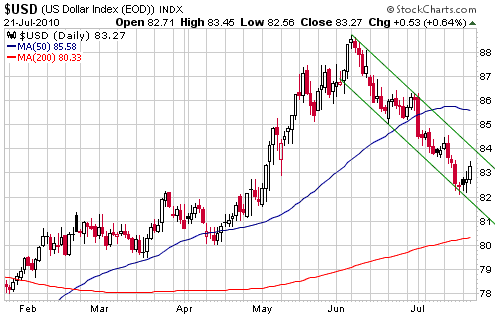
The Dollar Index has begun to rebound, but hasn't yet done enough to
confirm that a correction low is in place. A daily close above 84 would
provide such confirmation.
Update
on Stock Selections
(Notes: 1) To review the complete list of current TSI stock selections, logon at http://www.speculative-investor.com/new/market_logon.asp
and then click on "Stock Selections" in the menu. When at the Stock
Selections page, click on a stock's symbol to bring-up an archive of
our comments on the stock in question. 2) The Small Stock Watch List is
located at http://www.speculative-investor.com/new/smallstockwatch.html)
Chart Sources
Charts appearing in today's commentary
are courtesy of:
http://stockcharts.com/index.html
http://www.futuresource.com/

|