|
- Interim Update 21st September 2011
Copyright
Reminder
The commentaries that appear at TSI
may not be distributed, in full or in part, without our written permission.
In particular, please note that the posting of extracts from TSI commentaries
at other web sites or providing links to TSI commentaries at other web
sites (for example, at discussion boards) without our written permission
is prohibited.
We reserve the right to immediately
terminate the subscription of any TSI subscriber who distributes the TSI
commentaries without our written permission.
This time it's
different
We are expecting relentless inflation, but we differ from most people with the same inflation outlook in that we think the secular expansion in private-sector credit ended a few years ago. With regard to private-sector credit expansion and the monetary inflation that tends to go with it, we think the "deflationists" have it right (although they generally confuse credit and money). Where the "deflationists" have been wrong up until now and will likely be wrong in the future is in their belief that the central bank (the Fed in the US) and the government will be unwilling or unable to perpetuate the inflation in the face of the private sector's increasing desire to save.
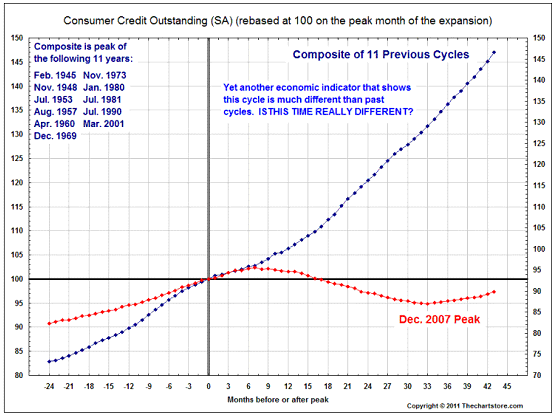
Our purpose, today, isn't to rehash our argument for relentless inflation, but to present another piece of evidence that there has been a secular change in the realm of private sector credit. The evidence is the following chart, which comes to us from
www.thechartstore.com via Barry Ritholtz's blog.
There have been 12 complete business cycles since 1945, the latest of which peaked in December of 2007. The blue line on the following chart is "Consumer Credit Outstanding" for a composite of the 11 cycles prior to the most recent one, with the zero point on the horizontal axis coinciding with the cycle peak. The red line is "Consumer Credit Outstanding" for the period leading up to and following the December-2007 peak.
The chart's message is obvious.
 A
healthier way to approach the art of speculation
Everyone involved in a financial market has an opinion on what the market will do in the future, but it's important not to be held prisoner by this opinion. Rather than assuming that the future will unfold in one particular way, it is much better to approach the market with a bunch of 'ifs' and 'thens' in mind.
To further explain what we mean, let's assume that you expect Outcome "A". While "A" is, in your opinion, the most probable future course, you should acknowledge that many other courses are possible. In fact, you should acknowledge that your probability assessment could be completely wrong and that some other outcome is actually more likely than Outcome "A".
Let's call the other possible outcomes "B", "C" and "D" (at any time there will be an infinite number of possible outcomes, but only a few will make sense and from the point of view of market positioning many of the different possibilities will essentially be the same). In this situation a reasonable approach would involve thinking along the lines of: "A" is the most likely outcome, and if it happens I will do "W". However, if "B" happens I will do "X"; if "C" happens I will do "Y"; and in the unlikely event that "D" happens I will do "Z". This contrasts with the approach of most novice speculators, which involves assuming that "A" will definitely happen and then being at a total loss regarding what to do when "A" doesn't happen.How
to reduce your deficit without cutting your spending or increasing your
revenue
We had thought it was impossible to reduce a budget deficit without either cutting spending or increasing revenue, but the Obama Administration has proved us wrong. The proof that we are wrong came in the form of the deficit-reduction plan unveiled by Obama early this week.
The aforementioned plan includes $1 trillion of "savings" over 10 years due to the withdrawal of troops from Iraq and Afghanistan. This is money that was never factored into any budget forecast and was never intended to be spent, but apparently you can generate savings by not spending money that was never intended to be spent. This prompts the question: Why not "go the whole hog" and cut the deficit by $20 trillion over 10 years by not funding the development of a colony on Mars?
In related news, your editor saved $10M this week by not purchasing a luxury yacht. He never had any intention of buying a luxury yacht, but under UGAP (US Government Accounting Principles) the decision not to buy still counts as a saving. His financial position has therefore just improved by $10M, but only on paper.Junk
Credit spreads (yield differentials between higher-risk and lower-risk debt) have widened markedly since February, but the widening has been due as much to falling yields on low-risk debt (treasury bonds) as it has to rising yields on high-risk debt (junk bonds).
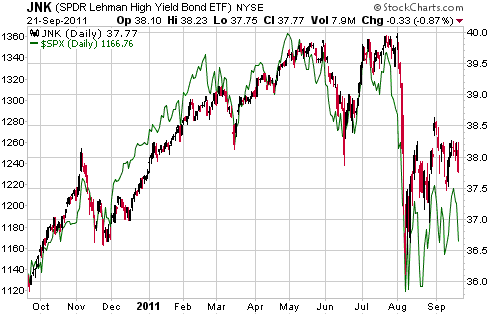
As a group, high-yield (junk) bonds usually track the broad stock market; in other words, they tend to trade like equities. The following chart comparison of JNK (the High Yield Bond ETF) and the S&P500 Index illustrates this point. Interestingly, considering the economic backdrop and the prevailing fears linked to the euro zone's debt crisis, JNK has been stronger than the S&P500 since the early-August bottom.
It will be worth keeping a close eye on JNK over the weeks immediately ahead, especially if the S&P500 re-visits its August low. A test or breach of the August low by the S&P500 combined with a significantly higher low by JNK would constitute a bullish divergence.
 The Stock Market
The Fed announced the start of a new interest-rate manipulation program on Wednesday. Numerous commentators have referred to the program as "Operation Twist", because it involves "twisting" long-term interest rates down towards short-term interest rates. This program can't possibly have a positive effect on the economy. In fact, it is almost guaranteed to have a negative effect because it adds to the long line of price distortions created by the Fed.
Fed chairman Bernanke, the arch interventionist who earlier this year pointed to the new high in the Russell2000 Index as evidence of the success of his latest QE program, obviously feels the need to do something, even if it's something that can't possibly help.
The stock market gave the Fed's new program a "thumb's down", but there wasn't a significant change in the S&P500's chart pattern over the first three days of this week. The following chart shows that the market reversed downward after testing resistance at 1225, but that support hasn't yet been breached.
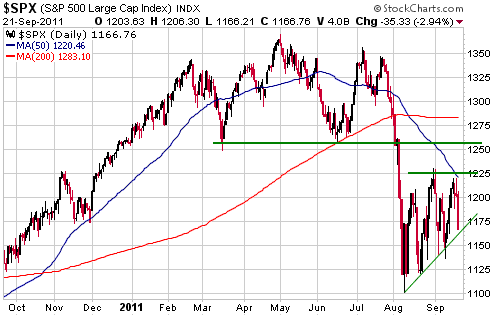
It's likely that the S&P500 will test its August low (1100) within the next three weeks. Our guess is that the August low will hold or that a breach of the low will be short-lived, but the risk of a panic that results in a plunge to a much lower level shouldn't be ignored.
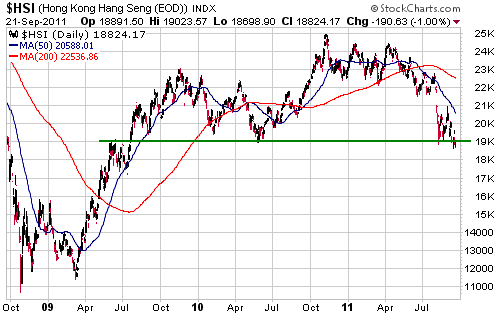
Whereas the S&P500 is yet to breach significant support, the same cannot be said about Hong Kong's Hang Seng Index (HSI). As illustrated below, the HSI achieved its lowest close in more than 2 years on Wednesday. Wednesday's downside breakout was marginal, but the breakout is about to become definitive because as we write the HSI is down by more than 800 points in Asian trading.
Gold and the Dollar
Gold
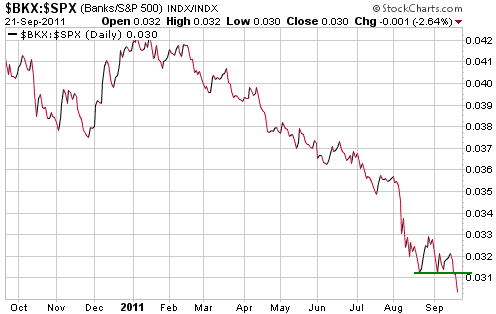
The following chart shows that the BKX/SPX ratio has clearly broken to new lows for the year. This sign of continuing relative weakness in the banking sector is bullish for gold.
The next chart shows that the US$ gold price has been edging lower over the past couple of weeks in what is beginning to look like a routine consolidation within a short-term upward trend.
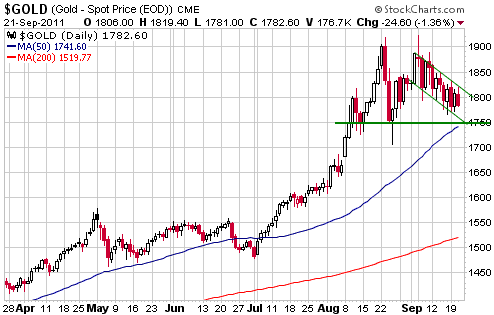
Due to the breakdown in BKX/SPX and gold's recent price action, we are upgrading our short-term gold market outlook from "neutral" to "bullish". This short-term bullish view is contingent upon the nearest gold futures contract remaining above $1745 on a daily closing basis.
A daily close below $1745 would suggest that there was downside potential to the 200-day moving average in the low-$1500s.
Relative weakness in the banking sector isn't as bullish for silver as it is for gold, but it is reasonable to expect that strength in the gold market would lend support to the silver market. As a result of this and because time is running out, we have exited our insurance position in October SLV put options. We now hold no put options apart from the FXE puts we bought last Thursday when the euro rebounded to above 1.39. However, we are hedged via a large cash reserve. Almost 40% of our portfolio is cash, some of which will be put to work over the next few weeks if prices continue to drop.
Gold Stocks
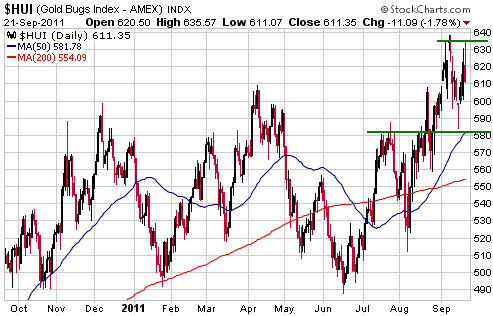
The HUI reversed lower on Wednesday after testing its early-September peak. This means that resistance at 635-640 is now well defined. A daily close above 640 would suggest that the HUI was on its way to 700 or higher. The most important nearby support continues to be in the low-580s.
We are maintaining our short-term bullish outlook for the gold sector, contingent upon the HUI remaining above 575 on a daily closing basis.
Currency Market Update
The Dollar Index's price action is bullish. The following chart illustrates that it broke out to the upside from a multi-month basing pattern in early September, pulled back to 'test' its breakout last week, and now appears to have resumed its advance.
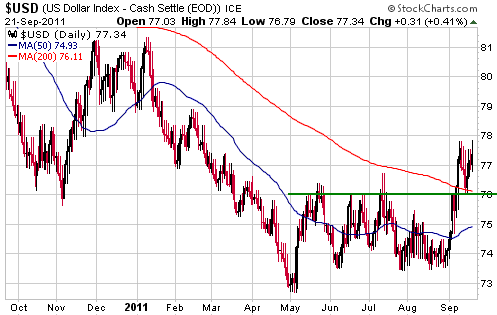
The dollar's early-September strength was primarily driven by the burgeoning debt crisis in Europe, but it is now being helped along by renewed weakness in equity markets. A short-term US$ peak will probably be put in place within the next few weeks, concurrently with a short-term bottom in the stock market and some sort of temporary resolution to Greece's debt drama.
Update
on Stock Selections
Notes: 1) To review the complete list of current TSI stock selections, logon at
http://www.speculative-investor.com/new/market_logon.asp
and then click on "Stock Selections" in the menu. When at the Stock
Selections page, click on a stock's symbol to bring-up an archive of
our comments on the stock in question. 2) The Small Stock Watch List is
located at http://www.speculative-investor.com/new/smallstockwatch.html
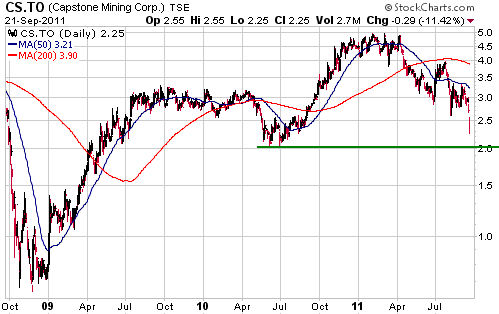
 New TSI stock selection: Capstone Mining (TSX: CS). Shares: 374M issued, 404M fully diluted. Recent price: C$2.25 New TSI stock selection: Capstone Mining (TSX: CS). Shares: 374M issued, 404M fully diluted. Recent price: C$2.25
CS is a junior copper producer with projects in Canada, Mexico and Chile. It is currently producing copper at the rate of around 80M pounds/year at a cash operating cost of about US$1.50/pound, and has the opportunity to greatly increase its production over the next few years via the development of in-house projects. The bulk of the potential production growth is associated with the Chile-based Santa Domingo (SD) project that Capstone acquired during the second quarter of this year.
The investment case for CS can be briefly summarised as follows:
1. Using a share count of 385M, the company has a market cap of $866M at the current stock price of C$2.25
2. The balance sheet is very strong, with no long-term debt and working capital of $553M. The working capital equates to about C$1.45/share.
3. The current enterprise value (market cap plus long-term debt minus working capital) is $313M, which is only about 1.1-times the current annual revenue run-rate. A revenue multiple of 1.1 is low for a profitable copper miner with good growth potential.
4. The Feasibility-Stage SD project has been estimated to have an after-tax NPV (8%) of US$1.1B at a copper price of US$2.50/pound. CS owns 70% of the project, which means that CS's stake in SD has a net present value of around $770M. In other words, the SD project alone is possibly worth more than double CS's current enterprise value.
We are currently bearish on copper and therefore aren't keen to increase our exposure to the producers of this metal at this time. However, the average copper mining equity has been a lot weaker than the underlying commodity over the past 6 months, which suggests to us that the copper-mining sector of the stock market has already factored-in a significantly lower copper price. More importantly, CS's valuation is at a level where its upside potential is greater than its downside risk even if we make the assumption that the copper price is not yet close to an intermediate-term low.
After weighing CS's attractive valuation against our bearish short-term outlook for copper and the risk of another round of stock market panic, we have decided to add CS to the TSI Stocks List. The most likely place for a low is support near C$2.00, which is only about 10% below the current price. The maximum downside risk is probably defined by the C$1.45/share of working capital (if CS trades blow 1.45 then the market will, in effect, be valuing its copper assets at less than zero).
Upside potential is largely dependent upon the copper price. If copper does no worse than drop to $2.50/pound and averages at least $3.00/pound over the next 12 months, then CS's valuation would support a rally to around C$4.00.
Sabina Gold and Silver (TSX: SBB). Shares: 154M issued, 166M fully diluted. Recent price: C$4.40
On Tuesday of this week SBB announced a resource update for the "Goose" deposit. The Goose deposit is one of several gold deposits that comprise SBB's Back River project in Nunavut (northern Canada).
The project resource has increased from around 4.2M ounces to around 4.6M ounces (about 3.2M ounces "Indicated" plus 1.4M ounces "Inferred"). Revised estimates for other Back River deposits are expected to be complete within the next three months, probably leaving SBB with a total NI-43-101 resource in the 5M-6M-oz ounce range. This would be large enough to be of interest to a senior gold producer such as Newmont, but SBB shareholders would be best served if the company remained independent for at least another year. This is because the overall Back River resource should eventually grow to at least 10M ounces.
SBB shares are still mired in the correction that began in April. A decisive break above the top of the channel drawn on the following chart would be a signal that the correction had ended.
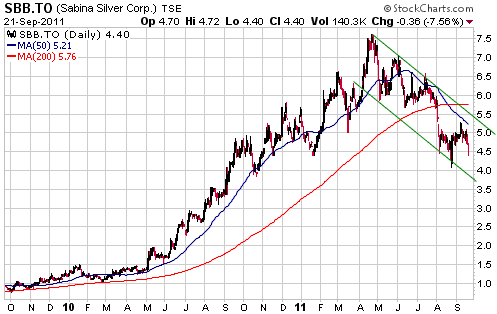
We think that SBB is a buy near its current price of C$4.40 and that it would be a very strong buy in the event that it dropped back to C$3.50-C$4.00.
Chart Sources
Charts appearing in today's commentary
are courtesy of:
http://stockcharts.com/index.html

|









