|
- Interim Update 22nd February 2012
Copyright
Reminder
The commentaries that appear at TSI
may not be distributed, in full or in part, without our written permission.
In particular, please note that the posting of extracts from TSI commentaries
at other web sites or providing links to TSI commentaries at other web
sites (for example, at discussion boards) without our written permission
is prohibited.
We reserve the right to immediately
terminate the subscription of any TSI subscriber who distributes the TSI
commentaries without our written permission.
Greece!
Leaving the euro zone wouldn't be the best solution for Greece IF staying in the euro zone didn't impose large and unreasonable costs. Unfortunately, based on the public utterances of European officialdom it seems that remaining part of the euro zone involves continuing to divert a lot of resources to the task of minimising bondholder losses. In effect, Greece will be able to remain in the euro zone if, and only if, the Greek government stays on a course that all but guarantees depressionary economic conditions for many years to come. This is why Greece probably will, and definitely should, exit the euro zone.
As was the case with the various measures that have been undertaken in the US over the past few years to alleviate financial stress, the primary guiding force behind the decisions of Europe's political and monetary leadership is the desire to minimise the losses suffered by banks and bondholders. The ECB's December-2011 decision to provide unlimited near-zero-cost financing to European banks via the "LTRO" is one example. The cobbling together -- announced early this week -- of a new 130 billion euro financing package for the Greek government is another example, as this new money helps bondholders partially recoup their investments while doing nothing to lessen the Greek government's financial predicament.
"Eurobonds" is another talked-about (but not yet agreed upon) scheme that has the minimisation of bank and bondholder losses as its main goal, except with eurobonds (bonds issued jointly by the 17 euro-zone countries) the cost of making the bondholders of one country whole would be shifted from the taxpayers of that country to the taxpayers of all euro-zone countries. We doubt that the voting populations of the economically-strong euro-zone nations would ever sign off on such a proposal, although stranger things have happened.
Once you've dug yourself into a hole it makes sense to stop digging, but almost everything that has been tried to date and almost everything that is currently being talked about to 'solve' Europe's government debt predicament involves digging deeper. The problem of bloated government liabilities is not being faced. Instead, more debt is being thrown at a problem that has a lot to do with excessive debt, with the focus being on transferring costs from entities that made bad lending/investment decisions to people who had nothing to do with these decisions. The whole process is economically and ethically unsound.
Getting back to Greece, this week's deal to provide new loans to the Greek government in exchange for the Greek government's promise to be more "austere" has pushed out the likely timing of Greece's exit from the euro-zone by at least a few months. It hasn't, however, made an eventual exit any less probable.
An exit would undoubtedly be messy, but we don't think it would need to be as calamitous as some analysts have posited. The descriptions we've seen about what an exit would entail include capital controls to prevent money from leaving the country, the freezing of bank accounts, and the forced exchange of euros for drachmas (or whatever new currency is adopted). However, no such draconian measures would actually be required to effect a currency change.
How's this for a rough plan:
1. All Greek government bonds would be re-denominated in drachmas on a one-for-one basis. This would constitute a large debt write-down, because the purchasing power of a drachma would be much less than the purchasing power of a euro.
2. All Greek government obligations other than bonds -- everything from the salaries of government employees to public pension entitlements -- would be re-denominated in drachmas in a way that reflected the anticipated initial drachma-euro exchange rate.
3. All tax bills and other government charges would be denominated in drachmas from the moment of exit. This would ensure that there was demand for the new currency.
As an aside, in a world where money can be created in unlimited amounts out of nothing there is no reason for a government to directly tax its citizens, except to create demand for money. To put it another way, instead of going to the trouble of collecting tax a government could simply print all the money it needed to pay its bills, but if it did so then a critical mass of people would quickly come to the conclusion that the money was worthless. The demand for money would therefore collapse. Direct taxation (as opposed to surreptitious taxation via inflation) not only gives a direct boost to the demand for money, it also indirectly boosts money demand -- and, therefore, money value -- by fostering the illusion that the money supply is limited.
4. There would be no requirement to convert existing paper euros or euro-denominated bank accounts to drachmas. Also, no restrictions would be placed on the ability of anyone to shift euros in/out of the country or to use euros in everyday commerce. The euro would continue to be used as money alongside the drachma and it would be up to individuals to decide whether private (non-government) commercial transactions were done in euros or drachmas.
Under our exit plan the biggest losers would be those who made the mistake of lending money to the Greek government, with the ECB probably being the biggest loser of all. This is as it should be. The Stock Market
The S&P500 Index (SPX) has just tested the upper edge of its 1340-1370 resistance range, but hasn't broken through.
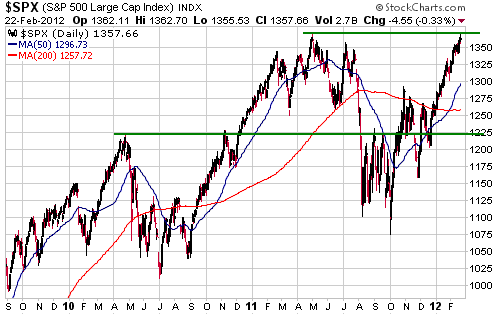
When reading some commentary you could easily get the impression that the stock market has been rocketing upward in a 'take-no-prisoners' bull market, but that's definitely not the case. The SPX is only about 10% higher now than it was in April of 2010, and all of the gain since April of 2010 has occurred over the past two months. In other words, as things stood in mid December of last year the SPX had essentially spent 20 months going nowhere.
This situation can be interpreted in two ways. The bearish interpretation is that sentiment is now excessively bullish considering the pedestrian price action of the past 22 months. The bullish interpretation is that the slow rate of increase prior to the past two months means that there is plenty of scope for additional upside.
We are bearish, which simply means that we perceive more downside risk than upside potential. The market PROBABLY hasn't peaked on anything more than a very short-term basis, but there is a distinct POSSIBILITY of a very negative outcome.
Gold and the Dollar
Gold and Silver
Current Market Situation
In the latest Weekly Update, we wrote:
"...we can't know for sure that gold and silver are experiencing minor mid-trend consolidations. We will only KNOW this if they don't move significantly lower before moving to new highs for the year. It's just that the gradual slide of the past fortnight looks much more like a consolidation than a topping pattern."
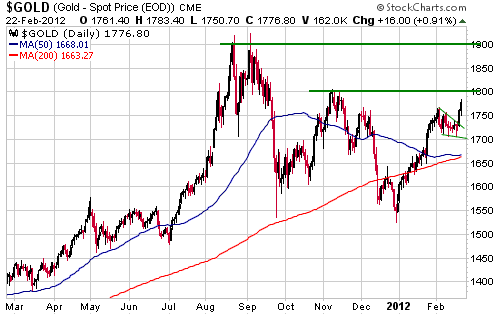
As a result of the price action of the past two days we know for sure that the gradual price declines of the past 3 weeks were minor mid-trend consolidations.
This week's upside breakouts don't imply that substantial additional gains are likely. There is a high probability that the gold market will gain enough additional ground to test resistance at $1800, but this resistance is only $17 above Wednesday's high.
Our view continues to be that resistance at around $1900 defines the maximum short-term upside potential and that support in the $1650s defines the short-term downside risk. This means that on a short-term basis we now perceive the remaining upside potential to be roughly the same as the downside risk. We are therefore downgrading our short-term gold outlook from "bullish" to "neutral".
PSLV's premium has ALMOST returned to Earth
In the 9th January Weekly Update, we wrote:
"Just when we thought the premium to net asset value (NAV) of the Sprott Physical Silver Trust (PSLV) couldn't get more ridiculous, it did. At the close of trading on Friday the fund was priced at a 32.25% premium to the value of its silver bullion. This means that when the price of spot silver was $28.75/ounce on Friday, buyers of PSLV units were paying the equivalent of around $38.00/ounce. Amazing."
PSLV's premium
has since plunged. It was 9.2% at the close of trading on Wednesday and spent a few days in the 6-7% range earlier this month.
PSLV will be a reasonable way to obtain exposure to silver bullion when (not if) its premium to NAV falls below 5%.
Gold Stocks
Sentiment
We get the impression that the general level of interest in gold stocks is uncommonly low. In fact, we would go as far as saying that the general level of interest in gold stocks is lower now than it has been at any time over the past 10 years. This is not the same as saying that the public is more bearish right now than it has been in 10 years. For example, most people were more bearish in the immediate aftermath of the 2008 crash than they are today. The point we are trying to make is that today's sentiment towards the gold sector can aptly be described by the phrase: most people couldn't care less.
The public's attitude towards gold stocks can be partly explained by the fact that the gold sector has now been in 'consolidation mode' for 14 months (the XAU peaked in December of 2010). People naturally want to own stocks that are trending upward, not stocks that consistently take one-and-a half steps up followed by two steps down. It can also be explained by bad experiences with stocks in general. The S&P500 Index has been in a steep upward trend over the past two months, but when performance is gauged over a longer timeframe it becomes apparent that upward progress has been slow (as noted above, the S&P500 is only about 10% higher today than it was in April of 2010) and has been periodically interrupted by scary plunges. Many people have probably come to the conclusion that it's best to stay away from all stocks.
Current sentiment increases the probability that the gold sector will perform much better over the next few months than most people expect. For example, in our opinion the most likely outcome is that the gold-stock indices will do not better than test their 2011 highs this year and won't break decisively to new all-time highs until the first half of next year, but the current lack of interest improves the chance of the gold sector surprising us by breaking out to the upside much earlier.
Current Market Situation
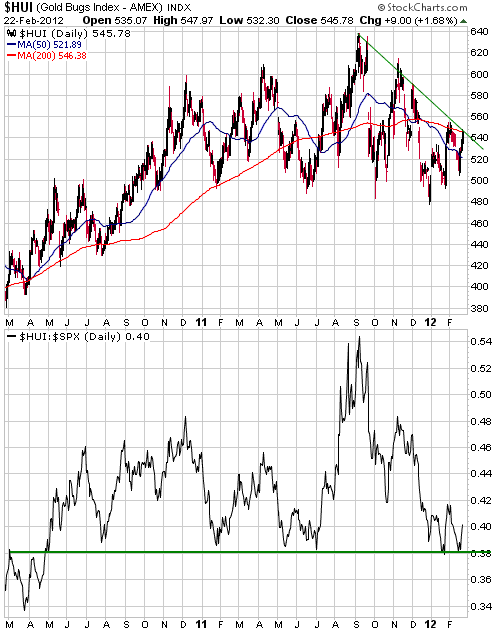
The HUI has rebounded over the past few days and ended Wednesday's session at psychological resistance defined by its 200-day moving average and a trend-line drawn from last year's high. Refer to the top section of the following daily chart for details. There's a good chance that it will break above this resistance, either immediately or following a few days of consolidation.
The bottom section of the following chart shows the HUI/SPX ratio (a measure of how the gold sector is performing relative to the broad stock market). With the ratio having just turned up from near a 2-year low it is not surprising that sentiment is depressed. But consider this question: Does it make more sense to be bullish near a 2-year low or to be bullish near a 2-year high?
Currency Market Update
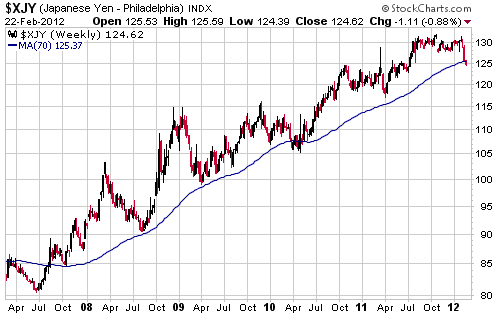
The following weekly chart shows that the Yen has just edged below its 70-week moving average. This means that it is either close to an intermediate-term bottom or in the early part of a downward trend that will last at least 2 years. At this time neither the price action nor the fundamentals are clearly saying that one of these very different outcomes has a higher probability than the other. If forced to choose we would opt for the former (the "close to an intermediate-term bottom" scenario), but we aren't inclined to place a bet.
Whether or not the Yen is close to an intermediate-term bottom it will probably soon begin to rebound, and what happens after this rebound should give us a clue as to which of the scenarios is playing out. In particular, a 2-week or longer rebound followed by a decline to a new low for the move would be a clear sign that a major downward trend had begun. If this were to happen it could create an opportunity to 'go long' the Japanese stock market for an intermediate-term trade, since currency depreciation is potent fuel for a stock market rally.
Update
on Stock Selections
Notes: 1) To review the complete list of current TSI stock selections, logon at
http://www.speculative-investor.com/new/market_logon.asp
and then click on "Stock Selections" in the menu. When at the Stock
Selections page, click on a stock's symbol to bring-up an archive of
our comments on the stock in question. 2) The Small Stock Watch List is
located at http://www.speculative-investor.com/new/smallstockwatch.html
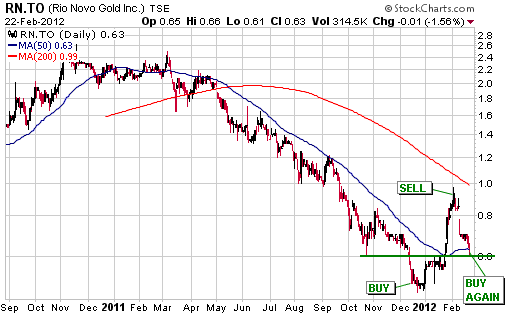
 New short-term trading position: Rio Novo Gold (TSX: RN). Shares: 143M issued, 180M fully diluted. Recent price: C$0.63 New short-term trading position: Rio Novo Gold (TSX: RN). Shares: 143M issued, 180M fully diluted. Recent price: C$0.63
We added RN to the TSI List as a short-term trading position on 14th December. We then removed it about 6 weeks later (on 2nd February) after it had gained 86%.
Since its removal from the List, RN has issued two significant press releases. The first was the 8th February announcement of channel-sampling results from the company's early-stage gold project in Colombia. These results were positive, but the market yawned (the stock closed up $0.01 at $0.85). The second significant press release was the next day's announcement of a sizeable ($20M) equity financing priced at C$0.75 per unit, with each unit comprising one common share and half of a C$1.00 share-purchase warrant. The market again yawned, but this time it was the technicolour variety as many shareholders regurgitated their holdings in reaction to such an inopportune and lowly-priced issuance of new shares. The stock closed at C$0.70 on 9th February has since continued its slide. It closed at C$0.63 on Wednesday 22nd February -- $0.12 below the financing price -- after trading as low as C$0.61.
Why RN's management chose to do such a value-diluting financing when the company already had more than $30M in its treasury is beyond us. However, the ill-conceived financing has created a second good opportunity to buy RN shares in anticipation of a substantial rebound.
We have returned RN to the TSI List as a short-term trading position (a position with a likely holding period of less than three months) at Wednesday's closing price of C$0.63.
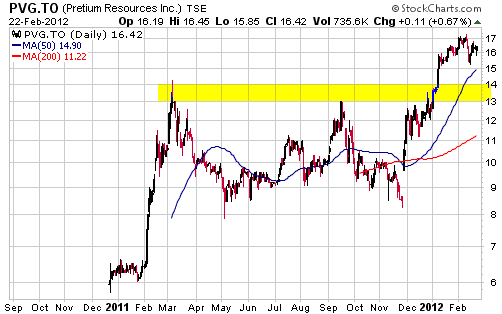
Pretium Resources (TSX and NYSE: PVG). Shares: 88M issued, 93M fully diluted. Recent price: C$16.42
PVG announced the results of an updated Preliminary Economic Analysis (PEA) for the Brucejack high-grade portion of its massive Snowfield-Brucejack gold project on Wednesday. The results were positive, to put it mildly.
At an assumed gold price of $1100/oz, the PEA completed in June of 2011 had come up with the following estimates: Pre-tax NPV(5%) of $662M, average annual production of 173K ounces, and initial capital cost of $282M. Using the same gold price, the updated PEA has the following estimates: Pre-tax NPV(5%) of $2.26B, average annual production of 325K ounces, and initial capital cost of $436M. So, there has been a $1.6B improvement in the estimated NPV with only a $150M increase in the estimated cost of building a mine.
The updated PEA also comes up with a POST-tax NPV(5%) of $2.81B at a gold price of $1733/oz. This equates to about $31 per PVG share for what is really just one part of the company's main asset.
There wasn't a meaningful reaction in the stock market to Wednesday's news. This is undoubtedly because of the large gain in the stock price that occurred over the past three months in anticipation of the news.
We have no opinion as to what PVG's stock price will likely do over the next several weeks. It wouldn't surprise us if the price rose to $20 and it also wouldn't surprise us if the price pulled back to support at $13-$14. If the latter (a pullback to support) occurred it would constitute an opportunity for new buying.
Energy Fuels Inc. (TSX: EFR). Shares: 212M issued, 230M fully diluted. Recent price: C$0.31
EFR's all-stock acquisition of Titan Uranium has been approved by the shareholders of both companies. This deal gives EFR an additional 31M pounds of Indicated uranium resources.
With the stock having drifted lower over the past month in what appears to be a routine consolidation and with the uranium mining sector of the stock market starting to garner more interest, this looks like an opportune time to buy some EFR shares. EFR is risky, but the risk is offset by huge upside potential.
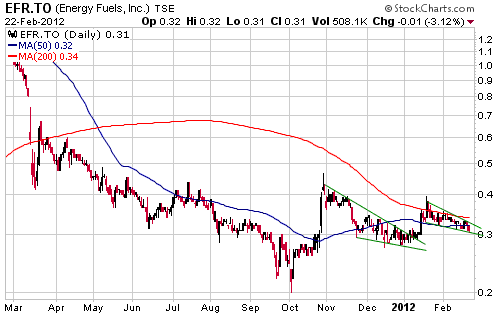
Chart Sources
Charts appearing in today's commentary
are courtesy of:
http://stockcharts.com/index.html

|









