|
- Interim Update 22nd April 2015
Copyright
Reminder
The commentaries that appear at TSI
may not be distributed, in full or in part, without our written permission.
In particular, please note that the posting of extracts from TSI commentaries
at other web sites or providing links to TSI commentaries at other web
sites (for example, at discussion boards) without our written permission
is prohibited.
We reserve the right to immediately
terminate the subscription of any TSI subscriber who distributes the TSI
commentaries without our written permission.
"Grexit"
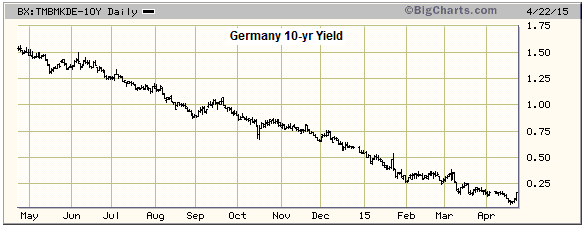
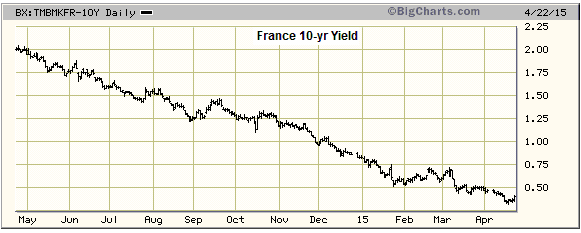
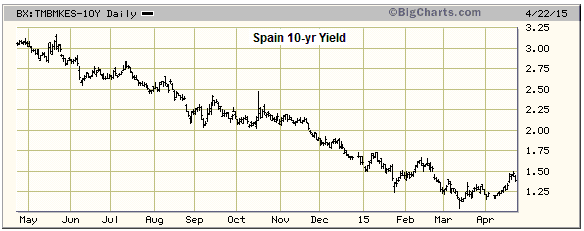
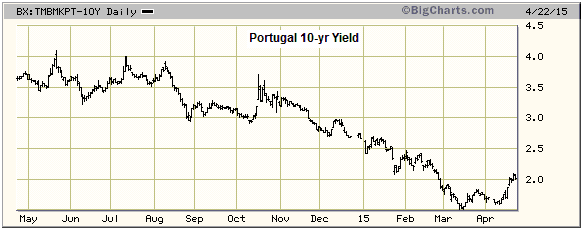
fears cause euro-zone (EZ) bond yields to diverge
Over the past two weeks there was a notable divergence between
the yields on the 10-year government bonds issued by the
'peripheral' EZ countries and the 10-year government bonds issued by
the 'core' EZ countries. In particular, the following charts shows
that a) the yield on Germany's 10-year government bond continued
along its inexorable path towards negative territory, b) the yield
on France's 10-year government bond also continued to decline and is
only marginally above the equivalent German yield, and c) the yields
on the 10-year bonds issued by the governments of Spain, Portugal
and Italy have clearly turned upward.
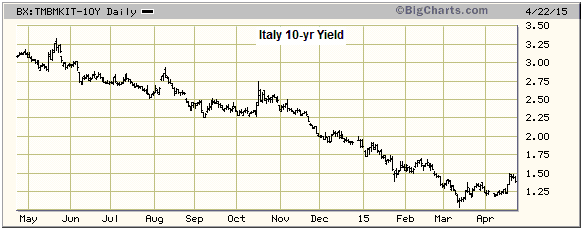
The most plausible explanation for the recent divergence is the small but
increasing risk of Greece leaving the EZ. If "Grexit" were to be transformed
from a remote possibility to a fact it would prove that entering the EZ was not
irreversible and would prompt the question: Who's next? With the 'G' gone, the
most likely answer would be one of the remaining PIGS.
We expect that a deal will be done within the next three weeks that keeps Greece
in the EZ. This is also what the market expects, as the rise in the yields on
Portugal-Italy-Spain (PIS) government bonds has not been substantial and the
recent divergence closed a little on Wednesday. Furthermore, if Greece does make
its feared exit in the near future we expect that the resultant sell-off in PIS
government bonds will be mitigated by aggressive ECB intervention. However, the
current situation is certainly interesting.
Quick note on uranium
Despite the lack of significant movement in the
uranium price, the uranium-mining sector of the stock market is starting to show
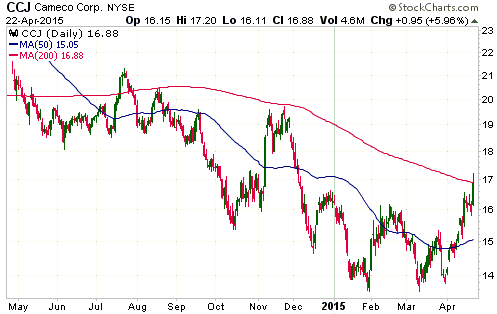
signs of life. This is most apparent in the recent stock-market performance of
Cameco (CCJ), the world's most important publicly-traded uranium producer.
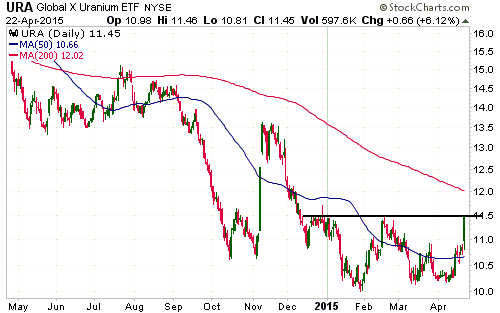
Thanks to a 6% rise on Wednesday 22nd April it is also now apparent in the
stock-market performance of the Global X Uranium Mining Fund (URA). The relevant
charts are displayed below.
This could finally be the long-awaited major turning point for the uranium
sector, but some words of caution are warranted. First, CCJ has just risen to
resistance defined by its 200-day MA, which is where a strong rebound ended last
November. Second, URA has just risen to lateral resistance and is within 5% of
its 200-day MA. Third, the uranium-mining rebound is no doubt related in part to
the recovery in the oil price, but our guess is that oil will make a short-term
peak within the next couple of weeks.
The Stock Market
China's policy-makers send conflicting signals
Stricter rules on margin lending were implemented in China after the close of
trading last Friday. We assume that this was done in an effort to reduce the
amount of speculative froth in the stock market and, in doing so, reduce the
risk of a 2007-2008-style collapse. However, just two days later (on Sunday)
China's policy-makers cut the banking system's Required Reserves Ratio (RRR) by
1%, which, according to what we've read, would likely have the effect of
releasing at least a trillion Yuan of 'liquidity'. So, within the space of two
days while the stock market was closed the apparatchiks in China first made a
move that would have the effect of quelling speculation and then completely
negated it by making a move that would have the effect of boosting speculation.
Why the sudden change of mind?
We can only guess, but Sunday's policy move was probably a knee-jerk reaction to
the futures market, which showed that China's stock market would open 6% lower
when trading resumed on Monday due to Friday's rule changes. It seems that
China's policy-makers want to slow the speed of the stock market's advance, but
they don't want it to fall. Like their Keynesian counterparts in the West,
having caused economy-wide mal-investment via earlier bouts of monetary
inflation and market manipulation they now perceive the need to inflate new
investment bubbles to offset the fallout from the bursting of previous bubbles.
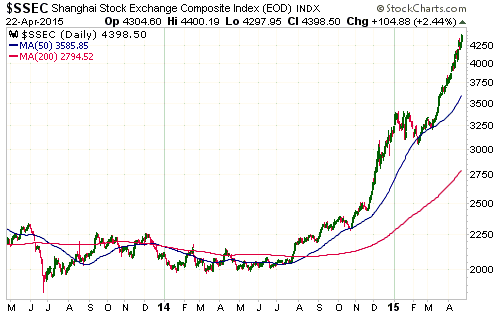
China's stock market is dominated by the public's perception of what senior
policy-makers want the stock market to do. Valuation means nothing. The public's
belief that policy-makers want higher stock prices was reinforced by last
weekend's policy flip-flop.
All of this prompts the question: With China's economy still growing at 7%
according to the latest GDP report, why are policy-makers so worried about
bursting the stock market bubble?
The answer is that China's economy is almost certainly not growing at 7%/year.
The official target is 7%, so regardless of what is actually happening on the
ground a growth rate of around 7% will be reported. China's entire economy could
collapse in a heap of mal-investment rubble and the country's government would
still report on-plan GDP growth.
Currently, China's economy is probably not growing at anywhere near the 7%
reported rate. The following chart of the year-over-year change in rail-freight
indicates that it might even be shrinking. Nobody knows. What we do know is that
China's apparatchiks are sufficiently concerned about the economy's performance
that, in true Keynesian fashion, they see the urgent need to prop-up "aggregate
demand" by whatever means available. At the moment this involves taking a leaf
out of the US Federal Reserve's playbook and pumping-up the stock market.
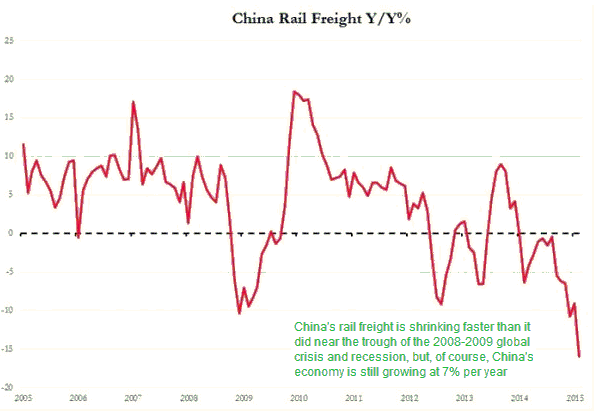
Chart source: zerohedge.com via
Stockman's blog
Japan
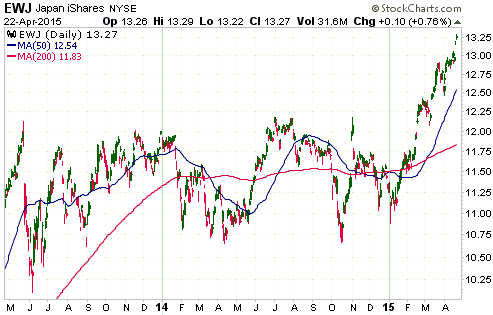
Like China's stock market, Japan's stock market, as represented on the following
chart by EWJ (an ETF that tracks the performance of the Japanese market in US$
terms), is in the midst of an upward surge. The difference is that the Japanese
stock market's surge is currently of far more modest proportions. In particular,
at this time the Japanese market is well short of 'bubble territory'. In
addition to the price action, a similarity is that both markets are being
deliberately pushed upward by the government and the central bank.
The $14-$15 range (about 10% above the current price) is the target we have in
mind for EWJ and is where we plan to take profits. If US and European equity
markets hold together for another month or so, which, admittedly, is a big if,
then EWJ could reach the aforementioned target by the end of next month.
You might not want to be 'long', but it isn't advisable to be bearish on a
market that a buyer with infinitely-deep pockets is trying to elevate.
The US
Most US stock indices have been range-bound since the beginning of March. They
almost broke out to the downside about three weeks ago and have since rebounded.
In the case of the S&P500 Index (SPX), the rebound has taken the price back to
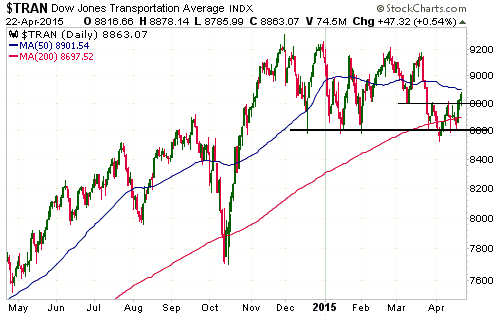
near the top of its 8-week range. In the case of the Dow Transportation Average
(TRAN), which is the index that came closest to breaking out to the downside and
signaling a top of at least intermediate-term significance, the rebound has
taken the price back to near the 50-day MA (see chart below).
The recent back-and-forth price action in the US stock market provides us with
no clues as to what lies ahead, but it goes part of the way towards explaining
the recent indecisive price action in gold bullion and gold-mining stocks. The
reason is that although it doesn't always work this way, the extent to which the
fundamental backdrop is bullish for gold tends to move in the opposite direction
to the US stock market. For example, Wednesday's small up-move in the SPX was
accompanied by a small up-move in the real US interest rate and a small
narrowing of credit spreads, both of which are bearish for gold.
Gold and the Dollar
Gold and Gold Stocks
Overview
We posted some charts at the
TSI Blog
following Monday's trading session to make the point that the price action was
hinting at some near-term upside in gold and the gold-mining sector. There was
one day of upside (Tuesday), but on Wednesday there was enough weakness to
eliminate the near-term bullish signs. This continues the pattern of the past
few weeks, with the market for gold-related investments hinting at a move in one
direction and then being unable to follow through.
Most of the bullish-leaning investors who weren't already bludgeoned into
submission by the large declines of 2013-2014 have probably either given up or
are now close to giving up due to this year's superficially boring performance
by gold bullion and the gold-stock indices. From our perspective, however, the
recent price action has been fascinating. The main reason is that although we
haven't been expecting gold bullion and the HUI to do much more in the near
future than rise to the $1230s and the 190s, by the close of trading on Tuesday
the gold-mining sector had worked itself into the position where it was not far
from generating price signals that were bullish on an intermediate-term basis.
And an intermediate-term bullish signal for gold mining would imply an
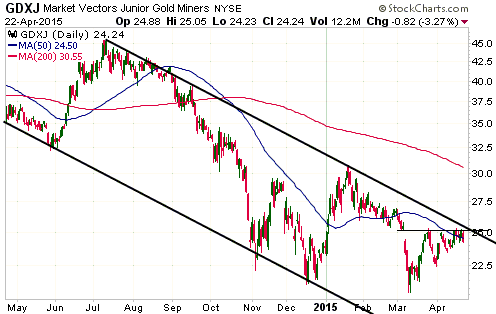
intermediate-term bullish signal for gold bullion. For example, at the end of
Tuesday's session GDXJ was near the top of its intermediate-term
downward-sloping channel.
The problem is the fundamental backdrop. Many gold-bullish commentators claim
that gold's fundamentals are bullish and, therefore, that the lacklustre
performance of the US$ gold price is anomalous. We expect that gold's true
fundamentals will turn bullish before this year is out, but the current
fundamental backdrop is actually no better than neutral for gold. Furthermore, a
neutral/mixed fundamental backdrop for the US$ gold price has prevailed since
around July of last year (the fundamentals momentarily turned bullish during the
first half of last year).
Current Market Situation
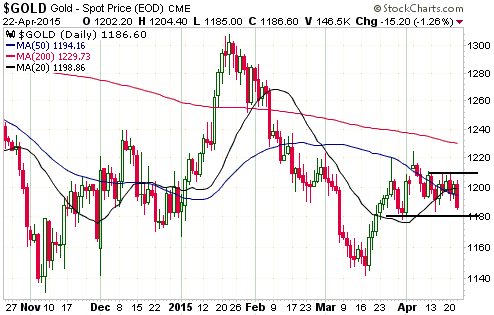
On Monday, gold closed below its 20-day MA and held at its 50-day MA. On Tuesday
it closed above both of these MAs, but on Wednesday it closed below both of
these MAs and achieved its lowest daily close in more than three weeks.
There is lateral support at $1180. If this support is breached then the obvious
conclusion will be that gold is on its way back to the November low (around
$1140), but the obvious conclusion is often not the right conclusion. For
example, gold's breach of obvious support in the low-$1180s in December was
almost immediately followed by a strong multi-week rally.
While we continue to suspect that gold will re-test its November low within the
next three months, we will be surprised if it happens within the next three
weeks.
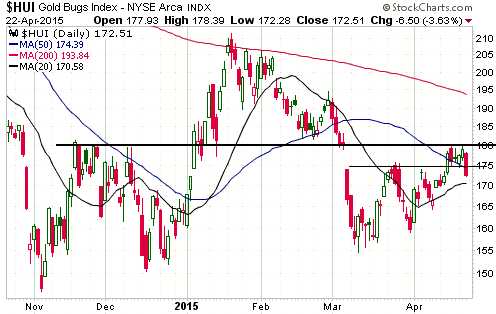
The HUI re-tested resistance at 180 on Tuesday and then pulled back in sympathy
with gold bullion on Wednesday. It has fallen below its 50-day MA and lateral
support/resistance at 175, but remains above its 20-day MA.
Wednesday's price action reduced the probability of the HUI making it to the
190s in the near future. However, there have been a number of deceptive price
moves over the past six weeks, so we are reticent to base any conclusions on the
conflicting signals that occurred over the past three days. The only clear
message is that resistance at 180 is important.
The Currency Market
We mentioned earlier in today's report that the recent back-and-forth price
action in the US stock market goes part of the way towards explaining the recent
indecisive price action in gold bullion and gold-mining stocks. The US Dollar's
recent back-and-forth movement also goes part of the way towards explaining the
indecisiveness of gold-related investments.
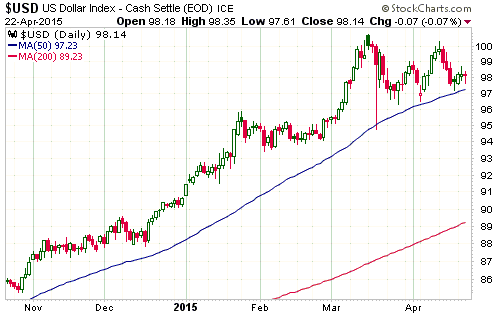
The mid-March bottoms in gold and the gold-mining indices coincided with a peak
in the US$. As illustrated by the chart displayed below, the Dollar Index
quickly lost a few percent during the days immediately following its peak and
then began range-trading. With the Dollar Index leaving open the question as to
whether it has peaked on a multi-month basis or only a multi-week basis, there
are no clear currency-market signals for gold to key-off.
We expect the Dollar Index to drop back to near its 200-day MA, even if its
longer-term upward trend is intact. A daily close below the 50-day MA would be a
preliminary sign that the market was in the process of meeting this expectation,
while a daily close below 96 would be a more definitive sign and a daily close
below 94 would eliminate all doubt. However, as things currently stand there is
still a realistic chance of the Dollar Index making a marginal new high prior to
the start of the anticipated decline to the 200-day MA.
Updates
on Stock Selections
Notes: 1) To review the complete list of current TSI stock selections, logon at
http://www.speculative-investor.com/new/market_logon.asp
and then click on "Stock Selections" in the menu. When at the Stock
Selections page, click on a stock's symbol to bring-up an archive of
our comments on the stock in question. 2) The Small Stock Watch List is
located at http://www.speculative-investor.com/new/smallstockwatch.html
Chart Sources
Charts appearing in today's commentary
are courtesy of:
http://stockcharts.com/index.html
http://bigcharts.marketwatch.com/

|









