|
- Interim Update 22nd May 2013
Copyright
Reminder
The commentaries that appear at TSI
may not be distributed, in full or in part, without our written permission.
In particular, please note that the posting of extracts from TSI commentaries
at other web sites or providing links to TSI commentaries at other web
sites (for example, at discussion boards) without our written permission
is prohibited.
We reserve the right to immediately
terminate the subscription of any TSI subscriber who distributes the TSI
commentaries without our written permission.
Crash
Patterns
On the rare occasions when the US stock market crashes, the
crash never begins immediately after the price peak. Instead, the
ultimate price peak is followed by a process that involves an
initial decline (usually 5%-10%), a rebound that retraces 50%-90% of
the initial decline, and then a second decline to support defined by
the low of the initial decline. This process, or "crash pattern",
takes two months or more to complete. If a crash is going to happen
it does so after the price breaks below support defined by the
initial low.
It should be understood that the vast majority of "crash patterns"
don't actually lead to crashes. A lot of times, support defined by
the initial low will not be breached and the "crash pattern" will
turn out to be a routine consolidation. Other times, a break below
support defined by the initial low will happen without prompting a
crash. In the same way that most dogs aren't poodles but for an
animal to be a poodle it must first be a dog, most crash patterns
don't lead to crashes but for the stock market to crash it must
first follow the crash pattern.
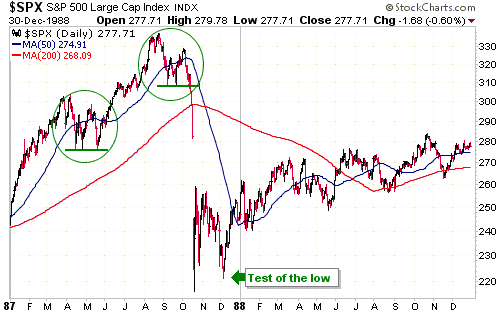
The price action of the S&P500 Index during 1987 provides examples
of two crash patterns, one of which -- as everyone knows -- ended in
a crash, and the other of which turned out to be a routine
consolidation. Here's a chart with the crash patterns circled. Also
noted on the chart is the test of the low that happened a few weeks
after the October crash.
An implication of the above is that even if the US stock market has
just hit its ultimate peak, the second half of July would be the
earliest that it could crash.
We hasten to point out that a crash is NOT a likely outcome for the
US stock market during 2013. As previously advised, our best guess
is that the market will make a rounded top over the next 6 months
and then roll over into a 1-2 year cyclical bear market. That being
said, the combination of the relentless nature of the advance of the
past 7 months, the disconnect between earnings growth and
share-price growth (the "earnings game" results in the earnings of
most companies coming in ahead of expectations every quarter, but
the fact is that S&P500 earnings and revenue have barely grown at
all over the past 12 months) and the complacent sentiment (the
popular view that nothing can go wrong as long as the Fed keeps
monetising $85B of bonds per month) makes a crash more likely than
it would ordinarily be. First, however, we need a "crash pattern" to
form, beginning with a 5-10% pullback.
The crash pattern described above applies to the US stock market and
possibly to the stock markets of other developed economies, but it
doesn't apply to gold and silver. Gold and silver are quite capable
of rocketing up to a major price peak and then immediately crashing,
as was seen with both of these metals in January of 1980 and as was
seen with silver in April-May of 2011. Also, as per recent
experience it is clearly possible for gold and silver to crash after
breaking below the bottoms of multi-quarter trading ranges. However,
the aftermath of the gold-silver price crash of April-2013 has, to
date, been similar to the aftermath of the US stock market's 1987
crash. Of particular note, following gold's April-2013 price crash
there was a 2-3 week rebound and then a decline to test the crash
low.
The Stock Market
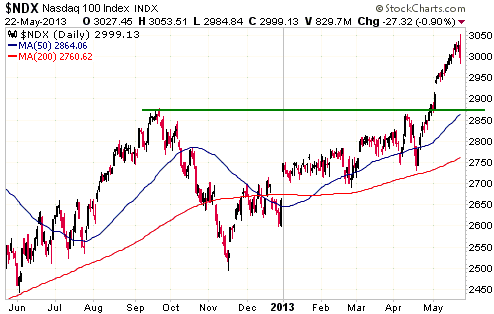
Most US stock indices made multi-year highs on Wednesday 22nd
May and then reversed to end the day below the low of the preceding day, making
Wednesday an outside day to the downside for these indices. The following daily
chart shows the NASDAQ100 Index (NDX).
It's obviously way too soon to be drawing any conclusions about the significance
of Wednesday's price action. The price action was blamed on Ben Bernanke's
utterings and the minutes of the latest FOMC meeting, but what we have is a
market that has gone up in straight-line fashion since mid-April and is looking
for a reason to 'correct'. A normal short-term correction could take the NDX
back to former resistance (now support) at around 2875.
Gold and the Dollar
Gold
Gold backwardation/contango and interest rates
Gold is said to be in "contango" when the spot price is lower than the nearest
futures price and the prices of nearer futures contracts are lower than the
prices of longer-dated contracts. In other words, a contango in the gold market
is effectively the same as a positively-sloped yield-curve in the credit market.
"Backwardation" is the opposite. Specifically, gold is said to be in
backwardation when the spot price is higher than the nearest futures price and
the prices of nearer futures contracts are higher than the prices of
longer-dated contracts. Backwardation is therefore similar to an inverted
yield-curve. Due to the fact that gold's existing aboveground stock is massive
in relation to the amount of gold that gets mined in a year and that most gold
is held as a store of value or speculation (meaning: it doesn't get consumed in
commercial processes), there should never be a shortage of gold. This results in
"contango" being the norm in the gold market.
The main point we want to address today is the relationship between the gold
market's contango and the zero-risk short-term US interest rate. For the
purposes of this discussion, we will consider the yield on the 3-month T-Bill to
represent this interest rate. Also, before proceeding we'll note that a single
"spot price" doesn't exist in the gold market. We therefore determine gold's "contango"
or "backwardation" by comparing the prices of liquid futures contracts,
beginning with the difference in price between the nearest liquid COMEX futures
contract and the price of next liquid contract.
The extent to which the gold market is in contango is usually linked to the
zero-risk short-term interest rate, with a lower interest rate leading to a
smaller contango (a smaller difference between the price of gold for immediate
delivery and the price of gold for delivery a few months or more into the
future). To understand why this is so, consider the case of a gold trader that
wants to take delivery of gold in three months. The trader could either buy a
futures contract that expires in three months or buy physical gold immediately
and store it for three months. The latter option would entail a
storage/insurance cost and an opportunity/financing cost related to the interest
that could have been earned, or that would have to be paid in the case of a
loan, over the three-month period on the money that has been invested in the
gold. The trader will therefore choose the latter option if adding the
storage/insurance cost and the opportunity/financing cost to the price of gold
for immediate delivery results in a lower number than the price of a futures
contract expiring in three months. Otherwise, he'll choose the former option.
Continuing with the explanation, arbitrage trading will generally ensure that
the relationship between interest rates and the gold "contango" remains tight.
For example, assume that the price of gold for delivery in three months moved to
a 5% premium over the price of gold for immediate delivery and that the sum of
the 3-month interest rate and the gold storage/insurance cost was 1%. In this
case a trader could lock-in a 4% profit by purchasing physical bullion and
simultaneously selling the futures contract. Many large traders (such as bullion
banks) would do exactly that, thus bringing the futures price into line with the
"spot price" and the short-term interest rate.
With gold storage/insurance costs being fairly constant at only a small fraction
of a percent per year, the extent to which the gold market is in contango will
mostly be determined by the short-term US$ interest rate. In other words, when
the T-Bill yield is close to zero, as it is right now, gold's contango should be
very small. In fact, it should be so small that minor random price fluctuations
could momentarily lead to backwardation, which is what has occasionally happened
over the past five years.
As we write, the price of gold for delivery in June-2013 (the nearest liquid
futures contract) is marginally lower than the price of gold for delivery in
August-2013 (the next-to-nearest liquid futures contract), which, in turn, is
marginally lower than price of gold for delivery in December-2013. This
miniscule contango is consistent with the current T-Bill yield of 0.04% and
therefore says a lot more about the Fed's manipulation of interest rates than
about the gold market.
Escape Velocity
The idea is beginning to take hold that at some point over the next several
months the US economy will reach "escape velocity". At that point, so the
thinking goes, the economy will have enough forward momentum that it will no
longer require the 'support' of aggressive Fed money creation. Furthermore, so
the thinking also goes, the upcoming reduction in the Fed's monetary
accommodation is bound to cause gold's bear market to continue.
There is so much wrong with the above line of thinking that thoroughly debunking
it would require a book. However, the super-abridged version of the
counter-argument goes like this:
The Fed's aggressive 'monetary accommodation' during the late-1990s caused the
investment boom that inevitably led to the bust of 2000-2002. The even more
aggressive 'monetary accommodation' put in place to alleviate the pain of the
2000-2002 bust caused the ensuing economic recovery to be weaker than average
and also caused another investment boom that inevitably led to a much bigger
bust during 2007-2009. The even more aggressive 'monetary accommodation' put in
place to alleviate the pain of the 2007-2009 bust caused the ensuing economic
recovery to be even weaker than the 2003-2007 episode as well as yet another
investment boom that is guaranteed to lead to the next in the series of
escalating busts/crises.
The "escape velocity" analogy is absurd, because the distortion of prices caused
by the 'monetary accommodation' creates and supports bubble activities that
can't exist without the continuing flood of new money. These activities WILL
collapse after the monetary flood is stopped or significantly slowed, revealing
a reality that will undoubtedly provide justification for the next round of
'monetary accommodation'. Moreover, gold will only do poorly until it starts to
become clear that the preceding monetary accommodation hasn't helped. This point
could be reached as a result of either a "tapering off" or a panicked
acceleration of the current monetary accommodation.
Current Market Situation
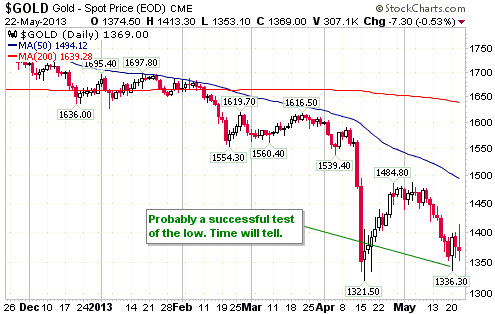
At this stage it looks like gold successfully tested its mid-April low on Monday
20th May, although it hasn't yet moved far enough above the low to confirm that
this is, indeed, the case.
If a successful test of the mid-April low has just happened then the gold price
should move up to the low-$1500s within the next month or so.
Gold Stocks
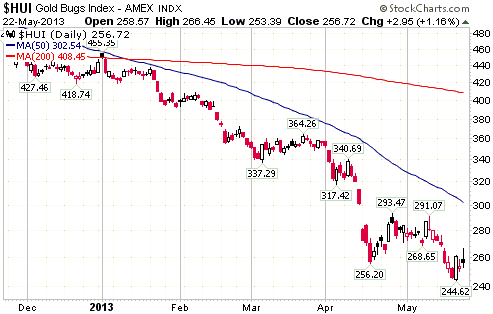
It could turn out that Monday's upward reversal in the gold sector marked an
important low -- the latest in a series of important May turning points.
However, significant additional strength will be required over the days
immediately ahead to determine if this is, in fact, the case.
If you purchased a short-term trading position in a gold-stock ETF during the
first three days of this week it would make sense to place a sell stop just
below Monday's intra-day low.
Currency Market Update
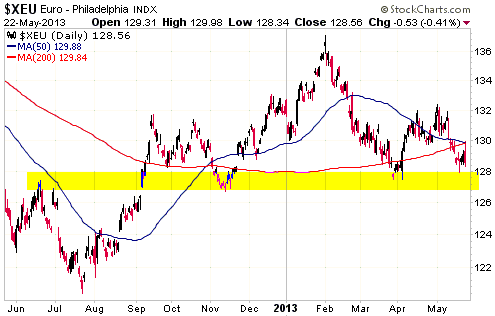
Over the past month the US$ has been very strong relative to all major
currencies except the euro. The euro has weakened a little, but is still holding
above critical support at 127-128.
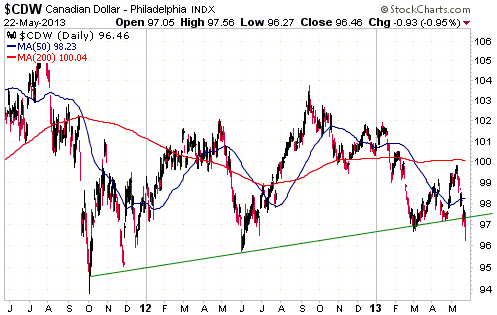
The A$ and the C$, the main commodity currencies, appear to be completing major
topping patterns. Both have recently broken below long-term trend-lines and are
rapidly approaching long-term lateral support at around 95. A chart of the C$ is
displayed below.
There is probably a lot more upside in store for the Dollar Index over the next
6-12 months, but with many currencies now very 'oversold' relative to the US$
there's a good chance that the Dollar Index is close to a short-term peak.
Update
on Stock Selections
Notes: 1) To review the complete list of current TSI stock selections, logon at
http://www.speculative-investor.com/new/market_logon.asp
and then click on "Stock Selections" in the menu. When at the Stock
Selections page, click on a stock's symbol to bring-up an archive of
our comments on the stock in question. 2) The Small Stock Watch List is
located at http://www.speculative-investor.com/new/smallstockwatch.html
Chart Sources
Charts appearing in today's commentary
are courtesy of:
http://stockcharts.com/index.html

|









