|
- Interim Update 22nd June 2011
Copyright
Reminder
The commentaries that appear at TSI
may not be distributed, in full or in part, without our written permission.
In particular, please note that the posting of extracts from TSI commentaries
at other web sites or providing links to TSI commentaries at other web
sites (for example, at discussion boards) without our written permission
is prohibited.
We reserve the right to immediately
terminate the subscription of any TSI subscriber who distributes the TSI
commentaries without our written permission.
The end of "QE2"
The
Fed's "QE2" program is complete. The Fed has stated that it will
continue to purchase Treasury debt using the proceeds from interest and
principal payments on its holdings of mortgage-backed securities, but
note that this doesn't involve the creation of new money and is
therefore not inflationary (it is not "quantitative easing").
Consequently, we expect that the rate of money-supply growth will
decline over the next few months.
It looks like the financial markets have been discounting reduced
monetary inflation since the beginning of May. In so doing, however,
some markets recently became sufficiently 'oversold' to enable
multi-week rebounds to get underway just as "QE2" was officially
ending. We are referring in particular to the broad stock market and
the gold sector of the stock market.
Rebounds in the 'oversold' markets will potentially continue for a few
weeks, but it should be kept in mind that the monetary backdrop will
likely become less accommodative from here on unless the Fed does an
unexpected 'about-face'. This could pave the way for significant
additional price weakness during August-October.
The Stock Market
A stock market divorced from the real economy
China's stock market, as represented by the Shanghai Stock Exchange
Composite Index (SSEC), is presently about 20% higher than it was 10
years ago. This means that it has achieved a compound growth rate of
only 1.8%/year over the past 10 years. Given that the Yuan has lost a
lot of purchasing power over the same period, anyone who bought the
basket of stocks represented by the SSEC in mid-2001 and held until now
would have suffered a significant loss in real terms.
Over the same 10-year period, China's economy grew by more than 10% per
year in nominal currency terms (how much it grew in real terms is
unknowable). So, nominal economic growth of more than 10% per year was
accompanied by a nominal stock market return of less than 2% per year.
This prompts the question: why has there been such a large performance
difference between China's stock market and China's economy?
First, it should be understood that there generally isn't a strong
correlation between economic performance and stock market performance.
This is the case everywhere, not just in China. However, the divergence
between China's economy and its stock market is uncommonly large and is
probably due to the following factors:
a) The enormous influence exerted by China's government on the country's financial markets.
b) The general lack of accounting reliability and transparency, which
makes it extremely difficult for serious outside investors (meaning:
investors who aren't company insiders) to value companies.
c) The fact that the retail investing public in China treats the stock market like a casino.
The influence of the government and the casino-like nature of China's
stock market can be seen in the way the SSEC achieved its small nominal
10-year return. As illustrated by the following chart, all the gains
(and then some) over this 10-year period occurred between December of
2005 and October of 2007. We don't recall the exact details, but we do
recall that by the second half of 2005 the dismal performance of
China's stock market had become a source of embarrassment for the
political elite and so policy changes were made with the aim of
boosting the investment demand for equities. The result was an upward
trend, which, thanks to an abundance of monetary fuel, quickly became
self-reinforcing and turned the stock market into the most popular game
in town. Prices rose at such a frenetic pace that by 2007 the political
elite had become concerned that a dangerous investment bubble was
forming, the bursting of which would potentially have dire consequences
for the overall economy. The government therefore intervened again,
this time with the aim slowly letting the air out of the bubble.
Naturally, that plan didn't work.
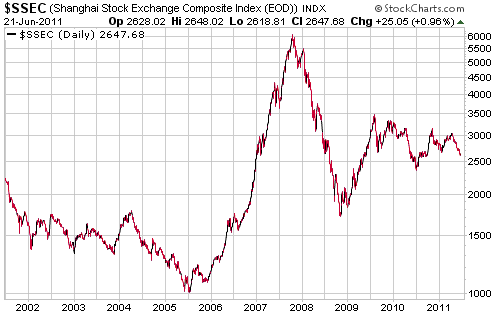
China's stock market
crashed during 2007-2008 and then experienced a routine post-crash
rebound that peaked in August of 2009. Since August of 2009 the SSEC
has made a sequence of lower highs, despite the fact that the stock
markets of most other "emerging" economies maintained their upward
trends until November of 2010.
The only conclusion that can reasonably be drawn from the SSEC's
'sloppiness' over the past two years is that the stock market has not
come close to regaining the popularity it had during 2006-2007. We
don't think it says anything about China's economy, although we are
bearish on China's economy for other reasons.
It would be nice if China's stock market evolved into something like
the US stock market used to be. But unfortunately, the evolution that
appears to be taking place is the US stock market becoming increasingly
like that of China.
Current Market Situation
The S&P500 Large-Cap Index (SPX) and the Russell2000 Small-Cap
Index (RUT) have intermediate-term support at 1250 and 775,
respectively. These support levels are drawn on the daily charts
displayed below.
It looks like the aforementioned support levels have held for now, and
that multi-week rebounds have begun. The 50-day moving averages (the
blue lines on the charts) are reasonable targets for these rebounds.
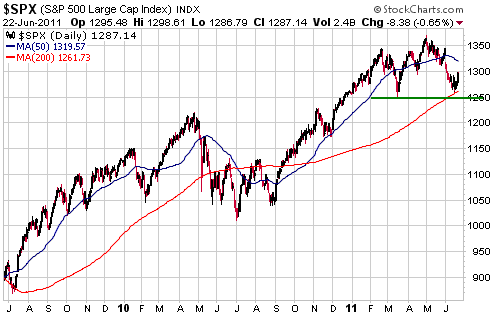
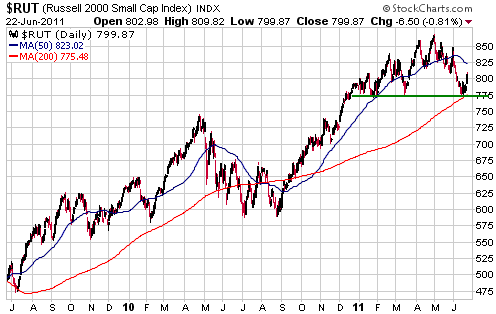
To confirm that
intermediate-term tops were put in place at the beginning of May, the
SPX and the RUT will have to achieve weekly closes below 1250 and 775.
Our guess is that this will happen within the next few months, but not
within the next few weeks.
Gold and
the Dollar
Gold
Perspective
The best way to put gold's performance into perspective is to look at
charts showing gold relative to other asset classes. For example, here
is some of the information that can be gleaned from the following
long-term chart of gold's performance relative to the Dow Industrials
Index (Gold/Dow):
1. For the Gold/Dow ratio to reach its 1980 peak it would have to rise by more than 500% from its current level.
2. Since bottoming in 1999 the Gold/Dow ratio has been moving upward in
a way than can aptly be described as "a few steps forward followed by a
few steps sideways". To put it another way, the chart pattern since the
1999 bottom involves a repeating surge-consolidate sequence. This is
similar to the pattern that occurred from 1980 through to 1994, except
in the opposite direction.
3. There was a downside blow-off during the final 5 years of Gold/Dow's
1980-1999 secular bear market. During this period the Gold/Dow ratio
declined in almost straight-line fashion.
4. The current bull market has not yet commenced an upside blow-off.
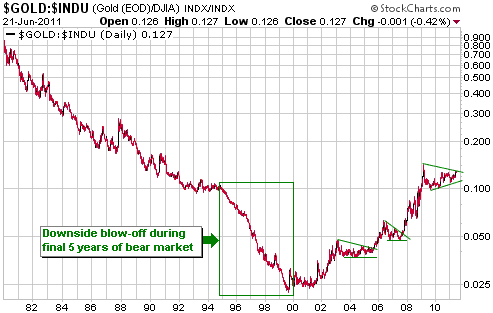
There are no
guarantees, but it would be very strange if gold's long-term bull
market were to end before the Gold/Dow ratio had experienced an upside
blow-off. Furthermore, due to the differing natures of the gold and
stock markets there's a good chance that the upside blow-off in
Gold/Dow's long-term bull market will be steeper and shorter than the
downside blow-off in its preceding long-term bear market.
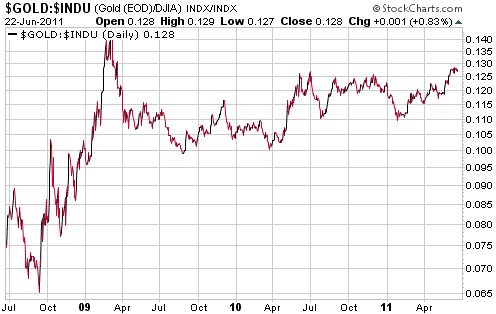
The chart displayed below zooms in on Gold/Dow's performance over the
past three years. During much of this period Gold/Dow has been in the
"few steps sideways" part of its repeating sequence.
At this stage there is no definitive evidence that the consolidation
that began in Q1-2009 is complete, although we suspect that it is. This
suspicion is based on the fact that in February of this year two
important indicators of economic confidence began to trend in a
direction that indicates falling confidence. We are referring to credit
spreads, which began to widen, and the CCI/gold ratio, which began to
decline.
It should be noted that similar trend changes appeared to be underway
at this time last year but were ultimately prevented from gaining
traction by the Fed's "QE2" program. There is a possibility that the
Fed will again find a way to extend the consolidations that began in Q1
2009, although the spreading recognition that "QE2" didn't help the
real economy makes it likely that a new inflation-promoting program
won't be introduced until after the backward-looking economic numbers
paint a much bleaker picture and/or the stock market drops to a much
lower level.
Current Market Situation
In the latest Weekly Update we wrote:
"If gold and silver
futures can continue to hold above support ($1520 for gold, $33 for
silver) this week then the risk of a sharp near-term decline will
subside. As mentioned in the last two TSI commentaries, the most likely
alternative to a sharp near-term decline is several more weeks of
'choppy' range trading. We suspect that this extended period of range
trading would be followed by declines to below the May lows for both
gold and silver."
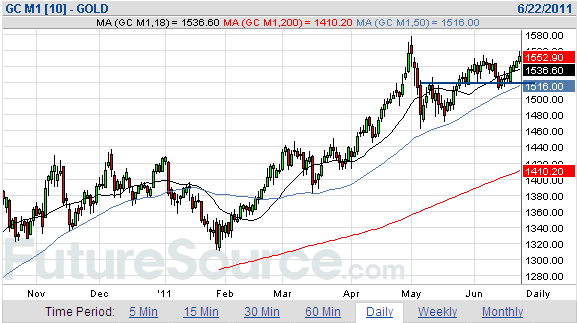
Based on the action over the first three days of this week it looks
like we are in for "several more weeks of 'choppy' range trading".
Since closing slightly below support at $1520 on Monday 13th June, the
nearest gold futures contract has risen for seven days in succession.
This probably means that a multi-day pullback or consolidation will
soon commence.
The most important nearby support remains at $1520. Resistance is at $1560-$1580.
Gold Stocks
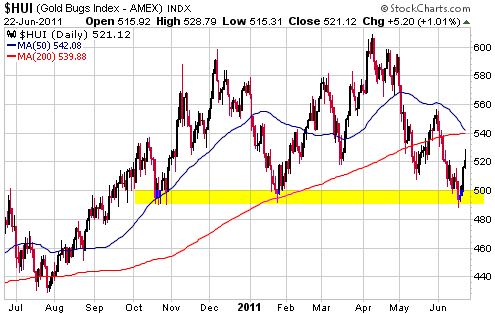
The extent to which the HUI was 'oversold' at the end of last week made
it likely that a significant rebound would soon begin. The only
question was whether there would be a spike below support at 490-500
before the rebound began. Based on the price action over the past three
trading days, it looks like support at 490-500 is going to hold for now
and that a multi-week rebound has begun.
The following daily chart shows that the HUI's 50-day and 200-day
moving averages are converging at 540. This makes 540 a reasonable
near-term upside target.
There is some chance
that the HUI's ultimate correction low was put in place late last week,
but this is not the most likely scenario. The reason is that the
intermediate-term correction that began last December has not yet
resulted in the HUI falling as far, relative to its 50-day moving
average, as it has during every other intermediate-term correction of
the past 10 years.
Short- and intermediate-term corrections in bull markets often have
nothing to do with fundamental changes, but if you desire a fundamental
justification for additional weakness in the gold sector you need look
no further than the temporary end of the Fed's money pumping.
Currency Market Update
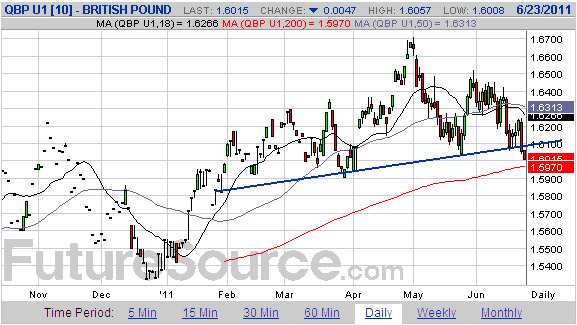
Things are generally quiet on the currency front, although the British Pound is showing signs of breaking down.
The US$ will be
boosted if the euro-zone's leadership fails to quickly apply another
"bandaid" to the gaping hole in the Greek government's balance sheet,
but substantial strength in the US$ will probably require substantial
weakness in the broad stock market. Therefore, the Dollar Index
probably won't do much if the stock market rebounds or consolidates
over the next few weeks.
Update
on Stock Selections
(Notes: 1) To review the complete list of current TSI stock selections, logon at http://www.speculative-investor.com/new/market_logon.asp
and then click on "Stock Selections" in the menu. When at the Stock
Selections page, click on a stock's symbol to bring-up an archive of
our comments on the stock in question. 2) The Small Stock Watch List is
located at http://www.speculative-investor.com/new/smallstockwatch.html)
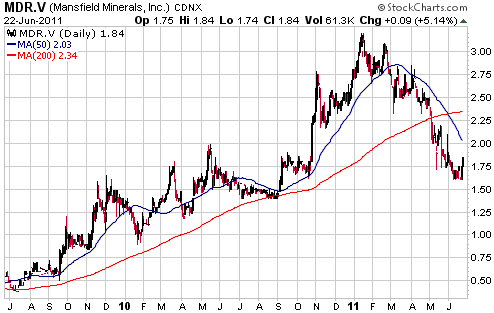
 Mansfield Minerals (TSXV: MDR). Shares: 51M issued, 54M fully diluted. Recent price: C$1.84 Mansfield Minerals (TSXV: MDR). Shares: 51M issued, 54M fully diluted. Recent price: C$1.84
MDR is developing the Lindero gold project in Salta Province,
Argentina. Lindero's 3M-ounce deposit has the potential to be developed
into a mine that produces 150K ounces of gold per year.
A Feasibility Study (FS) should soon be complete. Based on the results
of the earlier Pre-FS, the FS is likely to show positive economics at a
gold price of $1000/oz or higher.
The FS should give a boost to MDR's downward-trending stock (see chart
below), but our main concern is whether the company will get the
permits it needs to construct a mine. MDR has a very low valuation
despite the strong potential for the Lindero project to be developed
into a profitable mining operation, but we won't be totally comfortable
with the stock until the mine permits are in place.
MDR is presently a member of the TSI Small Stocks Watch List.
Depending on the stock price at the time, we may decide to transfer it
to the TSI Stocks List -- that is, make it a formal TSI stock selection
-- once a mine permit is received, because in addition to removing some
risk the receipt of the mine permit would probably make the stock more
liquid.
International Tower Hill Mines (AMEX: THM, TSX: ITH). Shares: 85M issued, 90M fully diluted. Recent price: US$7.01
A common misconception is that large moves in market prices are driven
by changes in the so-called "fundamentals", the implication being that
large declines shouldn't occur if the fundamentals are bullish and
large rises shouldn't occur if the fundamentals are bearish. The
reality, however, is that financial markets routinely make large moves
that turn out to have had absolutely nothing to do with changing
"fundamentals". To paraphrase Warren Buffett, on a long-term basis the
markets are weighing machines, but over shorter timeframes they are
voting machines.
The performance of THM's stock price over the past three months
provides a good example of what we are talking about. As far as
exploration-stage gold-mining stocks go, THM is relatively low risk. It
has 100% ownership of a large deposit in a good location (in Alaska,
close to power and transport infrastructure); it has a strong balance
sheet (more than $100M in the bank); it has a supportive major mining
company (Anglogold) as its largest shareholder; and it is in what we
refer to as the "sweet spot" of the mine development sequence (the
stage where there is minimal scope for disappointing news).
THM offered reasonable value at C$10.50/share in early April, but
despite this and the positives mentioned above it then began to trend
downward to a low of C$6.50 early this week. During this downward trend
there was no deterioration in the "fundamentals". In fact, the most
important fundamental (the gold price) improved.
In general, when markets make large moves that are counter to the
fundamentals they create money-making opportunities. In THM's case, the
recent decline created a better buying opportunity than we expected
would arise (we previously thought the stock was a buy after it fell to
around C$8.00).
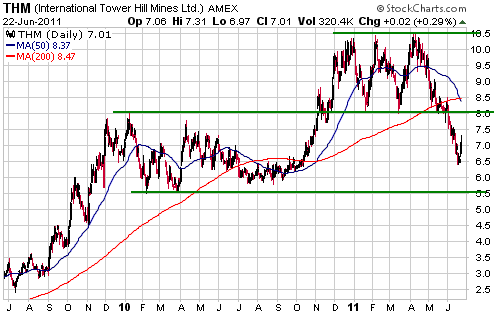
Chart Sources
Charts appearing in today's commentary
are courtesy of:
http://stockcharts.com/index.html
http://www.futuresource.com/

|









