|
- Interim Update 22nd August 2012
Copyright
Reminder
The commentaries that appear at TSI
may not be distributed, in full or in part, without our written permission.
In particular, please note that the posting of extracts from TSI commentaries
at other web sites or providing links to TSI commentaries at other web
sites (for example, at discussion boards) without our written permission
is prohibited.
We reserve the right to immediately
terminate the subscription of any TSI subscriber who distributes the TSI
commentaries without our written permission.
Not
learning from history
"We used to think you could spend your way out of recession
and increase employment by boosting government spending. I tell you,
in all candour, that that option no longer exists. And in so far as
it ever did exist, it only worked on each occasion…by injecting a
bigger dose of inflation into the economy, followed by a higher
level of unemployment as the next step…"
- The words of British Prime Minister, Jim Callaghan, at the
1976 Labour Party conference (hat tip to Grant Williams' "Things
that make you go hmmm...")
"We have tried spending money. We are spending more than we have
ever spent before and it does not work. And I have just one
interest, and if I am wrong ... somebody else can have my job. I
want to see this country prosperous. I want to see people get a job.
I want to see people get enough to eat. We have never made good on
our promises ... I say after eight years of this Administration we
have just as much unemployment as when we started ... And an
enormous debt to boot!"
- The words of Henry Morgenthau, Franklin Roosevelt's
Treasury Secretary, in an address to Congressional Democrats in May
of 1939.
Keynesianism, a major component of which is counter-cyclical
spending by the government in an effort to lessen the pain during
economic downturns, was discredited during the 1930s...before it was
even called Keynesianism. However, it rose to dominate economic
policy-making during the 1960s and 1970s. It was then totally
discredited during the 1970s, and yet it subsequently managed to
worm its way back to a position of dominance. Based on the way
things are headed it will again be totally discredited over the
years immediately ahead. Will the next time be the charm?
A central
bank would be fine if...
We occasionally read comments along the line of:
the Fed would be fine (beneficial to the US economy) if it did nothing other
than what it was originally set up to do, which is provide temporary "liquidity"
during emergencies. According to this line of thinking the problem is that the
Fed has overstepped its bounds during the past 12 years. The real problem,
however, is that the whole central banking concept is rotten to the core.
While the monetary experiments of Greenspan and Bernanke have led to wider
appreciation of the problems that can be caused by a central bank, even a
central bank that stuck to the originally intended role of liquidity provider
during times of crisis would do more harm than good. One reason is that the
central bank offers the equivalent of gambling insurance to the banking
industry.
Imagine if an insurance company made the following deal with all patrons of a
casino: In exchange for a patron's promise to gamble prudently, the insurance
company promises to come to the patron's aid if he finds himself short of money.
Knowing that the insurance company was essentially acting as a financial
backstop, at least a few gamblers would take more risk than they would
otherwise.
In a similar vein, knowing that the central bank will be ready, willing and able
to provide support via emergence liquidity injections if things go wrong, some
private banks will take more risks. Furthermore, due to the higher profits that
tend to temporarily accrue to the banks that take more risk, most banks will
eventually be drawn towards riskier business practices. This is why a mechanism
supposedly (according to the propaganda) put in place to prevent banking crises
ends up increasing the severity and frequency of banking crises.
A second and perhaps even more important reason to be against the whole concept
of a central bank is that if the power to create money out of nothing is given
to an institution, the institution will eventually abuse this power. It is naive
to believe otherwise. It's as naive as believing that if the government is given
the power to search and seize without following due process as part of an effort
to combat terrorists, this power will only ever be used against bona fide
terrorists.The Stock Market
While silver and gold tend to top with a 'bang', stock markets
often make important tops by gradually rolling over to the downside. The major
2007 stock market top, for example, was actually a topping process that lasted
many months. It's likely that a topping process in currently underway in the US
stock market.
The senior US stock indices are near their highs of the past few years, but
indices that represent most of the world's major stock markets are not remotely
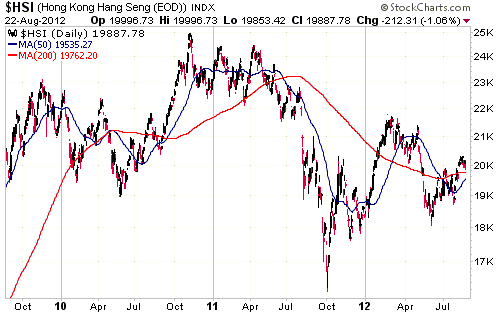
close to multi-year highs. Take Hong Kong's Hang Seng Index (HSI), for instance.
The following chart shows that this index has been making lower highs since
November of 2010.
Hong Kong's stock market appears to offer reasonable value, but there are good
reasons to be concerned about Hong Kong's future. One is that prices in Hong
Kong have been distorted in a big way by China's inflation. Another is that
China's government has begun to exert greater influence over Hong Kong's press
and schools. In other words, there are signs that the "one country two systems"
policy is coming to an end.
Gold and the Dollar
Gold and Silver
This week's price action in the gold market can aptly be described by the
phrase: it's about time! Gold finally broke upward from the narrow range in
which it had oscillated for years (months, actually, but it felt like years).
Gold stands a good chance of moving up to at least $1700 within the next few
weeks, but a poor chance of moving much above $1750 anytime soon unless there is
a significant fundamental change. A significant fundamental change would be the
Fed introducing, or clearly signaling the introduction of, a new
inflation-promoting program. We remain very sceptical that such a change will
happen in the near future, although we are confident that it will happen within
the next 12 months. Another significant change would be an attack on Iran by
Israel and/or the US. The Iran-Israel-US situation is a wildcard.
We now turn our attention to silver. The following daily chart shows silver and
the silver/gold ratio. Silver has not only just broken out of a narrow
short-term trading range along with gold, it has also begun to strengthen
relative to gold (as indicated by the recent up-tick in the silver/gold ratio).
We think that silver has near-term upside potential to $31-$32.
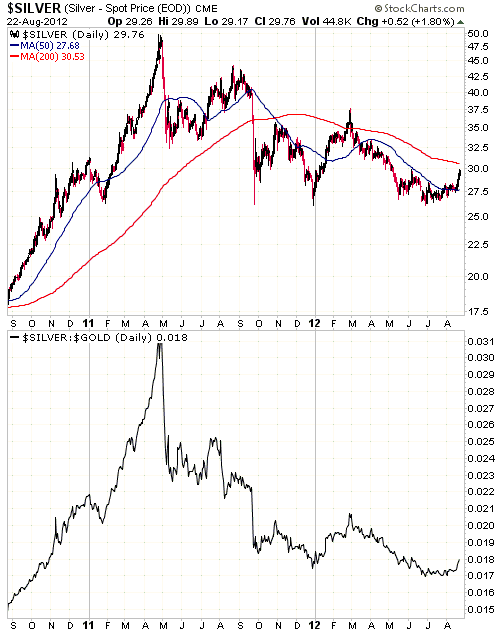
Our view continues to be that silver has been immersed in a drawn-out bottoming
process since last October. There's no way of knowing if this bottoming process
is now complete. The overall correction from the April-2011 peak has lasted a
typical amount of time for an intermediate-term correction in this market, but
one more test of support at $26-$27 is still possible. A breach of support and
subsequent spike down to $22 is also still possible, although it remains a
low-probability risk.
If you make sensible buy/sell decisions then you will never know for certain if
you are buying near a low or selling near a high. The cold hard reality is that
certainty has a substantial cost. For example, if you hold off on buying until
after silver decisively breaks above $50 then you will have the comfort of
knowing for certain that you are buying after the bottoming process is complete,
but you will be paying an additional $25/ounce for that certainty.
Gold Stocks
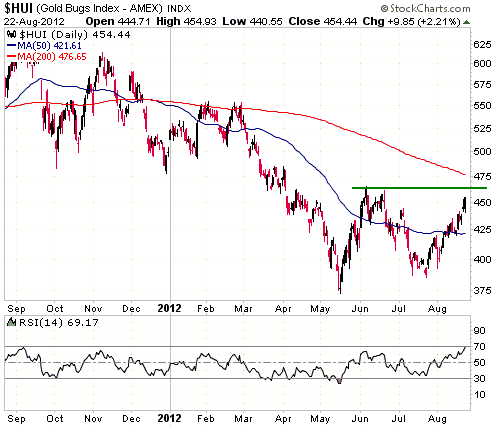
This week's strength in the bullion market has pushed the HUI up to near
resistance defined by its early-June peak. It will probably soon break through
this resistance.
Because the HUI is now almost 'overbought' by some short-term measures (for
example, the RSI shown at the bottom of the following daily chart), it could
reach a multi-week high within the next few days. This is regardless of whether
or not it breaks above resistance in the 460s. From the standpoint of a
gold-stock bull, the ideal pattern would be for the HUI to move up to at least
480 before commencing a 2-3 week correction.
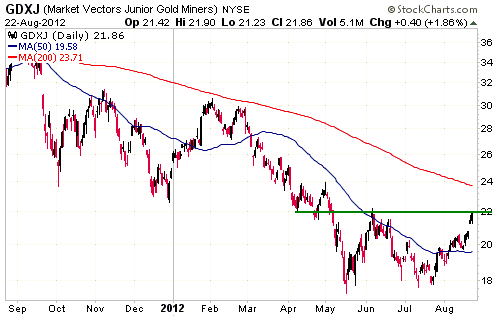
Like the HUI, GDXJ has risen to just below resistance defined by its early-June
peak. It will hopefully break above this resistance before commencing its next
correction, but in the absence of the sort of fundamental change mentioned in
the above "Gold and Silver" discussion a 2-3 week correction will probably begin
within the next few days.
A short-term GDXJ buying opportunity has departed, but a short-term selling
opportunity hasn't yet arrived. A new buying opportunity would probably be
created by a pullback to around $20, while a selling opportunity would be
created by a rise to around $26.
Currency Market Update
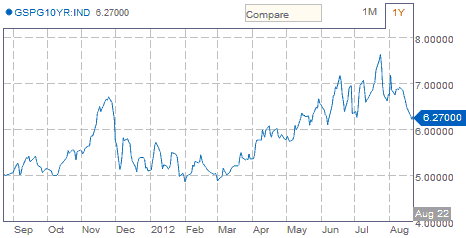
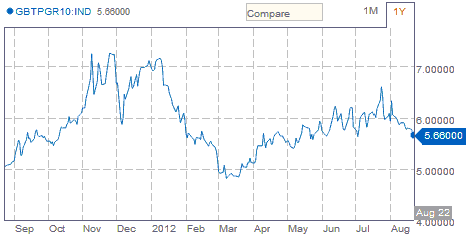
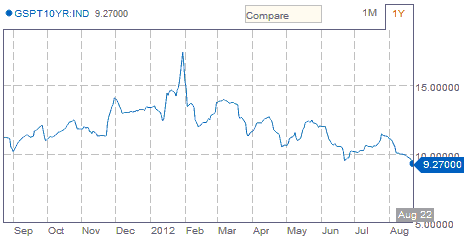
The following charts show the recent declines in the yields on Spanish, Italian
and Portuguese 10-year government bonds. These yield declines reflect increasing
confidence that the ECB will use its vast money-creating powers to support
government bonds.
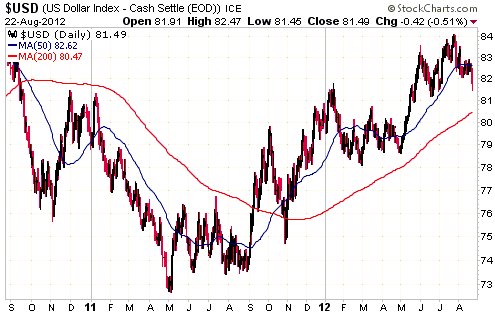
The combination of stock market stability and improved sentiment in the market
for the debt of financially-stretched EZ governments has paved the way for a
rebound in the euro and a pullback in the Dollar Index. These short-term moves
probably have further to go, but we don't expect them to evolve into major new
trends.
Update
on Stock Selections
Notes: 1) To review the complete list of current TSI stock selections, logon at
http://www.speculative-investor.com/new/market_logon.asp
and then click on "Stock Selections" in the menu. When at the Stock
Selections page, click on a stock's symbol to bring-up an archive of
our comments on the stock in question. 2) The Small Stock Watch List is
located at http://www.speculative-investor.com/new/smallstockwatch.html
 Prodigy
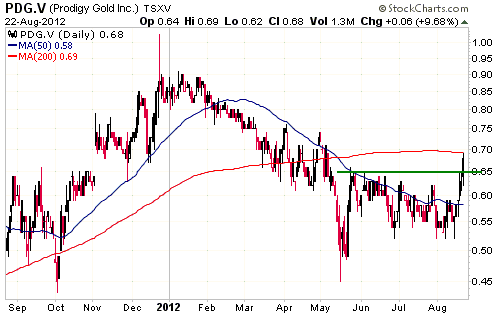
Gold (TSXV: PDG). Shares: 293M issued, 313M fully diluted. Recent price: C$0.68 Prodigy
Gold (TSXV: PDG). Shares: 293M issued, 313M fully diluted. Recent price: C$0.68
A press release issued by PDG on Monday 20th August contained some very good
news and some very strange news.
The good news is a substantial improvement in the estimated size and quality of
the gold resource at PDG's Magino project in Ontario. Using a 0.50-g/t cut-off,
Magino's gold resource has gone from 1.94M ounces Indicated plus 1.54M ounces
Inferred (3.48M ounces total) to 5.03M ounces Indicated plus 0.25M ounces
Inferred (5.28M ounces total).
The size, average grade (about 1.1-g/t) and location (Ontario) of this
'open-pit-able' gold project makes PDG a likely takeover target within the next
12 months. As previously noted, permitting appears to be the most important
company-specific risk.
To set the scene for the strange news, this is what was said in a press release
issued by the company on 8th February 2012:
"Prodigy is on schedule to complete its full feasibility study in late 2012
for Magino."
And here is an excerpt from the MD&A issued by the company on 29th May 2012:
"The project timeline requires Prodigy to complete the bankable feasibility
study, First Nations consultations and environmental work before the end of 2012
so that it can submit formal permitting documents to the Ministry in early
2013."
We now turn to this week's press release, which contained the following
statement:
"The Company intends to incorporate the new resource estimate into a
Prefeasibility Study (PFS) for the Magino Mine gold project, expected early in
2013."
So, within the past two months the company has gone from having the completion
of a full Feasibility Study scheduled for late 2012 to having a PRE-Feasibility
Study scheduled for early 2013. This is a huge change in schedule that was
casually mentioned in this week's press release as if it were a minor detail. As
far as we know, prior to this week's press release there had been no mention by
the company of a Pre-Feasibility Study.
The strange and as yet unexplained change in the project's engineering schedule
doesn't negate the improvement in the estimated in-ground gold resource. We will
be interested to find out what, if any, effect the insertion of a PFS has on the
overall project schedule. The previous schedule had mine construction commencing
in 2014 and initial production in 2015.
The combination of good news on the resource estimation front and strength in
the gold market over the past three trading days broke PDG out of its lengthy
consolidation pattern. For what it's worth, C$0.84 is the short-term chart-based
target created by this week's breakout.
Categorising the TSI gold and silver stock selections
The current TSI gold/silver stocks can be categorised as follows:
Group 1: Producers with strong balance sheets and more than 200K
ounces/year of profitable production. The members of this group are
EDV.TO, EVN.AX and RSG.AX.
Group 2: Small-scale producers (100K ounces/year or less) and larger
producers with weak balance sheets or marginal economics. The
members of this group are DRA.AX, ELG.TO, GSS, JAG, ORV.TO and
RMS.AX. Note that GSS could/should move from Group 2 to Group 1
before year-end.
Group 3: Exploration-stage companies with reasonable stock market
liquidity, enough cash to fund their operations for at least the
next 6 months, and projects that appear to be economically viable
based on a PEA or higher-order study. The members of this group are
CPN.TO, KGN, PDG.V, PVG, SBB.TO, THM and VTR.TO.
Group 4: Exploration-stage companies with illiquid stocks and/or
weak balance sheets and/or projects that have not yet undergone
economic analysis. The members of this group are BAT.V, CFO.V, MDR.V
and SSP.V.
Group 1-type stocks have the lowest risk and will generally be among
the earliest movers in a sector-wide rally. Group 4-type stocks tend
to have the highest risk and will generally be among the last stocks
to move during a sector-wide rally. However, when they finally move
they are likely to do so in a very big way, possibly achieving gains
of several hundred percent in less than a year. Although Group
2-type stocks have current production and Group 3-type stocks are
typically still a few years away from having any production, it is
better/less-risky -- especially in the current market environment --
to have no production and a healthy balance sheet than to have
marginal (meaning: not very profitable) production and a weak
balance sheet. Some of the members of Group 3 are therefore less
risky than some of the members of Group 2.
A good case can be made for having some exposure to each of these
four groups (which is why we have exposure to each of the four
groups), but until the market for mining stocks becomes less
risk-averse and/or it becomes clear that gold has entered its next
major upward leg it will probably make sense to emphasise Group 1
and Group 3-type stocks when looking for new buying opportunities.
Note that emphasise stocks in some groups doesn't mean exclude all
opportunities that crop up in other groups. It's a general
guideline.
AEM Call Options
Agnico Eagle (AEM) is now testing the bottom of a range of
resistance that extends from $47 to $55. The TSI Stocks List has
exposure to AEM via $45 call options expiring in January-2014.
We will exit this option position if AEM moves up to around $50
before the end of August. However, if AEM consolidates below
resistance for at least a couple of weeks then we will hold out for
a higher exit price.
With 17 months until option expiry there is no urgency to exit the
position.
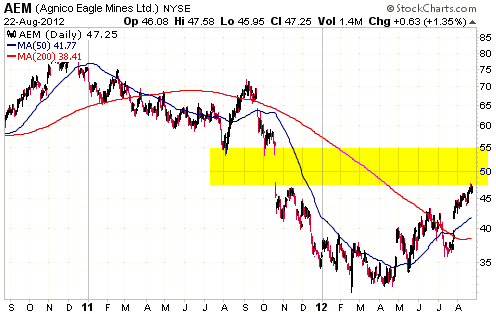
Chart Sources
Charts appearing in today's commentary
are courtesy of:
http://stockcharts.com/index.html
http://www.bloomberg.com/

|









