|
- Interim Update 22nd December 2010
Copyright
Reminder
The commentaries that appear at TSI
may not be distributed, in full or in part, without our written permission.
In particular, please note that the posting of extracts from TSI commentaries
at other web sites or providing links to TSI commentaries at other web
sites (for example, at discussion boards) without our written permission
is prohibited.
We reserve the right to immediately
terminate the subscription of any TSI subscriber who distributes the TSI
commentaries without our written permission.
TSI schedule and Xmas wishes
For
obvious reasons, we won't be posting a commentary this weekend. The
next TSI commentary will be the Interim Update scheduled for Thursday
30th December.
Merry Christmas! We hope that this year's Holiday Season will be everything you want it to be.
A series of quotes that encapsulates one of the major issues of the year gone by (and, likely, the year ahead)
The following list of quotes appeared in a recent issue of the Gartman Letter:
1. "Spain is not Greece."
Elena Salgado, Spanish Finance minister, Feb. 2010
2. "Portugal is not Greece."
The Economist, 22nd April 2010.
3. "Ireland is not in 'Greek Territory.'"
Irish Finance Minister Brian Lenihan.
4. "Greece is not Ireland."
George Papaconstantinou, Greek Finance minister, 8th November, 2010.
5. "Spain is neither Ireland nor Portugal."
Elena Salgado, Spanish Finance minister, 16 November 2010.
6. "Neither Spain nor Portugal is Ireland."
Angel Gurria, Secretary-general OECD, 18th November, 2010.
Deflation - still conspicuous by its absence
In many TSI
commentaries over the past decade we argued that the biggest error
being made by those forecasting US deflation was reliance on the notion
that expansion of the money supply required ever-increasing
private-sector borrowing. Our argument was that once the private sector
stopped adding to its overall debt burden, the government would ramp up
its own indebtedness by enough to ensure continued inflation of the
money supply.
The events of the past three years have supported our argument, in that
the greatest private sector de-leveraging of the past 70 years was
accompanied by ACCELERATION in the rate of money creation thanks to the
inflation-promoting efforts of the US government and the Fed. If the
sort of massive deflationary forces that were unleashed in 2007-2008
couldn't bring about actual deflation, then what will?
Due to the way the current monetary system operates, deflation has
always been a long-shot. It could potentially have come about on a
temporary basis due to the Fed-Treasury combination being overwhelmed
by market forces, but that potential scenario was probably eliminated
from contention by the events of 2008. The reason is that whereas the
Fed didn't slam down on the monetary gas pedal until the 2007-2009
cyclical bear market in equities was into its 12th month (the bear
market began in October of 2007, but the Fed didn't begin to
aggressively promote monetary inflation until September of 2008), the
current obvious nervousness of Bernanke and Co. suggests that next time
around the 'pedal will hit the metal' much sooner.
On the subject of the unlikelihood of deflation, Mike Pollaro made a good point in his latest Monetary Watch article. Here's the relevant part of the article:
"It's a common
misconception that the banking system needs willing borrowers in order
to expand the supply of money. We hear it every day, from one
deflationist after another. It's not true. It's not willing
borrowers we require but willing banks, for while it is true that even
a willing bank can not create money by making loans without willing
borrowers, it can always create money by buying securities. The fact is
even in the depths of a recession a banking system flush with excess
reserves is always in a position to pyramid up its deposit liabilities,
to create Uncovered Money Substitutes, regardless of the demand for
loans. And since the pyramiding up those reserves is one of the primary
ways banks make money, sooner or later, they'll do it, especially in a
system where the Federal Reserve stands ready to bail them out of their
mistakes.
Guess what banks are doing right now with their excess reserves? That's right, they are creating money by buying securities."
That is, private banks do not have to make new loans in order to
increase the money supply. They can also increase the money supply via
the monetisation of existing securities.
The bottom line is that deflation remains a low-probability outcome. In
fact, a good argument can be made that the probability of deflation is
lower today than it has ever been.
Concentrated long positions in base metals
The article linked HERE
mentions that a single trader owns 80% to 90% of the copper sitting in
London Metal Exchange warehouses, equal to about half of the world's
exchange-registered copper stockpile and worth about $3 billion. The
article also mentions that single traders own large holdings of other
metals, with one trader holding as much as 90% of the exchange's
aluminum stocks and single traders owning 50%-80% of the nickel, zinc
and aluminum alloy stockpiles.
Why isn't the anti-manipulation crowd 'kicking up a fuss' about the
massively concentrated long positions in the physical base-metal
markets? Could it be that manipulation of commodity markets is not
deemed to be a problem by the anti-manipulation agitators if the likely
effect is HIGHER prices for the commodities to which they have
long-side exposure?
The Stock Market
Anecdotal evidence that an important peak lies in the near future
The latest edition of Barrons magazine is almost universally optimistic
with regard to next year's prospects for equities and the economy (Alan
Abelson's article is a notable exception, but Abelson is always
bearish). Here are examples of articles that reflect the aforementioned
optimism:
1. Outlook 2011: Our group of investment experts sees stocks continuing their climb next year as the economic recovery takes root.
2. Bullish on Tech and 2011: Federated Investors' Stephen F. Auth expects technology stocks like Broadcom to lead a market rally next year
3. Auguring more gains in 2011:
Continental equities should rise about 15% in 2011, with
earnings-per-share growth averaging about 12%. Probable stand-outs:
Germany, Scandinavia.
4. Stockpickers, look eastward:
Some analysts think that a 10% gain is likely, and that 30% is not out
of the question -- even with the ever-present threat of inflation.
5. Why bullish call options may be in vogue next year
6. In dim tech, light may loom:
A tech analyst sees the sector improving in 2011 for many reasons,
including emerging-market growth, corporate outlays and new products.
7. Five reasons we'll get real in 2011:
It may not heat up as much as we'd like, but the economy is likely to
post 3.7%-to-3.8% growth in real gross domestic product next year.
8. It gets even better:
Dividends made a comeback in 2010, and will do better in 2011. There's
lots of room for continuing improvement after the payout cuts of 2008
and 2009.
9. New World Explorer:
Top bond fund manager Michael Hasenstab finds lots of debt and currency
opportunities in emerging markets. South Korea is especially attractive.
Such unanimity of bullish opinion doesn't guarantee anything, but it is
consistent with the view that an intermediate-term top will arrive in
the near future.
Current Market Situation
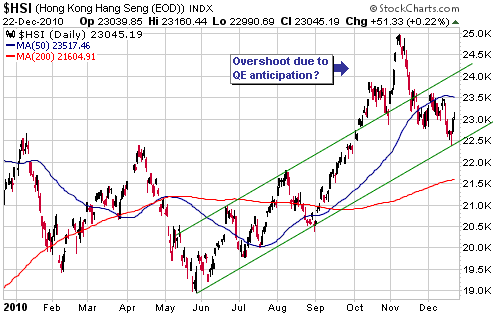
In our opinion, it is likely that Hong Kong's Hang Seng Index (HSI)
reached an intermediate-term peak early last month. But even if this
were the case, it wouldn't be surprising to see a test of the peak
prior to the start of a substantial decline.
The following chart indicates that the HSI hit channel support on
Monday and has begun to rebound. Assuming that an intermediate-term
peak is in place and that the initial decline from the peak is
complete, a counter-trend rebound to 24000-24500 would be a reasonable
expectation.
The next chart shows
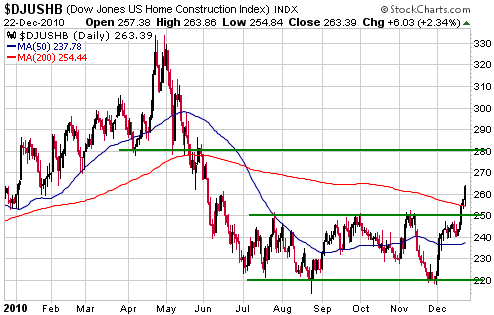
the Dow Jones Home Construction Index (the DJUSHB), a proxy for the
homebuilding sector of the market. As a group, the homebuilders are the
US stock market's weakest link. It is therefore reasonable to assume
that as long as the homebuilders aren't breaking down, the overall
market isn't about to collapse in a heap.
The DJUSHB tested the bottom of its range late last month and has since
rallied. It has just broken above the top of its range and is probably
on its way to resistance at 280 (about 6% above Wednesday's close).
Most charts and
technical indicators suggest that the stock market is 'overbought', but
is likely to maintain its upward bias into January. However, our views
are based on risk versus reward, not on the most likely price
direction. Whereas the most likely near-term outcome is a further rise
in price, we think the magnitude of the remaining upside potential is
small compared to the downside risk. The risk is that everything
(sentiment indicators, momentum indicators and valuation) is
dangerously stretched as we head into the New Year, meaning that the
conditions are in place for a major trend reversal or, at best, a sharp
pullback. We are therefore downgrading our short-term stock market
outlook to "bearish".
Gold and
the Dollar
Gold and Silver
Gold and/or Silver Money
The article by "Friend of Friend of Another" (FOFOA) linked HERE
is interesting (it is quite long, but worth the time it takes to read).
Some aspects of the article are highly questionable or wrong, including
the assertion that the medium-of-exchange and store-of-value functions
of money should be separated, and the author doesn't seem to have a
good understanding of how monetary inflation affects the economy;
however, he makes a convincing argument that the demonetisation of
silver during the 1800s was market-driven rather than
government-driven. Governments during the 1800s periodically tried to
re-establish silver as money in their attempts to pander to the special
interest groups that desired easier money, but these attempts failed.
Here's an excerpt:
""The people" wanted
silver back then (late 1800s) because it was the "easy money" of the
time. "The people" NEVER want harder money. Today silver would be
harder money, so it will never have the support of "the people" (other
than the silverbugs). 16:1 was quite obviously an artificial monetary
ratio, because whenever they maintained it, there was a run on the
gold. The market wanted to push the ratio much wider, and the
government, in service to "the people," fought that market force.
Today silver would be
"harder" money than cotton-pulp. This is why there will NEVER be a big
enough political movement of the people that will bring back a silver
standard. We have now discovered easier money than silver!!!
If you want harder money,
it's gold. If you want easier money, it's cotton-pulp. So where does
silver fit in? Well, it's just another industrial commodity with a
lingering sentimental mystique as the old "easy money.""
In our opinion, it isn't correct to say that the market rejected silver
as money, but it is probably correct to say that the market rejected a
government-enforced 16:1 gold/silver ratio. Regardless of the monetary
system, fixing the gold/silver ratio makes no more sense than fixing
any other price.
Hopefully, the market will eventually be given the opportunity to
choose its own money. It's a good bet that it would choose gold for
most international trade, but that both gold and silver would be
routinely used as money within most local economies. Unfortunately,
though, the current trend is towards easier rather than harder/sounder
money, and towards greater government control of money rather than a
free market in money. We are therefore probably a long way from the
point where gold or silver re-enter the monetary system, except as an
act of tokenism to prop-up confidence in the paper currencies.
Current Market Situation
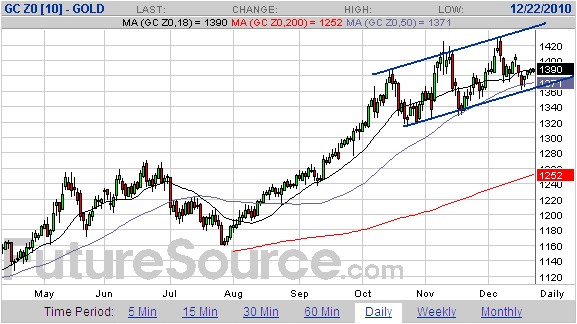
The gold futures market was extremely quiet over the past three days,
meaning that nothing worth commenting on has happened or changed. We
continue to interpret the short-term chart pattern as a "running
correction".
With regard to
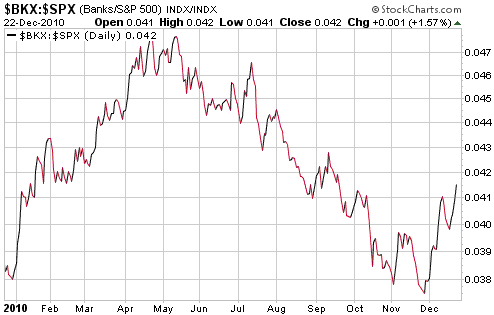
indirect influences on the gold market, one noteworthy development is
the continuing rebound in the BKX/SPX ratio (the Bank Index relative to
the broad stock market). Relative strength in the banking sector is
usually bearish for gold, but the new upward trend in BKX/SPX hasn't
yet put significant downward pressure on the gold price.
Gold Stocks
The gold-stock indices moved sideways over the first three days of this
week, but as usual there was some volatility within the ranks of the
juniors. In particular, several of the junior gold/silver miners on our
radar screen were down by 5% or more on Wednesday, and the Market
Vectors junior gold miners ETF (GDXJ) dropped 3.4% on the day. We
suspect that these moves were the result of some traders cashing-in
gains at a time of year when the market is less liquid than usual.
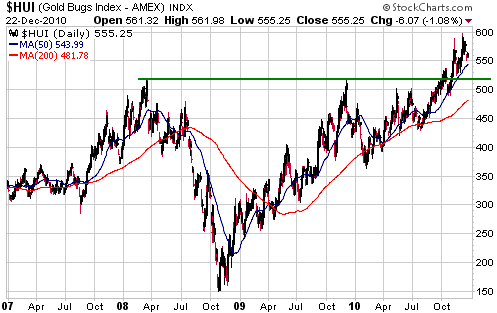
The following chart shows that the HUI broke above the top of a large
basing pattern during October-November, which suggests to us that it is
positioned to make meaningful upward progress in early 2011. This
longer-term chart shows that the HUI could pull back as far as 515-520
(support defined by the March-2008 and December-2009 peaks) without
doing any damage to the technical picture, but our guess is that it
won't do any worse in the near future than drop back to the 50-day
moving average in the 540s.
Update
on Stock Selections
(Notes: 1) To review the complete list of current TSI stock selections, logon at http://www.speculative-investor.com/new/market_logon.asp
and then click on "Stock Selections" in the menu. When at the Stock
Selections page, click on a stock's symbol to bring-up an archive of
our comments on the stock in question. 2) The Small Stock Watch List is
located at http://www.speculative-investor.com/new/smallstockwatch.html)
 Orvana Minerals (TSX: ORV). Shares: 115M issued, 119M fully diluted. Recent price: C$3.78 Orvana Minerals (TSX: ORV). Shares: 115M issued, 119M fully diluted. Recent price: C$3.78
We have removed junior gold producer ORV from the TSI Stocks List.
Based on Wednesday's closing price of C$3.78 and our August-2009 entry
at C$0.76, the profit was around 400%.
Our reason for exiting at this time is that the stock has moved up to
just below the C$4.20/share valuation mentioned in our 6th October
commentary. A plausible argument could be made that the stock still
offers reasonable value and stands to make significant additional
headway if metal prices remain strong, but the downside risk is now of
some concern given that the company's El Valle gold/copper project in
Spain (its most important asset) will be brought into production over
the next few months. ORV's managers have shown themselves to be good
operators, but at the current stock price there isn't much room for
negative surprises. And negative surprises regularly occur during the
early stages of production as 'teething problems' are sorted out.
Geovic Mining Corp. (TSX: GMC). Shares: 103M issued, 138M fully diluted. Recent price: C$0.67
GMC owns 60% of the Nkamouna exploration/development-stage cobalt
project in Cameroon. According to a Feasibility Study (FS) completed in
late 2007, Nkamouna has a net present value of US$695M at a cobalt
price of around $20/pound (a little above the current price). This
implies a value of around US$417M, or about $3.50/share, for GMC's
stake. This potential value combined with the fact that GMC is well
financed kept us interested in the stock over the past couple of years,
despite its lacklustre performance.
GMC has been working on an update to the 2007 FS to account for a
change in the mine plan. In March of this year it was expected that the
FS Update (FSU) would be complete by mid year, but when mid year came
around the company advised that completion had been delayed to
September. When September came around the company announced that
completion of the FSU had been delayed to December. Now that December
has arrived, the company has informed the market that April 2011 is the
new estimated completion date. They also mentioned that the updated
cost of mine construction was going to be much higher than the earlier
estimate.
We've lost patience with GMC. It had the potential to be a good
speculation and remains very under-valued, but the company's management
seems incapable of moving the Nkamouna project forward at a reasonable
pace. We have therefore jettisoned it from the TSI Stocks List and
recorded a loss of around 56%. (Note: We have a small position in GMC
in our own account and we do not intend to sell at this time, but we
will probably exit if the stock rebounds to the C$0.80s over the
weeks/months ahead).
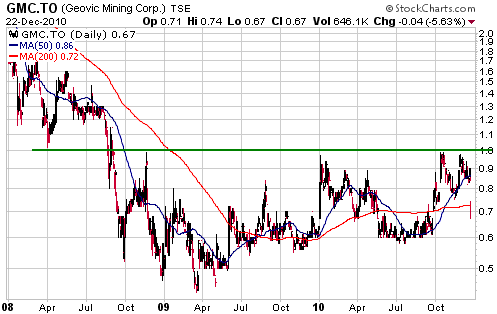
By the way, the recent performance of GMC's stock is a good example of
how chart patterns can be deceptive. Prior to Tuesday's large
high-volume decline in response to the latest delays and capital-cost
increase, the stock appeared to be consolidating in bullish fashion in
preparation for a break above resistance at C$1.00.
Potential stock selection: Hathor Exploration (TSXV: HAT). Recent price: C$2.85
In the 1st December Interim Update we wrote the following to explain
why we were interested in HAT.V, an exploration-stage uranium miner:
"HAT owns 90% of the
Roughrider deposit in the Athabasca Basin of Saskatchewan (a region
that accounts for more than 20% of global uranium production), and this
deposit contains a very high-grade -- and, therefore, potentially very
valuable -- uranium resource. The total NI-43-101 in-ground resource at
Roughrider is presently estimated to be 27.8M pounds, 24.2M pounds of
which has an average U3O8 grade of 11.7% (by way of comparison, most
uranium deposits owned by junior mining companies have average grades
of less than 0.5% U3O8). With a fully diluted share count of 117M and
an enterprise value of C$380M at Wednesday's closing price of C$3.40,
this means that HAT is being valued by the market at around C$15/pound.
This is comparatively high, although a premium is warranted due to the
quality of the resource."
We went on to say that HAT would probably have to pull back to the low-C$2 area to become a member of the TSI Stocks List.
The stock has since pulled back from C$3.40 to C$2.85. It is therefore
cheaper than it was, but still not close to the low-C$2 area mentioned
above.
We've taken another look at HAT's chart and valuation, and come to the
conclusion that HAT is unlikely to drop to our suggested buy area
unless the uranium sector becomes a lot weaker than we currently
expect. The chart (see below), for example, shows that there is good
support at C$2.40 that could limit the downside. Therefore, we now plan
to add HAT to the TSI List if it drops to the C$2.50s within the next
two months.
By the way, the upside potential of the Roughrider uranium deposit
could also be played via Terra Ventures (TSXV: TAS). TAS, which ended
Wednesday's session at C$0.50, owns the remaining 10% of Roughrider and
has a market capitalisation of about one-tenth HAT's. If HAT drops to
the C$2.50s then TAS will probably drop to the low-C$0.40s.

Chart Sources
Charts appearing in today's commentary
are courtesy of:
http://stockcharts.com/index.html
http://www.futuresource.com/

|









