- Interim Update 23rd January 2019
Copyright
Reminder
The commentaries that appear at TSI
may not be distributed, in full or in part, without our written permission.
In particular, please note that the posting of extracts from TSI commentaries
at other web sites or providing links to TSI commentaries at other web
sites (for example, at discussion boards) without our written permission
is prohibited.
We reserve the right to immediately
terminate the subscription of any TSI subscriber who distributes the TSI
commentaries without our written permission.
Euro-Zone Issues
Who will buy euro-zone
government bonds?
Euro-zone (EZ) government bond yields
are massively distorted. For example, despite last year's political scare
and a government-debt/GDP ratio of more than 130%, the yield on a 10-year
Italian government bond is about the same as the yield on a 10-year US
Treasury Note. For another example, the governments of France, Spain and
Portugal currently are able to borrow money for 10 years at much lower
interest rates than the US government. This situation is absurd given
relative default and "inflation" risks, but it exists due to the ECB's
manipulation. The manipulation was ratcheted down at the start of this
month when the ECB ended its bond-buying program, leading to the question:
Now that the ECB has stepped aside, who will buy EZ government debt at
anywhere near current yields?
The reality is that there will be
substantial on-going demand from pension funds, commercial banks,
insurance companies, mutual funds, hedge funds and other bond speculators,
at least while the "inflation" risk is perceived to be low. One of the two
main reasons is that the structure of the current monetary system
effectively forces the large holders of cash to buy government debt.
To see what we mean by the above statement, assume you want to
maintain $100,000 of cash-like liquidity. In this case you can deposit the
money in a bank, knowing that you will be covered by government insurance
if the bank goes bust. Now assume that you want to maintain $10 billion of
cash-like liquidity. In this case you can't deposit the money in a bank
without risking a near-total loss, because if the bank goes bust only a
trivial portion of your deposit will be covered by insurance. You are, in
effect, forced to buy the most liquid debt securities.
The other
main reason that there won't, anytime soon, be a substantial net decline
in the desire to hold EZ government debt is the belief that at some point
the ECB will return to the market as a large, price-insensitive buyer.
On the surface the belief cited in the above sentence seems
reasonable, because there is no evidence that central bankers have learned
anything from their past mistakes. There is no doubt that the leaders of
the major central banks will be inclined to react to the next bout of
economic weakness the same way they reacted to previous bouts -- by
creating new money as part of an effort to manipulate interest rates
downward. However, outside the world of central banking there are now many
people who understand that "QE" achieved nothing positive -- that it
helped some governments cope with their excessive debt burdens, but only
at the expense of savers and long-term economic progress. Consequently,
the pushback against downward manipulation of interest rates will be
greater in the future than it was in the past.
This won't stop the
ECB from attempting to falsify the price of credit in the future. In fact,
there is already talk of a new
TLTRO (Targeted Longer-Term Refinancing Operation) being introduced
before the middle of this year and we expect that the ECB will be
monetising bonds again well before year-end. However, we also expect that
political pressure, mostly but not solely from Germany, will cause the
next bond-buying program to be smaller-scale.
Anyway, our point is
that despite the ridiculously-low current levels of government bond yields
in the EZ and the ECB's removal, at the start of this month, of the most
important downward-acting force on these yields, the demand for EZ
government debt isn't about to collapse. Instead, what we should see from
here is a steady rise in EZ government bond yields as governments and
existing holders of bonds are forced to offer better deals (higher yields)
to attract new buyers. Eventually the upward trend will accelerate in dramatic fashion
due to plunging confidence (rapidly-rising fear of default), but that
isn't likely to happen this year.
The absurdity known as
"TARGET2"
TARGET2 is the system set up in the euro-zone to
clear inter-bank payments. The Bundesbank (Germany's central bank)
describes it as a payment system that enables the speedy and final
settlement of national and cross-border payments. The problem is that
often there is no "final settlement" under TARGET2. Instead, credits and
debits can build up indefinitely.
To understand the issue it first
must be understood that although the 19 countries that comprise the
euro-zone use a common currency, the euro-zone isn't really a unified
monetary system. It is more like 19 separate monetary systems, each of
which is overseen by a National Central Bank (NCB). These NCBs are, in
turn, overseen and coordinated by the ECB. TARGET2 is the means by which
money is transferred quickly and efficiently between these 19 separate
monetary systems. The transfer may well be quick and efficient, but, as
noted above, it often doesn't result in final settlement.
Further
explanation is
provided by the Bundesbank, as follows:
"...both the
Bundesbank and the Banque de France will be involved in a cross-border
payment transaction made in settlement of a German export to France, for
instance. That transaction begins when the French importer's commercial
bank in France debits the purchase amount from the importer's account and
submits a credit transfer in TARGET2 to the German exporter's commercial
bank in Germany. The Banque de France then debits the amount from the
TARGET2 account it operates for the French commercial bank and posts a
liability owed to the Bundesbank. For its part, the Bundesbank posts a
claim on the Banque de France and credits the amount to the German
commercial bank's TARGET2 account. The transaction is concluded when the
commercial bank credits the amount in question to the account it operates
for the German exporter.
At the end of the business day, all the
intraday bilateral liabilities and claims are automatically cleared as
part of a multilateral netting procedure and transferred to the ECB via
novation, leaving a single NCB liability to, or claim on, the ECB.
Viewed in isolation, the transaction used as an example above leaves the
Banque de France with a liability to the ECB and the Bundesbank with a
claim on the ECB at the end of the business day. These claims on, or
liabilities to, the ECB are generally referred to as TARGET2 balances."
The example given above by the Bundesbank refers to a German export to
France, but the same process would apply when someone transfers money from
a bank deposit in one EZ country to a bank deposit in another EZ country.
For example, the electronic wiring of funds from a commercial bank account
in Italy to a commercial bank account in Luxembourg would leave the Banca
d'Italia with a liability to the ECB and the Banque Centrale du Luxembourg
with a claim on the ECB.
The process described above means that
there is never any net clearing of cross border payments at the NCB level.
Unless the money flowing in one direction (into Country X) equals the
money flowing in the opposite direction (out of Country X), credit/debit
balances will build up and there is no limit to how large these balances
can become.
As illustrated by the following
chart from Yardeni.com,
this is not just a hypothetical issue. The NCBs of some EZ countries, most
notably Germany and Luxembourg, now have huge positive TARGET2 balances,
and the NCBs of some other EZ countries, most notably Italy and Spain, now
have huge negative TARGET2 balances.
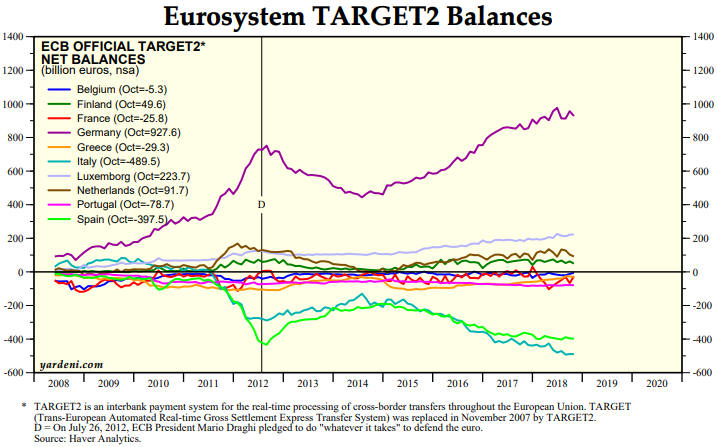
As at October-2018, the central bank of Germany was owed 928 billion
euros by the TARGET2 system, while together the central banks of Italy and
Spain owed 887 billion euros to the TARGET2 system. Is this a problem?
The system is so strange that there doesn't appear to be a clear-cut
answer to the above question, at least not one that we can fathom. It
could be a huge problem or it could be no problem at all.
The
Bundesbank is sitting there with an asset valued at almost 1 trillion
euros that will never pay any interest and cannot be collected. At first
blush this appears to be a huge problem. It implies that at some point the
asset will have to be written off, perhaps leading to a very expensive
bailout funded by German taxpayers. But then again, due to the way the
current monetary system works it may well be possible for TARGET2 balances
to grow indefinitely with no adverse consequences. That's why we haven't
devoted any commentary space to this issue in the past.
If we were
forced to give an answer to the above question it would be that rising
interest rates, burgeoning government debt levels and private bank
failures will become system-threatening issues in the EZ long before the
TARGET2 balances pose a major threat.
The Stock Market
The senior US stock indices
pulled back to start the week. This could mean that multi-week tops were
set last Friday, but there will have to be additional weakness over the
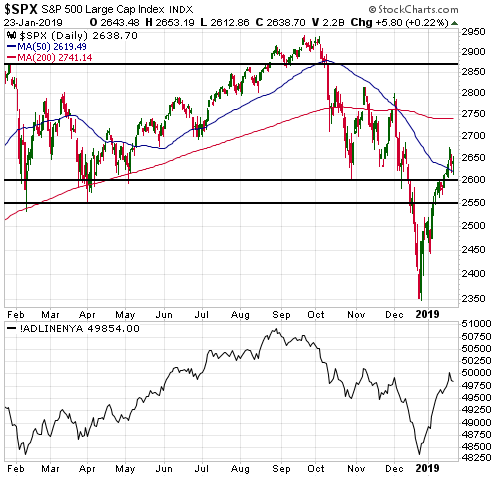
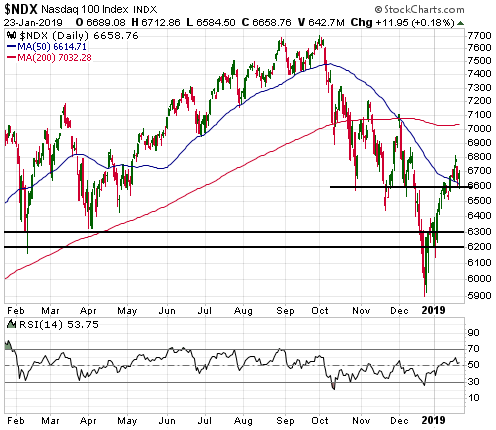
next few days to confirm this possibility. As illustrated by the following
daily charts of the SPX and NDX, so far all that's happened is pullbacks
to 50-day MAs. These pullbacks could be routine tests of last week's
upside breakouts.
To put it another way, it's possible that the US
stock market's initial rebound from the December low ended last Friday,
but the decline from Friday's high has not been of sufficient magnitude,
yet, to signal a reversal of the multi-week trend. Until the SPX and the
NDX close below their respective 50-day MAs there will be a decent chance
that the 18th January highs will be exceeded prior to such a reversal.
The coming multi-week decline could fully retrace the rebound from the
December low, but a partial (say, 50%) retracement is now more likely.
With regard to timing, if a reversal is signaled within the coming week or
so then a significant low could occur on or near 15th February, the Fed's
next big "QT" day.
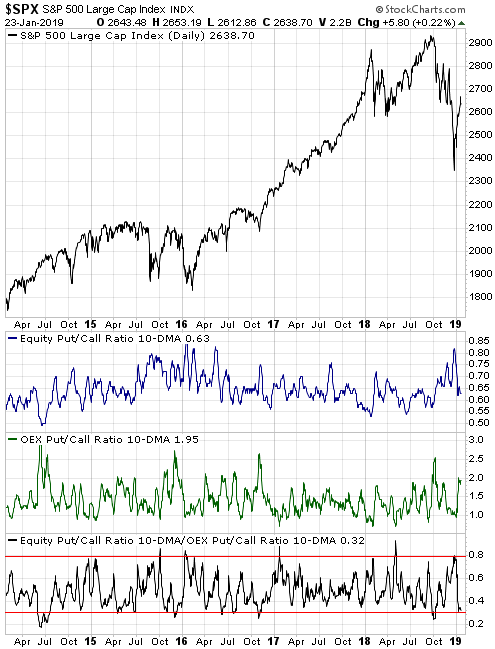
It's worth mentioning that our put/call indicator, which is shown in
the bottom section of the following chart, remains very close to its sell
zone. All the signals generated by this indicator over the past two years
have been timely.
Gold and the Dollar
Gold
There was a minor downside breakout in the US$ gold price last Friday.
Over the first two trading days of this week the gold market traded
quietly, with the US$ gold price remaining slightly below its 20-day MA.
Consequently, for all intents and purposes nothing has changed since we
posted the latest Weekly Update.
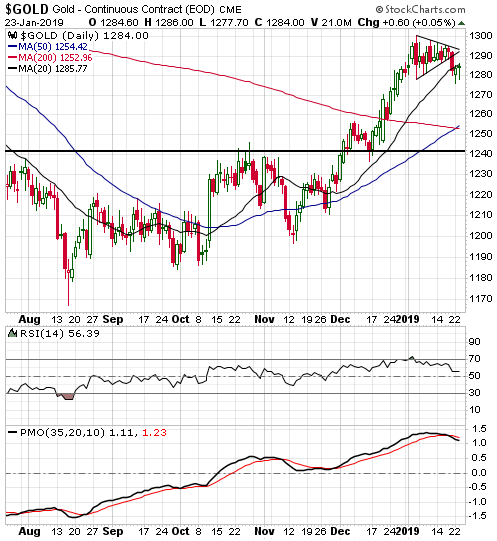
As noted in the latest Weekly Update, "...the US$ gold price could
drop as far as the low-1240s without confirming a reversal of its
short-term trend. However, if the market is still in a short-term upward
trend then the additional downside from here should be limited by the
50-day and 200-day MAs in the low-$1250s."
We view the
low-$1250s as a reasonable 2-4 week target, but there is a risk of a
larger decline.
Gold Stocks
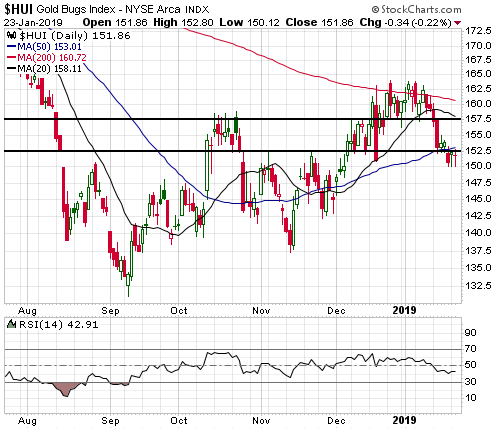
For the
gold-mining indices and ETFs, nothing changed over the first two trading
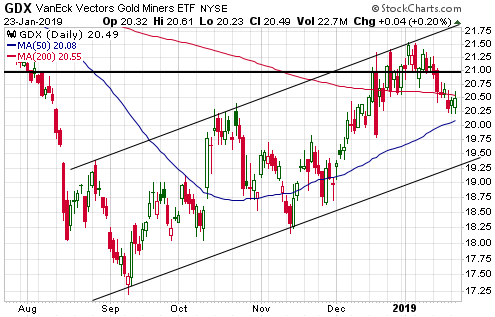
days of this holiday-shortened (in the US) week. As illustrated by the
first of the following daily charts, the HUI traded in a narrow range
slightly below its 50-day MA and lateral resistance at 152.5. As
illustrated by the second chart, GDX chopped around in the narrow gap
between its declining 200-day MA and its rising 50-day MA.
A
counter-trend bounce could take the HUI to resistance at 157, while an
immediate extension of the decline probably would lead to tests of support
at 142.5 for the HUI and $19.30-$19.50 for GDX.
Right now we like the idea of having our long exposure to the
gold-mining sector hedged via GDX March (or later) put options and would
view a near-term bounce in the HUI to around 157 as an opportunity to buy
some additional put-option insurance. This implies that while the
above-mentioned support levels (142.5 for the HUI, $19.30-$19.50 for GDX)
are realistic downside targets, we view the short-term downside RISK as
being significantly greater.
Keep in mind that a gold bull market
has NOT been signaled. Until it is or until the gold-mining indices/ETFs
again look 'washed out', it will make sense for long-focused traders and
investors to be cautious.
Just to be clear, we are anticipating an
upward bias for the gold-mining sector during the first 3-6 months of this
year, but we don't expect a powerful rally or even a consistent upward
trend. We are anticipating a choppy advance involving multi-week rallies
followed by substantial retracements. Of course, we aim to adjust our
expectations if/when the facts change.
The Currency Market
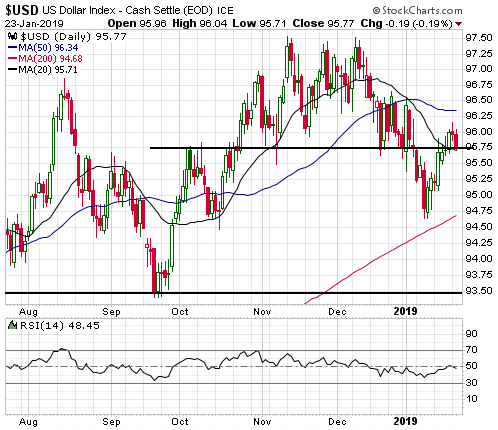
Last week the Dollar Index (DX) negated a bearish chart pattern by
closing above 95.75. Over the first two trading days of this week it
consolidated last week's up-move.
Prior to last week we were
expecting a decline to support at 93.5, but we are now devoid of opinion.
The fundamental backdrop is neutral, the price action is non-committal,
and without the COT data we can't properly assess the sentiment situation.
In effect, we are on the sidelines waiting for either the price action or
the fundamental currency-market drivers to signal the most likely
direction of the next tradable move.
Updates on Stock Selections
Notes: 1) To review the complete list of current TSI stock selections, logon at
http://www.speculative-investor.com/new/market_logon.asp
and then click on "Stock Selections" in the menu. When at the Stock
Selections page, click on a stock's symbol to bring-up an archive of
our comments on the stock in question. 2) The Small Stock Watch List is
located at http://www.speculative-investor.com/new/smallstockwatch.html
Chart Sources
Charts appearing in today's commentary
are courtesy of:
https://stockcharts.com/