|
- Interim Update
23rd April 2014
Copyright
Reminder
The commentaries that appear at TSI
may not be distributed, in full or in part, without our written permission.
In particular, please note that the posting of extracts from TSI commentaries
at other web sites or providing links to TSI commentaries at other web
sites (for example, at discussion boards) without our written permission
is prohibited.
We reserve the right to immediately
terminate the subscription of any TSI subscriber who distributes the TSI
commentaries without our written permission.
Uranium
Update
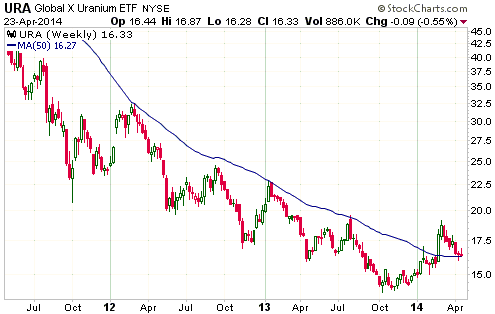
The Global X Uranium Fund (URA), a proxy for uranium mining
stocks, signaled an upward reversal of at least intermediate-term
importance when it clearly broke above its 50-week MA in February.
The following weekly chart shows that it has since dropped back to
this moving average in what looks, at this stage, like a correction
within a bullish trend.
The 'fly in the ointment' is the performance of the underlying
commodity, in that the uranium price just fell to a new 8-year low
of $32.50/pound. This means that uranium is still in a bear market.
When there is a large and sustained divergence between the price of
a commodity and the stock prices of the companies that mine the
commodity, the stock market will usually turn out to be correct.
This means that the uranium price is probably not far from an upward
reversal.
We expect that the uranium price will soon begin to confirm the
upward reversal in the uranium-mining sector. There is, however, a
risk that the uranium equities turned higher prematurely and will
fully retrace the rally of the past 6 months.
The Stock Market
The US stock market's high valuation
The price/earnings (p/e) ratio for the S&P500 Index is presently about 18.6.
This is high, but not extremely so. However, the S&P500's current valuation is
much higher than indicated by its p/e ratio. The reason is that profit margins
are much higher than average and profit margins have historically always
reverted to the mean.
Normalising for profit margins, the S&P500's current p/e ratio is in the
mid-20s. This can definitely be classified as extremely high. To put it another
way, the US stock market's current valuation only looks moderately high, rather
than extremely high, if the assumption is made that for the first time in
history profit margins are not going to mean-revert. Or, to put it yet another
way and to borrow a phrase from the famous comment made by Irving Fisher just
three days prior to the 1929 stock market crash, the market's present valuation
is not dangerously high if it can be assumed that profit margins have reached a
permanently high plateau.
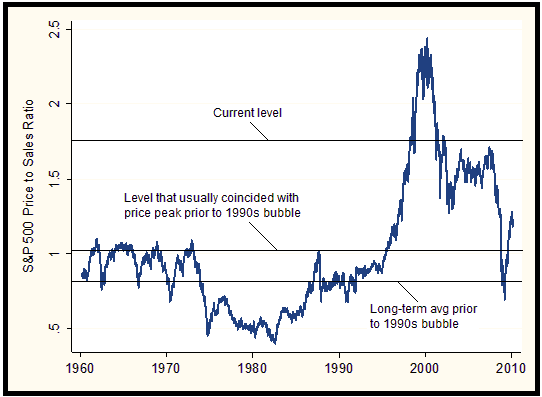
At times when profit margins are well above average or well below average, the
price/sales (p/s) ratio will be a more accurate measure of overall market
valuation than the p/e ratio. To put today's valuation level into perspective we
therefore wanted to show a long-term chart of the S&P500's p/s ratio. We
couldn't find exactly what we were looking for, as p/s charts that were updated
through to the present didn't go back far enough. The best we could come up with
on short notice was the following chart from a March-2010 commentary at
Hussmanfunds.com. This chart extends back to 1960, but doesn't show the past
three years. We have therefore added a line and a note to indicate where the
market sits today. We have also added lines and notes to show the long-term
average level and the level that coincided with important market peaks prior to
the 1990s bubble.
Notice that today's p/s ratio is above its 2007 peak, a long way above the level
that coincided with important price peaks from 1960 through to the early-1990s,
and well below the stratospheric level reached in 2000. The US stock market had
never previously attained anything remotely close to the valuation extreme of
2000 and will probably not attain anything remotely close to that extreme again
in our lifetime, so the fact that the current valuation is still well below the
all-time high reached in 2000 is not suggestive of additional upside potential.
The bottom line is that the S&P500 Index, the most important US equity index,
has an extremely high valuation. This doesn't guarantee substantial downside
over the months ahead, but it creates substantial downside risk.
Regardless of whether or not a major topping process is now underway, we think
that the SPX will trade at least 20% below its April-2014 peak before year-end.
Current Market Situation
The price action is consistent with our view that an intermediate-term or major
top is in process in the US stock market. Some stock indices, including the
NASDAQ100 (NDX) and the Russell2000, have probably already peaked for the year,
while other indices, most notably the S&P500, look set to make new highs prior
to reaching their 2014 peaks. The coming two weeks is the most likely time for
the next meaningful turning point (from up to down).
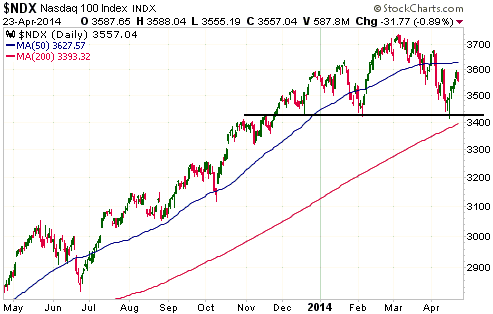
What will probably turn out to be the NDX's initial decline in a 6-month or
longer downward trend ended at important lateral support last week. The ensuing
rebound has retraced a little more than half of the initial decline and is
probably almost complete, although it wouldn't be surprising if the NDX were to
gain enough additional ground to reach its 50-day MA (the blue line on the
following chart) prior to embarking on its next downward leg.
Gold and the Dollar
Gold
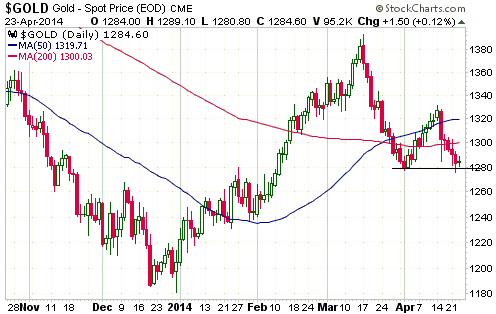
The US$ gold price traded slightly below its early-April low during the first
half of this week. It hasn't yet shown any sign of strength, so a spike to
another new 2-month low is likely prior to an end to the current correction.
Based on the expected performance of the broad stock market, the time of the
year and the resilience of the gold-mining sector, we expect that gold will make
a correction low within the coming two weeks at not far below its present level.
Gold Stocks
The HUI has rebounded to its 200-day MA.
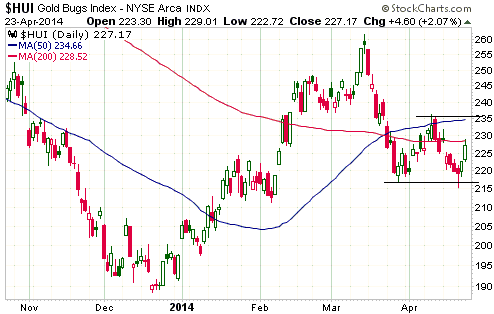
Taken in isolation, this rebound is not significant. However, we should also
take into account that:
a) The rebound commenced following an intra-day spike to a new correction low.
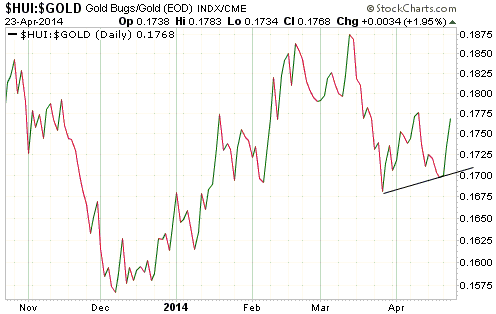
b) The HUI/gold ratio made a higher closing low this week and has been
strengthening since late-March.
c) There was a pronounced upward reversal in the GDXJ/GDX ratio during the first
half of this week, indicating strength in the junior gold stocks relative to the
senior gold stocks.
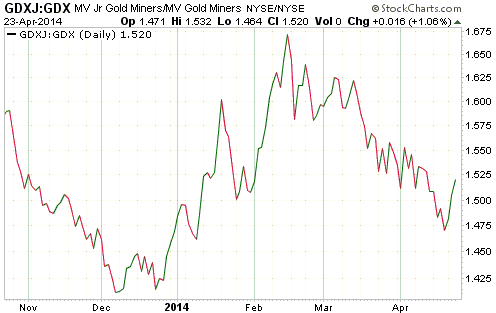
All of which suggests that the gold-mining sector's correction probably just
ended.
As noted in a previous commentary, a close by the HUI above its early-April high
(236) would provide additional evidence that the correction was over and that a
new short-term upward trend had begun.
Updates
on Stock Selections
Notes: 1) To review the complete list of current TSI stock selections, logon at
http://www.speculative-investor.com/new/market_logon.asp
and then click on "Stock Selections" in the menu. When at the Stock
Selections page, click on a stock's symbol to bring-up an archive of
our comments on the stock in question. 2) The Small Stock Watch List is
located at http://www.speculative-investor.com/new/smallstockwatch.html
 Two
potential underground gold mines worth considering Two
potential underground gold mines worth considering
Roxgold (ROG.V) has been in the TSI Small Stocks Watch List since May of last
year. This means that we thought it had enough speculative merit to be worth
bringing to the attention of our readers, but that it was probably too
small/illiquid to be a formal stock selection. (Note: There are a few current
stock selections that are smaller and more illiquid than ROG, but these were
added to the TSI Stocks List before we imposed a size/liquidity restriction).
ROG now has a higher average daily trading volume, a stronger balance sheet
courtesy of a $29M equity financing completed last month, and a more advanced
project (as of this week, ROG's flagship Yaramoko gold project in Burkina Faso
has a completed Feasibility Study (FS)). It is therefore now a candidate for
inclusion in the TSI Stocks List, depending on how the economics of its project
and its valuation stack up.
Rather than just outline the economics of the Yaramoko project and ROG's
valuation, we are going to compare ROG to Dalradian Resources (DNA.TO). We've
been following DNA and its Curraghinalt gold project in Northern Ireland for
almost a year, but this is the first time we've mentioned it at TSI. This is an
appropriate comparison because both companies are developing high-grade (>10-g/t
average) gold deposits that would be accessed via an underground mine and that
appear to be economically robust at the current gold price. Here is the
comparison in table form:
|
|
Dalradian Resources (DNA.TO) |
RoxGold (ROG.V) |
|
Project Name |
Curraghinalt |
Yaramoko |
|
Location |
Northern Ireland |
Burkina Faso |
|
Engineering Study / Date |
PEA / Jul-2012 |
FS / Apr-2014 |
|
Planned Mine Type |
Underground |
Underground |
|
M&I Resource (oz) |
1.0M |
810K |
|
Avg Resource Grade |
10.4g/t |
15.8g/t |
|
P&P Reserve (oz) |
0 |
759K |
|
Metallurgical Recovery |
92% |
97% |
|
Strip Ratio |
n/a |
n/a |
|
Avg Annual Production (oz) |
145K |
100K |
|
Cash Cost (per oz) |
$532 |
$467 |
|
All-In Cost (per oz) |
|
$590 |
|
Mine Life |
15 years |
7.4 years |
|
Initial Capital Cost ($M) |
192 |
107 |
|
Assumed Gold Price (US$) |
1378 |
1300 |
|
NPV ($M) |
467 |
250 |
|
IRR |
41.9% |
48.4% |
|
Capital Payback Period |
|
1.6 years |
|
Project Ownership Percent |
100% |
90% |
|
NPV of Company Stake ($M) |
467 |
225 |
|
Current Stock Price (US$) |
0.87 |
0.66 |
|
Share Count (M) |
109 |
236 |
|
Current Market Cap ($M) |
95 |
156 |
|
Net Cash ($M) |
19 |
38 |
|
Current Enterprise Value ($M) |
76 |
118 |
|
EV/NPV |
16% |
52% |
|
Current Discount to NPV |
84% |
48% |
|
EV + Capital Cost (EVCC) |
268 |
225 |
|
EVCC/NPV |
0.57 |
1.00 |
In ROG's favour, the economics of its deposit
are not only better (48% IRR at a gold price of $1300/oz for Yaramoko versus 42%
IRR at a gold price of $1378/oz for Curraghinalt), they are based on a
higher-level and more recent engineering study (April-2014 FS versus July-2012
PEA). Due to the immense difference between PEA and FS standards, at this time
we can be far more confident about the published economics of Yaramoko than the
published economics of Curraghinalt.
Stock market liquidity is also in ROG's favour.
In DNA's favour is a much lower valuation (as evidenced by the EVCC/NPV ratio at
the bottom of the table -- the lower this ratio, the more attractive the
valuation). Project location could also be to DNA's advantage, although this
would partly depend on a speculator's current portfolio. Country and permitting
risk is not a major concern in either case, but from our perspective the
Northern Ireland location would be a plus because we already have a lot of
exposure to West Africa.
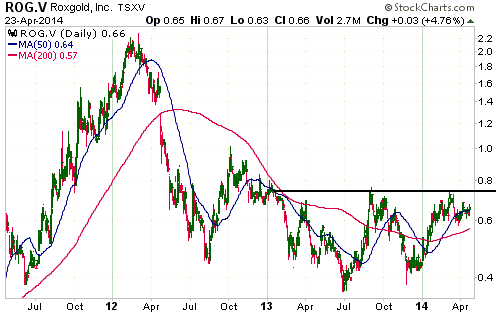
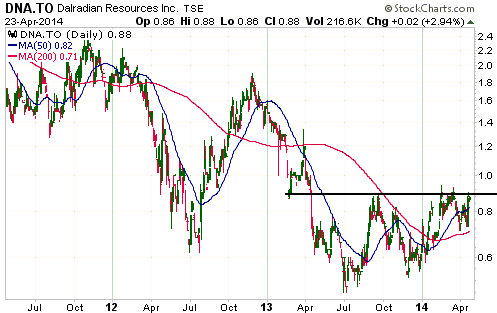
Technically, both stocks appear to have built bases and are close to breaking
out to the upside. Charts are displayed below.
In summary, both stocks have considerable speculative merit. We are more
comfortable with the economics of ROG's project, but DNA's lower valuation
offsets the risk associated with its earlier stage of project development.
Here's what we are going to do:
1) We will add ROG to the TSI List if we are able to do so within the next few
weeks at around 10% below its current price. Specifically, ROG will be added to
the List if it trades at C$0.60.
2) We are going to replace the Elgin Mining warrants (TSX: ELG.WT), which are
currently in the TSI List and due to expire next week, with the Dalradian
warrants (TSX: DNA.WT). DNA.WT closed at C$0.11 on Wednesday 23rd April and
there appears to be reasonable (by the low standards of warrants on junior
mining equities) liquidity at C$0.11-C$0.12. With the stock at C$0.87 we
calculate fair value for the warrants to be C$0.12-C$0.13, so we wouldn't pay
more than C$0.13.
Note that a Dalradian warrant (DNA.WT) is a much riskier proposition than a
Dalradian share. These warrants are slightly out of the money (their exercise
price of C$0.90 is 3c above the current stock price) and will expire next
February, which means that in the absence of a rally in the underlying stock
within the next 10 months the warrants will expire worthless.
The risk of owning out-of-the-money warrants is highlighted by our experience
with the Elgin Mining warrants, which are leaving the TSI List and are about to
expire worthless. We received these warrants free of charge as part of Elgin's
takeover of Gold-Ore Resources, but for TSI record purposes we assumed an
initial cost of C$0.10 (the market price at the time). The ELG.WT speculation
will therefore go into the books as a 100% loss.
The other side of the coin is that the warrants offer much greater reward
potential than the underlying shares. For example, if DNA breaks out from its
basing pattern and rallies to C$1.30, which it could easily do within the next
few months, the warrants would have C$0.40 of intrinsic value and would probably
trade at C$0.45 or higher. This means that a 50% gain in the stock price would
likely lead to a 300% gain in the warrant price.
Chart Sources
Charts appearing in today's commentary
are courtesy of:
http://stockcharts.com/index.html

|









