|
- Interim Update 23rd May 2012
Copyright
Reminder
The commentaries that appear at TSI
may not be distributed, in full or in part, without our written permission.
In particular, please note that the posting of extracts from TSI commentaries
at other web sites or providing links to TSI commentaries at other web
sites (for example, at discussion boards) without our written permission
is prohibited.
We reserve the right to immediately
terminate the subscription of any TSI subscriber who distributes the TSI
commentaries without our written permission.
Reasons 11, 12, 13 and
14 to be a China bear
In the latest Weekly Update we listed 10 reasons to be bearish on China. Here are four more reasons that we should have included, but forgot about in the heat of the moment:
11) Corruption. The PBOC (China's central bank) estimated last year that $120B had been stolen by government officials and sent outside China
since 1990. The actual figure sent outside China is likely to be much higher, and then there's all the corruption that doesn't lead to money being sent out of the country. All governments are corrupt, but China's government, being more powerful than most, is more corrupt than most.
12) The financial protection being given to State-Owned Enterprises (SOEs) is starving the private sector of capital. Due to the widespread perception that insolvent SOEs will be bailed out, investors are favouring the bonds of inefficient state-run operations with very weak balance sheets over the bonds of private companies that have far superior prospects and performance. This crowding-out of private-sector credit by state-backed credit is evident in many countries, but the problem is more extreme in China. According to the chief executive of brokerage CLSA in Singapore, as quoted in the article posted
HERE:
"You've got basically 10 times the amount of credit going to the state sector [in China] as to the private sector to produce the same amount of
output."
13) Wealth accumulation in China is being seriously hindered by capital controls that make it difficult to get money into the country and even more difficult to get it out (unless you are well connected).
14) China is no longer a communist country, but it still has a command economy. The government has complete control over the banking system, which results in the total monetary value of bank loans made during any year bearing no resemblance to the total monetary value of prudent lending opportunities. The government also exerts considerable control over the prices of important commodities, the entire construction industry, the amounts of exports and imports, the movement of people between provinces, and the number of children per family (the famous
"one-child policy"). This leads to great inefficiency, but it also means that China's government has more ability than most governments to maintain an illusion of real progress in the face of major underlying weakness. Charting
fun with Krugman
Paul Krugman can't possibly be stupid enough to believe many of the things he writes/says. It is therefore likely that he deliberately distorts and omits in an effort to promote a political agenda.
We don't have the patience to sift through Krugman's analytical garbage and calmly explain his errors, but, fortunately, Robert Murphy does. Here's a link to an entertaining (if you like economics) article in which Murphy shows that data put forward by Krugman to support Keynesian theories actually do more to support the opposing (Austrian) theories:
http://mises.org/daily/6055/Charting-Fun-with-KrugmanThe Stock Market
From the 28th March 2012 Interim Update:
"As at the end of last week the Consensus-inc bullish percentage was near its highest level of the past 15 years. Although this is the type of sentiment backdrop that tends to occur prior to the start of a major decline, it doesn't mean that a major decline is necessarily about to begin. Based on the historical record, it means that there is minimal scope to recruit additional traders to the bullish side of the fence (the remaining upside potential is very limited) and that something will probably happen within the next six months to push the bullish percentage down to 30 or lower. For example, whereas the October-2007 extreme high in the Consensus-inc bullish sentiment was followed by a major decline, the extreme high in January of 2004 was followed by a 7-month 'choppy' consolidation that resulted in the average market participant becoming bearish but never pushed the S&P500 Index more than 10% below its January-2004 peak."
Since we wrote the above the Consensus-inc bullish percentage has fallen from 78 to 53 (see chart below). This is roughly the middle of its long-term range, so while it is clear that short-term sentiment indicators such as put/call ratios recently showed extremes of fear and pessimism, there remains plenty of scope for longer-term sentiment indicators to reflect additional negativity.
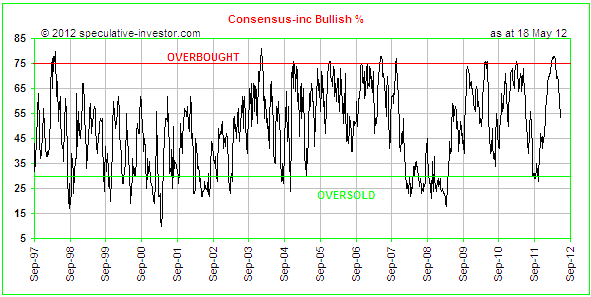
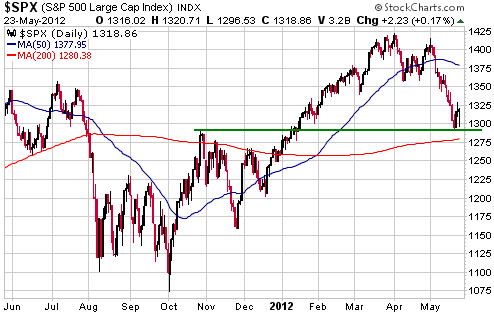
As per our comment in the 28th March Interim Update, the historical record suggests that something will happen over the next few months to push the Consensus-inc bullish percentage down to around 30. However, there is likely to be a multi-week stock market rebound that allows bullish sentiment to recover before the next downward trend gets underway. This line of thinking is backed up by the S&P500's daily chart, which shows that Wednesday's downward spike was a potentially successful test of the previous week's low.
Gold and the Dollar
Gold
The biggest short-term threat to the gold market
Some commentators on the gold market have claimed that because the recent sharp decline in the gold price occurred in parallel with massive money printing by central banks, the gold price must have been manipulated downward. As discussed below, this claim is poorly reasoned on two counts.
First, short-term price moves in the gold market aren't usually driven by money-supply changes. They are, instead, largely sentiment-driven. That's why there have been many periods over the past 10 years when gold has risen sharply in parallel with slowing money-supply growth and many periods when it has fallen sharply in parallel with rising money-supply growth. That is, no sensible conclusions about gold price manipulation can be drawn from a short-term comparison of the money-supply growth rate and the gold price.
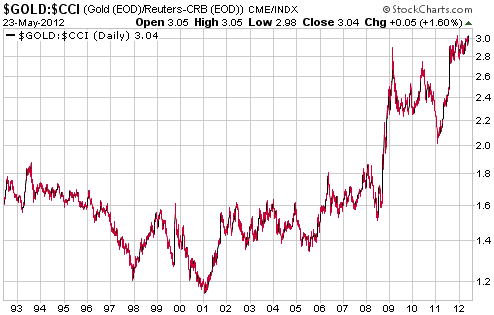
Our opinion continues to be that attempts to manipulate the gold price downward have been ineffective over the timeframes that interest us (we couldn't care less about gold's performance from one hour to the next, we care about multi-month and multi-year trends). This opinion is based on evidence such as the performance of the gold/commodity ratio. As illustrated by the following chart, gold made an all-time high last year relative to commodities in general and is still very close to its high (actually, the 23rd May 2012 closing level for the gold/CCI ratio was a marginal new all-time high).
Second, the rate of monetary expansion engineered by the world's two most important central banks (the Fed and the ECB) has moderated considerably. At the risk of letting facts get in the way of a good story, here's a summary of the recent money supply situation:
- The Fed has not grown its balance sheet at all since the completion of "QE2" last June.
- The US money supply (US$ TMS) has continued to expand at a double-digit pace, but this is partly due to the shifting of existing dollars from Europe to the US.
- The ECB has expanded its balance sheet dramatically over the past six months, but due to the way this was done it has not, as yet, given the euro-zone money supply (euro TMS) a significant boost. In fact, the total euro supply contracted at an annualised rate of 3% over the most recent 3-month period.
The two charts displayed below show the year-over-year growth rate of the G2 money supply (US$ supply plus euro supply). The first chart is unadjusted and the second chart includes an adjustment for the boost to the US money supply stemming from the transfer of existing dollars from Europe to the US (we have assumed that dollars have been leaving Europe at the rate of $50B per month since September-2011).
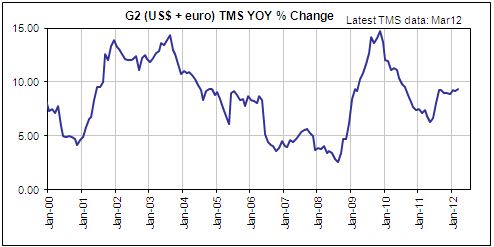
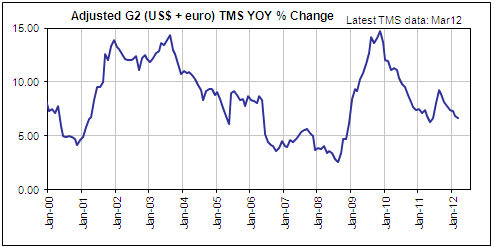
This brings us to the biggest SHORT-TERM threat to the gold market: monetary deflation in the euro-zone, leading to a further slowdown in the G2 monetary inflation rate and rising fear of
"deflation" in the markets. The year-over-year rate of growth in the total euro supply is currently about 2.8%, but given what is happening in Europe it could easily go negative within the next few months unless the ECB steps in and starts aggressively monetising debt.
We put "short-term" in capitals in the above paragraph to emphasise that monetary deflation is not a threat over any period beyond the next few months. The more that deflation of any type (monetary or price) appears to be a realistic and imminent possibility, the more aggressive the major central banks will become in their efforts to counteract it. There is no doubt that central banks have the power to reverse any trend towards deflation.
We aren't predicting a brief bout of deflation; we are simply pointing out that it is a plausible risk. It is important to consider all realistic possibilities and not be lulled into complacency by the "central banks are printing like crazy so gold will rocket upward as soon as the manipulation stops" crowd.
Current Market Situation
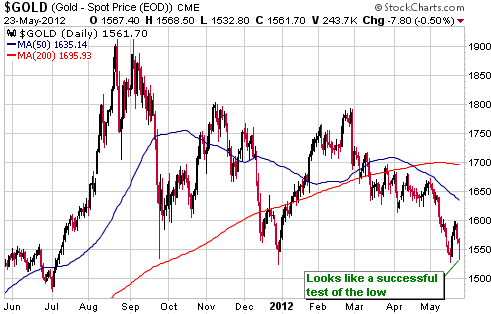
It looks like gold joined the US stock market in successfully testing last week's low on Wednesday, but no definitive conclusions can be drawn at this stage. What we know for sure is that gold sentiment indicators are at levels that have, in the past, been associated with important price lows.
Gold Stocks
This week's price action has provided us with preliminary evidence that the bottom was put in place last week. The evidence we are referring to is the clearly visible difference between the current rebound and the previous rebound attempts. This difference is not only apparent in the performance of the HUI, but also in the performance of the HUI/gold ratio (the bottom section of the following chart).
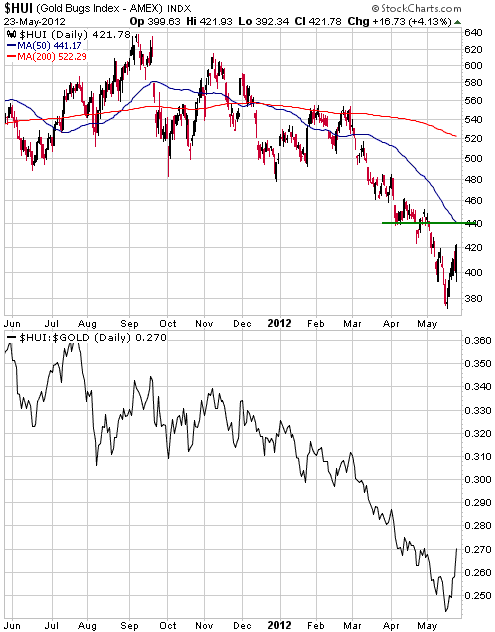
The gold sector has obviously traded a lot more lightly over the past several days than at any other time over the past 3 months. This lightness was observable during the first hour of trading on Wednesday (due to the time difference, the first hour of North American trading is usually the only hour that we see), when the HUI refused to fall by much despite substantial weakness in the stock and bullion markets.
The next piece of evidence that an important bottom is in place would be a higher high following a multi-day pullback. More specifically, the following sequence would give us the next piece of evidence:
1. A peak for the initial rally (the rally that began at last week's low)
2. A pullback to a higher low that lasts somewhere between three days and two weeks
3. A daily close above the intra-day high of the initial rally.
Note that the initial rally probably won't do any better than take the HUI up to the confluence of lateral resistance and the 50-day moving average at 440. Note also that at this stage it is best not to have a strong opinion on whether a bottom is in place. The reality is that a bottom will only be definitively evident many months after the fact. In the mean time, it is best just to focus on doing the right thing. The right thing is to methodically scale in during weakness, take some money off the table into significant strength, and remain hedged via a sizeable cash reserve.
Currency Market Update
It's amazing how the same old news out of Europe continues to drive the financial markets in general and the currency market in particular. Yes, Greece is a financial basketcase and will almost certainly have to leave the euro-zone at some point. We've only known this for about 2.5 years.
At this time last week the Dollar Index had risen for 13 trading days in a row and was at resistance defined by its January high. At that time our short-term US$ outlook shifted to "bearish", and we wrote:
"...this outlook change is not a call that the Dollar Index is at a top. Having come this far it would actually be a little surprising if the Dollar Index didn't move at least marginally above resistance defined by its January high, perhaps following a short pullback. It is, instead, an expression of our opinion that the Dollar Index's short-term risk/reward is now skewed decisively towards risk."
The following daily chart shows that the Dollar Index has just moved above resistance to a new high for the year. In the process of doing so it has become more 'overbought', although at this stage it is only 'overbought' on a short-term basis.

We can't rule out the possibility that over the weeks ahead the markets will become even more panicked about the stresses within the euro-zone, sending the Dollar Index up to the mid-80s. If this were to happen it would very likely create a good set-up for a trade in euro call options, but a continuation to the mid-80s is not the most likely outcome. There's a higher probability that the Dollar Index is now close to a short-term top.
Update
on Stock Selections
Notes: 1) To review the complete list of current TSI stock selections, logon at
http://www.speculative-investor.com/new/market_logon.asp
and then click on "Stock Selections" in the menu. When at the Stock
Selections page, click on a stock's symbol to bring-up an archive of
our comments on the stock in question. 2) The Small Stock Watch List is
located at http://www.speculative-investor.com/new/smallstockwatch.html
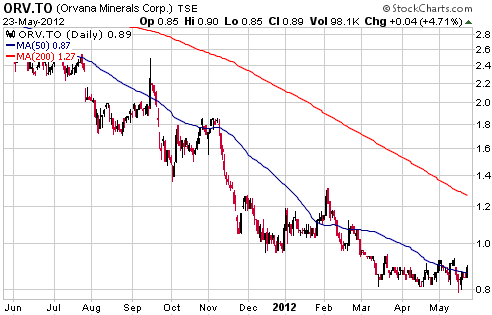
 Orvana Minerals (TSX: ORV). Shares: 136M issued, 139M fully diluted. Recent price: C$0.89 Orvana Minerals (TSX: ORV). Shares: 136M issued, 139M fully diluted. Recent price: C$0.89
A press release issued on 23rd May indicates that ORV's mining operations continue to improve. In particular, production is now ramping up nicely at its gold-copper mine in Spain, leading to lower cash costs and profit margins that should result in significant free cash flow.
ORV's weak balance sheet is still a risk, but if the recent trends persist and the debt load begins to shrink then this stock will again become a good candidate for new buying.
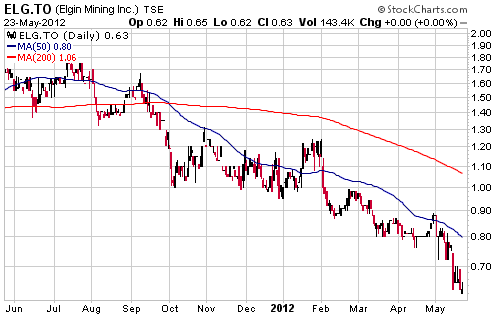
Elgin Mining (TSX: ELG) (Formerly Gold-Ore Resources - GOZ.TO). Shares: 148M issued, 200M fully diluted. Recent price: C$0.63
During the first half of May a few junior gold mining stocks plunged on almost no volume. One was Clifton Star (CFO.V). Another was Elgin Mining (ELG.TO). ELG held up quite well until early May, when some small shareholders decided that they had to get out at any price. The result was a quick low-volume decline in the stock price from C$0.80 to the low-C$0.60s, where it sits today and where it offers exceptional value.
At current prices ELG is one of the best buys on the market. Like a lot of very small gold miners its current stock-market valuation is very low, but it is less risky than most because it has both a strong balance sheet ($35M in cash, almost no debt) and a cash-flow-positive mining operation in a secure location (Sweden). It also has high-potential exploration-stage assets in a secure location (Canada).
Note: The ELG C$1.30 warrants are an interesting speculation, but at current prices the shares offer better value than the warrants.
Chart Sources
Charts appearing in today's commentary
are courtesy of:
http://stockcharts.com/index.html

|









