|
- Interim Update 23rd July 2014
Copyright
Reminder
The commentaries that appear at TSI
may not be distributed, in full or in part, without our written permission.
In particular, please note that the posting of extracts from TSI commentaries
at other web sites or providing links to TSI commentaries at other web
sites (for example, at discussion boards) without our written permission
is prohibited.
We reserve the right to immediately
terminate the subscription of any TSI subscriber who distributes the TSI
commentaries without our written permission.
Why bad
economic policies remain popular
Bad economic policies never seem to die. Instead, despite their
failures they get re-cycled time and time again. In the following
paragraphs we'll expand on why this is so, using inflation policy as
an example, but here is a summary of the three main reasons: First,
many people mistakenly believe that the validity of a policy can be
determined by observing economic data. Second, policy-makers and the
people who employ or elect them usually don't know correct economic
theory, that is, they usually don't have a good understanding of
economic cause and effect. Third, every economic policy will have
its beneficiaries, which means that every economic policy will have
its enthusiastic promoters.
Assuming that the goal of an economic policy is a stronger/healthier
economy, you cannot determine if a policy was successful by looking
at data. This is because a myriad of forces will always be present,
so it will never be possible to know that the observed outcome was
primarily the result of a particular policy or to know exactly what
would have happened in the absence of the policy. In addition,
looking at how the economic numbers changed in the aftermath of a
policy usually won't tell you the indirect and long-term effects of
the policy. To take a topical example, it doesn't matter how badly
an economy performs in the aftermath of monetary and fiscal
stimulus, Keynesians will always be able to claim, with straight
faces and without fear of being proven wrong by empirical methods,
that the performance would have been even worse if not for the
stimulus. They cannot be proven wrong by empirical methods because
it is never possible to go back in time and see what would have
happened under a different set of policies.
Fortunately, though, by applying flawless logic based on sound
economic theory you can know, prior to the implementation of a
policy, whether or not the policy has a realistic chance of creating
a net benefit to the overall economy. This means that a government
or a central bank can never justify doing something by arguing that
doing something -- anything -- is better than doing nothing. In the
realm of economic policy-making, trial-and-error is not a valid
approach.
Inflation policy, which involves inflating the money supply with the
aim of devaluing the currency, is the most popular and the most
widely misunderstood of all economic interventions. Moreover, it is
popular BECAUSE it is misunderstood.
Sound economic theory tells us that inflation policy cannot possibly
create a net benefit for the overall economy and can only get in the
way of economic progress. The reason is that it distorts the price
signals upon which investment decisions are made, leading to a
greater number of ill-conceived decisions and making the economy
less efficient. That's why the strongest economies over the long run
tend to have the lowest monetary inflation rates, the lowest price
inflation rates, and the strongest currencies. Inflation policy
remains popular, however, because its effects are generally not
understood.
Rather than think deeply about indirect and long-term consequences,
most people, including almost all politicians and Keynesian
economists, focus exclusively on the short-term and superficial
effects of economic policy. From such a perspective inflation policy
will often look sensible, because it often prompts a burst of
activity. That many of the activities stimulated by the policy are
counterproductive is either not seen or considered irrelevant (to
the Krugman's of the world, unproductive spending is just as useful
as productive spending).
On a related matter, there is a popular opinion that "price
inflation" is generally a negative, but a weaker currency on the
foreign exchange market is generally a positive. This line of
thinking is completely wrong. First, if it were possible to
artificially lower a currency's foreign exchange value without
causing "price inflation", doing so would simply give exporters a
benefit at the expense of importers and consumers. It would be an
undeserved wealth transfer from one group to another group, with no
advantage to the overall economy. The same applies to any form of
subsidy. Second, it is not possible to 'engineer' a long-term
reduction in the exchange rate without reducing the currency's
domestic purchasing power at a relatively fast pace, since long-term
changes in exchange rates are primarily driven by purchasing power
differences. This means that many of the initial beneficiaries of a
reduction in the exchange rate (the exporters) will ultimately be
hurt by the devaluation policy due to their costs rising faster than
their revenues.
With any economic policy there will always be winners and losers, at
least in the short-term. A policy will naturally be popular with and
supported by the likely short-term winners, and the likely winners
will often be more enthusiastic in their advocacy than the losers
are in their opposition. In fact, the losers will often not realise
that they are effectively having their pockets picked, while the
winners will often be readily identifiable. This is another reason
that bad policies continue to be popular.
In conclusion, always keep in mind that there are no free lunches in
the world of economic policy-making. When central banks and
governments meddle in the economy they shift wealth around and most
likely make the total amount of wealth less than it would otherwise
be, a reality that can only be seen through the lens of good
economic theory. Perhaps you believe that this wealth transfer
should happen for 'social' reasons, but don't kid yourself that the
overall economy will be made stronger.
The Stock Market
The financial markets have moved roughly in accordance with our
expectations during this year to date, with one stand-out exception: the US
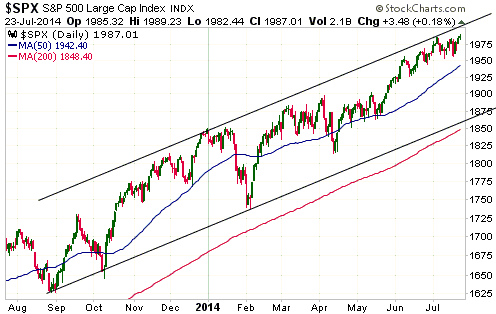
stock market. As depicted by the following daily chart, the S&P500 Index (SPX)
continues to make slow and steady upward progress near the top of its
intermediate-term channel. It made a marginal new all-time high on Wednesday
23rd July.
As discussed in a previous commentary, the fact that the SPX has made it this
far into the year without experiencing a meaningful correction opens up the
possibility of a crash. Keep in mind, though, that stock markets don't make new
highs and then suddenly crash. Instead, a stock market crash is a process that
usually takes at least 2 months to play-out. The process involves a sharp
initial decline of around 10%, a rebound to lower high, and a decline to below
the low of the initial sharp decline. If there is going to be a crash it will be
set in motion by the break below the low of the initial decline. Therefore,
before we get excited about the prospect of a crash we need to see a quick drop
of 10% (or thereabouts) followed by a multi-week rebound that fails to make a
new high.
Furthermore, although the price action makes a September-October crash possible,
the SPX's unexpected ability to stay on its upward path through the first 7
months of the year means that the most probable outcome entails the overall
upward trend continuing into the final quarter of this year, with a significant
(10% or greater) intervening correction.
Gold and the Dollar
Gold
Gold and Real Interest Rates
The real interest rate is one of the most
important determinants of whether the financial landscape is bullish or bearish
for gold, where the real interest rate is the default-free nominal interest rate
minus the EXPECTED rate of currency depreciation.
The trouble, for those of us who care about the true fundamental drivers of the
gold price, is that the rate of currency depreciation expected by the market
cannot be accurately measured, which means that the real interest rate cannot be
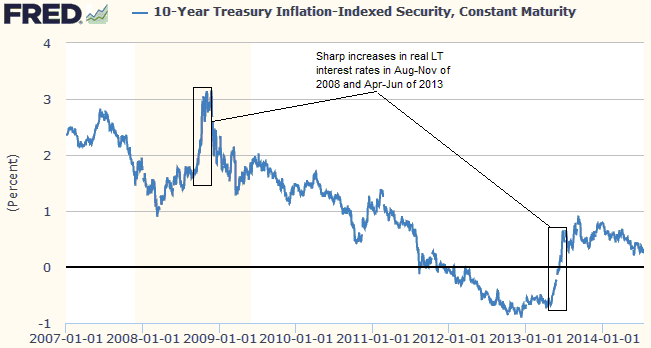
accurately measured. However, the yields on Treasury Inflation-Protected
Securities (TIPS) are ballpark estimates of real interest rates and should trend
in the same directions as real interest rates. The following chart of the
10-year TIPS yield therefore gives a rough indication of the performance of the
real US 10-year interest rate.
Since the real interest rate is not the only determinant of whether the
financial landscape is bullish or bearish for gold, the gold price doesn't
always trend in the opposite direction to the TIPS yield. However, note that the
two most significant declines in the gold price over the past 8 years (the price
plunges that occurred during Aug-Nov of 2008 and Apr-Jun of 2013) happened
concurrently with, and can therefore be explained by, sharp advances in the
10-year TIPS yield.
The H1-2013 sharp increase in real long-term interest rates was difficult to
anticipate, although gold was acutely vulnerable at the time due to the fact
that other important fundamental drivers (credit spreads, the yield curve and
the BKX/SPX ratio, for example) were bearish. We should have paid more attention
to these other drivers.
The real US long-term interest rate leveled off (that is, stopped getting more
gold-bearish) during the second half of last year and began to drift downward
(that is, started getting more gold-bullish) in December. The downward drift
will probably continue over the next several months due to a continuing downward
trend in the nominal 10-year T-Note yield and a small increase in inflation
expectations.
Top-Bottom Symmetry Revisited
In the 2nd June Weekly Update, we wrote:
"The recent price action ushers in the possibility that the gold market is
bottoming in a similar way to how it topped during 2011-2012. In particular, we
note that a major downward trend didn't get underway until about 13 months after
the 2011 top. If the bottoming/basing pattern turns out to be symmetrical to the
topping pattern, then a major upward trend won't get underway until about 13
months after the end-June 2013 bottom. Early-August 2014, in other words."
And:
"The future of any market price is never certain, but the fundamental
backdrop, which turned decisively bullish for gold in April of this year,
indicates with near certainty that a complex basing pattern -- as opposed to a
lengthy sideways move within a continuing bear market -- is what we are dealing
with."
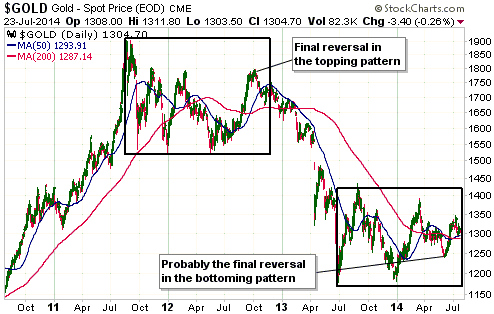
The idea that gold's 2013-2014 bottoming pattern will be roughly symmetrical to
its 2011-2012 topping pattern remains plausible. The potential symmetry is
illustrated by the following chart. At this stage it looks like the final upward
reversal in the bottoming pattern occurred about 11.5 months into the pattern,
as opposed to 13 months for the final downward reversal in the 2011-2012 topping
pattern, but early-August (the week after next) is still a likely time for a
consistent upward trend to get underway.
Current Market Situation
There was no change in gold's short-term situation over the first three days of
this week. There continues to be a realistic chance of a spike down to the
$1280s prior to the start of the next tradable price advance. Also, with or
without an intervening decline to the $1280s we would still view a daily close
above $1325.90 as preliminary evidence that the next tradable price advance had
begun.
We view the Ukraine drama as more of a short-term minus than a short-term plus
for the gold market. Consequently, we think that articles such as "Escalating
Ukraine crisis could blow gold sky high" are unhelpful. This article not
only promotes the myth that increasing geopolitical risk is fundamentally
bullish for gold, it effectively asserts that the absence, to date, of a large
rise in the gold price in reaction to what amounts to irrelevant news on the
geopolitical front is evidence that the gold price is being manipulated downward
by bullion banks.
On an intermediate-term or long-term basis, increasing international tensions
and acts of aggression are bullish for gold to the extent that they lead to
economic weakness in the US and/or Europe.
As an aside, we can't make sense of the US government's apparent eagerness to
worsen relations with Russia. What is the thinking behind it?
Whenever the US government claims to have evidence of serious wrongdoing by a
foreign power and refuses to provide the evidence, you can be confident that the
evidence doesn't yet exist. In other words, John Kerry's public claims that the
US government has evidence implicating the Russian government in the recent
shooting-down of a passenger jet in Ukraine airspace tells us that there is no
such evidence. Now, the US government has demonstrated in the past that if need
be it will fabricate evidence to support a predetermined course of action, but
what would be its purpose in this case? After all, sanctions against Russia hurt
US economic interests as well as Russian economic interests.
Gold Stocks
The consolidation has continued in the gold-mining sector. As previously
advised, the consolidation could lead to a test of moving-average support in the
mid-220s for the HUI.
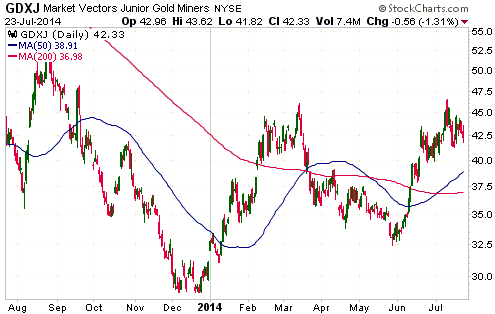
For GDXJ, the 50-day MA is a likely target for a correction low. As illustrated
below, this MA is presently near $39, or about 8% below the current price.
The Currency Market
With regard to price action, by far the most important development over the
first three days of this week was the downside breakout in the euro. This
breakout could have long-term implications, as it could mean that the Dollar
Index's long-term basing pattern is complete. However, the Dollar Index still
has to break above resistance at 81.5 to confirm the downside breakout in the
euro.
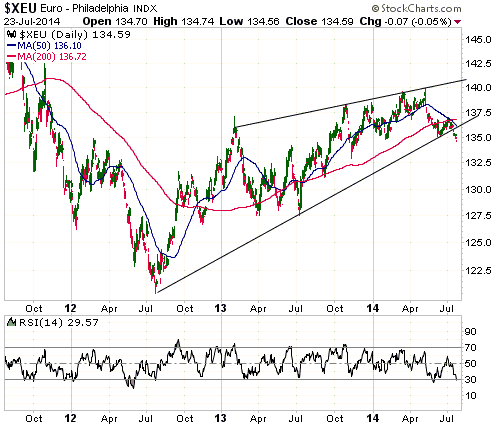
The euro is becoming very 'oversold' on a short-term basis and within the next
two weeks will probably make a low that holds for at least a few weeks,
regardless of its longer-term prospects. There is a risk, though, that the low
of the next two weeks will be well below the current level. In other words,
despite being short-term 'oversold' the euro could suffer a quick additional
decline before it begins to rebound.
Updates
on Stock Selections
Notes: 1) To review the complete list of current TSI stock selections, logon at
http://www.speculative-investor.com/new/market_logon.asp
and then click on "Stock Selections" in the menu. When at the Stock
Selections page, click on a stock's symbol to bring-up an archive of
our comments on the stock in question. 2) The Small Stock Watch List is
located at http://www.speculative-investor.com/new/smallstockwatch.html
Chart Sources
Charts appearing in today's commentary
are courtesy of:
http://stockcharts.com/index.html
http://research.stlouisfed.org/

|









