|
- Interim Update 24th April 2013
Copyright
Reminder
The commentaries that appear at TSI
may not be distributed, in full or in part, without our written permission.
In particular, please note that the posting of extracts from TSI commentaries
at other web sites or providing links to TSI commentaries at other web
sites (for example, at discussion boards) without our written permission
is prohibited.
We reserve the right to immediately
terminate the subscription of any TSI subscriber who distributes the TSI
commentaries without our written permission.
The Stock Market
From John Hussman's
latest letter:
"Rule o' Thumb: When the cover of a major financial magazine features a
cartoon of a bull leaping through the air on a pogo stick [as Barrons magazine
just did], it's probably about time to cash in the chips."
And:
"Looking across history, we've tended to observe peaks in gold shares well in
advance of peaks in the general market, plunges in gold shares slightly in
advance of plunges in the general market, and new advances in gold shares
several months in advance of troughs in the general market (see, for example,
the lows of 1982, 2000 and 2008). I suspect that the weakness we are seeing in
the gold sector is something of a precursor in this case as well. Investors
should note that when the Philadelphia gold index (XAU) has plunged by more than
20% over the prior 6-month period, the general stock market has often
experienced significant losses over the following 6-12 month period (see, for
example, the losses in the XAU in mid-1990 just before the general 1990 bear
market, in late-2000 just before the 2000-2002 bear market, and in August 2008
-- when the S&P 500 was still at 1300 -- just before the general market
collapsed). This is certainly no assurance of the market outcome in the present
instance, but in the context of an overvalued, overbought, overbullish market
with margin debt near record highs, it's also not a feature of the present
environment that we're inclined to overlook."
We expressed a similar opinion in the latest Weekly Update, when we wrote:
"Gold's lacklustre performance over the 8-month period prior to the past few
weeks was bullish for the stock market because it pointed to increasing economic
confidence, but...the extreme weakness in gold over the past 1-2 weeks does not
seem to be related to an accelerated shift away from safe havens towards risk. A
more likely explanation is that it relates to liquidity issues for banks and
other large speculators. If so, then something along the lines of what just
happened to gold could happen to the senior stock indices within the coming
month."
The risk is high, but the senior stock indices haven't yet buckled. For example,
having tested short-term support last week the NASDAQ100 Index (NDX) has
rebounded to just below intermediate-term resistance. Apple's
greatly-anticipated earnings announcement came and went without any fanfare or
drama.
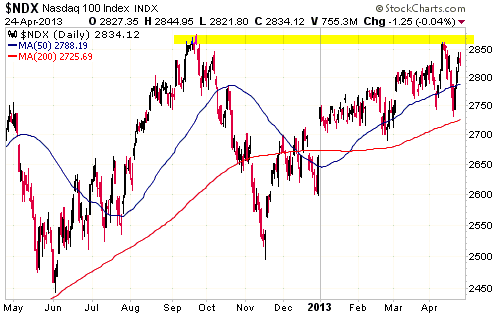
As has been the case for more than three months, the NDX requires a daily close
below 2700 to confirm that a multi-month top is in place. A spike above
resistance defined by last year's high followed soon after by a downward
reversal (an upside breakout failure) would also warn that a multi-month top was
in place. In the absence of such price action we will remain concerned about
downside potential, but without any solid evidence to indicate that the downside
potential will be realised in the near future.
Gold and the Dollar
Gold and Silver
The public's reaction to the price crash
The plunges in the prices of gold and silver early last week prompted a surge in
the public's demand for bullion coins and small bullion bars. This was
particularly evident in Hong Kong, where thousands of people rushed to take
advantage of the lower prices that were suddenly on offer. This led to shortages
of some types of physical bullion.
Something similar happened the last time the prices of gold and silver collapsed
and something similar will undoubtedly happen the next time as well. It is a
normal and understandable occurrence. It does not constitute a divergence
between the physical and paper markets or any sort of market failure/breakdown.
The reality is that it takes time for establishments that sell gold and silver
bullion in certain forms such as coins to obtain the additional inventory they
need to cater for a sudden increase in demand. Moreover, there is nothing
untoward or abnormal about a sudden increase in demand for some forms of bullion
-- and a temporary shortage consequently developing for those forms of bullion
-- happening while the international price is plunging. In fact, it would be
very strange -- and definitely worth writing about -- if a sudden large decline
in bullion prices did NOT lead to a surge in the public's demand for certain
types of physical bullion or if the establishments that sell coins and small
bars to the public correctly anticipated a sudden large price decline and
therefore stocked-up ahead of time.
While one part of the physical bullion market naturally experienced temporary
shortages and high premiums as a result of the sudden price decline of the past
two weeks, a lot of physical bullion continued to change hands at close to the
spot price. Furthermore, it was definitely possible for most investors to
purchase physical bullion near the spot price. For example, we had no trouble
buying physical silver from BullionVault.com at $22.50/ounce (about 1% above the
spot price at the time) on Tuesday 16th April. As we write, the price of May
silver (effectively, the spot price) is $23.24 and there is physical silver
being offered at BullionVault.com for $23.39.
At some point we expect that there will be urgent buying of physical bullion by
the public in parallel with a sharply RISING price. That type of sentiment
hasn't been seen over the past ten years, which is one reason -- although not
the main reason -- to believe that the long-term bull markets in gold and silver
are not over.
Strange COT
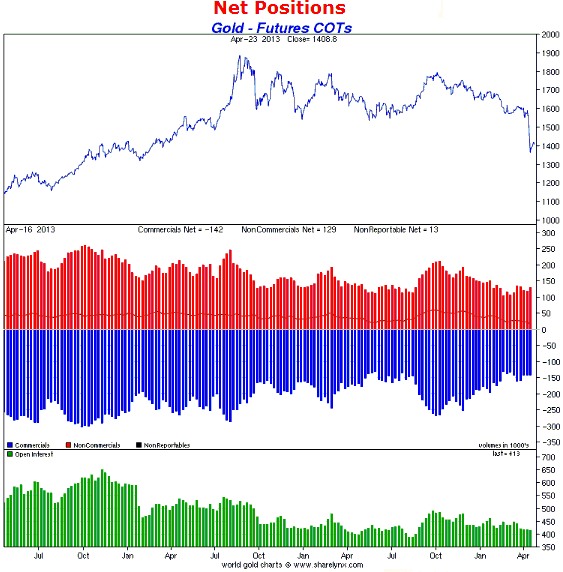
One of the strangest aspects of the recent gold market action is the change, or
rather the lack of change, in the Commitments of Traders (COT) data. As
illustrated by the following chart from
www.sharelynx.com, the net position of commercial traders (the blue bars)
essentially flat-lined over the past three weeks. An implication is that gold's
price crash was not driven to even a minor extent by the liquidation of
speculative long positions in the COMEX futures market.
If the price crash wasn't driven by the US futures market, what was it driven
by?
There's no way to be sure, but aggressive selling of GLD (SPDR Gold Trust)
shares was certainly one of the drivers. We know that this is the case because
the reduction in the amount of bullion held by GLD means that GLD's price fell
faster than the spot price (GLD was a leader to the downside).
Despite popular opinion to the contrary, another likely driver was aggressive
selling of physical bullion. Bullish gold commentators have focused on the surge
in retail demand for physical gold, but the wholesale LBMA (London Bullion
Market Association) is by far the world's largest market for physical gold and
could have been the venue for massive dumping of the physical on the 12th and
15th of April. Ownership to about 21M ounces of physical gold changes hands on
an average trading day on the LBMA, so it's quite possible that more than 50M
ounces ($75B worth) of gold were sold (and bought -- for every seller there must
be a buyer, and vice versa) via the LBMA during the 2-day far-from-average price
crash. To put this into perspective, 50M-ounces is more than 100-times the
MAXIMUM amount of gold that the central bank of Cyprus will sell.
Who would be so desperate to get out of a large physical gold position?
Almost certainly not a central bank, but quite possibly one or more private
banks that suddenly found themselves in need of cash.
By the way, none of the above explains why there was no net liquidation of
speculative longs in the COMEX gold (and silver) futures. Regardless of whether
or not the price decline was led/driven by the futures market, we would have
expected such a large price decline to have been accompanied by substantial
reductions in the speculative net-long and commercial net-short positions. If
anyone has a plausible explanation for why the COMEX positioning was almost
unchanged, we'd like to hear it.
Current Market Situation
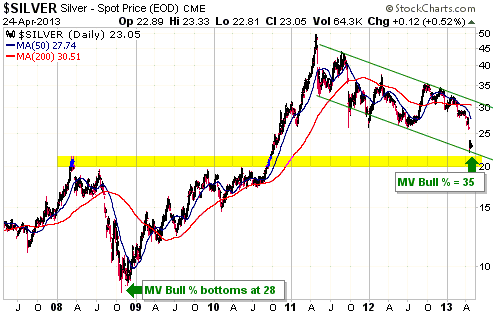
Market Vane's bullish percentage for silver hit a new multi-year low of 35 on
Tuesday 23rd April. This compares to the 10-year low of 28% that was reached
when the silver price was bottoming at around $8.50/ounce at the conclusion of
the 2008 crash. Also, the current sentiment makes a stark contrast with the
bullish percentage of 97 achieved almost exactly two years ago, when absurd
claims that the gold/silver ratio was on its way to 16 or lower were all the
rage and when we were busily accumulating silver put options.
This is what we wrote about silver in a TSI update on 24th April 2011:
"We can be confident about HOW silver's parabolic advance will end (it will
end in a spectacular decline), but we can't be confident about WHEN it will end.
Our guess is that it will end by the middle of next month [May 2011]."
We are almost as enthusiastic about silver's upside potential now as we were
concerned about silver's downside risk two years ago. The difference is that
whereas important tops in the silver market are always characterised by
spectacular up-moves and equally-spectacular downward reversals, important
bottoms often take the form of a lengthy basing pattern. Consequently, a lot of
patience is usually required during the months following an important bottom.
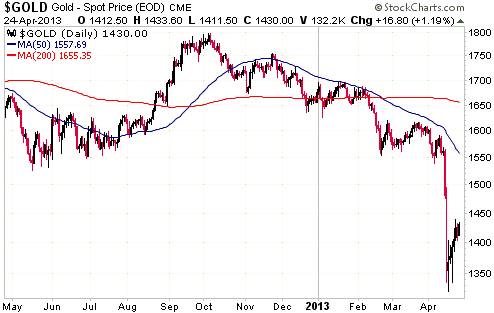
The following daily chart shows that gold has rebounded from last week's low.
That it only took gold a few days to gain about $100 is a reflection of the
extent to which the proverbial beachball had been pushed underwater when the
price was in the $1320s early last week, but the strength of the rebound doesn't
change the most likely scenario. A test of last week's low remains likely.
Gold Stocks
This is the first time we've shown the following weekly chart at TSI. The chart
shows the distance, in percentage terms, of the Barrons Gold Mining Index (BGMI)
from its 200-week moving average. We are showing it today because it helps to
put the recent decline and the current situation into perspective. In
particular, it provides a good way of comparing the current situation to the
major bottoms of the past 50 years. It also shows that over the past 10 years
the gold-mining sector never became anywhere near as extended to the upside as
it did during the 1970s.
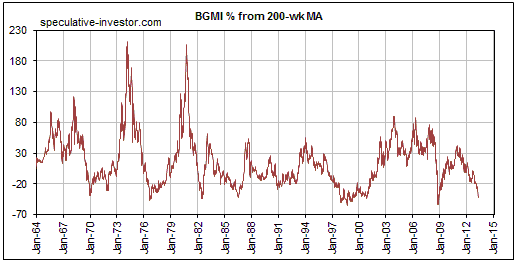
At the end of last week the BGMI was 41.5% below its 200-week MA. This compares
to other major bottoms as follows:
- At the 1970 bottom the BGMI was 39.2% below its 200-week MA
- At the 1976 bottom the BGMI was 46.8% below its 200-week MA
- At the 1982 bottom the BGMI was 43.7% below its 200-week MA
- At the 1986 bottom the BGMI was 41.5% below its 200-week MA
- At the 1998 bottom the BGMI was 55.7% below its 200-week MA
- At the 2000 bottom the BGMI was 43.6% below its 200-week MA
- At the 2008 bottom the BGMI was 53.6% below its 200-week MA
The BGMI's average distance below its 200-week MA at major gold-sector bottoms
over the past 50 years was 46.3%. The range is from 39.2% to 55.7%.
So, last week's BGMI bottom was within the historical range for a major bottom.
Furthermore, at last week's low the HUI was 46% below its 200-week MA, or right
at the long-term average for a rare, major bottom.
Note that for the HUI to roughly match the most extreme bottoms of the past 50
years in terms of distance below the 200-week MA, it would have to fall to
around 215 within the next few weeks. This could be viewed as a measure of the
maximum remaining downside risk, although we think the chance of the HUI getting
that low is remote. We are only mentioning the possibility because the recent
price action makes almost anything seem possible.
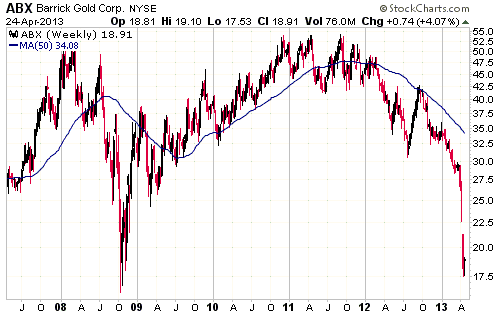
One reason that the chance of a further large decline is remote is that at this
week's low Barrick Gold (ABX), the world's largest gold-mining company, was
trading 57% below its 200-week MA and close to its October-2008 bottom (refer to
the following weekly chart). In order for the HUI to trade well below last
week's low, ABX will have to plunge well below its 2008 crash low. Considering
that the stock market has already priced in a complete write-off of ABX's most
important development-stage project (Pascua Lama) and poor performance from all
the company's other assets, this seems unlikely in the extreme.
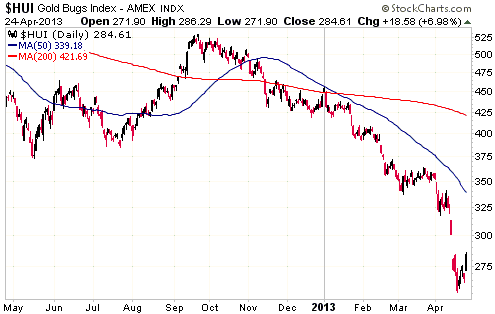
There was a decent rebound in the gold sector on Wednesday 24th April, with the
HUI gaining about 7%. However, no conclusions regarding the sustainability of
last week's low can yet be drawn.
If the HUI is able to build on Wednesday's gain over the final two days of this
week then it will achieve the sort of weekly performance that constitutes
preliminary evidence of an important bottom.
Update
on Stock Selections
Notes: 1) To review the complete list of current TSI stock selections, logon at
http://www.speculative-investor.com/new/market_logon.asp
and then click on "Stock Selections" in the menu. When at the Stock
Selections page, click on a stock's symbol to bring-up an archive of
our comments on the stock in question. 2) The Small Stock Watch List is
located at http://www.speculative-investor.com/new/smallstockwatch.html
 Batero
Gold (TSXV: BAT). Shares: 90M issued, 106M fully diluted. Recent price: C$0.17 Batero
Gold (TSXV: BAT). Shares: 90M issued, 106M fully diluted. Recent price: C$0.17
In last week's Interim Update we mentioned that the stock price of Asanko Gold (AKG)
had dropped to the point (US$2.28) where the company was trading at cash value,
meaning that the company's 5M-oz Esaase gold project was being assigned a value
of zero. BAT is now in the same position, because at the current stock price of
C$0.17 the company's market capitalisation is equivalent to its net cash. In
other words, BAT's 4.5M-oz Batero-Quinchia gold project in Colombia is now being
assigned a value of zero.
BAT.V is a much riskier proposition than AKG, but the current valuation is
absurdly low. The company is fully funded for at least the next 12 months and
has a financially-supportive major shareholder.
Chart Sources
Charts appearing in today's commentary
are courtesy of:
http://stockcharts.com/index.html

|









