- Interim Update 24th October 2018
Copyright
Reminder
The commentaries that appear at TSI
may not be distributed, in full or in part, without our written permission.
In particular, please note that the posting of extracts from TSI commentaries
at other web sites or providing links to TSI commentaries at other web
sites (for example, at discussion boards) without our written permission
is prohibited.
We reserve the right to immediately
terminate the subscription of any TSI subscriber who distributes the TSI
commentaries without our written permission.
Oil Update
Propelled in part by stock
market weakness, the oil price extended its short-term decline during the
first half of this week. In doing so it managed to close below its 200-day
MA for the first time in more than 12 months. The close below the 200-day
MA differentiates the current correction from the relatively minor one
that occurred during July-August.
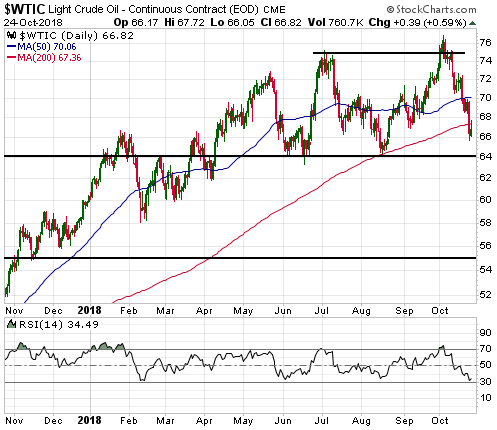
We continue to have lateral support in the mid-$50s in mind as a
short-term downside target, but there is also strong lateral support at
$64 that could soon come into play. We may take PARTIAL profits on USO
January-2019 put options if this support is tested within the next few
days.
A rebound to near $70 would create a new opportunity to place
a short-term bet against oil.
The Stock Market
The US
Recent TSI commentaries have been focused on the US stock market, because
that's where the most significant price action and the best short-term
trading opportunities have been. That's still the case.
We sent
an email to
subscribers in response to Tuesday's market action. Here's an excerpt:
"In the latest Weekly Update we wrote that we expected a decline
to below the 11th October low, either this week or after 1-2 weeks of
additional rebounding/consolidation. On Tuesday 23rd October the SPX
traded well below its 11th October low before recouping almost
three-quarters of its loss and ending the day above the 11th October low.
Also, there was a bullish non-confirmation at Tuesday's intra-day low due
to the NDX holding above its 11th October low.
Based solely on the
price action, the sell-off during the early-going on Tuesday 23rd October
could have been a successful test of the 11th October low and marked the
end of the short-term downward trend that got underway in September.
Arguing against the possibility that a correction low has just been
put in place is the absence of fear. For example, the VIX only got as high
as 24.7 on Tuesday and ended the day at a measly 20.7. Also, there was
only a half-hearted flight to safety evident in the bond and gold markets.
There doesn't have to be obvious evidence of fear prior to a short-term
bottom, but without such evidence the risk of new multi-month lows will be
high.
So, there are bullish signs in the price action and a
sentiment backdrop that suggests the potential for significant additional
weakness. A mixed picture."
The SPX's ability to recover
following Tuesday's brief spike below the 11th October low kept the crash
pattern in play. We'll explain by taking another look at the 1987 price
action.
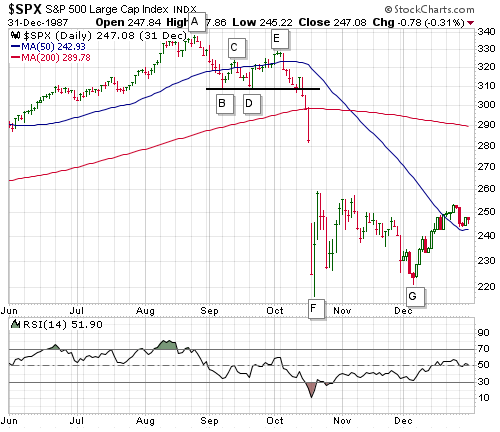
The following daily chart shows the SPX's crash in 1987. On
this chart we have labeled the significant turning points with letters A
through G, beginning with the major high in August.
Notice that the
end of the initial decline from the major high (point B) was proceeded by
a short rebound to point C and then a multi-day decline to point D to test
the initial low. After this successful test of the low there was a
slightly larger/longer rebound to point E and then a decline that turned
into a crash after the low of the initial decline was breached.
The SPX's ability to close above its 11th October low on Tuesday 23rd
October created the possibility that the current market was at the
equivalent of 1987's point D, but this possibility was eliminated by
Wednesday's plunge to a new multi-month low. Paradoxically, Wednesday's
plunge to well below the 11th October low makes it less, not more, likely
that we are dealing with a genuine crash scenario.
Here's a chart
showing the current situation with the significant turning points also
labeled.
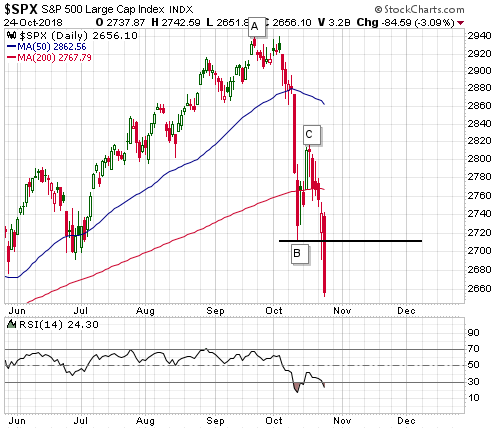
Wednesday's plunge took the SPX down to around 2650, which is a level
we mentioned earlier this month as a potential target for a short-term
bottom. The significance of 2650 is that it is about 10% below the
all-time high reached in September and meaningful SPX corrections tend to
be 10% +/- 2%. For example, the SPX's peak-to-trough decline was 11.1% in
Q1-2018, 12.6% in Q3-2015 and 9.8% in Q4-2014.
There are many
interesting charts that we could use to illustrate the market's current
situation, but we have singled out the three displayed below.
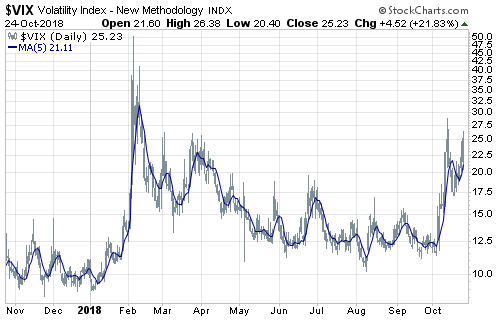
The
first chart shows that despite this week's plunge to a new multi-month
low, the S&P500 Volatility Index (VIX) has only moved up to 25 and the
5-day MA of the VIX is only at 21. Furthermore, it shows that during the
entire downturn to date there has not been a single VIX spike above 30 and
the VIX's 5-day MA has never been above 22. By way of comparison, prior to
the end of the Q1-2018 correction the VIX spiked up to 50 and the VIX's
5-day MA moved above 30.
Note that the VIX doesn't measure current
volatility, it measures the volatility implied by the prices of S&P500
options. In effect, it is a measure of the future market volatility
expected by options traders. It is also a fear gauge, because the more
concerned that options traders become about the market's short-term
downside risk the more these traders bid-up the prices of put options.
In essence, the VIX's message is that the general level of fear in the
market has not yet approached the level that tends to be seen near the
bottom of a significant correction.
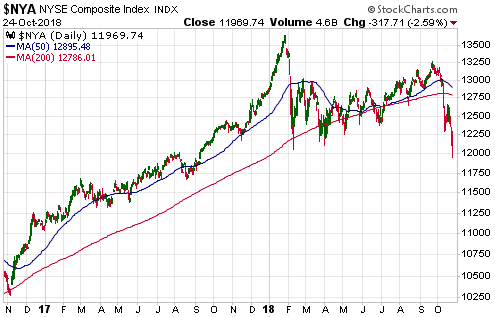
The second chart shows the NYSE Composite Index (NYA), one of this
year's weakest US stock indices. For the NYA, the 7-month rebound from the
February-2018 low ended well below the January-2018 high and the
February-2018 low has just been breached. This broad equity index is now
at a 12-month low.
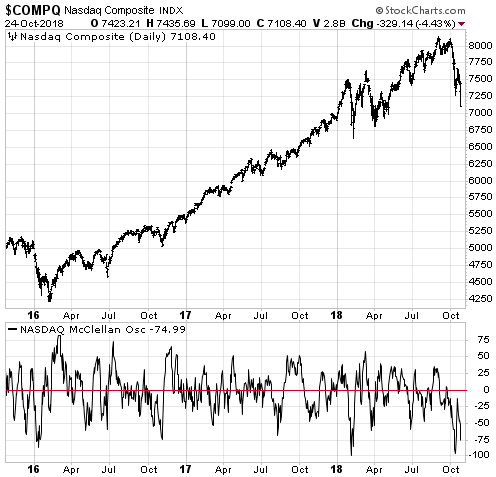
The third chart shows the NASDAQ Composite Index (COMPQ) and the
NASDAQ McClellan Oscillator (MO).
Here's what we wrote on this
topic in the 15th October Weekly Update:
"The NASDAQ McClellan
Oscillator (MO), which is shown in the bottom section of the following
daily chart, got close to its lowest level in 5 years on Thursday 11th
October. This probably means that the low for the NASDAQ MO is either in
place or will be put in place within the next couple of trading days.
Extreme lows for the NASDAQ MO sometimes coincide with extreme lows
for the NASDAQ Composite Index, but it's more common for the MO extreme to
precede the price extreme."
The following chart shows that we
now have COMPQ well below its 11th October low and the NASDAQ MO still
above its 11th October low. This is the sort of non-confirmation by the MO
that has regularly occurred at correction lows in the past.
The upshot is that it is still a mixed picture, with sentiment
suggesting that a sustainable low is NOT in place, the price action
bearish but stretched to the downside, and at least one measure of market
breadth (the NASDAQ MO) suggesting that a short-term price bottom is very
near.
We think that the near-term downside risk is defined by the
Q1-2018 low, which means about 100 points for the SPX. At the same time,
there is at least 100 points of near-term upside potential, so we
certainly wouldn't be adding bearish speculations into the hole here.
In the Market Alert Email sent earlier this week we noted that we had
taken profits on about two-thirds of our SPY December-2018 put options
during the first hour of trading on Tuesday and would exit the rest of our
puts if the market plunged anew on Wednesday or Thursday. The market has
plunged anew, so unless there is a big rally at the start of trading we
will exit the balance of our SPY put options during the first hour of
Thursday's session.
China Reversal
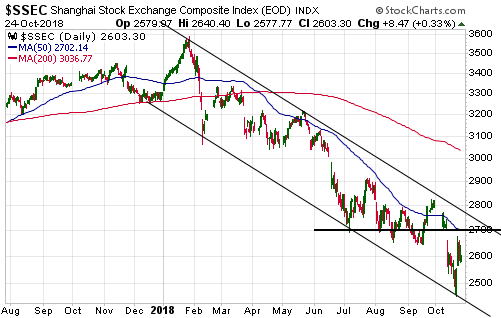
There
has been a definitive upward reversal in the Shanghai Stock Exchange
Composite Index (SSEC). The reversal occurred last Friday and was
confirmed via impressive follow-through to the upside on Monday of this
week. Further confirmation would come from a daily close above 2700.
As is often the case when it comes to China's financial markets, the
turnaround was engineered by the government. However, this doesn't make it
more likely to fail. In fact, the belief that the government is 'behind'
the stock market can fuel sufficient speculation in China to bring about a
substantial rally.
Now, Xi Jinping has made it clear that he
dislikes stock market and property market speculation. Therefore, a major
stock market rally is almost certainly not the aim of the recent
government intervention in China's stock market.
As far as we can
tell, the main reason for the intervention is that declining share prices
were creating widespread collateral deficiencies due to shares having been
pledged as security for loans. In effect, there was the potential for a
giant margin call that would have adverse ramifications well beyond the
stock market.
Also, although Xi probably doesn't care about the
level of the stock market beyond the risk of the economy-wide margin call
mentioned above, he would be well aware that his US counterpart places
great importance on stock market performance and has pointed to the SSEC's
relatively dismal performance as evidence that China's economy is in big
trouble. Boosting the stock market therefore could improve the hand that
China's government is perceived to hold in future negotiations with the US
government.
China's economy actually is in big trouble, but the
trouble is not related to Trump's tariffs. The tariffs and
counter-measures are going to make life more difficult for businesses and
individuals in both China and the US, but up until now their overall
economic impact has been small. This is due to the front-running of the
tariffs by importers and exporters on both sides of the Pacific. Thanks to
this front-running, last month China's exports were up by 14.5%
year-over-year and the trade surplus with the US was a record-high $34.1B.
The big trouble for China's economy is a long-term issue that stems
from 12 years of massive mal-investment in unoccupied buildings and
unneeded infrastructure. Realigning China's economy with economic reality
will involve either the mother-of-all collapses or, more likely, at least
a decade of virtual stagnation.
Gold and the Dollar
Gold
In
response to the stock market turmoil, credit spreads have shifted in
gold's favour and are now in a short-term widening trend. This means that
one of the inputs to our gold model has just switched from bearish to
bullish. However, the overall fundamental backdrop remains gold-bearish.
We therefore should remain circumspect with regard to gold's short-term
upside potential.
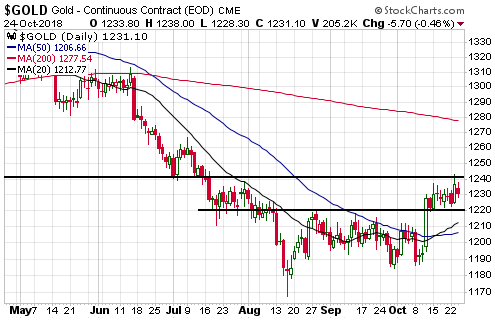
Over the past 7 trading days the US$ gold price
consolidated between support at $1220 and resistance at $1240. A daily
close below $1220 should now be viewed as a warning that the rally is
over, while a daily close above $1240 would pave the way for a quick rise
to the vicinity of the 200-day MA in the $1275-$1280 range.
The
above-mentioned range continues to be a reasonable target for the rebound
that got underway in August.
Silver
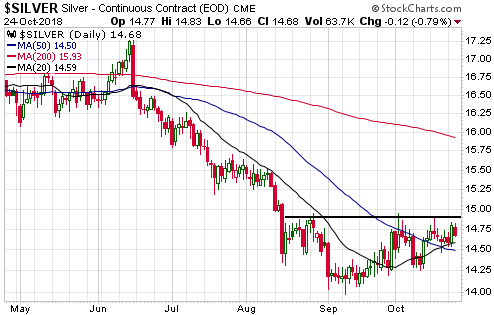
The silver market still appears to be
coiling in preparation for a quick move up to the $15.60-$16.00 range.
Gold Stocks
The gold-mining sector is the only
equity sector capable of bucking a major downward trend in the broad stock
market, but if the stock market decline becomes crash-like then gold
stocks usually will get taken down with other equities even if the gold
price is rising. The reason is that when equity investors/traders are in
panic mode they sell whatever they can.
The broad stock-market
decline of the past several weeks has been accompanied by a rebound in the
gold-mining sector. We doubt that the rebound is over, but we aren't
expecting a lot more upside prior to a short-term top. For GDX (see chart
below), resistance near $21.00 is the target we've had in mind from the
start.
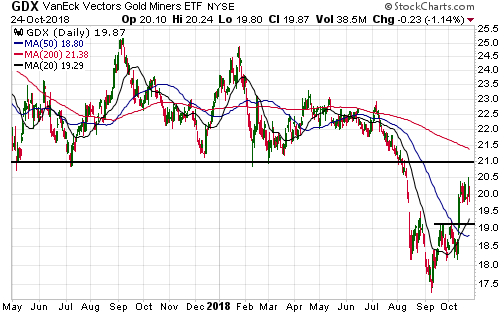
$21.00 is a rough guideline based on an obvious resistance level.
However, similar obvious resistance for the HUI lies at 170, and if the
HUI's current rebound stretches as far as 170 then GDX's rebound should
extend to around $22.00 (assuming the same percentage increases for GDX
and the HUI). Therefore, we won't be surprised if GDX tops closer to $22
than $21.
With regard to managing the risk that the gold-mining
sector's rebound ends lower than expected, we think it makes sense to use
a daily GDX close below its 20-day MA as a bearish warning. This MA is now
at $19.29 and is rising.
Updates on Stock Selections
Notes: 1) To review the complete list of current TSI stock selections, logon at
http://www.speculative-investor.com/new/market_logon.asp
and then click on "Stock Selections" in the menu. When at the Stock
Selections page, click on a stock's symbol to bring-up an archive of
our comments on the stock in question. 2) The Small Stock Watch List is
located at http://www.speculative-investor.com/new/smallstockwatch.html
 Kidman
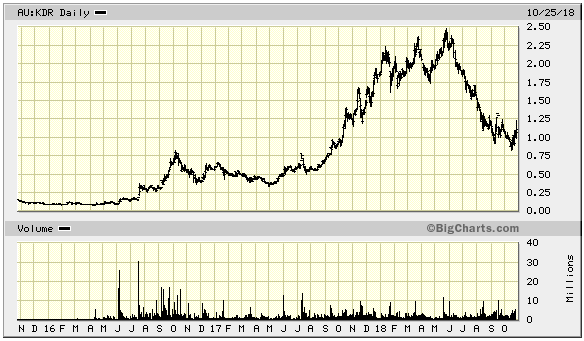
Resources (ASX: KDR). Shares: 400M. Recent price: A$1.07
Kidman
Resources (ASX: KDR). Shares: 400M. Recent price: A$1.07
This is a stock we have mentioned a couple of times in the past as a
speculative play on lithium. The company is developing the Mt Holland
lithium project in Western Australia as part of a 50/50 JV with SQM, the
world's second-largest lithium producer. SQM's stamp of approval is an
important part of the bullish KDR story.
KDR.AX became a lot more
interesting on Monday of this week due to the release of new economic
studies. Specifically, the combination of the updated Mt Holland lithium
mine PEA and the Kwinana Lithium Refinery PFS indicated that:
1)
The mine will produce spodumene concentrate that will be transported 845
kms to the refinery and processed to create about 45K t/y (tonnes per
year) of battery-grade lithium hydroxide (LiOH) over a mine life of 47
years.
2) The combined capital cost of the mine and the refinery
is estimated to be US$601M.
3) The combined project is estimated to
have a post-tax NPV(10%) of US$2.3B and a post-tax IRR of 27.7% at an
assumed LiOH price of US$15.1K/tonne. This price is slightly below the
current spot price.
4) A Final Investment Decision is expected
during the first half of next year.
The above figures are for 100%
of the project, so KDR's 50% stake is estimated to have a post-tax
NPV(10%) of US$1.15B (A$1.6B). This compares extremely well with KDR's
current market cap of A$428M.
KDR's balance sheet looks weak, in
that the company had a working capital deficit of A$8.5M at 30th June.
However, as part of the JV agreement SQM will have to pay an additional
US$25M directly to KDR and US$60M into the JV. Also, it was announced
today that SQM will be helping KDR meet its capex funding obligations by
providing its partner with a US$100M credit facility at a very reasonable
interest rate (6-month LIBOR plus 2%).
Due to space limitations we
aren't going to add KDR to the TSI Stocks List at this time (the current
number of long-term positions in the List is at our self-imposed limit of
15), but we bought half a position for our own account at A$0.99 on 24th
October. We are hoping that stock market volatility over the coming month
will create a good opportunity to buy the other half.
Realised gains/losses on options
Two option
positions in the TSI List recently expired or were exited.
First,
the QQQ October-2018 $150 Put Option expired worthless last Friday.
Second, as noted in the
Market Alert
Email sent to subscribers earlier this week, the GFI January-2019
$3.00 Call Option was exited for a 200% gain.
Chart Sources
Charts appearing in today's commentary
are courtesy of:
https://stockcharts.com/
http://bigcharts.marketwatch.com/