|
- Interim Update
25th February 2015
Copyright
Reminder
The commentaries that appear at TSI
may not be distributed, in full or in part, without our written permission.
In particular, please note that the posting of extracts from TSI commentaries
at other web sites or providing links to TSI commentaries at other web
sites (for example, at discussion boards) without our written permission
is prohibited.
We reserve the right to immediately
terminate the subscription of any TSI subscriber who distributes the TSI
commentaries without our written permission.
Oil's
Bottoming Process
Here's part of what we wrote about oil a few weeks ago in our
2015 forecast for industrial commodities:
"We expect that oil will soon turn upward on a sustained basis
relative to industrial metals such as copper, but that in US$ terms
and relative to gold a sustained up-turn won't get underway until
the second half of this year. In US$ terms, we expect that during
the first half of the year the oil price will build a base, with the
likely pattern involving a rebound during the first quarter followed
by a second-quarter test of the January bottom."
One of the two reasons we gave for believing that it was too early
to start speculating on a sustained turn to the upside in the US$
oil price was that speculators in oil futures hadn't yet
capitulated. The second reason was that although there had been a
large decline in the quantity of US drilling rigs over the preceding
three months, US oil production hadn't yet begun to decline. These
reasons remain in place, as speculators still haven't capitulated
and US oil production has continued to rise as producers try to
offset the impact of a lower price per barrel by ramping up the rate
at which they produce new barrels.
There is another reason for believing that it is too early to start
speculating on a sustained upward reversal in the US$ oil price.
This reason wasn't mentioned in our 2015 forecast, but was mentioned
in an earlier commentary. We are referring to oil's bottoming
process following previous price crashes.
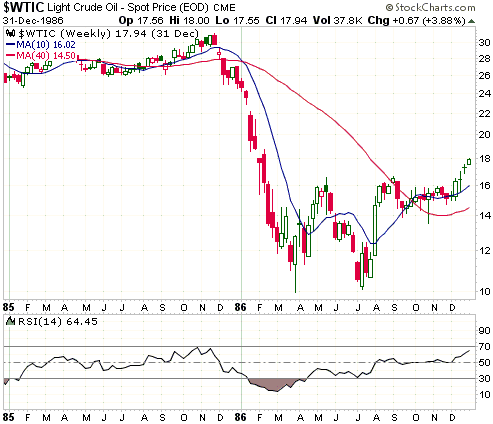
In terms of price action, the closest parallel to the recent
collapse is oil's performance during 1985-1986. As illustrated by
the weekly chart displayed below, the crash in the oil price that
occurred during the final quarter of 1985 and the first quarter of
1986 was followed by a 2-month rebound and then a decline to test
the crash low. A sustained upward reversal happened after the crash
low was tested.
Another potential road map is oil's performance during 2008-2009. In
this case the crash low was followed by a 2-week rebound and then a
decline to a marginal new low. Here is the relevant weekly chart.

The time between the crash low and the test of the low was about 3.5
months in 1985-1986 and 7 weeks in 2008-2009. The point is that
oil's performance following its two most similar crashes of the past
40 years projects a test of the January-2015 crash low prior to a
sustained turn to the upside.
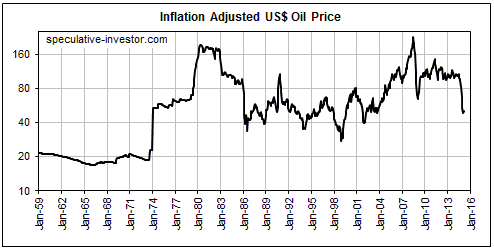
We favour the 1985-1986 comparison, because when we look at oil's
inflation-adjusted (IA) performance the 2008-2015 period looks
similar to the 1980-1986 period. Our updated monthly chart of the IA
oil price is displayed below.
As noted in our 2015 forecast, our calculations of
inflation-adjusted performance suggest maximum downside risk during
the first half of this year to the mid-$30s -- the current-dollar
equivalent of the major price bottom in 1986. We do not expect the
oil price to fall that far, but such an outcome cannot yet be ruled
out.
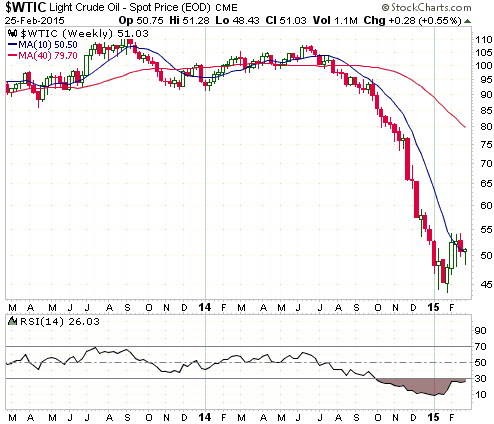
Here is a weekly chart showing the current situation. So far, the
crash low has been followed by a 2-3 week rebound to the vicinity of
the 10-week moving average (the blue line on the chart) and then a
pullback. If the bottoming process turns out to be similar to 2009
then the price will drop to a new low in March, after which there
will be an intermediate-term rally. However, if the bottoming
process turns out to be similar to 1986 then the rebound from the
January low will probably extend into March and be followed by a
decline to test the low during the second quarter of the year.
Finally, it could be argued that the supply/demand fundamentals are
more bearish now than they were in 2009 or 1986, which is
essentially what the people who are predicting $20/barrel or lower
are saying. In our opinion, these people are kidding themselves. For
a long time the oil market ignored an increasingly bearish
commercial supply/demand backdrop, but now every analyst and his dog
is well versed in all the reasons to expect the price to fall
further and remain at a low level indefinitely. In other words, the
bearish supply/demand situation is very much 'in' the price, which
is why the January low will probably turn out to be close to the
ultimate bottom.
The Stock Market
Europe
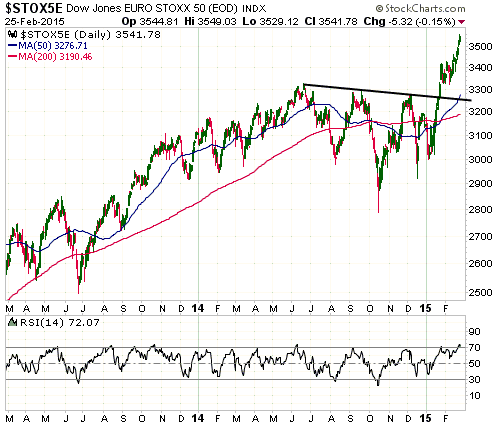
The EURO STOXX 50 Index (STOX5E), the European equivalent of the US Dow
Industrials Index, broke out to the upside in mid-January and has since moved
higher with only a minor pullback. It is now short-term 'overbought' and likely
to commence a downward correction in the near future. Note that a routine
correction from whatever high is made over the next week or so would take the
price back to around 3300.
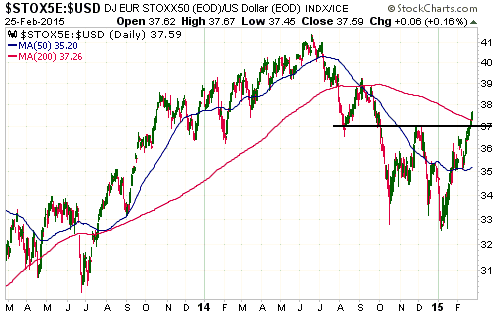
The STOX5E is euro-denominated, so the weakness in the euro is partly
responsible for the rally in the STOX5E's nominal price. However, the following
chart shows that since early-January of this year the STOX5E has also been
rallying in US$ terms. The STOX5E/US$ ratio remains well below last year's high,
but it has just broken above significant lateral resistance and its 200-day MA.
This is an example of how monetary inflation causes the distortion of relative
prices, resulting in some prices making REAL gains in response to the inflation.
It is called the
Cantillon Effect.
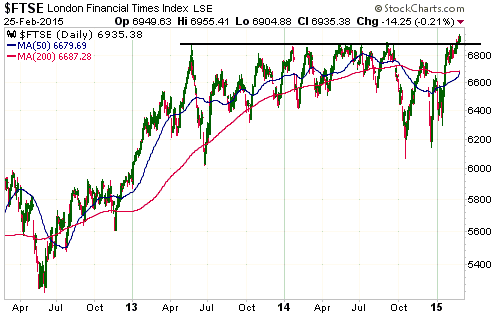
The performance of London's FTSE Index over the past three years is strangely
similar to the performance of Japan iShares (EWJ) over the same period. In
particular, both rallied strongly from mid-2012 through to mid-2013 and then
began oscillating within a wide horizontal range. In the latest Weekly Update we
mentioned that EWJ had just poked its head above the ceiling that had been in
place since mid-2013. This week, the FTSE has done the same.
It will be interesting to see if the FTSE can build on and sustain its upside
breakout.
With the US stock market 'overbought' over every timeframe and with the European
and Japanese stock markets short-term 'overbought', the stage is set for a
significant global stock-market decline to begin during the first half of March.
The Coal Opportunity
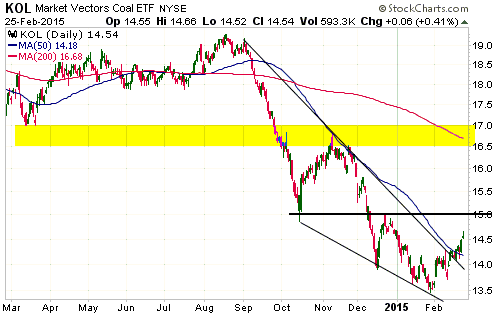
In the 16th February Weekly Update we wrote that a long position in the Market
Vectors Coal ETF (KOL) was a speculation worth considering.
More evidence has since emerged that KOL has bottomed on a short-term basis and
possibly on a long-term basis. We are mainly referring to the break above the
50-day MA, which differentiates the current rebound from the counter-trend
rebound that occurred during October-November of last year.
In our opinion there is less downside risk and more upside potential in the coal
sector than in the oil sector.
Gold and the Dollar
Gold
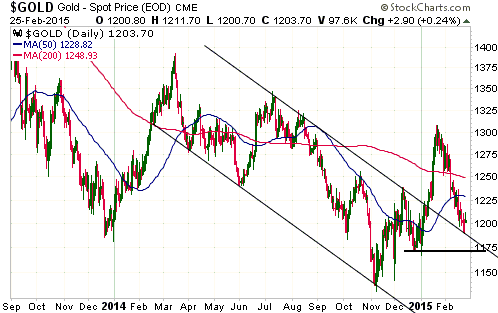
The US$ gold price was essentially unchanged over the first three trading days
of this week, although there was an intra-day spike down to the low-$1190s.
Our impression is that gold's correction has done as much as it needed to do (in
US$ terms, but not in terms of the euro and some other currencies), but this
doesn't imply that the correction is over. We suspect that a short-term bottom
is either in place or will be put in place next week, after which there will be
a multi-week rally that results in a lower high for the year in gold bullion and
a higher high for the year in the HUI.
Platinum
Almost every article that Mineweb journalist
Lawrence Williams writes about the gold market is abysmal, but, giving
credit where credit is due, this week he posted a
well-researched article about the platinum market. The article contains some
useful facts about platinum and clearly explains why the price of this metal
fell over the past 12 months despite a superficially bullish supply/demand
backdrop.
Unlike the gold market, where changes in mine supply are trivial relative to
total supply (and therefore to price), the platinum market tends to live 'hand
to mouth'. This means that current platinum demand is mostly satisfied by recent
mine production and that a significant reduction in the current year's
production can legitimately be viewed as bullish for the platinum price. That's
why many analysts were bullish on the platinum price at the beginning of last
year. They could see that newly-mined platinum supply was going to fall well
short of demand over the year ahead.
However, what everyone sees in the markets is often not worth seeing. As pointed
out in the above-mentioned article, there was a large build-up of platinum
stockpiles ahead of, and obviously in anticipation of, the supply issues
(primarily, last year's long strike in South Africa's platinum mining industry)
that caused 2014 mine production to fall well short of demand. In other words,
what was obvious to the analysts making bullish price forecasts had previously
become obvious to the major consumers and producers of platinum. The consumers
and producers took steps to mitigate the mine production shortfall the
'everyone' knew was coming, which is why the price didn't do what many analysts
expected.
The World Platinum Investment Council (WPIC) estimates that the aboveground
platinum stockpile was 4.14M ounces at the end of 2013 and that the mine-supply
deficit caused the stockpile to fall to 2.56M ounces at the end of 2014. 2.56M
ounces is enough to cover another 1-2 years during which mine supply falls well
short of industrial demand, but the industry will want to retain a sizeable
buffer. It is therefore not reasonable to assume that the current stockpile will
result in a lacklustre market for a long time to come.
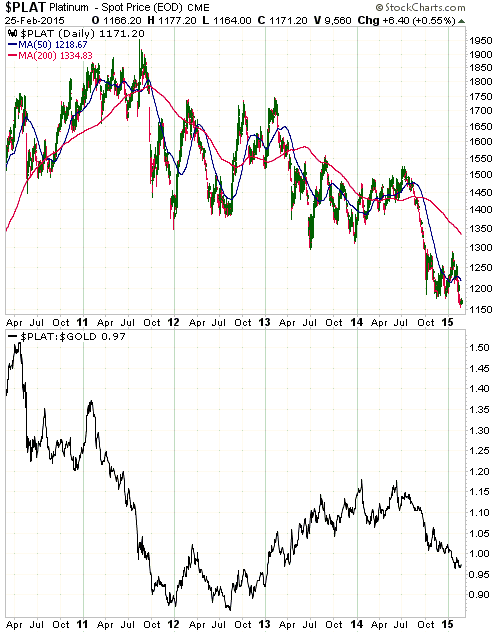
A year ago we were not bullish on platinum, especially not relative to gold, but
it is now at a price level in dollar terms and relative to gold where our
interest is piqued. In particular, we reiterate this comment from the 6th
October 2014 Weekly Update: "We will probably be interested in adding some
exposure to platinum (the metal, not the mining stocks) if it drops to a 5%-10%
discount to gold." As evidenced by the bottom section of the following chart,
platinum is now trading at a 3% discount to gold. It is therefore almost cheap
enough on a relative basis.
Gold Stocks
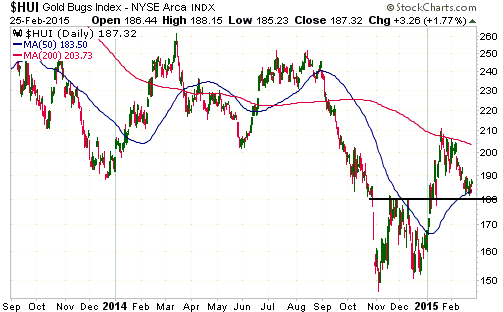
The HUI has continued to hold above support at 180, which is what it needed to
do to maintain the potential for the next multi-week rally to make a new high
for the year. It has also remained above its 50-day MA, which is now at 183.5
and rising.
We expect the next multi-week rally to begin in early-March.
The Currency Market
Since peaking on 23rd January (the day after the ECB introduced its QE program),
the Dollar Index has oscillated within an increasingly narrow range. Not
surprisingly, given that the USD/EUR exchange rate is about 60% of the Dollar
Index, while the Dollar Index has recently been oscillating within a narrowing
range near a multi-year high the euro has been oscillating within a narrowing
range near a multi-year low.
The following daily chart shows the Dollar Index's narrow, contracting range. It
will soon have to break out of this range, one way or the other.
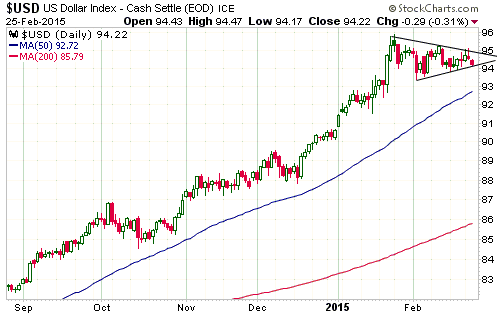
Our view is that the Dollar Index is close to a high that will hold for at least
a few months, but the price action leaves open the possibility that the January
high will be tested or marginally exceeded prior to the start of a meaningful
(5-10 point) decline.
Updates
on Stock Selections
Notes: 1) To review the complete list of current TSI stock selections, logon at
http://www.speculative-investor.com/new/market_logon.asp
and then click on "Stock Selections" in the menu. When at the Stock
Selections page, click on a stock's symbol to bring-up an archive of
our comments on the stock in question. 2) The Small Stock Watch List is
located at http://www.speculative-investor.com/new/smallstockwatch.html
Chart Sources
Charts appearing in today's commentary
are courtesy of:
http://stockcharts.com/index.html

|









