|
- Interim Update
25th March 2015
Copyright
Reminder
The commentaries that appear at TSI
may not be distributed, in full or in part, without our written permission.
In particular, please note that the posting of extracts from TSI commentaries
at other web sites or providing links to TSI commentaries at other web
sites (for example, at discussion boards) without our written permission
is prohibited.
We reserve the right to immediately
terminate the subscription of any TSI subscriber who distributes the TSI
commentaries without our written permission.
A
reliable long-term commodity trend indicator
The EEM/SPY ratio (the Emerging
Markets ETF relative to the S&P500) has a remarkably good record
over almost 20 years of signaling intermediate- and long-term trend
changes in commodity prices. The record is illustrated by the
following weekly chart, the top section of which shows the EEM/SPY
ratio with its 70-week MA and the bottom section of which shows the CRB Index.
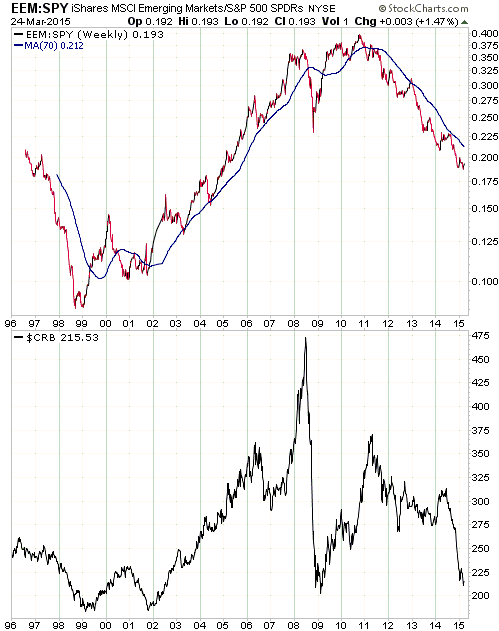
It is clear that since the mid-1990s, which is when EEM came into
existence, emerging-market equities have been strong relative to US
equities when commodity prices were trending upward and weak
relative to US equities when commodity prices were trending
downward. Moreover, the relative strength of the emerging-market
equity world has tended to reverse direction ahead of important
(intermediate-term and long-term) turning points in the commodity
world. This increases the usefulness of the EEM/SPY ratio.
In the past the EEM/SPY ratio crossing from above to below its
70-week MA has been a reliable signal that the commodity trend was
turning down on at least an intermediate-term basis, and the
opposite MA crossover has been a reliable signal that the commodity
trend was turning up on at least an intermediate-term basis. Here
are some examples:
1) EEM/SPY's cross from below to above its 70-week MA during the
first half of 1999 signaled an end to the commodity bear market of
the 1990s.
2) EEM/SPY's cross from above to below its 70-week MA in mid-2000 signaled that the CRB Index would have to test its bear-market low
prior to the start of a major rally.
3) EEM/SPY's cross from below to above its 70-week MA in late-2001 signaled the start of a major CRB rally. EEM/SPY subsequently
remained above this MA until mid-2008, which was just prior to the
start of the commodity crash prompted by the Global Financial
Crisis.
4) Consistent with the bearish trend in commodity prices, EEM/SPY
has steadfastly remained below its 70-week MA since early-2011.
If history is a guide, the EEM/SPY ratio's next cross from below to
above its 70-week MA will likely happen near the start of a
commodity rally that lasts at least 12 months. Consequently, it will
probably make sense NOT to be aggressively bullish on non-monetary
commodities and the related equities until after EEM/SPY
accomplishes such a crossover.
It's a different situation with the monetary commodities (gold and
to a much lesser extent silver), although gold is sufficiently
expensive relative to commodities in general that an
intermediate-term commodity rally will probably have to be underway
before gold makes a sustained move above $1350.
Just to be clear, the US$ gold price could easily rebound to its
200-day MA (around $1240) or even as far as $1300 based on its own
sentiment situation and fundamentals, but, as we pointed out in a
blog post earlier this week, gold's price should never be
completely 'out of whack' with the prices of most other commodities.
In the absence of a significant general increase in commodity
prices, a gold price above $1350 would be completely 'out of whack'.
It could happen in reaction to a financial/banking crisis, but it
wouldn't be sustainable.
The copper bottom, revisited
In the latest Weekly Update we discussed the
surge in the copper price to a 2-month high and the impressive upward reversal
in the Industrial Metals Index (GYX). Then, after copper and GYX held onto last
week's gains over the first two days of this week, we discussed copper's
relatively high price (high, that is, compared to the prices of other
non-monetary commodities) in a
post at the TSI Blog.
We're spending a lot more time than usual on the copper market, which is not a
primary focus of ours, because something strange is happening there and in some
of the other base-metal markets. By strange we mean that the price action is at
odds with the superficial fundamentals. This could be because the supply/demand
fundamentals are considerably more bullish than they appear to be on the
surface, or it could be because a major player in the market is trying to create
the false impression that the fundamentals are more bullish than they appear.
Although the COMEX futures market is not as significant for copper as it is for
gold, we think that the Commitments of Traders (COT) situation in COMEX copper
futures sheds some light on what's behind the recent price action.
In January of this year the Commercial net-long position in COMEX copper futures
was much higher than it had ever been. Putting it another way, in January of
this year the total Speculative net-short position in COMEX copper futures was
much higher than it had ever been. Here's a chart from
Sharelynx.com covering the past 9 years
that clearly shows the recent position extremes.
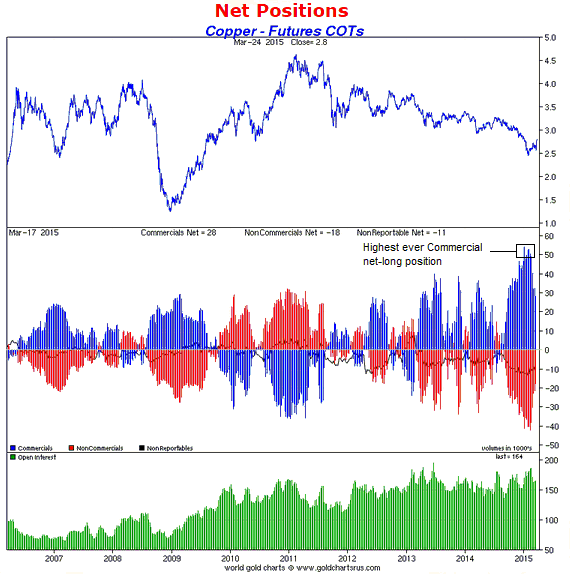
If the COMEX situation is representative of what's happening around the world,
then speculators, as a group, have been massively short copper, making the
copper market acutely vulnerable to a short squeeze. It seems that the squeeze
began in late-January and ramped up a couple of notches last week.
Over the past few years, rebounds in the copper price have ended at around the
time that the Commercials and the Speculators became approximately 'flat'
(neither long nor short). That could now be the case, as the positions shown on
the above chart are based on 17th March COT data (the latest available data at
this time) and therefore don't reflect the effects of the price surge of the
past several days.
We wait with bated breath for the next set of COT numbers (due on Friday) and
will include an updated chart in the next TSI commentary.The Stock Market
From the latest Weekly Update:
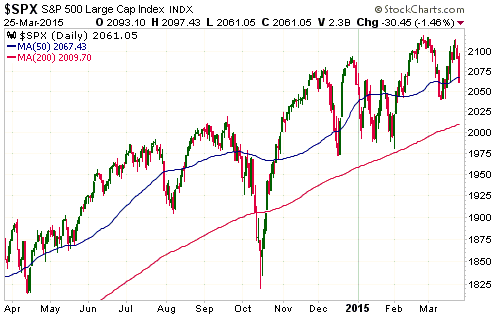
"It's possible that the S&P500 Index (SPX) peaked in late-February, suffered
an initial decline, and is now testing its peak prior to suffering a much larger
decline. This is the short-term scenario that we favour, but there are obviously
other possibilities. The good news is that we should find out this week if our
favoured scenario is valid, because this scenario will be rendered invalid
unless the SPX reverses lower within the coming few days without making
significant additional headway. That makes risk management straightforward for
any bearish speculations."
The SPX subsequently reversed lower without making significant additional
headway. This doesn't prove that our favoured short-term scenario is correct; it
means that the market did what it needed to do to avoid invalidating our bearish
scenario.
To stay on the expected path, the SPX will have to close below its early-March
low within the next several days. Also, the expected path involves a decline to
well below the 200-day MA within the coming four weeks.
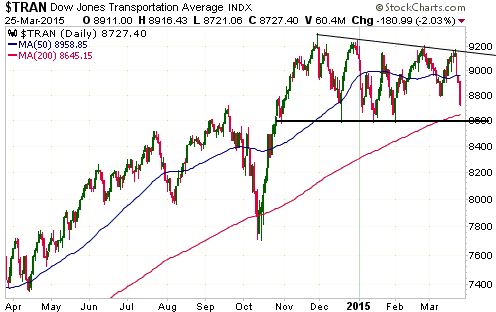
The Dow Transportation Average (TRAN) has been one of the weakest US stock
indices since late last year. As a consequence, TRAN should be one of the first
indices to provide clear-cut evidence that something more than a routine
short-term consolidation is taking place in the US stock market. Such evidence
would come in the form of a daily close below lateral support at 8600.
Gold and the Dollar
Gold
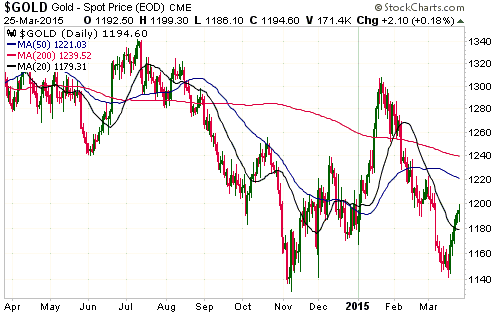
More evidence emerged over the first three days of this week that the US$ gold
price successfully tested its November-2014 low last week and is now immersed in
a multi-week rally. The 200-day MA (near $1240) is a reasonable upside target
for this rally.
Note that as part of the aforementioned rally there could be at least a week of
consolidation in the $1175-$1205 range. That's not a forecast, it's just an
acknowledgement that the gold price is unlikely to go from last week's low of
around $1140 all the way up to $1240 in a straight line. Although if it does go
there in a straight line, we won't complain.
Gold's current rebound is largely a reaction to an 'oversold' extreme, but it is
being helped along by a turn for the better in some fundamental drivers of the
gold price. For example, over the past week there has been a small but
significant decline in US real interest rates and a downward reversal in the BKX/SPX
ratio.
Gold Stocks
Thanks to the high level of the gold/oil ratio and gold's strength in non-US$
terms, gold-mining fundamentals are more supportive than they have been in over
two years. That's especially the case for gold miners operating outside the US.
However, it would be an understatement to say that the bullish fundamentals are
not being reflected in the price action.
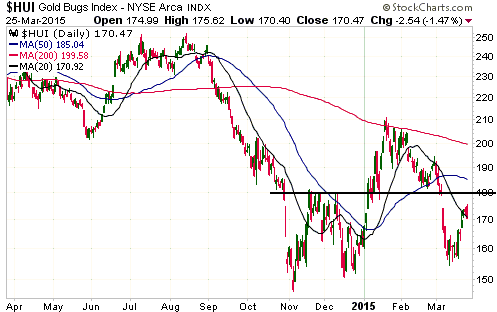
The HUI has rebounded over the past six trading days, but the rebound has been
unimpressive considering that it began from an oversold extreme and from just
above important support defined by last year's low. In particular, it hasn't yet
achieved a decisive break above the 20-day MA or generated sufficient upside to
test the first lateral resistance level of significance (180). We think that
additional gains will be made over the next 2-4 weeks, though, because the
bullion market looks set to maintain its recent upward bias.
The Currency Market
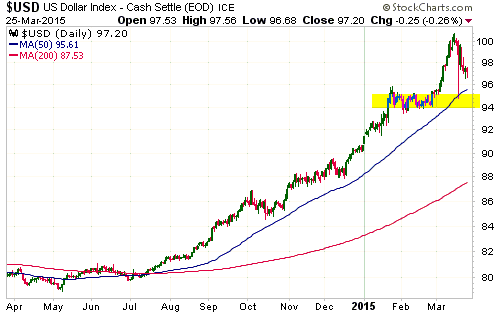
The dramatic downward spike in the Dollar Index in reaction to a few words from
the Fed on Wednesday 18th March ended within a range of support defined by the
January-February consolidation. It will take a daily close below this support
range to confirm that a multi-month top is in place. However, confirmation of a
top (or a bottom) will often come too late to have practical value. For example,
if the Dollar Index closes below 94 within the next few weeks it will remove any
remaining doubt that a multi-month top is in place, but at that point the price
decline will probably be closer to an end than a beginning.
We are working under the assumption that a multi-month top is in place and that
a decline to the vicinity of the 200-day MA (88-90) is in progress. The biggest
threat to this assumption is the small probability that Greece will be forced to
leave the euro-zone. News that the euro-zone was losing one of its members could
create enough turmoil and enough demand for the perceived safety of the US$ to
propel the Dollar Index to a new high for the year. The same news would probably
also cause the gold price to shoot upward in both euro and US$ terms, along the
lines of what happened during the first three weeks of January.
Updates
on Stock Selections
Notes: 1) To review the complete list of current TSI stock selections, logon at
http://www.speculative-investor.com/new/market_logon.asp
and then click on "Stock Selections" in the menu. When at the Stock
Selections page, click on a stock's symbol to bring-up an archive of
our comments on the stock in question. 2) The Small Stock Watch List is
located at http://www.speculative-investor.com/new/smallstockwatch.html
Chart Sources
Charts appearing in today's commentary
are courtesy of:
http://stockcharts.com/index.html

|









