- Interim Update 25th March 2020
Copyright
Reminder
The commentaries that appear at TSI
may not be distributed, in full or in part, without our written permission.
In particular, please note that the posting of extracts from TSI commentaries
at other web sites or providing links to TSI commentaries at other web
sites (for example, at discussion boards) without our written permission
is prohibited.
We reserve the right to immediately
terminate the subscription of any TSI subscriber who distributes the TSI
commentaries without our written permission.
Potential platinum
supply shock
Commodity supply disruptions
resulting from measures implemented to prevent the spread of the
coronavirus could lead to huge price rises in some commodities, especially
since supply disruptions will collide with government efforts to stimulate
demand. The platinum market could be affected more than most, for two
reasons.
The first reason is that earlier this week the
South African government announced a 21-day lock-down commencing at
midnight on 26th March. This means that for the next three weeks all of
the country's mines will be closed. Since South Africa (SA) produces about
75% of the world's platinum, this will be a significant supply disruption
for the platinum market (unlike the gold market, current mine supply is
critical to total supply in the platinum market). Furthermore, a
significant supply disruption could turn into a major supply shock if the
lock-down is extended.
As an aside, something similar could happen
in the copper market due to the temporary closure of mines in Chile and
Peru. About 30% of the world's copper production comes from Chile and
another 10% comes from Peru.
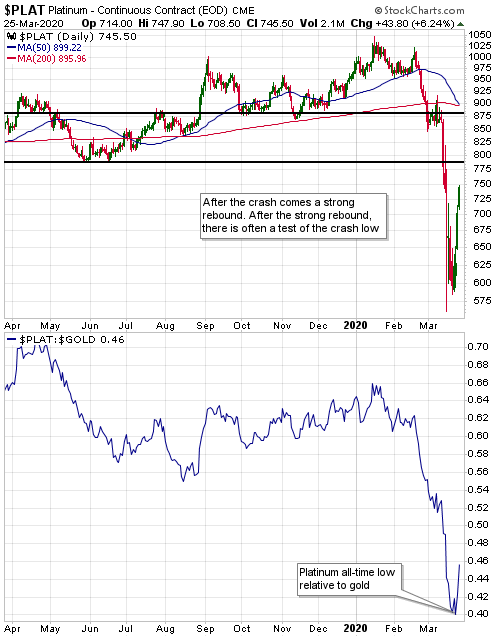
The second reason is the extent to
which the platinum price was beaten down over the past month. In addition
to hitting a 17-year low in dollar terms and an all-time low in gold
terms, platinum traded at its lowest price in more than 20 years relative
to the Industrial Metals Index (GYX).
We suspect that platinum's
relative cheapness combined with its supply vulnerability will result in
the metal trading at a MUCH higher price within the coming 12 months. In
the short-term, the sort of price crash experienced by platinum over the
past several weeks typically would be followed by a strong rebound and
then a pullback to test the crash low.
The TSI List has exposure to
platinum via PPLT (the Physical Platinum ETF), which was added early last
week.
The Stock Market
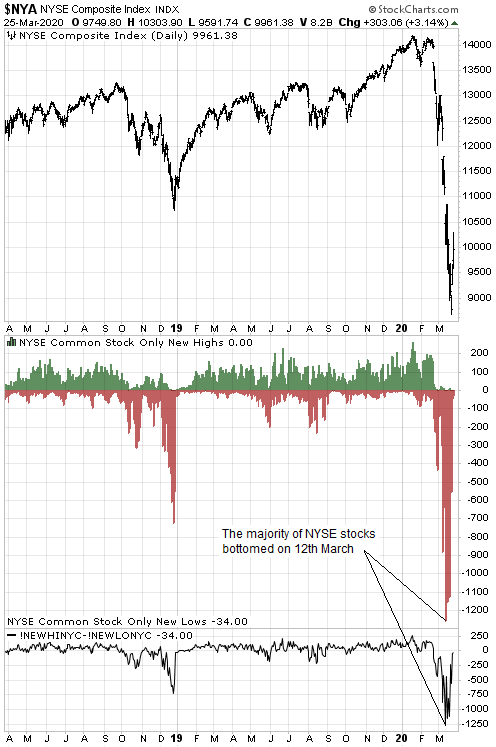
The following daily chart shows
that the number of individual NYSE-traded common stocks making new
12-month lows has collapsed from more than 1200 on 12th March to only 34
on 25th March. This means that the majority of stocks bottomed about two
weeks ago, even though the NYSE Composite Index and most other US stock
indices made new multi-year lows on Monday of this week. The positive
divergence between the market internals and the indices that developed
during 12th-23rd March set the stage for a strong rebound.
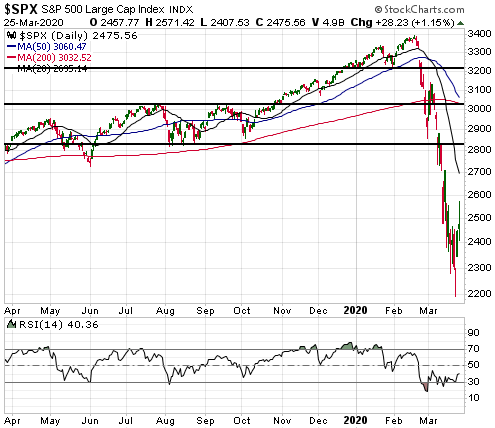
We wrote in the latest Weekly Update and in last week's Interim Update
that it was reasonable to expect a rebound that retraced about half the
decline from the February peak after a short-term bottom was in place.
This would be regardless of the market's long-term prospects. For example,
if last week's S&P500 (SPX) low of around 2300 had been the crash low then
the retracement target would be around 2850.
Due to this Monday's
new low near 2200, the most plausible target for a rebound is 2800. As
illustrated by the following daily chart, 2800 is slightly below lateral
resistance.
Depending on the news backdrop, the expected rise to around 2800 could
happen within two weeks or it could be a drawn-out affair involving an
early-April test of this week's low. The huge amount of money being
created out of nothing by the Fed and the $2T stimulus package being
rushed through the US parliament put the odds in favour of the former
(quick rise) scenario, but more bad news on the coronavirus front could
result in the latter scenario.
Gold and the Dollar
Gold
Claims of a gold shortage are not only wrong,
but also dangerous
As always happens when there is a sharp
decline in the gold price, there recently was chatter on the internet
about the price action not being consistent with 'evidence' of a shortage
of physical gold. These periodic claims about a shortage of physical gold
are always wrong. Also, in one important respect they are dangerous.
There can never be a shortage of physical gold because almost all of
the gold that has been mined throughout history is still around in
saleable form today. Every year the gold mining industry makes a small
addition to the existing aboveground stockpile (the stockpile grows by
about 1.5% per year thanks to mining), but the aboveground stock is so
large relative to the amount of annual production that even if the entire
gold mining industry were to shut down there would not be a shortage of
physical gold.
Of course, there can be a temporary shortage in
parts of the world of some items that are made from gold. For example,
coin dealers can't afford to maintain in their stores a large volume of
every different type of gold coin, so they predict what they will sell
within the ensuing few months and stock up accordingly. Sometimes they run
out of stock due to an unexpected increase in demand for certain coins,
which leads to new orders being placed at the local mint. It takes time
for the mint to fill these orders and during this period it will not be
possible for some prospective buyers to obtain the coins they desire, at
least not at reasonable prices. There also will be times when the coin
dealers stock up on particular items in anticipation of demand that
doesn't materialise.
Neither the situation where coin dealers are
temporarily out of stock nor the situation where coin dealers have an
unusually large amount of unsold inventory indicates anything about the
overall supply of and demand for physical gold.
As mentioned above,
it simply isn't possible for there to be a genuine shortage of physical
gold. However, it is possible that at some point the vast majority of gold
owners will refuse to exchange their gold for dollars. Although this could
create the impression that there is a major shortage of gold, this
impression would be false. Rather than indicating a lack of physical gold
supply, it would indicate a lack of demand for dollars. To explain using
an absurd example, a man who wants to buy physical gold using Monopoly
money will find no takers, not because there isn't plenty of gold
available for sale but because nobody wants to exchange their gold for
Monopoly money.
The situation described in the above paragraph
would be foreshadowed by persistent and large backwardation in the gold
futures market. That is, for an extended period of time the spot price of
gold would be well above the price of the nearest futures contract and the
nearest futures contract would be priced well above the distant contracts.
That is not the current situation. Currently, the gold futures curve is
almost flat, but with a slight upward slope. Given that short-term US
interest rates are near zero, this is not in any way strange or indicative
of a lack of demand for US dollars. On the contrary, it indicates that on
a global market-wide basis there is ample physical gold supply to meet the
demand being expressed by the holders of dollars. That being said, the
gold futures curve has flattened over the past few days, which indicates
that the recent surge in the gold price had more to do with the buying of
physical gold (400oz and 1kg bars, not coins*) than the speculative buying
of gold futures. It's a similar story in the silver market.
We
mentioned near the start of this discussion that claims of a shortage of
physical gold are dangerous as well as wrong. Such claims are dangerous
because the most popular argument against returning to gold as money (the
general medium of exchange) is that there is insufficient gold in the
world. According to apologists for the current monetary system and
denigrators of earlier systems that were based on gold, the money supply
should be very flexible so that it can be rapidly expanded in times of
stress or simply to meet the needs of a growing economy. In effect, the
"goldbugs" who periodically assert that there is a shortage of physical
gold are saying to the gold haters: "You are right! We should never go
back to having gold as money because if we did we eventually would end up
with a severe shortage of money."
In summary, there will never be a
shortage of physical gold. There could, however, be a shortage of gold
available to be exchanged for fiat currency, but that's not the situation
today.
*The public's demand for gold coins
is such a small part of the overall market for physical gold that it
generally won't affect the spot price of gold.
Current Market Situation
In the
email sent to subscribers after this Monday's US trading session, we wrote
that the Fed had ramped up its efforts by committing to buy almost
anything (using money created out of nothing, of course) and that it was
getting involved in direct lending to businesses of all sizes. Also, we
pointed out that this new cunning plan had boosted inflation expectations
and in doing so reduced the real US interest rate (the real interest rate
is the nominal interest rate minus the EXPECTED rate of currency
depreciation), causing the fundamental backdrop to shift in gold's favour.
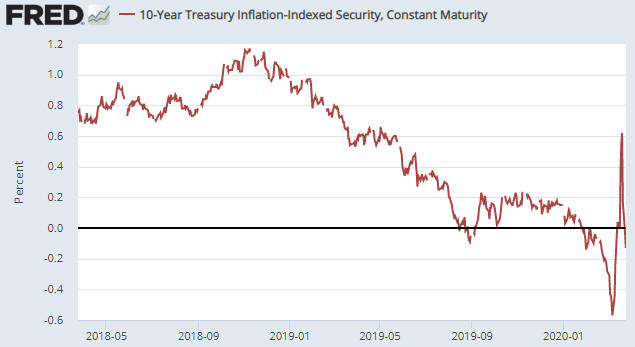
The following chart of the 10-year TIPS yield, a proxy for the US real
interest rate, illustrates what we were talking about. Notice that the
TIPS yield was around negative 0.60% in early-March but then rocketed
upward. This was in response to the collapse in inflation expectations.
Last Thursday (19th March) it was around positive 0.60%, which was close
to a 12-month high, but then inflation expectations began to rise and the
TIPS yield was pushed back into negative territory.
In the same email we wrote that the actions being taken by the Fed
could put a higher floor under the gold price and enable gold to test its
Q1-2020 peak by May-2020. However, things are happening much faster than
expected. As it turned out, the plunge in the real interest rate was the
catalyst for the biggest 2-day rise in the gold price (in dollar terms) in
history, enabling a test of the Q1-2020 peak near $1700 during Tuesday's
frenetic trading session. Across the financial world, price moves that
normally take months are happening in days and price moves that normally
take weeks are happening in hours.
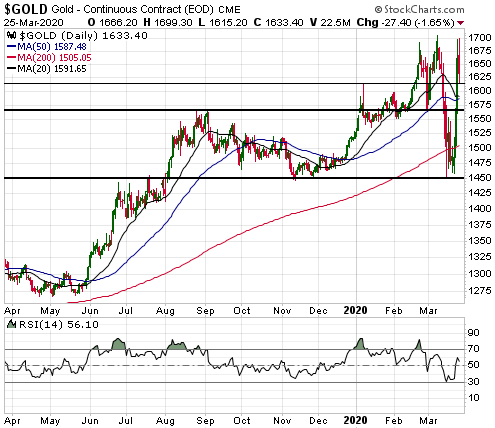
We doubt that gold will embark on a new intermediate-term advance
until there has been a more substantial reduction in speculator long
interest than has occurred to date. However, the on-going craziness of the
financial-market environment and the actions being taken by central banks
and governments make short-term forecasting more futile than usual.
Gold Stocks
We have written that the most
likely place for a countertrend rebound in the HUI to end is the area
between lateral resistance at 200 and the 200-day MA. The 200-day MA
currently is at 214-215. As illustrated below, the HUI reached the top of
the rebound's target range on Wednesday 25th March.
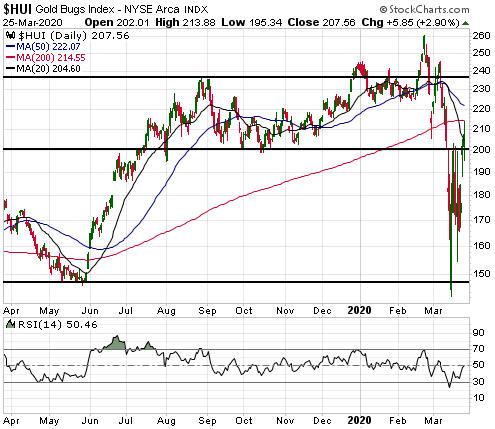
We can't be certain that the rapid rebound from the 16th March low is
a countertrend move, but that's the most prudent assumption until/unless
proved otherwise. Importantly, at this stage there is nothing in the price
action to suggest that we are dealing with something more bullish than a
reaction that will be followed by a decline to test the crash low. For
example, in 1987 the initial rebound in the XAU (the HUI didn't exist back
then) also involved a rapid rise to the vicinity of the 200-day MA.
In general, a crash is followed by a strong 1-2 week rebound and then
a multi-week decline that tests the crash low. A larger/longer upward move
then becomes a good bet, assuming that the test of the crash low is
successful. To indicate that this pattern is NOT being followed the HUI
will have to achieve consecutive daily closes above its 200-day MA.
The Currency Market
Volatility is still the
order of the day in the currency market.
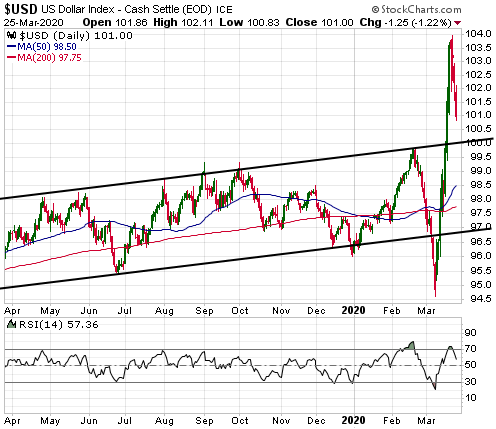
During the two weeks prior
to this week the Dollar Index (DX) rocketed upward. In reaction to being
stretched to the upside late last week, we now have the inevitable
pullback.
A routine pullback would end at or above 100, while a
weekly close below 99 would suggest that last week's upside breakout was
yet another fakeout.
We still think that the next intermediate-term trend in the DX will be
to the downside, and in this regard we have the Fed on our side. The Fed
has gone completely bonkers (a technical term) and entered full-on dollar
destruction mode. The ECB is also completely bonkers, but that happened
several years ago. The big change is with the Fed.
The Fed is being
egged on in its mindboggling pursuit of "inflation" by many people who
should know better and undoubtedly will, at some point in the future,
complain about the long-term damage caused by the Fed in its efforts to
"support the economy" during the coronavirus panic of 2020. It is only
during times of crisis that you discover who are the genuine supporters of
free markets.
Updates on Stock Selections
Notes: 1) To review the complete list of current TSI stock selections, logon at
http://www.speculative-investor.com/new/market_logon.asp
and then click on "Stock Selections" in the menu. When at the Stock
Selections page, click on a stock's symbol to bring-up an archive of
our comments on the stock in question. 2) The Small Stock Watch List is
located at http://www.speculative-investor.com/new/smallstockwatch.html
 Short-term
trade suggestions
Short-term
trade suggestions
1) GDXJ
The idea
was to buy GDXJ at US$22.50 or lower this week, preferably near the open
on Monday. However, the Fed's announcement prior to the start of trading
on Monday lit a fire under the gold sector and prevented GDXJ from trading
near our targeted buy price. Consequently, this trade suggestion is
cancelled.
2) SLV May-2020 $14.00 call option
This call option was added to the TSI List last week and will be
exited if it trades at US$1.40. For the option to trade at $1.40 within
the next week the silver price probably will have to make an additional
gain of about $1.
3) GDX June-2020 $20.00 put option
The gold mining indices/ETFs have risen almost as far as they should
IF we are dealing with a typical post-crash rebound. Also, if we are
dealing with a typical post-crash rebound then the next significant move
should be a decline that tests the crash low. Due to the potential for
such a decline, the above-mentioned GDX put option will be added to the
TSI List.
The option last traded at US$0.79 and ended with a
bid-ask spread of US$0.53-US$0.90. We will use the mid-point of this
spread (US$0.72) as our entry price.
Note that this trade idea is
most appropriate for those who have substantial exposure to gold mining
stocks, that is, for those who are well and truly covered in case the gold
mining rally continues.
Chart Sources
Charts appearing in today's commentary
are courtesy of:
https://stockcharts.com/
https://research.stlouisfed.org/