- Interim Update 25th May 2016
Copyright
Reminder
The commentaries that appear at TSI
may not be distributed, in full or in part, without our written permission.
In particular, please note that the posting of extracts from TSI commentaries
at other web sites or providing links to TSI commentaries at other web
sites (for example, at discussion boards) without our written permission
is prohibited.
We reserve the right to immediately
terminate the subscription of any TSI subscriber who distributes the TSI
commentaries without our written permission.
The Stock Market
The US
In the latest Weekly Update we warned that the US stock indices stood a decent
chance of rebounding prior to resuming their declines. The indices have
rebounded, but it's fair to say that the gains achieved over the first three
days of this week were bigger than anticipated.
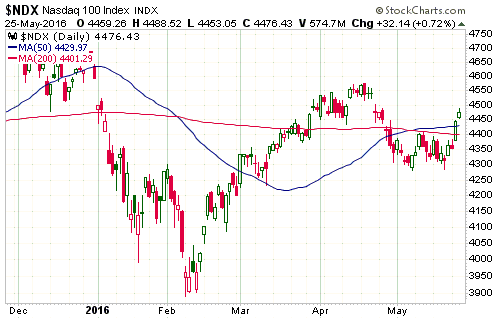
For example, in the Weekly Update we wrote that we would not be surprised if the
NASDAQ100 Index (NDX) rebounded to 4400-4450, but the following chart shows that
the NDX closed at 4476 on Wednesday. Also, there is no evidence in the price
action that the rebound from support is over.
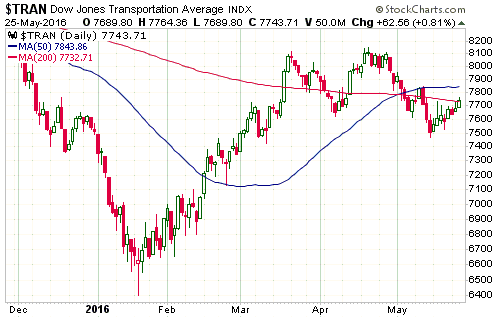
The next chart shows that the Dow Transportation Average (TRAN) has moved upward
over the past two weeks, although in this case the rebound has not been stronger
than anticipated. The TRAN continues to be relatively weak and after breaking
below its 50-day and 200-day MAs early this month has done no more than rebound
to the lower of these MAs.
Given its leadership over the past 18 months, the TRAN's recent relative
weakness is an important prop for the short-term bearish case. At the same time,
market internals (the numbers of individual stocks making new 52-week highs and
lows) and put/call ratios are more bullish (or less bearish) than they were
prior to the sharp declines that began in July and December of last year.
Overall, the set-up for a sizable multi-week decline is not as good right now as
it was last July and December. However, we continue to like the risk/reward of a
bearish stock-market trade. Furthermore, this week's larger-than-expected
rebound has, if anything, added to the appeal of the trade by reducing the
amount that the market would have to move in the wrong direction (upward) to
invalidate the trade. In other words, this week's rebound has enhanced the
ability to manage risk.
We are therefore still interested in speculating via QID (a fund that moves in
the opposite direction to the NDX at twice the pace) or QID call options.
There is a QID July $35 call option in the TSI List that is now underwater
thanks to this week's stock-market strength. This option still has enough time
to expiry to be worth holding, but due to the market action of the past two days
we think it makes sense for new buying to be directed towards options that
expire in October.
Further to the above comment, we have added the QID October-2016 $40 call option
to the TSI List at Wednesday's closing price of US$0.92.
Finally, we want to make it clear that the probability of a market crash
happening in the near future is almost zero. In our opinion, the most that can
reasonably be expected on the downside within the coming two months is a test of
the Q1-2016 lows. If we do get such a test then the above-mentioned QID call
options will be worth a multiple of their current prices.
Gold and the Dollar
Gold
The simple relationship between gold, T-Bonds and the US$
In a
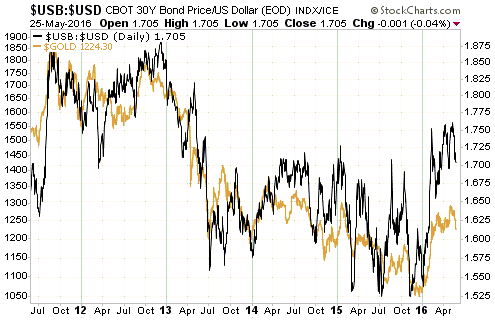
post at the TSI blog last week we discussed the positive correlation between
the US$ gold price and the bond/dollar ratio (the T-Bond price divided by the
Dollar Index). The correlation has existed for at least 20 years, although the
chart displayed in our blog post covered only the past 10 years. Today we are
going to look at the past 5 years and zoom in on this year. Interestingly, the
correlation has strengthened over the past 5 years and has been remarkably
'tight' since the beginning of this year.
Here are the relevant charts.
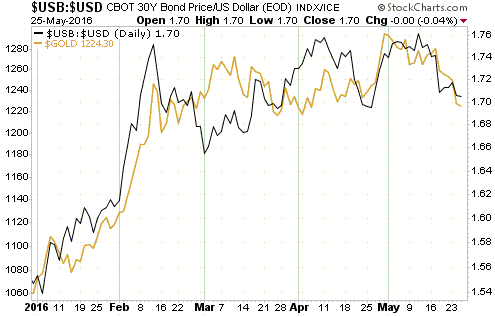
The second of the above charts shows that since the beginning of this year the
performances of the US$ gold price and the bond/dollar ratio have been almost
identical. Like gold, the bond/dollar ratio peaked on 11th February and then
made a couple of marginally-higher highs over the ensuing three months. In
essence, both gold and the bond/dollar ratio consolidated with slight upward
biases after 11th February. Over the past two weeks they have both dropped back
to near the bottoms of their consolidation ranges.
The main implication of the above charts is that for gold to make a big move
upward the T-Bond has to be strong relative to the US dollar. In particular, the
message from the charts is that a rise in the Dollar Index wouldn't be a problem
for gold if it were accompanied by a larger rise in the T-Bond price, and that a
decline in the Dollar Index shouldn't be expected to result in gold-price
strength if it is accompanied by a larger decline in the T-Bond.
Current Market Situation
Sometimes you only find out where the important support/resistance lies by
observing the market reaction. That is, you might think that a particular price
level is important support or resistance, but if there is no market reaction to
a break through that level then it probably wasn't important.
For example, we thought that the most important nearby support for the US$ gold
price was at $1260, but there was almost no reaction when $1260 was breached
during the second half of last week. Of particular relevance, the breach of
lateral support at $1260 last week didn't prompt a wave of long liquidation by
speculators in gold futures and didn't seem to cause much concern within the
ranks of short-term speculators in gold-mining stocks. The $1260 support level
therefore wasn't as significant as we thought.
Based on this week's price action it seems that short-term speculators were
primarily focused on support defined by the bottom of the channel drawn on the
following daily chart. The break below the channel bottom led to downward
acceleration and was confirmed by the performance of the gold-mining sector.
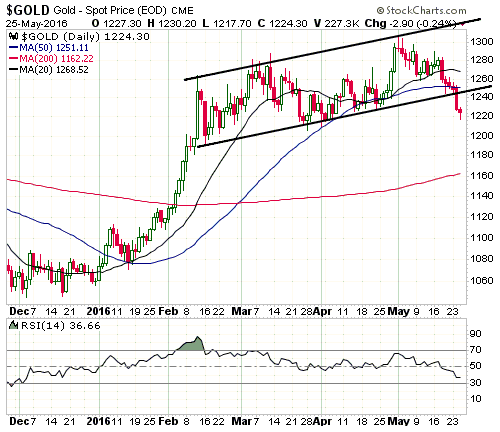
We think that intermediate-term support near $1190 is the most likely target for
the current decline and that the 200-day MA in the $1160s defines the near-term
downside risk. In other words, gold will probably fall as far as the $1190s and
could fall as far as the $1160s before reaching a bottom that will hold for at
least a few weeks.
With regard to gold's prospects over the days immediately ahead, the market has
just declined for 6 days in a row and is a little stretched to the downside. A
rebound to the $1240s would therefore not be surprising even if the price is
destined to make it to the $1190s prior to a multi-week bottom.
Gold Stocks
In the latest Weekly Update, we wrote:
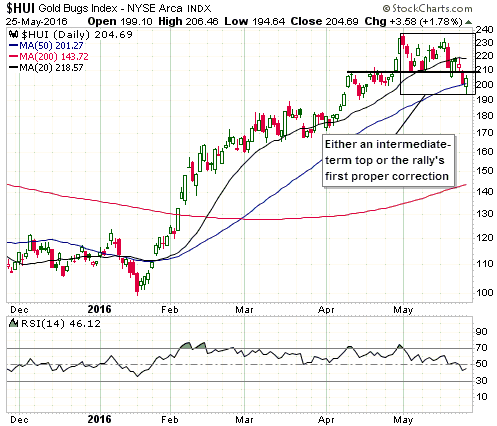
"Support for the HUI at 208-210 held again after being thoroughly tested last
week, which means that there is still a realistic chance of a final surge in
this index to as high as 250 prior to a multi-month top. However, a prudent
speculator would not bet on such an outcome. The reason is that the short-term
downside risk is higher than any remaining upside potential.
Although we would still view a daily close below 208 as an early warning that a
multi-month top was in place, due to last week's price action it would now take
a daily close below 190 to clearly signal a top."
On Tuesday 24th May we got the "early warning" that a multi-month top is in
place, but support at 190 is intact and the 50-day MA hasn't yet been breached
on a daily closing basis. This price action suggests two possibilities, the
first of which is the more likely although not yet the overwhelming favourite.
The first possibility is that an intermediate-term peak was put in place at the
beginning of May when the HUI traded at 236. If so, we will probably get a 3-6
month correction involving a short-term bottom within the next week followed by
a rebound to a lower high sometime next month and then a decline to a new
multi-month low.
The second possibility is that we are getting an overdue short-term correction
to the 50-day MA within an on-going intermediate-term advance. If so, a
short-term bottom was probably put in place when the HUI spiked down to 194 on
Wednesday 25th May and there will be a rally to an intermediate-term top (likely
the high for the year) next month.
Note that both of these scenarios involve similar price action over the next
couple of weeks (a short-term bottom soon followed by a rebound). The difference
is that in the first scenario the next rally will end at a lower high.
Also note that a daily HUI close below 190 would all but eliminate the second
possibility.
The Currency Market
The Euro
A deal was done earlier
this week to 'unlock' 10.3B euros of funding to the Greek government from
its official-sector creditors. This money will be used to satisfy the Greek
government's immediate debt-repayment obligations to some of the same
official-sector creditors, so the deal amounts to a charade designed to sustain
the accounting fiction that the Greek government is solvent. That being said, it
probably means that the re-emergence of the Greek debt crisis won't happen until
at least 2017.
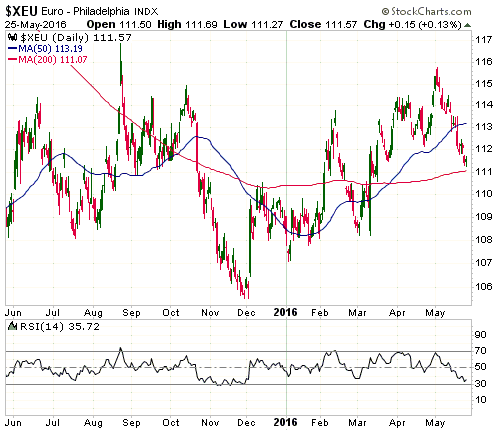
This should be a temporary plus for euro sentiment. Also, the euro is now a
little 'oversold' on a short-term basis and is due for a counter-trend bounce.
The Pound
Over the past couple of weeks the British Pound has moved from support near 143
to resistance near 147. Based on the chart pattern, a solid daily close above
147 would point to a short-term target of 155.

In the 4th May Interim Update we described a potential British Pound trade as
follows:
"Our rough plan is to accumulate half of a full position [a long position in
the Pound] during periods of weakness prior to the BREXIT vote. We would then
either double the position following a sharp sell-off in reaction to a "yes"
vote (although a "yes" vote would be a long-term plus for the UK, the knee-jerk
market reaction would probably be a mini-panic out of the Pound) or take profits
following a relief rally in reaction to a "no" vote.
A position in the Pound could, for example, be taken by converting a bank
deposit from another currency to Pounds, purchasing Pound futures, purchasing
FXB (CurrencyShares British Pound ETF), or, for those who want more leverage and
are prepared to take a much greater percentage loss if the trade doesn't work
out, purchasing call options on Pound futures or FXB. Our intention at this time
is to convert part of an existing currency deposit to Pounds and to purchase
some September FXB call options.
As mentioned above, the price will ideally pull back to around 143 to test the
April breakout before resuming its advance."
Note that we are implementing the above trade in our own accounts but are not
tracking it via the TSI Stocks List.
The Pound pulled back to around 143 a couple of weeks ago, creating a good
opportunity to take an initial 'long' position. Unless there is substantial
strength in the Pound prior to the 23rd June "Brexit" vote we intend to hold our
initial position and either take profits or add to the position following the
vote as outlined in the above plan. Also, we will take profits if the Pound
moves up to the mid-150s prior to the vote.
Updates on Stock Selections
Notes: 1) To review the complete list of current TSI stock selections, logon at
http://www.speculative-investor.com/new/market_logon.asp
and then click on "Stock Selections" in the menu. When at the Stock
Selections page, click on a stock's symbol to bring-up an archive of
our comments on the stock in question. 2) The Small Stock Watch List is
located at http://www.speculative-investor.com/new/smallstockwatch.html
Chart Sources
Charts appearing in today's commentary
are courtesy of:
http://stockcharts.com/index.html