|
- Interim Update
25th June 2014
Copyright
Reminder
The commentaries that appear at TSI
may not be distributed, in full or in part, without our written permission.
In particular, please note that the posting of extracts from TSI commentaries
at other web sites or providing links to TSI commentaries at other web
sites (for example, at discussion boards) without our written permission
is prohibited.
We reserve the right to immediately
terminate the subscription of any TSI subscriber who distributes the TSI
commentaries without our written permission.
Misunderstandings about Fed money creation, bank reserves and bank
lending
The first two false beliefs on our list of
economics myths remain very popular, even within the ranks of
people who are generally knowledgeable about economics. We are
referring to the beliefs that the amount of US bank lending is
determined by or at least influenced by the amount of bank reserves,
and that the Fed's QE boosts bank reserves but does not directly
boost the money supply. In response to their appearance in two
recent articles penned by people who are otherwise quite
knowledgeable, we are now going to briefly revisit these wrongheaded
notions.
One of the articles that prompted us to revisit this topic was "Long
Term Parking" by Ben Hunt. Here's the relevant excerpt:
"...the massive debt racked up by the Fed in its QE purchases of
US sovereign debt and mortgage-backed securities doesn't work like
household or corporate debt. The money for this buying spree never
actually enters the real economy, but instead sits in the reserve
accounts of the big banks. And that's where it sits, and sits, and
sits ... until the big banks use those reserves to make private
loans to households or corporations that want to use that money for
some sort of real-world economic activity. This private lending
activity is what turns reserves into money, and the cascading usage
of that money -- where it flows through multiple hands making real
economic purchases -- is what turns money into inflationary
pressures and expectations."
This is completely wrong. Firstly, for every dollar of assets
purchased by the Fed as part of its QE, one dollar is added to bank
reserves at the Fed and one dollar is added to demand deposits
within the economy (the demand deposits of the securities dealers
that sell the assets to the Fed). In other words, the money for the
Fed's buying spree definitely does enter the economy and therefore
does create inflationary pressures. However, sometimes the
inflationary pressures are focused on financial assets, thus
rendering them invisible to most analysts. Secondly, banks do not
use reserves to make loans. The volume of bank lending is mostly
determined by the availability of borrowers that are both willing
and qualified. That's why there has been no correlation over the
past few decades between US bank lending and US bank reserves.
Thirdly, reserves cannot be turned into money via bank lending.
Reserves at the Fed will remain at the Fed until they are either
removed by the Fed (via 'quantitative tightening') or are converted
to notes/coins in response to the public's increased demand for
physical currency.
The other catalyst for our decision to revisit the QE and
bank-reserve myths was "The
Fed's Stealth Tightening" by Casey Research's Bud Conrad. Here's
the relevant excerpt:
"The Fed funded and continues to fund its quantitative easing
programs with bank deposits. Here's the rundown on how that works:
1. The Fed creates cash from thin air.
2. The Fed buys Treasuries and mortgage-backed securities (MBS) from
banks with that freshly minted cash.
The Fed pays banks 0.25% interest as an incentive to keep the new
cash on deposit at the Fed.
That huge $2.8 trillion in deposits [bank reserves held at the Fed]
is a risk source, because the financial institutions could withdraw
those funds at any time, if they think they can generate better
returns than the 0.25% interest that the Fed pays."
This is wrong in two important ways:
First, the Fed doesn't buy Treasuries and MBS from banks; it buys
them from Primary Dealers (PDs). Although some PDs are subsidiaries
of commercial banks, the distinction is not trivial. Due to the
mechanics of the Fed's QE process, the monetisation of assets
results in dollars being added one for one to bank reserves at the
Fed and demand deposits within the economy (the demand deposits of
the PDs).
Second, banks cannot withdraw their huge deposits of reserves held
at the Fed. Banks can lend reserves to other banks, but the banking
system as a whole cannot reduce its reserves. As we stated above,
reserves at the Fed will remain at the Fed until they are either
removed by the Fed (via 'quantitative tightening') or are converted
to notes/coins in response to the public's increased demand for
physical currency.
Since the banking system cannot withdraw its reserves, the 0.25%
interest rate paid on reserves is not an incentive to keep the
'cash' at the Fed. Even if the interest rate were negative, that is,
even if the Fed started charging the banks on their reserve
balances, the commercial banking system would be powerless to reduce
the total quantity of its reserves. Why, then, did the Fed start
paying interest on reserves a few years ago?
As far as we can tell, there were two reasons. The minor reason was
to give bank balance sheets a boost, but the main reason was to
enable the Fed to maintain control of the Fed Funds Rate (FFR) at a
time when banks are inundated with "excess" reserves. If not for its
relatively new ability to pay interest on reserves, the Fed would be
unable to hike the FFR in the future without massively contracting
the quantity of reserves.
We'll end with a question for the many analysts who continue to
labour under the false belief that the Fed's QE boosts bank
reserves, but not the money supply, and the related false belief
that bank lending is the only means by which money gets injected
into the economy. The question is: Given that US True Money Supply*
has increased by about $4.7T over the past six years and that US
commercial bank credit has only increased by about $1.4T over the
same period, where has all the new money come from?
*The sum of physical currency in circulation, demand
deposits at private depository institutions and savings deposits at
private depository institutions
The Stock Market
Dow 44,000 and speculating on the possibility of a crash
A mainstream financial analyst has
come out with a prediction that the Dow Industrials Index is on its way to
44,000. This is the type of prediction that gets made near the end of a bull
market and reminded us of the "Dow 36000" book that was published in 1999. That
being said, the recent "Dow 44000" prediction is not remotely as nonsensical as
the "Dow 36000" prediction of 1999. This is because "Dow 44000" is a guestimate
of where the Dow will be in 10 years' time assuming that a secular bull market
began in early 2009. It implies an average gain of about 10% per year over the
coming decade. The "Dow 36000" book, on the other hand, attempted to make the
case that fair value for the Dow was 36000 way back in 1999.
It's extremely unlikely that a secular bull market got underway in 2009.
Valuations at that time were nowhere near low enough to set the scene for such
an outcome. However, even if we suspected that the US stock market really was
five-and-a-bit years into a secular upward trend that was destined to last ten
more years, we would be just as concerned as we are today about short-term and
intermediate-term downside risk. Our concerns are unrelated to the secular
trend. They are related to sentiment and valuation.
Sentiment and valuation were stretched to similar extremes at the same distance
into the 1982-2000 secular bull market. The result was the 1987 stock market
crash.
The stock market crash of 1987 is now just a 'blip' on the long-term chart, but
at the time it was devastating. It resulted in a peak-to-trough decline of
around 30% and wiped out all the gains accumulated over the preceding 18 months.
It also brought valuations down to a more reasonable level and caused sentiment
to become very constructive. In doing so it effectively reset the long-term bull
market.
The current bull market's best chance of continuing for a few more years is if
it experiences a similar reset, that is, if it suffers a 30% plunge later this
year.
Up until now we haven't seriously considered the possibility that the US stock
market could crash this year. Instead, our expectation has been that the market
would gradually roll over into a choppy multi-year decline. This is still our
favoured scenario, but with the S&P500 Index having made it to the middle of the
year without a significant short-term correction the probability of a crash has
increased to the point where it is a risk worth taking into account.
If a crash is going to occur, the most likely time would be mid-August through
to early-October. The most likely price pattern would entail an initial decline
of about 10% followed by a rebound to test the high and then a decline to below
the low of the initial decline, with the market plummeting immediately after the
low of the initial decline was breached.
We have small positions in SSO (ProShares Ultra S&P500) put options and VIX
(Volatility Index) call options that we added to over the past three days.
Current Market Situation
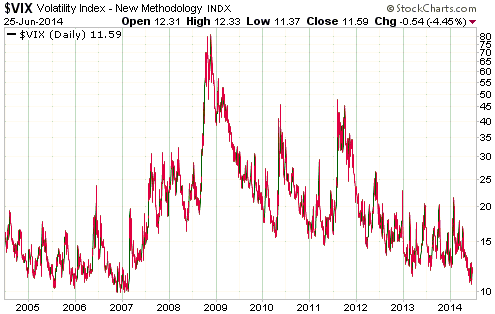
The following chart shows that over the past few days the Volatility Index (VIX)
made a new 5-year low and came close to its 10-year low. The unusually low
volatility reflected by the VIX is a consequence of widespread bullish
complacency.
The VIX is now so low that even a routine 10% pullback in the S&P500 Index would
probably result in an upward spike in the VIX to roughly double its current
level.
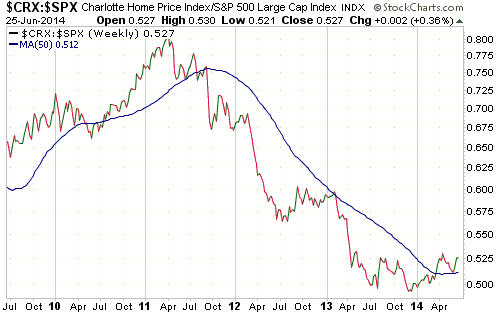
Evidence continues to slowly and steadily build in favour of the commodity
theme. For example, the following weekly chart shows that the CRX/SPX ratio
(commodity-related stocks relative to the S&P500 Index) bottomed in December,
broke above its 50-week MA in March, pulled back to test its breakout in June
and has recently resumed its advance.
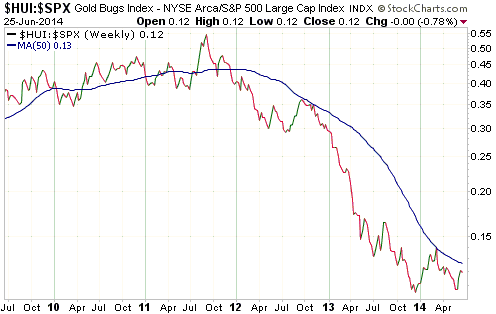
The next weekly chart shows that the HUI/SPX ratio (gold-mining stocks relative
to the S&P500) hasn't been as strong as the CRX/SPX ratio, in that HUI/SPX's
rally from its December-2013 bottom didn't result in a break above the 50-week
MA. However, HUI/SPX appears to have successfully tested its December-2013
bottom earlier this month. We suspect that a break above the 50-week MA will
happen in July.
Gold and the Dollar
Gold
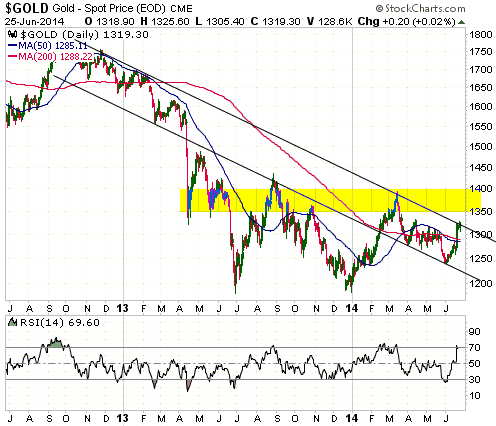
Gold is slightly 'overbought' on a short-term basis and has encountered
resistance in the $1320s. Breaking above this resistance will add another piece
to the puzzle (it will be additional evidence of a major reversal to the
upside), but far more important resistance lies at $1350-$1400.
As noted in the latest Weekly Update, we have no opinion on what the gold price
will do over the coming two weeks. It could pull back, in which case it would
likely find support at $1285-$1290. It could also break above the $1320s and
quickly move up to the $1350-$1400 range.
If there is a rise to the $1350-$1400 range within the next couple of weeks it
should be viewed as a short-term selling opportunity, whereas a decline to the
$1280s should be viewed as a short-term buying opportunity.
Gold Stocks
Our interpretation is that the HUI is close to completing a base that began to
form during the second quarter of last year. The top of the base is at 250 or
thereabouts. 250 is therefore an important resistance level.
A break above 250 would create a chart-based target of 300-320.
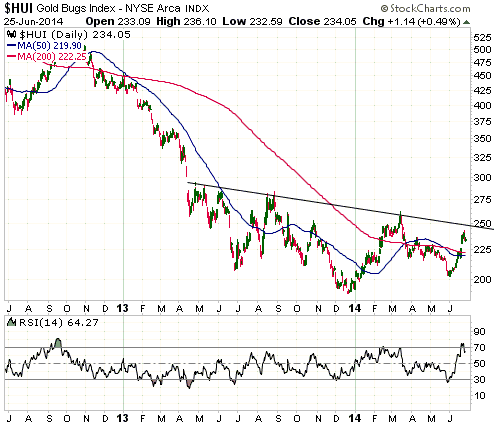
While the HUI didn't quite make it to important resistance at 250 before
beginning to consolidate, GDXJ, a proxy for the stocks that are leading the
gold-mining sector, reached equivalent resistance last week.
For GDXJ, a daily close above last week's high would create a chart-based target
of around $60.
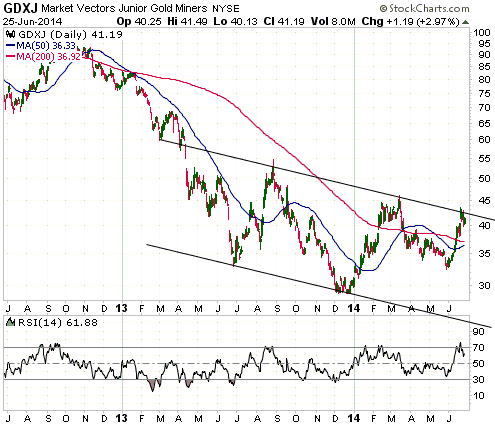
If a routine 1-3 week consolidation (the most that can reasonably be expected at
this time) has begun, then it should continue until the daily RSI shown at the
bottom of each of the above charts has fallen to 50 and/or the price has pulled
back to the vicinity of the 50-day and 200-day moving averages.
As is the case with the HUI and GDXJ, basing patterns of 12 months or longer are
clearly evident in the charts of many individual gold stocks. We'll include at
least a dozen examples in the coming Weekly Update.
Currency Market Update
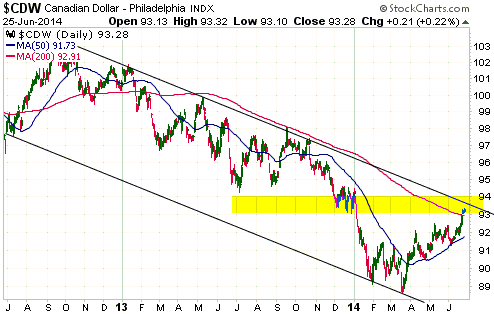
The Canadian Dollar (C$) has moved up to intermediate-term resistance in the
93-94 range. There are no surprises here, just more evidence that
commodity-related investments are slowly gaining popularity. However, it will be
surprising if the C$ breaks above 94 within the next few weeks. As far as we are
concerned, that would be too much too soon.
We expect that the C$ will make a short-term top in the 93-94 range and then
'correct' for at least a few weeks. The 50-day MA would be a likely target for a
correction low.
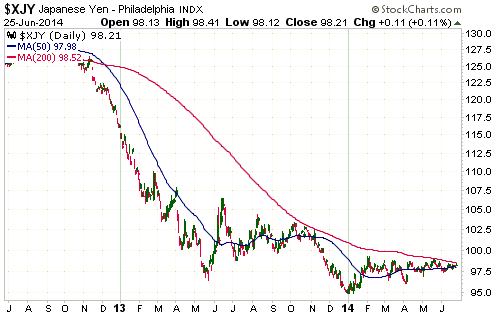
The Yen has now essentially flat-lined for five months. We don't recall ever
previously seeing a major financial market trade in such a narrow range over
such a long period.
We expect that the direction of the Yen's next tradable move will be to the
upside, but the move is obviously taking much longer than expected to get
underway. A daily close above 99 by the nearest Yen futures contract would be
the first sign that a rally has begun.
Updates
on Stock Selections
Notes: 1) To review the complete list of current TSI stock selections, logon at
http://www.speculative-investor.com/new/market_logon.asp
and then click on "Stock Selections" in the menu. When at the Stock
Selections page, click on a stock's symbol to bring-up an archive of
our comments on the stock in question. 2) The Small Stock Watch List is
located at http://www.speculative-investor.com/new/smallstockwatch.html
Chart Sources
Charts appearing in today's commentary
are courtesy of:
http://stockcharts.com/index.html

|









