|
- Interim Update 25th August 2010
Copyright
Reminder
The commentaries that appear at TSI
may not be distributed, in full or in part, without our written permission.
In particular, please note that the posting of extracts from TSI commentaries
at other web sites or providing links to TSI commentaries at other web
sites (for example, at discussion boards) without our written permission
is prohibited.
We reserve the right to immediately
terminate the subscription of any TSI subscriber who distributes the TSI
commentaries without our written permission.
The Bond Blow-Off
Treasury
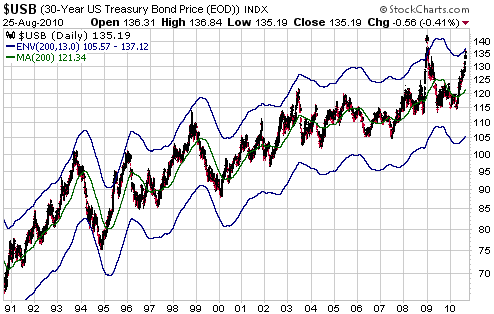
Bond futures continued their rapid ascent during the first half of this
week, and at Wednesday's intra-day peak had become extremely extended
to the upside relative to their 200-day moving average. In fact, the
following chart shows that December-2008 was the only occasion over the
past 20 years when the T-Bond was significantly more extended, relative
to its 200-day moving average, than it is right now (the chart shows a
13% envelope around the 200-day moving average). There is a chance that
the upside blow-off will continue for another 1-2 weeks, but in our
opinion the short-term downside risk is now much greater than any
remaining upside potential -- even taking into account the likelihood
of a lot more bad economic news over the next two months. We are
therefore downgrading our short-term T-Bond outlook from "neutral" to
"bearish".
The Stock Market
The US stock market in gold terms
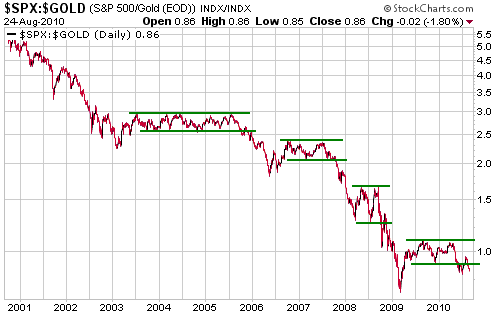
The SPX/gold ratio (the S&P500 Index measured in terms of gold
ounces) made intermediate-term lows in 2003, 2006 and 2008. After each
of these lows there was a sharp bounce and then a period during which
the ratio oscillated within a horizontal range. In each case, a
downside breakout from the horizontal range led to a substantial
decline of around 6 months to the next intermediate-term low.
The price action following the March-2009 intermediate-term low has
traced out a similar pattern to the price action that followed the
previous lows. In particular, after the March-2009 low there was a
sharp bounce and then a period of horizontal range trading.
SPX/gold now appears to be breaking out of its horizontal range, so if
the similarities continue then a substantial decline will unfold over
the next 6 months.
Change to intermediate-term stock market outlook
We perceive short-term downside risk in the S&P500 Index of about
10%, and expect that weakness over the coming 1-2 months will be
followed by a strong multi-month rebound into the first half of 2011.
Taking into account the expected decline to an October low and the
expected subsequent strength, the upside potential and downside risk
now appear to be roughly in balance with regard to the coming 6-9
months. We are therefore upgrading our intermediate-term stock market
outlook from "bearish" to "neutral".
Mixed Signals
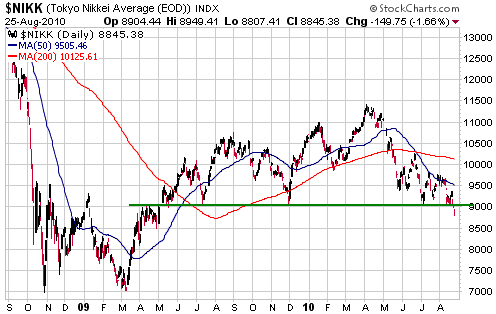
The first of the following charts shows that Japan's Nikkei225 Index
has just broken below a major support level. This obviously confirms
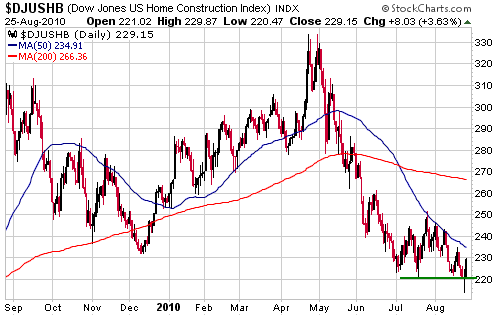
our short-term bearish outlook. However, the second of the following
charts shows that the US Home Construction Index (DJUSHB) spiked below
support and then immediately rebounded to above support. This week's
price action in the DJUSHB therefore failed to confirm our short-term
bearish outlook, despite a very negative news backdrop (reports on
Monday and Tuesday showed that sales of existing and new homes plunged
last month).
We are not speculating on a stock market decline, but if we were then
DJUSHB's recent price action would now be causing us some concern.
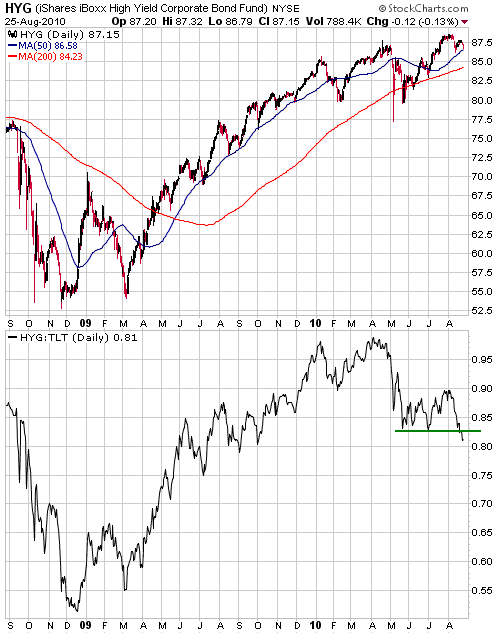
Continuing with the
"mixed signals" theme, the bottom section of the next chart shows that
the HYG/TLT ratio has just dropped to a new low for the year. This
points to an increase in risk aversion and is a bearish omen for the
stock market. However, the top section of the chart shows that HYG has,
to date, experienced only a minor pullback from the all-time high it
reached early this month. This means that the decline in the HYG/TLT
ratio has been almost totally due to strength in TLT. Putting it
another way, this year's widening of credit spreads has been driven by
a fall in government bond yields rather than a rise in junk bond yields.
The point is that the decline to a new low by HYG/TLT would be more
clearly bearish if it had been driven by rising yields on low-quality
bonds rather than by falling yields on high-quality bonds.
Gold and
the Dollar
Gold and Silver
Gold is 'overbought' on a short-term basis and could soon pull back,
but it has now done enough to suggest that the July low ($1160 in the
December futures) will hold during any correction over the next couple
of months.
Substantiating the idea that gold will do no worse from here than test
its July low is this week's strange action in the silver market. At the
beginning of this week silver was in the interesting position of only
having to fall by $0.90 or rise by $0.80 to effect a breakout on the
chart and thus signal the direction of its next multi-dollar move. It
has risen by about $1.00, in the process breaking above the highs of
the past several weeks and providing evidence that its multi-month
consolidation has ended.
The top section of the following chart shows the US$ silver price and the bottom section shows the silver/gold ratio.
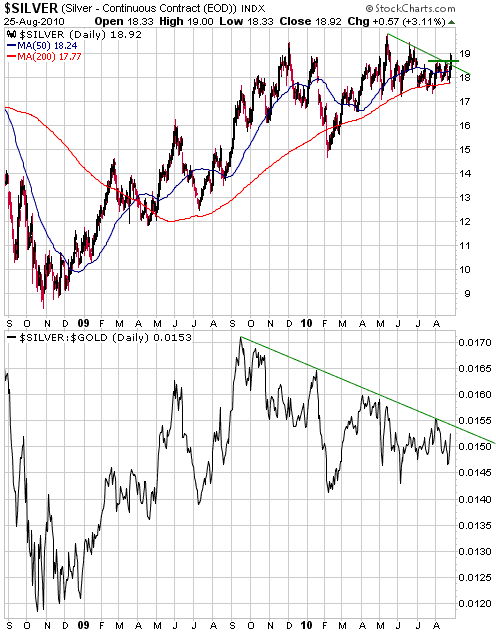
What's strange about
this week's price action in the silver market is that silver has shown
strength in both US$ and gold terms in parallel with stock market
weakness and bad economic news. The strength relative to gold has been
minor (the sequence of declining peaks dating back to last September
has not yet been broken), but given the financial/economic backdrop
even the minor strength is noteworthy.
Gold Stocks
At this time, our favoured gold-sector scenario entails a decline to an
October-November correction low followed by a new intermediate-term
advance. However, we are always cognisant that our favoured scenario
might not play out, so we are always on the lookout for clues that
something different is happening. Fortunately, as outlined below there
are strong seasonal tendencies that make the current situation in the
gold sector relatively straightforward.
Over the past 10 years the gold sector has never reached an
intermediate-term top during September. Rather, previous September
peaks of importance -- specifically, the peaks that occurred during
September of 2001, 2002 and 2006 -- were lower than the peaks reached
earlier in the year. Also, whenever the HUI has made a new 4-month high
during September -- as was the case in 2003, 2004, 2005, 2007 and 2009
-- its upward trend has always extended into November, and, with one
exception, has always ended in November or the first two trading days
of December. The exception was 2005, when the upward trend extended
into May of the following year. This tells us that if the HUI were to
exceed its May-2010 peak during September then its upward trend would
likely continue until November.
Another point is that during those years when the HUI has broken to a
new 4-month high during September, it has always done so by the 14th
trading day of the month.
Therefore, a move above the May high during the first 14 trading days
of September would not only be a clear sign that our currently favoured
scenario was wrong, it would also tell us that the short-term upward
trend was likely to remain intact until at least November.
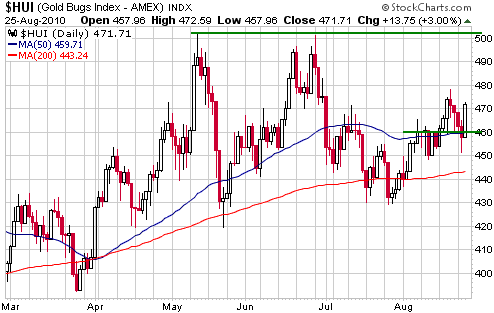
The HUI's price action over the first three trading days of this week
was bullish, in that a marginal break below support at 460 was not
sustained.
Currency Market Update
Purchasing power and interest rate differentials
It is said that you should never put off until tomorrow what you can do
today. While this is often true, there are times when it pays to put
things off. In some cases, by putting a task off until tomorrow...and
then tomorrow...and then tomorrow, the task eventually becomes
unnecessary, meaning that you increase your efficiency by
procrastinating. For example, for some time we've been planning to
write a detailed piece about how purchasing power parity (PPP) and
interest rate differentials influence currency exchange rates, but
because we put it off we no longer have to do it. The reason we no
longer have to do it is that John Hussman has done it for us in his
latest weekly comment. All that's left for us to do is summarise.
As Hussman explains, relative changes in purchasing power dominate
long-term trends in currency exchange rates, such that over the long
term there is a strong tendency for currencies with relatively high
"inflation" rates to depreciate against currencies with relatively low
"inflation" rates. When Hussman uses the word inflation he means a rise
in the general price level, but since long-term changes in the general
price level are determined primarily by changes in the money supply the
above statement is true regardless of whether inflation refers to the
monetary kind or the price kind.
Hussman goes on to explain that while purchasing power considerations
dominate on a long-term basis, interest rate differentials can cause
currency exchange rates to move well beyond their PPP levels over
shorter timeframes. In particular, he notes: "...a
currency should deviate PPP by an amount that reflects the difference
in real interest rates expected between the two countries over time.
Currencies with relatively high real interest rates will tend to trade
well above PPP, while currencies with low or negative real interest
rates will tend to trade below their PPP values."
The Australian Dollar (A$) is an example of a currency that has been
pushed a long way above its PPP (against the US$) with the help of a
sizeable interest rate differential. Considering the lack of relevant
price indices (indices that only count goods/services that are
identical and can be freely traded across countries) and the basic flaw
in the whole price-index concept (it makes no sense to calculate an
average of disparate items), quantifying PPP lies somewhere between
exceedingly difficult and impossible. However, people who do a lot of
international travelling can get a feel for which currencies are over-
and under-valued in relation to PPP, and by roughly how much. Right
now, based on our own assessment and the assessments of international
travellers to whom we've spoken, the cost of living in Australia is
mind-bogglingly high when the costs are converted to US dollars or
pretty much any other currency.
The large gap between the A$'s current level and its PPP creates
substantial long-term downside potential, but it's not the main reason
we are short-term bearish on this currency. The main reason for our
short-term bearishness is our expectation that the A$ will follow the
stock market.
In the above-linked Hussman article there is a discussion about how a
new "quantitative easing" (QE) program by the Fed could lead to a sharp
downward adjustment in the US dollar's foreign exchange value. In our
opinion, the key isn't so much what the Fed does to the monetary base,
but what happens to the total supply of US dollars (TMS) and how the
Fed's policies compare with those of other central banks. For example,
more 'easing' on the part of the Fed wouldn't necessarily be bearish
for the Dollar Index if it coincided with more 'easing' on the part of
the ECB. In that case, both currencies could plunge by roughly the same
amount relative to gold.
Current Market Situation
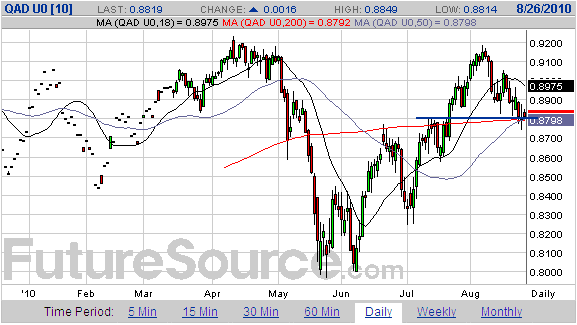
The September A$ tested short-term support at 0.88 on Tuesday and
Wednesday, and so far the support has held. As noted in the latest
Weekly Update, the A$ will have to close below 0.88 to provide
preliminary evidence that an important top is in place.
Update
on Stock Selections
(Notes: 1) To review the complete list of current TSI stock selections, logon at http://www.speculative-investor.com/new/market_logon.asp
and then click on "Stock Selections" in the menu. When at the Stock
Selections page, click on a stock's symbol to bring-up an archive of
our comments on the stock in question. 2) The Small Stock Watch List is
located at http://www.speculative-investor.com/new/smallstockwatch.html)
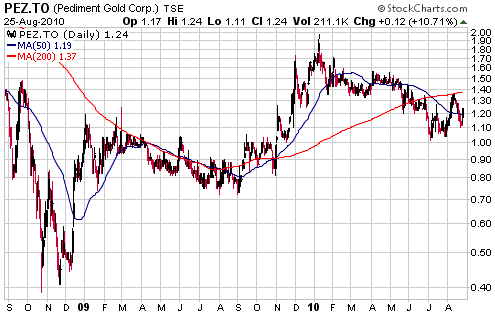
 Pediment Gold (TSX: PEZ). Shares: 48M issued, 54M fully diluted. Recent price: C$1.24 Pediment Gold (TSX: PEZ). Shares: 48M issued, 54M fully diluted. Recent price: C$1.24
In the 11th August Interim Update we explained that PEZ could conservatively be valued at C$2.30/share.
The drilling results announced by PEZ on Wednesday will probably lead
to an increase in the resource estimate for its San Antonio project and
enhance the stock's value. Of particular importance were the holes that
intersected significant gold widths (e.g. 36.5m of 2.73 g/t and 53.3m
of 1.18 g/t) between two previously defined mineralised zones.
For speculators interested in accumulating exploration-stage gold
stocks, PEZ is a good candidate for new buying in the C$1.20s.
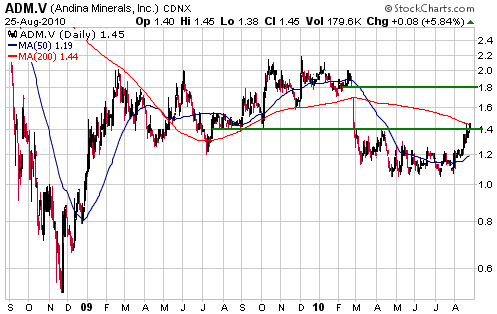
Andina Minerals (TSXV: ADM). Shares: 108M issued, 129M fully diluted. Recent price: C$1.45
The following chart shows that ADM has moved slightly above resistance
at C$1.40. As noted in the 9th August Weekly Update: "A break above
C$1.40 would probably be followed by a rise to C$1.70-$1.80, where a
lot of supply would undoubtedly 'come out of the woodwork'. Good news
relating to the PEA [due to be finished early next year] will probably
be needed to get the stock above C$1.80."
Even though the stock has made a marginal upside breakout, it wouldn't
be surprising if it pulled back before resuming its advance. A routine
pullback would take ADM back to around C$1.25 and would create another
buying opportunity.
Potential new stock selection: US Silver (TSXV: USA). Shares: 251M issued, 289M fully diluted. Recent price: C$0.22
We removed USA.V from the TSI Stocks List on 19th May 2010 because at
that time we didn't want exposure to a stock with such extreme leverage
to the silver price. Due to this week's upside breakout in the silver
price we will now return it to the List as a short-term trade, provided
that we are able to do so at C$0.20 (if it doesn't trade at C$0.20
within the next few days then we won't return it to the List at this
time).
USA's leverage stems mainly from its high cost of production. It is
currently producing 2.5M ounces of silver per year from its mine in
Idaho at the cost of almost US$13/oz (including lead and copper
byproducts). If the company achieves its goal of increasing the
production rate to 3M oz/year then the per-ounce production cost will
decline, but it will still be a high-cost producer.
If the silver price were to rise to $21-$22 then USA would potentially
begin to generate enough cash flow to justify a stock price of at least
C$0.40.
The following chart shows that USA has resistance at C$0.24-C$0.26.
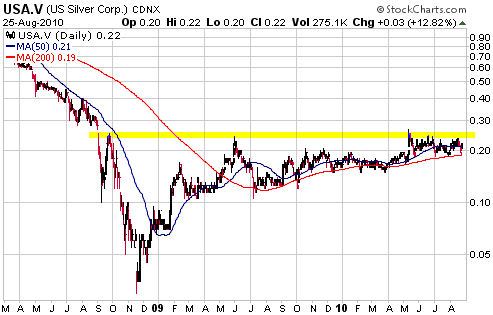
Chart Sources
Charts appearing in today's commentary
are courtesy of:
http://stockcharts.com/index.html
http://www.futuresource.com/

|









