|
- Interim Update 26th February 2014
Copyright
Reminder
The commentaries that appear at TSI
may not be distributed, in full or in part, without our written permission.
In particular, please note that the posting of extracts from TSI commentaries
at other web sites or providing links to TSI commentaries at other web
sites (for example, at discussion boards) without our written permission
is prohibited.
We reserve the right to immediately
terminate the subscription of any TSI subscriber who distributes the TSI
commentaries without our written permission.
Commodities
The commodity markets have almost certainly turned upward on an
intermediate-term basis and are showing signs of having turned
upward on a long-term basis. However, on a short-term basis the
Continuous Commodity Index (CCI) and many individual commodities are
'overbought' and likely to experience multi-week
pullbacks/consolidations. During the upcoming correction the CCI's
performance relative to the S&P500 Index (SPX) could be informative.
Regardless of whether the CCI rises or falls in nominal terms over
the weeks ahead, it could provide more evidence of an important
trend reversal by outperforming (rising by more than or falling by
less than) the SPX. This is because the current rebound in the CCI/SPX
ratio is close to breaching levels that would differentiate it from
the counter-trend rebounds of 2012-2013. The following two charts
illustrate what we mean.
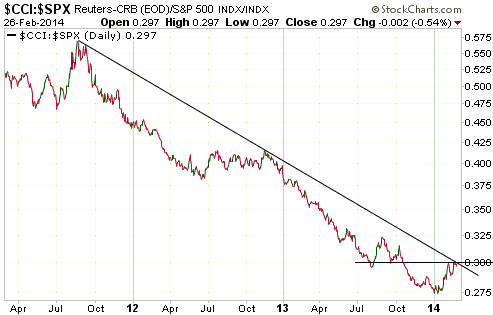
Our first chart shows CCI/SPX's daily performance over the past
three years. Notice that it would take only a small amount of
additional strength in the CCI relative to the SPX to break the
ratio above lateral resistance and a trend-line that dates back to
the 2011 peak.
Breaching the aforementioned levels on the daily chart would be
significant, but a more definitive and important signal would come
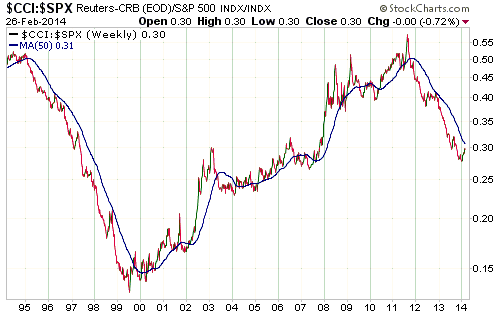
from a weekly close above CCI/SPX's 50-week moving average. Here's
why:
Our second chart shows that all counter-trend rebounds during the
cyclical CCI/SPX declines of 1995-1999 and 2011-2013 ended at or
below the 50-week MA (the blue line), and that the first weekly
close above the 50-week MA during the late-1990s signaled that the
bottom was in.
The CCI/SPX ratio is presently about 3% below its 50-week MA.
The Stock Market
We won't have anything new to say about the broad stock market
until we see where the S&P500 Index closes this week.
By far the most interesting price action over the first three days of this week
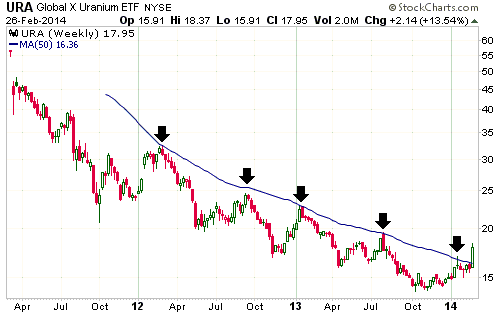
occurred in the uranium-mining sector of the stock market. As illustrated by the
following weekly chart of the Global X Uranium ETF (URA), a proxy for
uranium-mining stocks, the uranium miners have risen sharply over the past three
trading days (URA is up 13.5% since the end of last week). As long as it doesn't
give back most of these gains over the next two trading days, when this week
comes to an end URA will have achieved a weekly close above its 50-week moving
average (the blue line on the chart) for the first time in more than 2.5 years.
If this happens, the current rally will have differentiated itself from the
counter-trend rallies that occurred during 2012-2013 and we will have a clear
sign of a major trend reversal.
The catalyst for this week's surge in uranium mining stocks was news that the
political environment in Japan is becoming more favourable for nuclear power,
potentially enabling not only the restarting of many of the reactors that were
shut down in response to Fukushima but also the construction of new reactors. It
should be understood, however, that the entire rebound in uranium-mining stocks
has been based on anticipation of something that has not yet happened: a rebound
in the uranium price.
To underpin the equity rally that has already occurred and to enable the
equities to make additional price gains, the uranium price will soon have to
commence an upward trend. There's a high probability that it will.
Gold and the Dollar
Gold
Confusing Cause and Effect
As we explained in multiple TSI commentaries last year, the large 2013 decline
in the Comex gold inventory was an effect of the large decline in the gold
price, not a cause of it. Furthermore, based on the historical record it was a
predictable effect, in that over the past 35 years major trends in Comex gold
inventories have followed major trends in the gold price. In other words, there
was nothing untoward, suspicious or even the slightest bit strange about last
year's Comex inventory decline.
It's a similar story with the physical gold inventory of bullion ETFs such as
GLD. There's a nuance here in that changes in the quantity of gold held by GLD
are not directly driven by changes in the gold price, they are driven by
arbitrage. More specifically, if the price of a GLD share rises relative to the
gold price then arbitrage activity will cause physical gold to be added to GLD's
inventory, and if the price of a GLD share falls relative to the gold price then
arbitrage activity will cause physical gold to be removed from GLD's inventory.
(It's this arbitrage activity that prevents the GLD price from ever wandering
far from its net asset value.) This means that a rising gold price won't
necessarily result in gold flowing into GLD's inventory and a falling gold price
won't necessarily result in gold flowing out of GLD's inventory. However,
because trend-followers and other short-term traders exert a greater influence
on the price of GLD shares than on the price of gold bullion, GLD's price will
tend to rise faster than the gold price during a strong upward trend and fall
faster than the gold price during a strong downward trend. This creates a
tendency for the arbitrage activity mentioned above to add gold to GLD's
inventory during strong gold markets and remove gold from GLD's inventory during
weak gold markets.
The main point we want to make is that a likely EFFECT of an upward trend in the
gold price over the months/years ahead will be the addition of gold to the Comex
and GLD inventories, but going by past performance many analysts will confuse
cause and effect and wrongly interpret the inventory change as the cause and the
price change as the effect. There is a self-reinforcing element in that as
physical gold is added to the GLD inventory there will be marginally less gold
to satisfy demand elsewhere, but the process begins with a change in the price
trend.
Current Market Situation
In the latest Weekly Update, we wrote:
"Gold is 'overbought', but not by enough to create significant downside risk.
However, if it rises to around $1350 without first experiencing a multi-week
consolidation then the short-term downside risk will be as high as the remaining
short-term upside potential. Our short-term outlook will therefore shift from
"bullish" to "neutral" if gold trades in the $1340s this week."
The gold price moved into the $1340s on Tuesday 25th February, causing our
short-term outlook to shift back to "neutral".
It is important to temper your enthusiasm as the price rises, especially when
the market is 'overbought' and nearing a range of significant resistance. It is
equally important to become increasingly enthusiastic as the price declines,
especially when the intermediate-term trend appears to be 'up' and when the
market is nearing a range of significant support. In gold's case, there is
presently resistance at around $1350 and support at $1275-$1300.
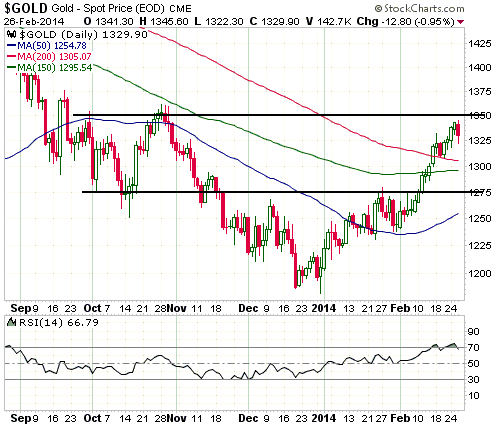
There's a good chance that gold will test intermediate-term resistance in the
low-$1400s by the middle of this year. Our short-term outlook will therefore
become "bullish" again if the price drops to $1300, because at that point there
will be more than $100 of short-term upside potential and probably no more than
$25 of short-term downside risk.
Gold Stocks
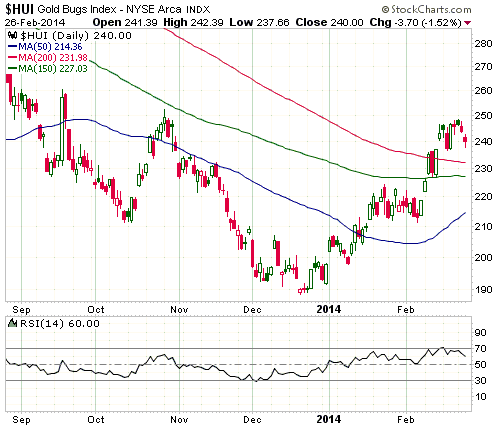
The HUI still hasn't conclusively signaled the start of a multi-week
consolidation, which means that there is still a realistic possibility of a rise
to the 250s prior to the start of such a consolidation. This possibility would
be kept alive if Thursday 27th February is an 'up' day for the HUI, but if the
daily losing streak extends to three via a 'down' day on 27th February it will
be reasonable to assume that a multi-week consolidation has begun.
Any 'corrective' activity over the days/weeks ahead will probably a) be limited
by the support that extends from the mid-220s to the low-230s, and b) push the
HUI's daily RSI (refer to the bottom section of the following chart) down to
around 50.
Currency Market Update
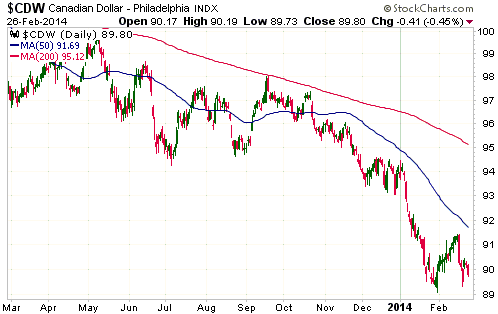
For a few years we were either intermediate-term bearish or neutral on the
senior commodity currencies (the A$ and the C$), but we recently became more
optimistic about these currencies' intermediate-term prospects. This was because
they had become extremely 'oversold' at the same time as signs had begun to
emerge that a major upward reversal was underway in the commodity world.
By breaking above its 50-day MA, the A$ has provided preliminary evidence that
it has turned the corner. However, the C$ has not yet provided any evidence of a
reversal.
While it is certainly possible that the C$ will make a new multi-year low before
making a sustained turn to the upside, we think it makes sense to average into a
'long' C$ position with C$ futures trading below 90.
Updates
on Stock Selections
Notes: 1) To review the complete list of current TSI stock selections, logon at
http://www.speculative-investor.com/new/market_logon.asp
and then click on "Stock Selections" in the menu. When at the Stock
Selections page, click on a stock's symbol to bring-up an archive of
our comments on the stock in question. 2) The Small Stock Watch List is
located at http://www.speculative-investor.com/new/smallstockwatch.html
 Updates
to short-term trading positions Updates
to short-term trading positions
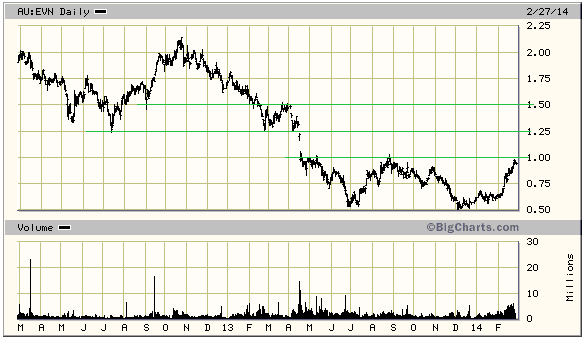
In the 17th February Weekly Update we wrote that for TSI record purposes we
would exit the short-term position in Evolution Mining (EVN.AX) if the stock
traded at A$0.96. It traded at this price on Tuesday 25th February, so this
position has been removed from the TSI List. The result was a profit of 55%.
Our decision to exit this short-term trade at A$0.96 was based on the stock's
price chart (see below). EVN has resistance at A$1.00, so it would be normal for
the stock to do some 'backing and filling' following a quick move up to around
$1.00.
After A$1.00, there is resistance at A$1.25 and then at A$1.50. We suspect that
the higher of these levels will be tested by mid-year, so some corrective
activity over the next couple of weeks could prompt us to initiate a new EVN
short-term trade. In any case, we are maintaining long-term exposure to the
stock.
Updates to
TSI Small Stocks Watch List (SSWL)
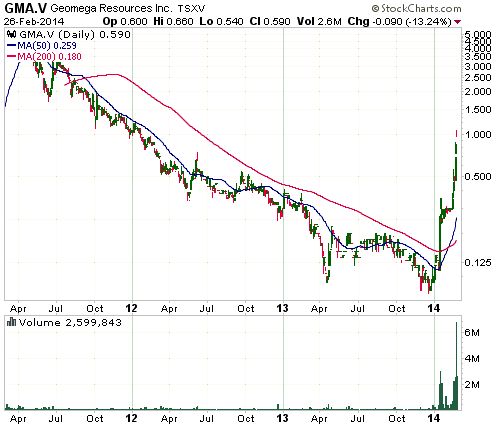
1) Geomega Resources (GMA.V), an exploration-stage miner with a tiny
market cap and a huge rare-earth-element (REE) deposit in Quebec,
was added to the SSWL on 3rd February this year. The share price at
the time was C$0.29.
The price of this stock has since been very volatile. Prior to this
Tuesday most of the volatility was to the upside, but after trading
as high as C$1.06 on Tuesday morning the stock reversed downward on
huge volume and ended the day at C$0.68. It then fell further to
close at C$0.59 on Wednesday. This week's price action appears to be
a case of "buy the rumour and sell the news", in that the downward
reversal in the stock price came shortly after the release of good
news in the form of positive results from additional testing of the
REE separation technology being pioneered by GMA.
The fundamental story is developing bullishly and at $25M the
company's market cap is still very low relative to the potential
value of its REE project. However, this is obviously not a stock
that should be owned by risk-averse investors or anyone who is put
off by extreme stock-price volatility. Also worth noting is that the
company will soon have to do an equity financing. Perhaps the
financing announcement will provide the next opportunity for
high-risk speculators to buy some shares.
2) On 18th September last year we added East Africa Metals (EAM.V)
to the SSWL. EAM owns an exploration-stage gold project with a 1M-oz
resource in Tanzania, but the sole reason for our interest in this
company was that it was trading at less than half the value of its
cash in the bank.
Unfortunately, the company's management has substantially changed
the situation for the worse via a takeover bid for Tigray Resources,
a company with negative working capital and mining claims covering
some elephant pasture in Ethiopia. This takeover is ethically
questionable, as the same guy is CEO of both companies (it looks a
lot like a bailout of Tigray at the expense of EAM shareholders),
but ethical or not it will greatly reduce the amount of cash per EAM
share and in doing so eliminate the reason for our interest. We have
therefore removed EAM from the SSWL.
EAM has left at the same price it entered (C$0.13).
Chart Sources
Charts appearing in today's commentary
are courtesy of:
http://stockcharts.com/index.html
http://bigcharts.marketwatch.com/

|









