|
- Interim Update 26th May 2010
Copyright
Reminder
The commentaries that appear at TSI
may not be distributed, in full or in part, without our written permission.
In particular, please note that the posting of extracts from TSI commentaries
at other web sites or providing links to TSI commentaries at other web
sites (for example, at discussion boards) without our written permission
is prohibited.
We reserve the right to immediately
terminate the subscription of any TSI subscriber who distributes the TSI
commentaries without our written permission.
"Austrian"-oriented investment advisors
A question we get asked a few times every year goes something like this:
"I am a Trustee on an
employee retirement fund board. Our current managers are good in many
respects, but one glaring weakness is their view of the financial
system problems. They believe the things that Governments and Central
Banks are doing are necessary and likely to be beneficial over time. It
has been an uphill battle to make inroads into changing this mind-set.
I would like to find another manager who realises that the attempted
solutions to the system's current problems are non-productive and are
leading to more and bigger problems. We the Board members are not able
to select and make direct investments into specific funds as our
fiduciary purview does not allow us to act as "investment
professionals". Are you aware of such a manager we could interview who
would manage our Benefit Trust funds?"
We have never been able to answer the above question in the past,
mainly because we have never had any interest in or connection with the
professional money management business (we manage all of our own money).
In the future we would like to be able to provide some useful
information to people who are searching for professional investment
advisors -- in the form of a short-list of advisors that 'get it'. We
are open to suggestions from the TSI readership as to who should go on
this short-list. Specifically, we are looking for the names and contact
details of professional managers/advisors who a) have good track
records over the past 5 years, and b) understand that the attempted
solutions to the system's current problems will lead to more and bigger
problems.
Paying interest to yourself
According
to the Congressional Budget Office, the Federal Reserve will probably
transfer record earnings exceeding $70 billion to the U.S. Treasury
this year. The Fed's earnings stem primarily from the interest income
generated by its holdings of mortgage-backed securities and Treasury
Bonds.
The situation can be summed up as follows: The US Government and
Government-Sponsored Enterprises issue bonds that are purchased by the
Fed. These bonds pay interest, which, after accounting for some
expenses, drops to the Fed's bottom line in the form of earnings. The
earnings are then paid to the US Government. In other words, when
Government bonds are purchased by the Fed, the Government is
effectively paying interest to itself.
An implication is that the US Government incurs almost no interest
expense on bonds that are purchased by the Fed, and, therefore, that
there is a strong incentive for the Government to sell its bonds to the
Fed. Another implication is that the interest rate on new US Government
debt will cease to matter once the point is reached where almost all
new Treasury Bonds are being purchased by the Fed. At least, it will
cease to matter with respect to the Government's ability to finance
itself.
Although it can be argued that the US is no better than the "PIIGS"
when it comes to government finances, the US Government should be able
to maintain the illusion of solvency for longer than any euro-zone
government thanks to the Fed's unlimited ability to monetise (purchase
with newly-created money) combined with the important reality that the
Fed operates like a branch of the US Treasury.
Is the "commodity supercycle" over?
We don't think the
"commodity supercycle" is over. Rather, we don't think it ever existed.
As we explained back in August of 2007:
"...when it comes to the
"commodity supercycle" we are definitely sceptics. We concur with the
view that commodity prices in general and metal prices in particular
are in long-term upward trends, but we do not think these trends are
being driven by the strong growth of "Chindia" or the global spread of
capitalism or the industrialisation of Asia or the movement of billions
of people to the ranks of the "middle class" or any of the other
catchphrases routinely used to neatly explain the price action. In our
opinion, these explanations rank alongside slogans such as "new
economy" and "technology-driven productivity miracle" that were used to
legitimise the price action of tech stocks during the boom of the
late-1990s.
As we see it, inflation
(money supply growth) is causing a rolling boom/bust cycle whereby the
combination of relative valuation and scarcity determines which sectors
will be the major beneficiaries of inflation during the current cycle
and which sectors will be relegated to the investment 'scrap heap'.
The analysts who concoct
simple explanations based on real (non-monetary) changes in the world
and repeat these explanations in mantra-like fashion will look
incredibly prescient for a long time, even though they largely ignore
the monetary factors that are actually at the root of the price
changes."
The argument that the past decade's major upward trend in commodity
prices was due to economic progress is inherently illogical. This is
because real economic growth causes prices to fall, not rise (real
per-capita economic growth is caused by increasing productivity, also
known as producing more for less). The reason that prices rose in
parallel with considerable global economic growth over the past decade
is that there was enough monetary inflation to more than offset the
downward pressure on prices exerted by the economic growth.
There will probably be enough inflation over the next several years to
push most commodity prices to new highs in nominal currency terms, but
we suspect that in real terms commodity indices such as the CCI and the
CRB reached secular peaks in June of 2008.
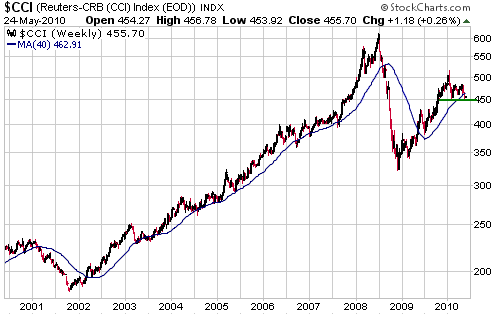
The following weekly chart of the CCI (Continuous Commodity Index)
shows the major upward trend that culminated in mid-2008, the H2-2008
crash, and the 2009 post-crash rebound. There's a good chance that the
post-crash rebound ended in January of this year and that an
intermediate-term decline is in its infancy, but as things presently
stand the CCI hasn't fallen far enough to confirm this interpretation.
The CCI will have to move decisively below 450 to remove most of the
remaining doubt that the post-crash rebound is over.
The next intermediate-term low for the CCI will likely arrive during
the final quarter of this year -- at around the same time that the
broad stock market will bottom if it continues to track the
"Presidential Cycle" model.
The Stock Market
The
S&P500 traded well below its 6th May ("flash crash") intra-day low
on Tuesday and tested support defined by its early-February low. Note,
though, that the 6th May low has thus far held on a daily closing
basis. The following chart shows the situation.

It's likely that the
market action of the past 5 trading days constituted a successful test
of support defined by the early-May and early-February lows, and that a
strong rebound will soon begin. We wouldn't attempt to 'play' this
rebound, but it could provide a good opportunity to either raise some
more cash or purchase some put options for hedging purposes.
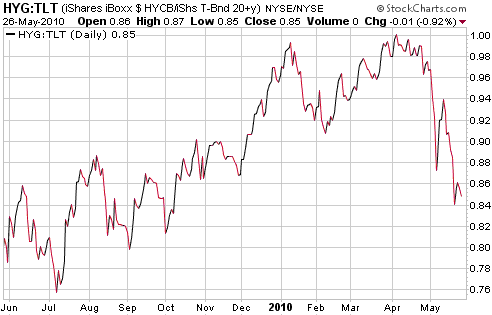
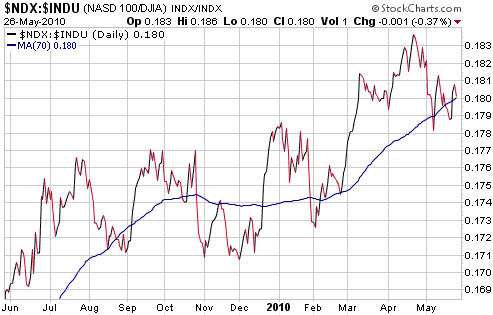
Two of our favourite indicators are charted below. The first chart
shows the HYG/TLT ratio, a proxy for credit spreads (a falling HYG/TLT
ratio is associated with a rise in credit spreads, which, in turn, is
associated with declining optimism about economic growth). It shows a
'double top' between January and April followed by a sharp decline. Its
performance is consistent with the view that the stock market is now in
an intermediate-term downward trend. The second chart shows the NDX/Dow
ratio, which almost always trends in the same direction as the broad
stock market and sometimes leads at important turning points. Although
this ratio has pulled back from its April peak, it hasn't yet fallen
far enough to confirm an intermediate-term trend reversal.
The TED Spread is an
indicator that we follow, but seldom mention in the TSI commentaries.
We seldom mention it because it rarely gives a meaningful signal.
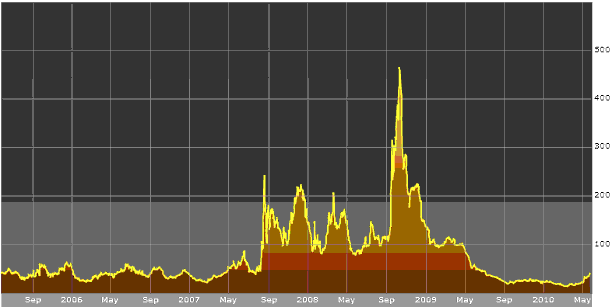
For the uninitiated, the TED Spread is the difference between the
three-month T-bill interest rate and three-month LIBOR, which means
that it is the difference between the interest rate at which banks lend
short-term money (US dollars) to each other via the London money market
and the interest rate at which the US Government borrows short-term
money. In the early stages of a financial crisis the TED Spread usually
rises as banks become less willing or less able to lend money to each
other.
The following Bloomberg chart shows that the TED Spread has just begun
to rise from the multi-year low it reached during the first quarter of
this year. Note that it would need to move well above 50 basis points
(0.50%) to generate a warning signal.
We will be paying
close attention to the TED Spread over the coming months, but we won't
be surprised if it remains at a relatively low level regardless of what
happens to the stock market and economic growth. The reason is that
with 2008 fresh in their minds and with minimal fear of inflation,
central bankers will likely react very quickly to any signs of
financial system stress. And they will react in the only way they know
how -- by flooding the banking system with new money.
Gold and
the Dollar
Gold
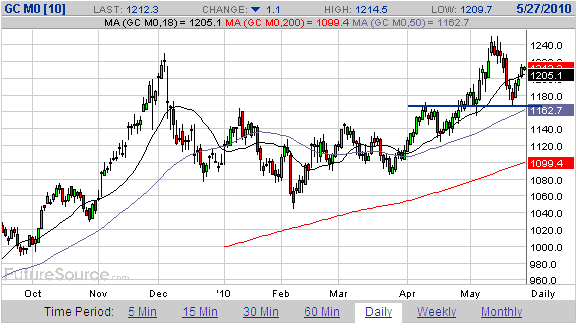
Gold is rebounding after testing support late last week. For the
short-term upward trend to remain intact, support in the $1160s must
continue to hold.
Some analysts are
forecasting a parabolic advance in the gold price over the next 6-8
months. In our opinion, this is a very UNLIKELY outcome, one reason
being that parabolic advances generally occur near the ends of
long-term bull markets and gold's long-term bull market is probably not
nearing its completion. Another reason is that a parabolic rise in the
US$ gold price would likely require rampant fear of US$ inflation or a
complete collapse of the euro. Both of these will eventually occur, but
there is very little chance of either occurring this year.
Rather than rocketing upward, the US$ gold price is more likely to
spend a few months chopping back and forth between $1100 and $1300
before resuming its longer-term advance. Relative to most other
commodities, gold's longer-term advance has probably resumed already.
After re-weighing risk and potential reward, we are downgrading our short-term gold outlook from "bullish" to "neutral".
Gold Stocks
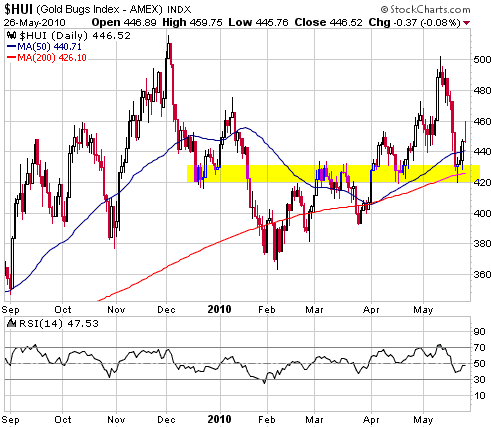
The 2-year outlook for the gold sector -- as represented by the HUI --
is extremely bullish, but in our opinion the sector is presently
immersed in an intermediate-term correction that will likely continue
until October and result in at least one test of the early-February low
(around 370 for the HUI).
On a shorter-term basis, the HUI is rebounding after testing support at
420-430 late last week. One possibility is that this rebound ended at
460 on Wednesday, while a more probable outcome is that it will
continue for another week or so.
Currency Market Update
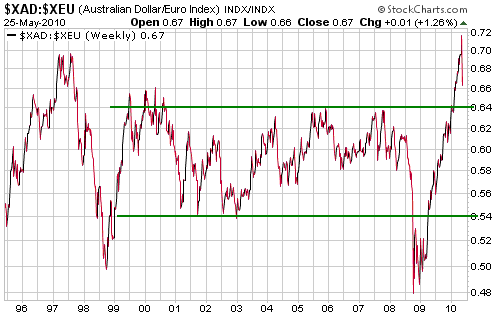
The following weekly chart shows the Australian Dollar relative to the
euro (A$/euro). Notice that A$/euro oscillated within a horizontal
range from 1999 through to mid-2008, but that during the second half of
2008 it plunged below the bottom of its range to a 15-year low. Notice,
as well, that it bottomed during Q4-2008 and then moved relentlessly
upward to a new 15-year high earlier this month. In other words,
relative to the euro the A$ went from a 15-year low to a 15-year high
within the space of only 18 months. It says something about today's
monetary system that the relative valuations of two major currencies
can vary so much over such a short time.
The A$ has been
elevated over the past year by speculative buying associated with
commodity-related optimism. This means that if industrial commodities
are now in intermediate-term downward trends then the A$ will likely be
pressured lower over the next six months against both the euro and the
US$ as optimism transmogrifies into pessimism. Assuming that this
causes A$/euro to do no worse than drop back to the middle of its
10-year range (0.58) and that euro/US$ drops to the 1.15
intermediate-term target previously mentioned at TSI, we end up with a
target of 0.66 for the A$ relative to the US$. This is several points
below the chart-based target noted in the latest Weekly Update.
The future is always unknown, which means that price targets shouldn't
be taken too seriously. We regularly mention price targets to give our
readers a rough idea of how much upside potential or downside risk we
perceive, but a speculator's success will be determined by his ability
to manage risk and adapt to changing circumstances in real time, rather
than by his ability to come up with accurate price targets.
Putting aside price targets, our A$/US$ view can best be phrased as
follows: A rebound to the mid-to-high 0.80s over the next few weeks
would create the situation where the downside risk was much greater
than the upside potential on both a short- and intermediate-term basis,
IF we are correct to assume that the commodity indices have commenced
intermediate-term declines.
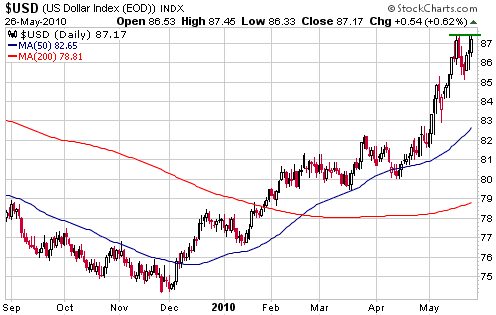
Moving along, the euro has dropped back to test its low and this has
pushed the Dollar Index back to last week's high (see chart below).
Sentiment indicators suggest the potential for a strong 1-2 month
correction (euro up, Dollar Index down), but price action hasn't yet
confirmed the start of a correction.
Update
on Stock Selections
(Notes: 1) To review the complete list of current TSI stock selections, logon at http://www.speculative-investor.com/new/market_logon.asp
and then click on "Stock Selections" in the menu. When at the Stock
Selections page, click on a stock's symbol to bring-up an archive of
our comments on the stock in question. 2) The Small Stock Watch List is
located at http://www.speculative-investor.com/new/smallstockwatch.html)
Chart Sources
Charts appearing in today's commentary
are courtesy of:
http://stockcharts.com/index.html
http://www.futuresource.com/

|









