|
- Interim Update 26th June 2013
Copyright
Reminder
The commentaries that appear at TSI
may not be distributed, in full or in part, without our written permission.
In particular, please note that the posting of extracts from TSI commentaries
at other web sites or providing links to TSI commentaries at other web
sites (for example, at discussion boards) without our written permission
is prohibited.
We reserve the right to immediately
terminate the subscription of any TSI subscriber who distributes the TSI
commentaries without our written permission.
The Stock Market
The US
We mentioned a couple of times over the past several weeks that there appears to
have been an important change in the relationship between the Japanese stock
market and Japanese Government Bonds (JGB). For many years, JGBs tended to
decline in reaction to stock market strength and rally in reaction to stock
market weakness. That is, the JGB market tended to be a slave to the stock
market. However, the stock market has recently started to act like a slave to
the bond market, with equities plunging in reaction to falling bond prices
(rising bond yields) and bonds essentially ignoring the steep decline in
equities.
A similar change has also become evident in the US markets, with a falling
T-Bond contributing to weakness in equities and T-Bonds not receiving any
support from the weak stock market. Consequently, a T-Bond rebound is the most
likely catalyst for the next multi-week rally in the US stock market.
The T-Bond may or may not have bottomed during the first half of this week, but
as discussed in the latest Weekly Update there is now more short-term upside
potential than downside risk in this market. The bond market will probably begin
to rebound within the next week or so, paving the way for the stock market to do
the same.
Our guess is that the US stock market hasn't yet reached a short-term bottom,
but will do so in the near future. It will probably then rally to a marginal new
all-time high.
Two reasons for expecting the next multi-week rally to make a higher high rather
than a lower high are:
1. Small-cap stocks have generally out-performed large-cap stocks during the
May-June weakness. This is the opposite of what should have happened if the
May-June weakness was the first phase of a new cyclical bear market.
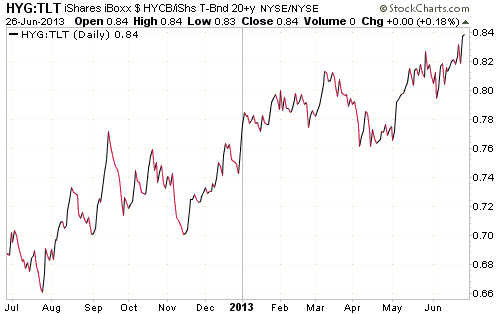
2. As illustrated by the following chart, there has recently been significant
strength in high-risk bonds (represented by HYG) relative to low-risk bonds
(represented by TLT). This is also the opposite of what should have happened if
the May-June weakness was the first phase of a new cyclical bear market.
China
The short-term liquidity crisis in China's banking system has been deliberately
created by China's central bank and will end whenever the central bank decides
it should end.
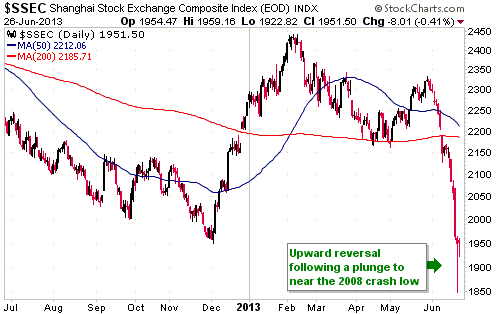
After the Shanghai Stock Exchange Composite Index (SSEC) fell more than 5% to
within spitting distance of its 2008 crash low on Tuesday 25th June, a rumour
emerged that the central bank was about to 'ease up'. This enabled an impressive
intra-day reversal, with the SSEC recouping its 5% loss to end roughly flat on
the day. The central bank subsequently confirmed the rumour, but the SSEC hasn't
yet built on Tuesday's reversal and inter-bank interest rates remain higher than
usual.
If we have time we'll write some more about China's economic plight in the
coming Weekly Update.
Gold and the Dollar
Gold
If fundamental analysis is correct then it will eventually be confirmed by price
action, but for fundamental analysis to be useful it must be independent of
price action. The reason is that the market price will often diverge from the
fundamentals due to sentiment, with the best opportunities for investors being
presented during those times when the gap between the market price and the
fundamentals becomes wide. You will never be able to identify these
opportunities if, like almost all financial journalists and many newsletter
writers, you concoct fundamental stories to match whatever the current price
action happens to be.
Gold's recent market action has created one of the biggest gaps we've ever
encountered between price and fundamentals. It has also led to a deluge of
'fundamental' explanations for why the gold market is destined to remain weak
for a long time to come. These explanations are just reactions to what has
already happened to the price and have as much chance of proving to be prescient
as all the gold-bearish articles doing the rounds during 1999-2000.
Turning to gold's daily price chart (see below), the downward trend obviously
continued over the first three days of this week. $1200, the chart-based
measured objective created by last week's downside breakout, was almost reached
on Wednesday 26th June.
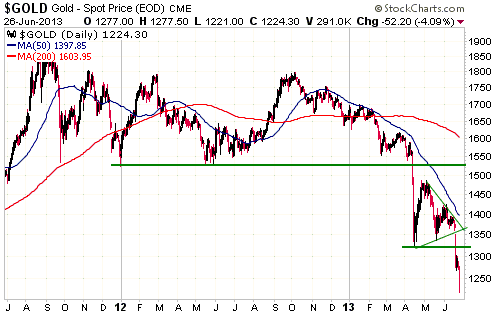
Clearly, gold's price is very extended to the downside and sentiment is almost
as bearish as it ever gets. This tells us that there is large rebound potential,
but it doesn't guarantee that the price won't go lower before a substantial
rebound begins.
Gold Stocks
Clarification of the latest Weekly Update
In response to questions from our readers, we want to make it clear that in the
Gold Stocks section of the latest Weekly Update we didn't mean to imply that the
most likely scenario now involved the HUI declining relentlessly to an Oct-Nov
low as per its performance during 2000. We were only pointing out that 2013's
price action to date was most similar to that of 2000. By most measures the HUI
is now far more oversold than it was at any time during 2000 (including at the
November-2000 bottom), so we are not expecting a lot more downside in prices.
However, once it was proven that May-2013 did not provide us with a major
turning point, Oct-Nov of this year became -- based on the gold sector's
long-term historical record -- the most likely time-window for such an event.
Real-time analysis should always trump any speculated scenario, so we are not
blindly assuming that a sustained upward reversal will wait for Oct-Nov or that
the transition to a new cyclical bull market will necessarily happen during
Oct-Nov if it doesn't happen earlier. Furthermore, even if a sustained upturn is
destined to wait until Q4 of this year, there are a number of possible paths
between now and then. One entails a 1-3 month rebound beginning very soon
(within the next few days) followed by a decline to test the June low in
Oct-Nov.
Current Market Situation
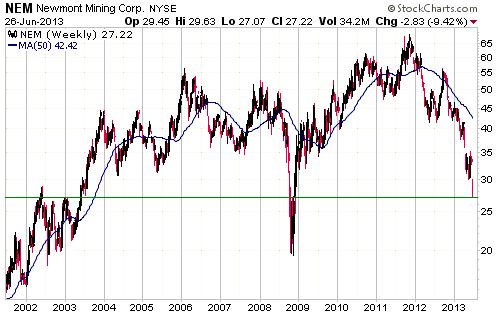
"Stretched to the downside" would be an under-stated way of describing the
current situation in the gold sector of the stock market. This is painfully
obvious in the following weekly charts of Barrick Gold (ABX) and Newmont Mining
(NEM), the world's two largest producers of gold.
ABX has just plunged below its 2008 crash low and is now trading at its lowest
level since the first quarter of 2003. In other words, it is trading at a
10-year low.

NEM remains comfortably above its 2008 crash low, but this is only because it
was much lower than ABX on a relative basis at the 2008 bottom. Apart from the
5-week period around the 2008 bottom, NEM is also now trading at a 10-year low.
If you are a value-oriented investor with a sizeable cash reserve, you should
relish the opportunity being offered by current price levels.
Update
on Stock Selections
Notes: 1) To review the complete list of current TSI stock selections, logon at
http://www.speculative-investor.com/new/market_logon.asp
and then click on "Stock Selections" in the menu. When at the Stock
Selections page, click on a stock's symbol to bring-up an archive of
our comments on the stock in question. 2) The Small Stock Watch List is
located at http://www.speculative-investor.com/new/smallstockwatch.html
 Addition
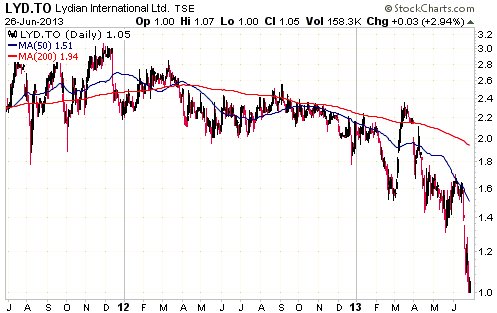
to the TSI List: Lydian International (TSX: LYD). Shares: 130M issued, 135M
fully diluted. Recent price: C$1.05 Addition
to the TSI List: Lydian International (TSX: LYD). Shares: 130M issued, 135M
fully diluted. Recent price: C$1.05
In the latest Weekly Update we stated that LYD would be added to the TSI Stocks
List if it traded at C$1.05. It reached this price level on Monday 24th June and
has therefore been added.
As noted in last week's Interim Update:
"LYD is an exploration/development-stage gold miner with working capital of
about $20M. Its primary asset is the Amulsar gold project in Armenia.
The Amulsar project has a total resource of 3.9M-oz (2.3M ounces M&I plus 1.6M
ounces Inferred). The resource has a fairly low average grade (just over 1-g/t),
but because it is close to the surface and has favourable metallurgy it appears
to have strong economic potential at the current gold price. In fact, a
Feasibility Study completed last September indicated that Amulsar could be
developed into a 170K-oz/year gold mine with a healthy pre-tax IRR of 28% at a
gold price of only $1200/oz."
The following table summarises the salient details from the Amulsar FS completed
last Sepember:
|
|
Lydian International (LYD.TO) |
|
Project Name |
Amulsar |
|
Location |
Armenia |
|
Engineering Study / Date |
FS / Sep-2012 |
|
Planned Mine Type |
Open Pit |
|
M&I Resource (oz) |
2.3M |
|
Avg Resource Grade |
1.14g/t |
|
P&P Reserve (oz) |
2.3M |
|
Metallurgical Recovery |
88% |
|
Strip Ratio |
2.23:1 |
|
Avg Annual Production (oz) |
170K |
|
Cash Cost (per oz) |
$468 |
|
All-In Cost (per oz) |
|
|
Mine Life |
12 years |
|
Initial Capital Cost ($M) |
270 |
|
Assumed Gold Price (US$) |
1200 |
|
NPV ($M) |
646 |
|
IRR |
27.7% |
|
Capital Payback Period |
4.0 years |
|
Project Ownership Percent |
100% |
|
NPV of Company Stake ($M) |
646 |
|
Current Stock Price (US$) |
1.05 |
|
Share Count (M) |
130 |
|
Current Market Cap ($M) |
137 |
|
Net Cash ($M) |
20 |
|
Current Enterprise Value ($M) |
117 |
|
EV/NPV |
18% |
|
Current Discount to NPV |
82% |
|
EV + Capital Cost (EVCC) |
387 |
|
EVCC/NPV |
0.60 |
Of particular relevance, at its current stock
price and assuming a gold price of only $1200/oz, LYD has an EVCC/NPV ratio of
only 0.60. This tells us that the project economics are robust and that the
stock is very attractively priced from the perspective of a potential acquirer.
As far as upside potential is concerned, we note that LYD's stock price would
have to rise to C$3.00 to push the EVCC/NPV ratio up to 1.0. C$3.00 seems a
little too ambitious considering the market environment and the stock's current
level, but we think that C$2.50 is a realistic intermediate-term (6-12 month)
target.
Also noteworthy:
1) LYD is expected to publish an updated FS next month, which means that the
stock has a near-term news-related catalyst.
2) LYD is a favourite of Brent Cook and Rick Rule, two astute and very
experienced investors in junior mining stocks.
3) LYD was one of the very few gold stocks to rise in price during the
sector-wide carnage on Wednesday 26th June. This could be an early sign that for
this particular gold stock, value-oriented buyers have finally begun to
overwhelm weak-handed sellers.
Addition to the TSI List: Premier Gold (TSX: PG). Shares: 150M
issued, 161M fully diluted. Recent price: C$1.51
In the latest Weekly Update we stated that PG would be added to the
TSI Stocks List if it traded at C$1.80. It reached this price level
on Monday 24th June and has therefore been added.
As noted in last week's Interim Update:
"PG is an exploration-stage gold miner with about $100M of
working capital and three interesting gold projects in excellent
locations: the Trans-Canada and Rahill-Bonanza projects in Ontario
and the Cove project in Nevada.
PG's value is impossible to quantify with any accuracy at this time
because none of its projects has a completed economic analysis and
only the Trans-Canada (TC) project has a defined resource. However,
the TC resource is substantial (4.12M ounces M&I plus 3.65M ounces
Inferred) and the Cove project's initial resource estimate is
scheduled for H2-2013. Also, a PEA for the TC project is scheduled
to be complete in Q3-2013.
The TC project is 100%-owned by PG, but the other two projects
mentioned above are joint ventures with major gold producers.
Specifically, Rahill-Bonanza is a JV with Goldcorp (PG owns 49%) and
Cove is a JV with Newmont (PG currently owns 100%, but NEM has the
right to claw back 51% [by paying 250% of PG's total expenditure on
the project since 2006])."
One of the reasons for our interest in PG is its takeover potential.
Over the past year, three of the most significant takeovers of
exploration-stage junior gold miners have been done in order to gain
ownership of projects in Ontario. We are referring to IAMGOLD's
takeover of Trelawney Mining, Argonaut Gold's takeover of Prodigy
Gold and New Gold's very recent takeover of Rainy River Resources.
Two of PG's three core projects are situated in Ontario.
New Gold and Agnico Eagle are potential acquirers of PG, but
Goldcorp (GG) is the most likely buyer. The reason is that the
Rahill-Bonanza project, which is presently a 49/51 JV between PG and
GG, is the last project on the main Red Lake mine trend that is not
100%-owned by GG. By taking over PG, Goldcorp would consolidate its
ownership of the Red Lake trend, obtain the separate 8M-oz
Trans-Canada project in the same jurisdiction, and obtain a
high-potential project in Nevada.
As stated above, it is difficult to quantify a value for PG at this
stage of its development. However, by assigning a value of $50/oz to
the TC project's M&I resource and no value to its Inferred resource
we can arrive at a conservative, albeit realistic in the current
market environment, value of about $200M for the TC project. Adding
PG's $90M of net cash and listed investments (5.6M shares of
Sandstorm Gold) yields a company valuation of $290M, not counting
the Rahill Bonanza and Cove projects.
At this time we are going to assign a very rough combined value of
$100M to PG's Rahill Bonanza, Cove and other projects, giving us a
total estimated company value of $390M. This equates to
C$2.60/share, which in our opinion represents a base case.
Our intermediate-term target for the stock price is C$3.50. This
assumes that higher valuations for the TC and Cove projects will
become appropriate after a PEA for TC and an initial resource
estimate for Cove are published during H2-2013. It is also based on
the price chart, in that a break above resistance at C$2.50 would
create a technical target of C$3.50.
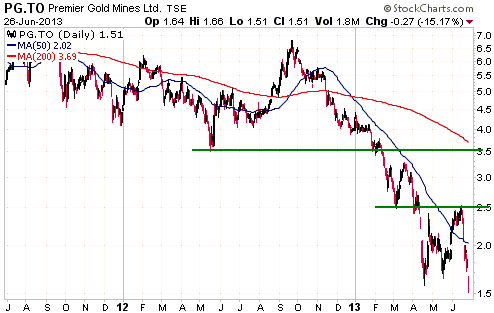
We thought that PG's intermediate-term risk/reward was attractive at
C$1.80. As a result of the stock's sharp decline in reaction to
Wednesday's sector-wide carnage, it is now considerably more
attractive.
Deletions from the TSI Stocks List
Due to the recent additions of RIO.TO, LYD.TO and PG.TO, and our
desire to not increase the total number of stocks that we cover (we
would actually like to reduce the number of stocks covered), we are
deleting three stocks from the TSI Stocks List. Unfortunately, each
deleted stock will go into the record books as a substantial loss.
The deletions are:
1) Pinetree Capital (PNP.TO), a leveraged play on the TSX Venture
Exchange Composite Index. PNP could make a future return to the
List, but one thing we've discovered is that this company's
highly-compensated management adds no value. The stock should
therefore only ever be purchased as a short-term trade.
2) Rio Novo Gold (RN.TO), an exploration-stage gold miner with
projects in Brazil and Colombia that could, with sufficient
financing, advance quickly to production. The problem is that it
will be almost impossible for RN to obtain sufficient financing
until well after the market for gold stocks embarks on a new bullish
trend. Furthermore, the company is at risk of running out of money
before year-end.
Probable lack of access to financing is the sole reason for our
decision to jettison this extremely under-valued stock.
3) Sandspring Resources (SSP.TO), an exploration-stage miner with a
large, low-grade gold project in Guyana. As is the case with RN.TO,
this company will have trouble raising money until well after the
market begins to improve and is at risk of running into a cash
shortage before year-end.
Probable lack of access to financing is also the sole reason for our
decision to jettison this extremely under-valued stock.
Chart Sources
Charts appearing in today's commentary
are courtesy of:
http://stockcharts.com/index.html

|









