|
- Interim Update 26th September 2012
Copyright
Reminder
The commentaries that appear at TSI
may not be distributed, in full or in part, without our written permission.
In particular, please note that the posting of extracts from TSI commentaries
at other web sites or providing links to TSI commentaries at other web
sites (for example, at discussion boards) without our written permission
is prohibited.
We reserve the right to immediately
terminate the subscription of any TSI subscriber who distributes the TSI
commentaries without our written permission.
China in
the News
Events in China often make news outside China, but even when we
were living in China it was difficult for us to figure out what was
really happening. Figuring out what's happening to China's economy
is especially difficult, in part because all of the economic
statistics put out by the Chinese government are totally bogus. We
note, for example, that according to HSBC's survey of China's
factory managers September-2012 was the 11th month in a row of
deterioration in the manufacturing sector, but even if the
manufacturing sector deteriorates every month this year the Chinese
government can still be relied on to report annual GDP growth of
around 7.5%. And many Western analysts can be relied on to treat the
reported 7.5% growth rate as if it reflected reality and use it to
justify bullish outlooks for some commodities.
Bogus statistics do not present the biggest challenge to those who
want the truth about China's economy. That honour belongs to the
combination of widespread corruption and unprecedented
mal-investment. As a result of these issues, the superficial signs
of China's economic strength are often, on a deeper level, evidence
of economic weakness, making it impossible to determine the extent
of China's real economic progress. We are referring in particular to
the nation-wide building boom that has squandered resources and
transferred immense wealth to Party officials, politically-connected
property developers and senior managers at State-Owned Enterprises.
We've discussed China's monetary-inflation-fueled investment boom in
many TSI commentaries over the years. The starring role played by
corruption is discussed in "The
Macroeconomics of Chinese Kleptocracy".
China recently made the Western news due to violent protests in the
streets of major Chinese cities, ostensibly in reaction to the
Japanese government's purchase, from a private Japanese citizen, of
a group of small uninhabited islands (the Diaoyu Islands in China,
the Senkaku Islands in Japan) over which
both countries claim sovereignty. We say "ostensibly", because
when it comes to China you never really know. A likely explanation
is that the widespread and high-profile protests were orchestrated
by the Chinese government, either as a way of turning up the heat on
the Japanese government or as a way of distracting the Chinese
public from economic problems at home. A less likely, but still
plausible, explanation is that many of the protestors were actually
venting anger at the Chinese government under the cover of a protest
against Japan. In China, protests against Japan are usually allowed
and are sometimes even encouraged, but protests against the Chinese
Communist Party are speedily quashed.
By the way, Taiwan's government also claims sovereignty of the
islands at the centre of the China-Japan dispute and attempted to
assert its 'ownership rights' earlier this week. In Taiwan the
chain of islands is called Tiaoyutai.
Another recent talking point in the Western press was China's
official announcement of $160B of spending on new infra-structure
projects. The announcement was designed to maintain a veneer of
economic strength a while longer -- at least until after next
month's Communist Party leadership transition is put to bed. If this
spending program goes ahead it will constitute another grand-scale
wastage of resources and line the pockets of Party officials and SOE
managers with tens of billions more dollars. A large proportion of
the looted money will inevitably find its way into the Hong Kong
property market, giving the world's most expensive real estate
another price-boost and pushing home ownership even further out of
the reach of the average Hong Kong resident. That being said, there
is considerable scepticism surrounding the latest infra-structure
spending binge. For one, it relies on substantial spending by
provincial Chinese governments that make the government of Greece
look like a picture of financial health. For another, the $160B
appears to cover existing as well as new projects.
We now turn our attention to the story about "ghost metal
inventories" that made the rounds over the past couple of weeks. The
crux of the matter is that many borrowers of money from Chinese
banks pledged steel stored in warehouses as collateral for their
bank loans. In some of these cases the borrowers defaulted, but when
the associated bank tried to take possession of the collateral it
discovered that the metal wasn't there, or that the metal was there
but not owned by the bank's customer, or that the same pile of metal
had been pledged as security to multiple lenders. The story that
recently circulated focused on steel inventories, but it's a good
bet that the same applies to inventories of copper and other metals.
It's also a good bet that the same applies to other collateral used
to obtain loans.
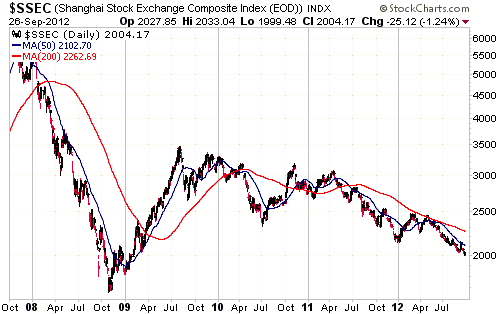
The final piece of China-related news that we'll deal with in
today's commentary is the decline by the Shanghai Stock Exchange
Composite Index (SSEC) to big round-number support at 2000. On
Wednesday 26th September the SSEC traded slightly below 2000, which
was also its lowest level since January of 2009, before ending the
day slightly above 2000.
We aren't inclined to place any bets on the performance of the SSEC,
but if we were forced to place a bet it would be a bullish one
predicated on the idea that the Chinese government will draw a line
at 2000.
T-Bond
Update
Treasury Bonds tend to perform relatively well
when the stock market is declining and relatively poorly when the stock market
is rising. This is mainly because inflation expectations tend to rise and fall
with the stock market. At least, that's the way it is today and the way it has
been for many years, although at some future time it's likely that rising
inflation expectations will cause large parallel declines in the stock and bond
markets.
Due to the current tendency of the stock and T-Bond markets to trend in opposite
directions, being short-term bearish on both markets is an uncomfortable
position. However, this is the position we are in. We can be short-term bearish
on both markets because from our perspective individual market analysis trumps
inter-market analysis, and both markets appear to have a lot more downside than
upside potential.
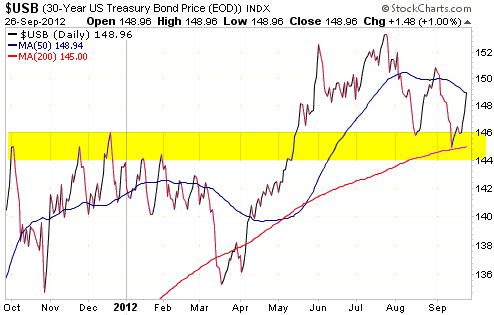
A couple of weeks ago the T-Bond was a little 'oversold' and within a range of
good support (see chart below). It is therefore not surprising that it has since
rebounded. A decline in inflation expectations over the past few days in
reaction to the stock market's pullback gave the T-Bond an additional boost, but
unless the stock market's decline gains momentum (unlikely in the immediate
future) the T-Bond market's rebound is probably close to an end.
 The Stock Market
The Fed announced "QE3" on 13th September. The S&P500 Index
closed at 1437 on 12th September and closed at 1433 on 26th September, meaning
that the US stock market is down since the introduction of the Fed's latest
inflation program. This simply reflects the fact that a lot of QE anticipation
was built into the market prior to the Fed's announcement.
There's a lot of downside risk in the US stock market, but the most likely
near-term outcome is that the current correction will be followed by a return to
the September high. We suspect that the ultimate high won't be more than 3% from
the September high, despite the Fed's helping hand.
Gold and the Dollar
Gold and Silver
Gold tested resistance at around $1800 late last week and then began to
'correct'. This is not the least bit surprising. It traded as low as the $1730s
on Wednesday before recouping some of its losses to end the day in the $1750s.
As previously advised, a new short-term buying opportunity would be created by a
decline to near the 50-day moving average. This moving average is presently at
$1665 and is rising at the rate of about $14/week.
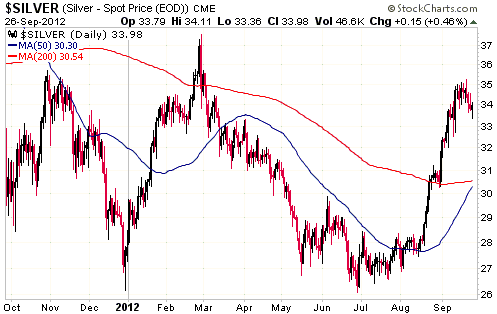
Silver became very 'overbought' during the past fortnight and has begun to roll
over to the downside, but the price action hasn't yet signaled that anything
more than a 2-3 week top is in place. A new short-term buying opportunity would
be created by a decline to $30-$31, but the chart suggests the possibility of a
surge to $37-$38 before a significant correction gets underway. This means that
we could get a short-term selling opportunity before the next short-term buying
opportunity presents itself.
The hard reality is that markets routinely forget to follow the paths that we
lay out for them. That's why it's dangerous to rely on forecasts, and, by the
same token, why it's much better to rely on real-time analysis. Sometimes we
expect to get a selling opportunity at a certain time, but instead the market
gives us a buying opportunity. And then an even better buying opportunity. At
other times we expect to get a buying opportunity, but the market instead gives
us a selling opportunity.
With respect to our own money management, we usually don't attempt to forecast
and we never get into the position where we are heavily dependent upon the
success of a single forecast. Instead, we try to look at the markets we trade
from the following perspective: "If A happens, then we'll do B; if C happens,
then we'll do D; if E happens, then we'll do F, etc." One outcome will often be
favoured, but we don't assume that our favoured outcome will necessarily be the
actual outcome.
Gold Stocks
Current Market Situation
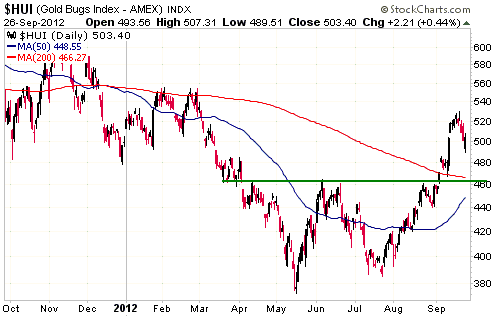
If the HUI had closed lower for a third consecutive day on Wednesday 26th
September there would be no doubt that the anticipated short-term correction had
begun, but the fact that the HUI managed to close higher on the day despite
weakness in both the gold market and the broad stock market leaves a smidgen of
doubt. We can therefore only say that a short-term HUI correction has probably
begun.
Our view continues to be that support in the 460s defines the maximum short-term
downside potential. On this basis and unless advised otherwise, our short-term
outlook will return to "bullish" if the HUI drops to the 470s.
A good set-up for a 2-4 month trade could soon emerge
It is common for junior gold mining stocks, as a group, to peak on an
intermediate-term basis well after the senior gold mining stocks that are
represented by indices such as the HUI and the XAU. Drawing from the historical
record to illustrate this point we present, below, a chart comparing the
performances of the CDNX and the HUI during 2003-2005. The CDNX isn't an ideal
proxy for the junior end of the gold mining sector, but for the period covered
by the chart it's the best we have.
The areas on the chart enclosed by the green boxes show the substantial gains
made by the CDNX during the months following the December-2003 and November-2004
intermediate-term peaks in the HUI.
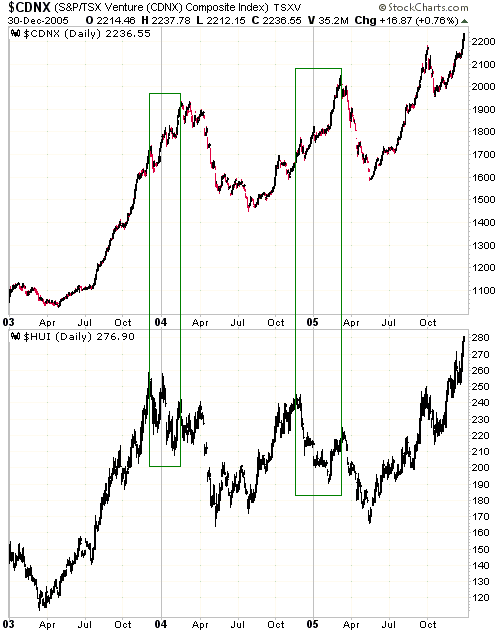
There are never any guarantees, but there's a better-than-even-money chance that
many junior gold stocks will go on to make new 6-month highs during the first
quarter of next year even if the HUI makes an intermediate-term peak during the
final quarter of this year (as mentioned in previous commentaries, November of
this year is the earliest that we are likely to get an intermediate-term peak in
the HUI). This suggests a trading opportunity.
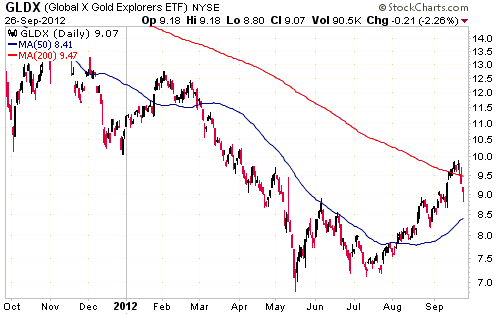
The trade we have in mind is to purchase GLDX, an ETF composed of
exploration-stage gold mining stocks (the most speculative stocks in the gold
mining universe), in reaction to near-term weakness. A daily GLDX chart is
displayed below. For record purposes we will add a GLDX trading position to the
TSI Stocks List if the ETF trades at US$8.60 within the next three weeks.
South African mining industry plagued by strikes
Last month, violent protests at Lonmin's Marikana platinum mine in South Africa
resulted in 45 deaths. The Marikana mine dispute has since been resolved via an
agreement between the company and its workers for pay increases ranging from 11%
to 22%, but labour unrest appears to be spreading like wildfire through the SA
mining industry. Here are some examples:
1) Workers at the KDC West gold mine of Gold Fields Ltd (GFI) went on strike on
9th September. The strike continues. Furthermore, workers at GFI's Beatrix gold
mine have been on strike since 21st September. The KDC West and Beatrix strikes
involve up to 24,000 workers.
2) Workers at the Kopanang gold mine of Anglogold Ashanti (AU) went on strike on
20th September and on 24th September were joined by the remainder of AU's Vaal
River workers, as well as its workers at the West Wits operations. This strike
action could involve as many as 35,000 workers.
3) Workers at Anglo American Platinum’s Rustenberg operations have gone on
strike.
We haven't had any interest in owning the shares of SA gold mining stocks over
the past two years and continue to have no interest. The risk of strike action
is too great. Agreements will be negotiated and the current surge in labour
unrest will be followed by a period of relative stability, but the problem is
bound to resurface.
Disruptions to South Africa's platinum production can have a big positive effect
on the platinum price, but disruptions to South Africa's gold production do not
have a significant effect on the gold price. This is because the amount of gold
produced in a year by South Africa's mining industry is the equivalent of only
about 0.15% of the total aboveground gold supply. Consequently, even though
about 40% of SA's gold production is presently halted due to strikes, this is
not important as far as the global gold market and the gold price are concerned.
It is, however, important for the SA economy and of course for the people
directly involved with gold mining in SA.
Currency Market Update
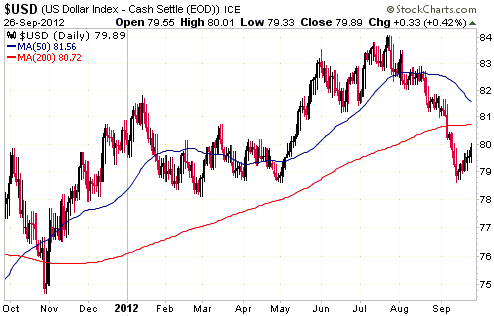
The new inflation-promoting schemes introduced by the ECB and the Fed during the
first half of September pushed the Dollar Index to an 'oversold' extreme (more
monetary inflation or expectations of more monetary inflation generally leads to
US$ selling). It has since rebounded.
The odds are in favour of the Dollar Index dropping to a new multi-month low
within the next month, but the downside risk from here is probably no more than
three points. However, as is always the case a lot will depend on the
performance of the stock market. The US$ generally benefits from stock market
weakness, so for the Dollar Index to make a new low next month the S&P500 Index
will probably have to return to its September high.
Update
on Stock Selections
Notes: 1) To review the complete list of current TSI stock selections, logon at
http://www.speculative-investor.com/new/market_logon.asp
and then click on "Stock Selections" in the menu. When at the Stock
Selections page, click on a stock's symbol to bring-up an archive of
our comments on the stock in question. 2) The Small Stock Watch List is
located at http://www.speculative-investor.com/new/smallstockwatch.html
Chart Sources
Charts appearing in today's commentary
are courtesy of:
http://stockcharts.com/index.html

|









