|
- Interim Update 27th February 2008
Copyright
Reminder
The commentaries that appear at TSI
may not be distributed, in full or in part, without our written permission.
In particular, please note that the posting of extracts from TSI commentaries
at other web sites or providing links to TSI commentaries at other web
sites (for example, at discussion boards) without our written permission
is prohibited.
We reserve the right to immediately
terminate the subscription of any TSI subscriber who distributes the TSI
commentaries without our written permission.
Grains
Governments, via incentives, subsidies and regulations, have increased
the use of grains in the making of fuel at a time when other factors
would already have created a very bullish supply/demand picture for
these agricultural commodities. Add the bullish supply/demand
fundamentals to massive monetary inflation and you have the recipe for
a huge rise in grain prices.
The supply/demand fundamentals for agricultural commodities such as
soybeans and corn remain unequivocally bullish, but we suspect that
they are close to being fully factored into current market prices. Our
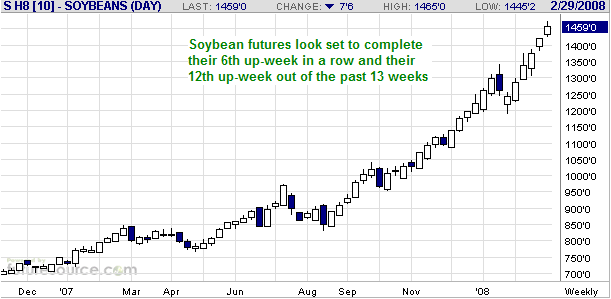
reasoning is two-fold: First, the following weekly chart shows that if
soybean futures end this week near current levels or higher they will
have risen for 6 weeks in a row and on 12 of the past 13 weeks. Such
extended sequences of rising weeks most often occur during the lead-ups
to intermediate-term or major peaks. Second, Market Vane's bullish
consensus for soybeans reached 96% this week, or, to put it another
way, the latest survey showed that only 4% of traders were bearish on
soybeans. The highest bullish percentage we have ever seen was the 98%
achieved by silver near its H1-2006 peak.
Further to the above we think it likely that the grains, as a group,
will reach an intermediate-term peak within the next two weeks.
The Stock Market
Current Market Situation
Sentiment has remained depressed since the January selling climax and
this has limited the downside risk in the market. After all, it's
difficult for a market to make additional downward progress if most
traders are already either 'short' or 'out' in anticipation of
additional weakness. Our thinking has therefore been that significant
risk wouldn't return until market participants had become more
optimistic, and that this probably wouldn't happen until the senior US
stock indices had moved above their early-February highs.
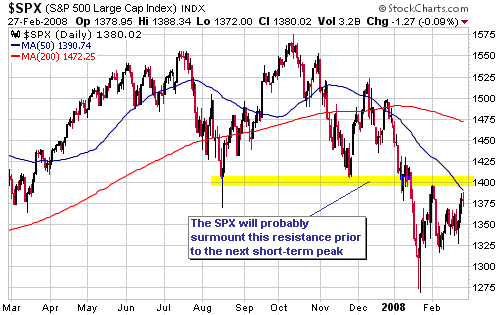
As far as the S&P500 Index is concerned, the following chart shows
that there is important resistance near 1400. A decisive break above
this resistance would probably convince the majority that a new
intermediate-term upward trend had begun, which, paradoxically, would
increase the risk of a new decline.
For those speculators
who are inclined to do so, the appropriate time to establish (or
re-establish) bearish positions will be after the S&P500 rebounds
to the low-to-mid 1400s, assuming that this happens within the next
couple of weeks. However, unless something changes in the mean time
this is not a trading idea that we will embrace because the worst we
expect the market to do over the next few months is test its January
low.
The dramatically oversold conditions reached on 22-23 January suggested
that a) there would be a test of the lows within three months, and b)
this test would be followed by a tradable multi-month rally even if a
bear market had begun. So, rather than placing bearish bets in
anticipation of a decline back to near the January lows it would make
more sense, in our opinion, to get financially and emotionally prepared
to place bullish bets in the event that such a decline takes place.
From our perspective, likely candidates for new bullish bets (buying)
following a test of the January lows include coal stocks, natural gas
stocks, airline stocks, tech stocks, and stocks that provide exposure
to the Japanese market.
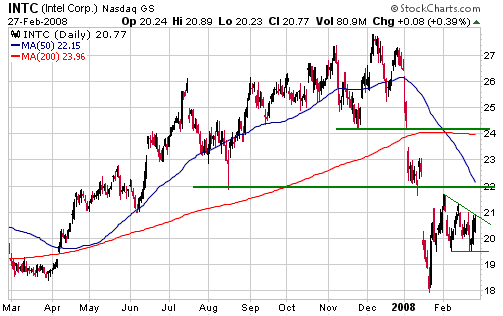
The chart of Intel (INTC) presented below reveals a pattern typical of
many stocks at this time. Specifically, it shows a quick rebound from
the January panic low to a peak on the 1st of February, followed by
weeks of consolidation. The consolidation will probably end in the near
future via an upside breakout.
INTC has resistance at $22 and $24. We currently have an INTC
call-option position in the TSI Stocks List and plan to take profits on
this position IF the stock price rises to near the higher of these two
resistance levels within the next few weeks.
Gold and
the Dollar
Currency Market Update
The US Ministry of Inflation (the Fed) reaffirmed its commitment to
currency depreciation earlier this week, thus putting additional
downward pressure on the US dollar's foreign exchange value. We don't
think this market reaction makes a lot of sense, though, because when
push comes to shove it's very likely that the European Ministry of
Inflation (the ECB) will prove to be equally dedicated to its primary
job function.
Our short-term bullish view on the Dollar Index was invalidated by
Tuesday's close above 1.49 in the March euro futures contract (the
Dollar Index is, in effect, the inverse of the euro). However, this
week's action -- including the break to new lows by the Dollar Index --
is not inconsistent with our view that the US$ is embroiled in a
multi-month bottoming process that began last November. Our expectation
has been, and is, that this bottoming process will be complete by the
end of March.
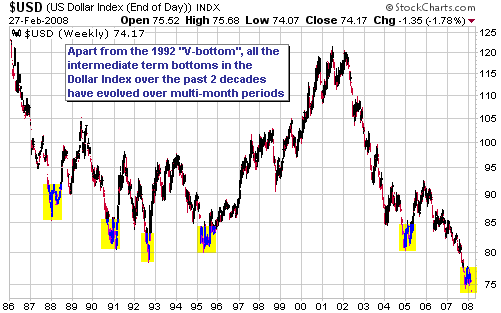
On the following weekly chart of the Dollar Index we've highlighted the
intermediate-term bottoms that have occurred over the past 2 decades.
The most recent bottom highlighted on the chart is obviously yet to be
confirmed by price action and therefore might not prove to be a bottom
at all, but the point we wanted to make is that with only one exception
the prior bottoms were multi-month processes. Each entailed an initial
low followed by a few months of bouncing around in the vicinity of the
low before a tradable rally got underway.
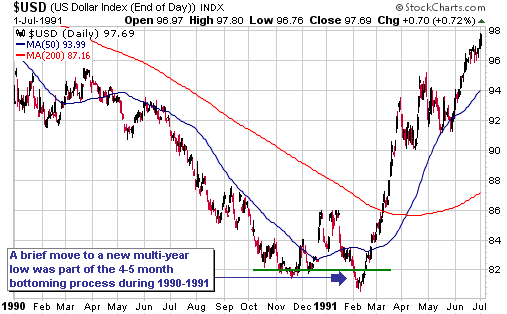
The previous
intermediate-term bottoming process for the dollar that bears the
closest resemblance to the present situation is the one that unfolded
between October of 1990 and February of 1991. As illustrated by the
following chart, the 1990-1991 bottoming process involved a break to
new multi-year lows just prior to the start of a large rally. If
today's market follows this pattern then the Dollar Index will reverse
upward within the next two weeks.
Silver and Silver Stocks
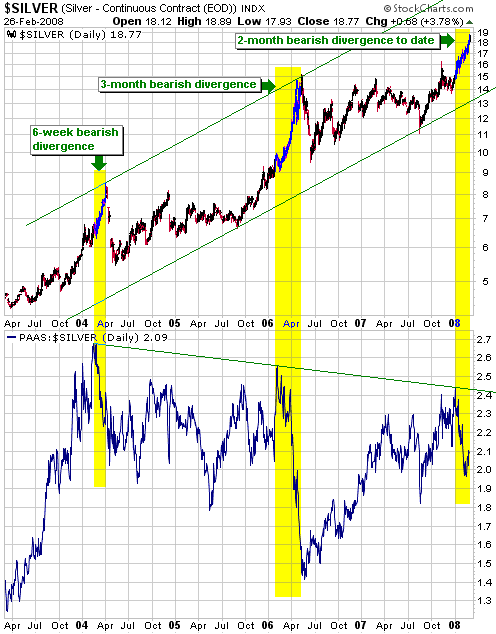
The PAAS/silver ratio (the price of Pan American Silver divided by the
price of silver) tends to peak and begin trending lower at least 6
weeks prior to an intermediate-term peak in the silver price. We
therefore consider an upwardly mobile silver price combined with a
multi-week downturn in the PAAS/silver ratio to be a bearish
divergence, especially if it occurs after silver has been trending
higher for at least 6 months.
On the following chart comparison of the silver price (the top section
of the chart) and the PAAS/silver ratio (the bottom section of chart)
we've highlighted the 6-week bearish divergence that occurred during
the first half of 2004 and the 3-month bearish divergence that occurred
during the first half of 2006. We've also highlighted the current
2-month (and counting) bearish divergence. (Note: the chart doesn't
include Wednesday's action.)
Assuming the current
bearish divergence persists for no longer than the longest of the
previous two such divergences, silver will reach an intermediate-term
peak by early April. In other words, if the pattern of the past several
years repeats then silver is within 6 weeks of an intermediate-term
peak.
But even if the aforementioned timing assumption is valid, silver might
not yet be close to an intermediate-term peak in price terms. The
reason is that this market tends to make near-vertical moves during the
final weeks of intermediate-term rallies (the bulk of its
trough-to-peak gains tend to occur towards the ends of rallies).
With respect to the remaining upside potential, we have mentioned in
previous commentaries over the past few months that $25 would become a
logical target once resistance at $15 had been decisively breached. $25
remains a logical upside target and could be reached by early April,
although on the way to $25 there would almost certainly be some
hesitation near the big round number of $20.
The stock of the average silver producer, like the stock of the average
gold producer, has not done a particularly good job of leveraging the
price-gains in the metal over the past few years. This is evidenced by
the long-term downward trend in the PAAS/silver ratio.
If the silver price rockets upward over the coming month or so then the
large producers such as PAAS will undoubtedly make new highs in nominal
dollar terms, but it's very unlikely that they will make new highs
relative to silver. In fact, we don't think the major silver stocks
have attractive risk/reward ratios with respect to either the
short-term or the intermediate-term. However, it's a different story
when it comes to the junior silver producers and explorers. That the
juniors have done so little over the past several months has added to
their already-large upside potential and reduced their downside risk.
This is the area where most new buying should be focused, and as far as
specific stock selection ideas are concerned we have re-printed, below,
the brief note included in yesterday's (27th February) email to
subscribers.
"Silver is probably
within 6 weeks of an important peak so this is not the time to be
moving aggressively into silver-related speculations, but those who
currently have minimal exposure to "poor man's gold" can still find
some reasonable buying opportunities at the junior end of the
silver-stock universe. For example: as a junior with a substantial
in-ground resource, about 4.5M ounces/year of unhedged current
production and a market capitalisation of only C$330M (70M shares at
C$4.70/share), First Majestic Silver (TSX: FR) should benefit greatly
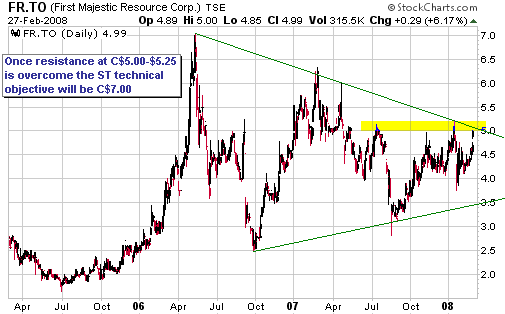
IF silver continues its surge over the next few weeks [note: a chart of
FR is displayed below]. This is because the company would experience a
sharp increase in its profit margin and because the stock market would
be forced to assign a much higher valuation to FR's 175M ounces of
in-ground resources under such a circumstance. We think that Sabina
Silver (TSXV: SBB), a tiny exploration-stage company with a massive
in-ground resource in a politically secure location, would also fare
extremely well if the degree of speculation were to increase over the
coming weeks.
A small silver producer
that looks interesting at this time, but is not a current member of the
TSI Stocks List, is US Silver (TSXV: USA). USA is expected to ramp-up
its production to around 3.5M ounces/year over the next 2-3 quarters
and has a market capitalisation of only C$160M (206M shares at
C$0.74/share).
Due to insufficient
liquidity the above-mentioned juniors -- and junior resource stocks in
general -- aren't well suited for short-term trading, but someone who
buys now with the aim of holding for 1-2 years could end up with
significant short-term gains."
Gold Stocks
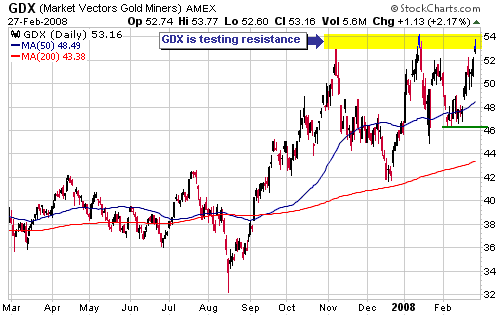
The following chart shows that the Gold Miners ETF (GDX) has moved up
to resistance defined by its January and November peaks. Regardless of
where the rally is ultimately headed it would not be surprising to see
GDX consolidate below this resistance for at least a few days.
Over the past
fortnight we twice suggested buying GDX for a trade when it was in the
$47-$48 range, but the time for new short-term buying has since passed
due to GDX's move from just above important support (the early February
low) to near intermediate-term resistance. Current 'long' positions
should, we think, be protected via in-the-money stops.
As far as the coming three months are concerned, two very different
gold-stock scenarios appear to be almost equally plausible. One is that
spectacular gains in the gold-stock indices over the next several weeks
will culminate at intermediate-term tops during April-May, while the
other is that the indices will soon peak a short distance from current
levels and then consolidate for about 2 months before resuming their
advances.
The latter of the above-mentioned scenarios is more consistent with our
overall financial-market outlook, but in any case there is no need to
bet heavily on one or the other of these potential short-term outcomes.
The best approach, in our opinion, would be to have sufficient
long-term exposure to the gold sector that you would welcome a 4-6 week
surge, and to simultaneously maintain a large-enough 'cash cushion'
that a 20% pullback would feel more like an opportunity than a problem.
Of course, if you are positioned in this way and the market rockets
upward over the next few weeks then you will wish you owned more, while
if the market pulls back to the tune of around 20% then you will wish
you owned less. In other words, in neither case will you be totally
satisfied. The point, though, is that in neither case will you be
stressed out.
Update
on Stock Selections
(Note: To review the complete list of current TSI stock selections, logon at http://www.speculative-investor.com/new/market_logon.asp
and then click on "Stock Selections" in the menu. When at the Stock
Selections page, click on a stock's symbol to bring-up an archive of our comments on the stock in question)
 Gold-Stock Warrants Gold-Stock Warrants
The following information was included in the email sent to subscribers on Wednesday 27th February:
"This far into a gold
rally the junior gold stocks would normally be running hard to the
upside and the warrants on these types of stocks would be going
berserk, but, as we've discussed many times in TSI commentaries, the
current gold-stock situation is not normal. As a result, most junior
gold stocks are still in consolidation patterns and some of the
warrants on these stocks are still reasonably priced. Here are two
examples of warrants that are candidates for new buying near current
prices:
1) European Minerals April-2010 C$1.20 warrants (TSX: EPM.WT.A).
With EPM at Tuesday's
closing price of C$1.40 we calculate fair value for EPM.WT.A to be
around C$0.50, but paying anything up to the high-0.50s would be OK.
2) Great Basin Gold April-2009 C$3.50 warrants (TSX: GBG.WT).
With GBG at Tuesday's
closing price of C$3.37 we calculate fair value for GBG.WT to be around
C$0.65, but anything up to around C$0.70 would be OK.
The above-mentioned
warrants are a lot more risky than the underlying stocks. For example,
if GBG were to trade sideways over the coming 14 months then someone
who owned the stock wouldn't lose any money, but someone who held the
warrants over this period would lose 100% of their investment (the
warrants will expire worthless if the stock price is below C$3.50 at
the April-2009 expiry date). The EPM warrants are less risky because
they are 'in the money' (their exercise price is below the current
stock price) and because they have an extra 12 months of time prior to
expiry, but there is still a significantly greater risk of loss with
the warrants than with the stock.
Despite the additional
risk, warrants are sometimes worth considering due to the leverage --
and the associated additional upside potential -- that they offer. For
example, a rise in GBG's stock price to around C$5.50 over the next few
months would result in a rise to more than C$2.00 in the fair value of
GBG.WT; that is, a 60% increase in the stock price over the next few
months would lead to an increase of at least 180% in the warrant price."
Note that the GBG warrants jumped up to C$0.75-C$0.80 in response to
the favourable mention in our email, but the EPM "A Series" warrants
are still available in the high-0.50s.
Chart Sources
Charts appearing in today's commentary
are courtesy of:
http://stockcharts.com/index.html
http://www.futuresource.com/

|









