|
- 27 March, 2002
Promoting
inflation and manipulating gold
A few days ago the Fed leaked to the
press that it had considered using "unconventional policy measures" if
interest rate reductions failed to stimulate the economy. These unconventional
methods apparently included buying stocks. It is interesting that the Fed
would have chosen this week to make such discussions public, but the news
itself should not come as a surprise. We've noted in the past that the
Fed has the power to create an effectively unlimited amount of currency
by monetising any assets they wish to monetise. This is why the US is not
going to experience a prolonged period of deflation, or at least why deflation
will not occur until inflation causes so much pain that a policy change
becomes both a political and an economic necessity.
Shortly after word leaked-out that
the Fed was considering unconventional policy measures, the head of Germany's
central bank publicly floated the idea that the Bundesbank might sell gold
in the future and use the proceeds to buy blue chip stocks. This definitely
was newsworthy. Announcements of potential Bundesbank gold sales are becoming
commonplace (they now seem to accompany every bounce in the gold price),
but the idea that the Bundesbank would ever consider exchanging Germany's
gold reserves for equity in private corporations really is extraordinary.
In fact, the idea is so completely absurd that we cannot believe it would
have been floated unless the Bundesbank, or a private bank with a lot of
influence on the Bundesbank, was facing a major problem with its gold position
(for example, the inability to cover a large short position in gold bullion).
The US
Stock Market
Business value versus stock price
We stopped watching CNBC about 12 months
ago for two main reasons. Firstly, we figured that our time would be better
spent doing something more productive, such as sleeping. Secondly, there
was almost never any effort made on CNBC to compare the price of a company's
stock to the company's underlying business value (its earnings, revenues,
assets and cashflows). A company would report earnings that "beat the estimates"
or showed strong growth and all the commentators would wax bullish, giving
viewers the impression that this company's stock was a great investment.
The major problem with CNBC was (and, we are told, still is) a total lack
of attention to value, that is, a lack of attention to stock prices relative
to the size and profitability of the underlying businesses.
The problem with CNBC is closely related
to the problem with the overall market. While the debate rages over how
strong the economic recovery is going to be this year the major issue -
valuation - is often brushed aside. For example, Intel, the world's largest
and most important semiconductor company, is twice as expensive in today's
slow-growing PC market, relative to the size of its business, as it was
in late-1997 just prior to the start of a huge multi-year growth spurt
in PC sales. And Intel is a veritable bargain compared to other stocks
in the chip sector. However, it is typical to see a small improvement in
the semiconductor book-to-bill ratio hailed as a reason to run out and
buy Intel and other chip stocks. For another example of the valuation problem
let's take Juniper Networks (JNPR). Juniper warned after the close of trading
on Wednesday that its first quarter revenue is now likely to be around
$125M versus its previous estimate of $155M. Juniper is, by all accounts,
a well-managed company with a strong balance sheet and technological leadership
in a business with reasonably-high barriers to entry (Juniper is the world's
second-largest manufacturer of communications routers). However, even though
Wednesday's closing price of $11.92 represents a 95% discount to its October-2000
peak of around $240, JNPR is still trading at 7.6-times revenue. In other
words, despite the company's positive attributes and the massive stock
price decline JNPR still appears to be very expensive.
Getting back to the debate over the
strength of the economic recovery, if a company is selling at 7-to-10 times
sales (the case for many tech companies with multi-billion dollar market
caps) does it really make that much difference whether this year's economic
growth rate is a sluggish 2% or a robust 5%? Does a dramatically over-priced
stock suddenly become a great investment just because the GDP growth rate
improves by 3%? We don't see how.
More thoughts on PE ratios
In recent commentaries we've tried
to make two points with regard to price/earnings (P/E) ratios. The first
point was that the earnings of cyclical stocks, a category into which many
of today's popular tech stocks fit, tend to collapse to the point of disappearing
altogether at around the same time as, or within a few months of, the associated
stock prices hitting 'rock bottom'. As such it is not uncommon for the
P/E ratios of cyclical stocks to peak shortly after the stock price
has bottomed (as 'E' heads towards zero the P/E ratio heads towards infinity).
This was the case with the Dow Industrials during the early-1930s and may
well be the case for the NASDAQ100 at some point over the next 2 years.
The second point was that the prices of stocks are, on average, determined
as much by long-term interest rates as they are by company earnings (the
expected future level of interest rates determines the price that investors
are willing to pay today for future earnings, that is, interest rates determine
the appropriate P/E ratio for the overall market).
Having made the point that it is dangerous
to draw conclusions about valuation based solely on the P/E ratios of some
of the narrower indices such as the Dow Industrials or the NASDAQ100, our
research indicates that a P/E ratio analysis can be effective at extremes
when applied to the broader indices and the overall market.
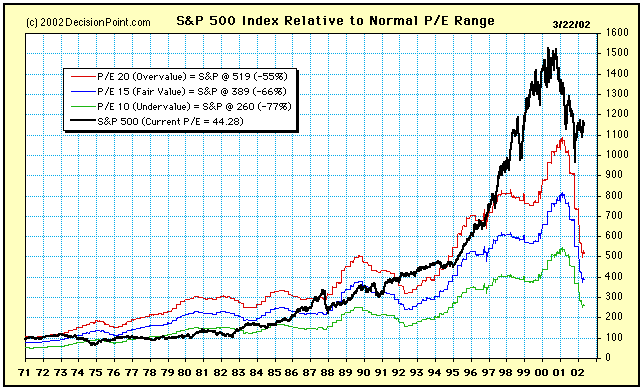
Below are two charts, provided courtesy
of www.decisionpoint.com, showing the S&P500 Index (in black) and where
the S&P500 would be trading if it had a P/E ratio of 20 (the red line),
15 (the blue line), or 10 (the green line). The top chart covers the period
from 1971 to the present day and the bottom chart covers the period from
1925 to 1955.
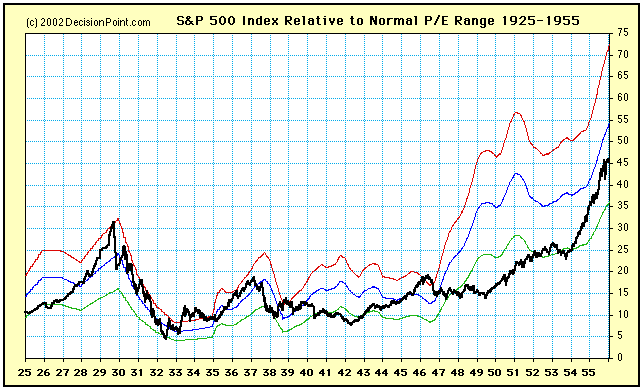
In last week's Interim Update we included
a chart showing how the Dow's P/E ratio soared beginning in late-1932 as
a result of collapsing earnings. The above chart shows that the P/E ratio
for the broader S&P500 Index moved well above 20 (the 'over-valued
range') during 1933 and 1934, but unlike the Dow it didn't experience a
huge upward spike. It also did a better job of identifying 'the bottom'
than did the Dow P/E ratio.
Interest rates are a critical factor
in determining the appropriate P/E ratio, but despite interest rates having
been very low for extended periods over the past 80 years the P/E ratio
has never previously been anywhere near as high as it is right now. In
fact, the top chart above indicates that the S&P500 Index could decline
by 55% from its current level and still be classed as over-valued by historical
standards. This highlights the extreme valuation risk that remains in the
market and is a reason that long-term investments in S&P500 Index funds
are going to yield lousy returns over the next few years. Our medium-term
target for the S&P500 Index is 800, which represents a less extreme
decline of around 30% from the current level and is based on a price-to-sales
analysis rather than a price-to-earnings analysis.
Current Market Situation
The stock market is dramatically over-valued
and it is going to drop to a level where it becomes either fairly valued
or under-valued. The only question is: when? Our current view is that a
big value-creating move will occur during the second half of this year,
but we are certainly open to the prospect that the decline will be longer
and less steep. It is also possible that the inevitable decline in stock
prices will be reduced, in nominal terms, as a consequence of dollar depreciation.
After all, to the extent that a stock represents a claim on real assets
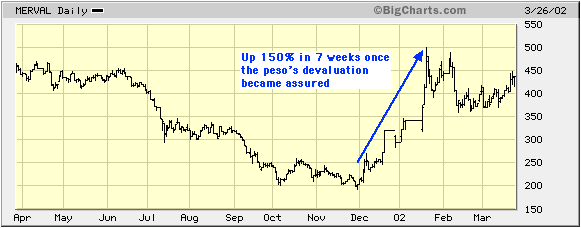
it is also a hedge against inflation. The performance of the Argentine
stock market since last December (see chart below) provides a good example
of stocks being re-valued to account for a devaluation of the currency.
In US$ terms the Argentine MerVal is down since the beginning of December,
but the owners of stocks have certainly fared much better than the owners
of pesos.
A recognition that the stock market
is over-valued will not stop us from trading the market from the long-side
if an opportunity presents itself. After all, over-valued markets can rise
and under-valued markets can fall. Valuation, which is determined by earnings,
revenues and interest rates, is by far the most important driver of the
stock market over the long-term. Over the short-term, however, the market
is strongly influenced by emotion and other factors that have nothing to
do with value. Legendary stock speculator Jesse Livermore neatly summed-up
the required attitude of a successful trader when he said: "There is only
one side to the stock market and it is not the bull side or the bear side,
but the right side".
We've previously identified 3 things
that had to happen in order for the stock market to set itself up for a
potential 2-3 month rally. First, the market had to pullback into the first
half of April. Second, there needed to be a substantial increase in fear
as measured by short-term sentiment indicators. Third, a bear-market rally
in bonds had to occur. If these things occur between now and mid-April
we will probably recommend a long-side trade in anticipation of a rally
into mid-year. In the mean time we remain short-term bearish and expect
significantly-lower levels to be reached before the current correction
is complete.
Since the US stock market continues
to follow the Japanese stock market with remarkable consistency, we'll
take a look at a chart of the Nikkei225.
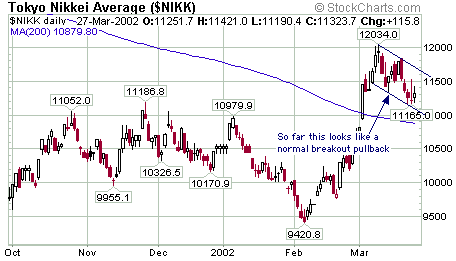
At this stage the decline in the Nikkei
over the past 2 weeks looks like a normal breakout pullback. If this is
the case then it should find support at its 200-day moving-average (currently
at around 10,870) or higher. A decisive move below the 200-DMA would, however,
cast doubt on the legitimacy of the entire Feb-Mar rally. This situation
should resolve itself within the next 3 weeks, either via a break below
support or a break above the short-term downward-sloping channel. Stay
tuned.
Gold and
the Dollar
In the 18th March Weekly Update we
noted that the various financial markets appeared to be setting themselves
up for important reversals during the first half of April. At the time
we were anticipating a stock market pullback and a bond market rally into
this time frame, thus setting the stage for a 2-3 month stock market rally
and the next downward leg in the bond bear-market that began last November.
There has been no reason to deviate from this view. With regard to the
Dollar we noted that the prospect of a final rally into April still existed
and that the direction of the gold price going into this 'reversal period'
was unknowable. Then, in the latest Weekly Update, we explained that both
gold and the Dollar were probably going to head higher into the first half
of April (we are in the midst of one of those strange periods that occur
from time to time when gold and the Dollar appear to be positively correlated).
Further to the above we are looking
for the current run-up in the prices of gold and gold stocks to lead to
another short-term profit-taking opportunity over the coming 2 weeks.
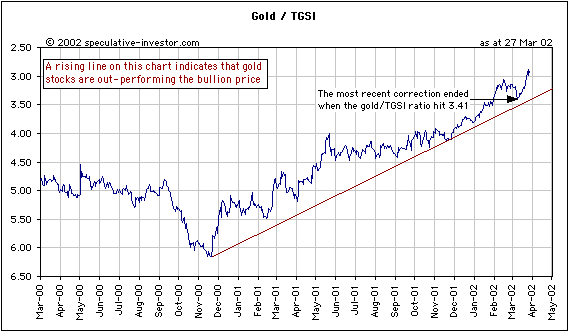
Below is our chart showing the ratio
of the gold price and the TSI Gold Stock Index (note that the scale is
inverted). A rising line on the chart indicates that gold stocks are out-performing
the bullion price, a characteristic of a gold bull market. With the gold/TGSI
ratio having just fallen to a new low (shown as a new high on the chart)
this chart is giving no indication that the latest rally has peaked. However,
gold stocks have moved well into over-valued territory relative to the
bullion price so the short-term risk in the gold sector is once again
becoming high (as it did in mid-February). We would not be surprised to
see the gold price move up to around $320 in the near-term, but it looks
like the gold stocks have already fully discounted such a move. That doesn't
mean that gold stock prices won't respond positively if the gold price
jumps another $15-$20, but it does mean that the short-term downside risks
are starting to outweigh the likely rewards.
The way things are progressing we expect
to be taking profits on gold-stock trading positions during the first half
of April. It is probably a little early to be doing any selling right now,
but we will consider any significant weakness in gold stocks relative to
the gold price as a signal that the rally is running out of steam. As emphasised
many times in the past, we are maintaining a core investment position in
gold stocks that will not be sold as long as we assess that the major trends
in the financial world are 'gold bullish'. We currently see no reason to
sell any part of this investment position.
Although gold stocks, as a group, are
over-valued relative to the bullion price, not all gold stocks are over-valued.
In this regard we take issue with comments made by Nick Goodwin in an article
that can be found at http://m1.mny.co.za/MGGold.nsf/Current/4225685F0043D1B242256B88002EBC63?OpenDocument.
Nick talks about the prices of the major SA gold stocks being "exotic"
and "extremely dangerous". He states that PE ratios have become unrealistic
and goes on to note that Anglogold, Harmony and Gold Fields have current
PE ratios of 13, 12 and 16 respectively. We confess to being slightly stunned
that a PE ratio of 12 for the world's best-managed and fastest-growing
major gold mining company (Harmony) could possibly be considered excessive.
Our view is that Harmony is still under-valued at its current price of
$11.69, even assuming no increase in the gold price. Our other SA gold
stocks - Gold Fields and Durban Deep - are fully priced at current levels,
but are not over-priced. The biggest risk that we see with the SA gold
stocks is that gold stocks tend to move as a group and the major North
American gold stocks are very expensive. Several of the major NA gold stocks
don't have PE ratios because they don't have any earnings and they have
significantly higher price-to-sales ratios than their SA counterparts.
Assuming a $300 gold price Harmony is currently trading at around 1.8-times
this year's expected revenue whereas NEM and PDG are trading at around
3-times revenue and AEM is trading at an incredible 9-times revenue.
Update
on Stock Selections
We sold half of our trading position
in DROOY at $2.76 in February and will raise the protective stop on the
remaining half to $2.90.

|









