|
- Interim Update 27th March 2013
Copyright
Reminder
The commentaries that appear at TSI
may not be distributed, in full or in part, without our written permission.
In particular, please note that the posting of extracts from TSI commentaries
at other web sites or providing links to TSI commentaries at other web
sites (for example, at discussion boards) without our written permission
is prohibited.
We reserve the right to immediately
terminate the subscription of any TSI subscriber who distributes the TSI
commentaries without our written permission.
The New
Cyprus Deal
Under the new bailout deal cobbled together at the beginning of
this week, bank customers in Cyprus with deposits of 100,000 euros
or less will not lose any money. As far as we can tell, this means
that 97% of bank depositors will not be forced to contribute
anything to the bailout. Under the original deal, these depositors
would have lost about 7% of their money. The remaining 3% of
depositors (those with accounts valued at more than 100,000 euros)
will, however, be forced to make a substantial contribution. The
amount of the loss has not yet been defined, but will almost
certainly be at least 30% and could be more than 50%. Under the
original deal, these depositors would have lost about 10% of their
money.
In summary, the new bailout deal involves:
1. A 10B-euro fund provided by the European Union and the IMF,
leaving 7B euros to be raised within Cyprus to pay the full cost of
the current -- but undoubtedly not the last -- bailout.
2. A restructuring of the banking system that entails closing down
Laiki Bank, Cyprus's second largest bank. Laiki Bank deposits above
100,000 euros will be moved to a "bad bank" and deposits below
100,000 euros will be moved to Bank of Cyprus, the country's biggest
bank. Deposits at Bank of Cyprus of more than 100,000 euros will be
frozen.
3. Tapping bond-holders and large deposits for the bulk of the
7B-euro local contribution to the bailout, and obtaining the balance
via privatisations and tax increases. The Cyprus Government's tax
revenue is far more likely to fall than rise over the coming 12
months and privatisations probably won't raise as much money as
expected, so bond-holders and large depositors will probably end up
taking a bigger hit than presently envisaged.
4. Capital controls to prevent money from fleeing the country and
from freely shifting between deposits within the country following
the re-opening of banks.
Many commentators asserted that the original Cyprus deal would have
resulted in the theft of deposits. We tried to explain in our most
recent two reports that this wasn't the case. Money was lost due to
bad investments. Making depositors 'whole' would therefore require
stealing money from somewhere and giving it to Cyprus's bank
depositors. Under the new Cyprus bailout deal, depositors with
100,000 euros or less in their accounts (about 97% of all
depositors) will be 'made whole'. This means that most depositors
will now be beneficiaries of theft. It is true that these deposits
were insured, but there was never any insurance reserve from which
money could be obtained to offset deposit losses.
Part of the money used to 'make whole' the 97% of depositors with
100,000 euros or less on deposit will come from the remaining 3% of
depositors. In effect, bank customers with large deposits are being
forced to contribute to the bailout of bank customers with small
deposits. This means that large depositors will be victims of theft
under the new deal.
Another part of the local contribution to the Cyprus bank bailout
will come from bank bond-holders. The bond-holders, however, are not
victims of theft, because bond-holders SHOULD lose 100% before
depositors lose anything. One of the 'unique' aspects of the Cyprus
situation is that the banks in this tiny economy were funded almost
totally by deposits, meaning that there was almost no financial
buffer-zone to shield depositors from the consequences of the banks'
investing mistakes. So, even if the banks' bonds were written off in
total it would not have prevented the deposits from being exposed to
substantial losses.
From a global financial-market perspective, the recent Cyprus ordeal
isn't important. In addition, the fact that an attempt was made to
impose losses on insured bank deposits in Cyprus doesn't say
anything about the risk of having money in an insured bank deposit
in most other countries. In the US, for example, the risk of an
insured bank customer incurring a nominal loss is close to zero,
because even though the FDIC is under-capitalised the insurance is
ultimately backed by an institution with unlimited ability to create
dollars (the Fed). Cash savings in the US and most other countries
will suffer losses in real terms, but not in nominal terms.
The recent Cyprus ordeal does, however, have significance for three
longer-term reasons.
First, it highlights the true nature of deposit insurance. This is a
plus, although it appears that most commentators are still missing
the point. For example, someone has missed the point if his/her
takeaway from the Cyprus situation is that EZ-wide deposit insurance
is needed. The point is that deposit insurance is effectively a
promise by the government to steal money -- either directly via
taxation or indirectly via inflation -- and give the stolen money to
bank depositors to offset any losses incurred by the depositors due
to bank failure. EZ-wide deposit insurance would therefore, in
effect, entail a commitment by the German government to take money
from German taxpayers to cover the losses incurred by Greek
depositors as a result of a banking collapse in Greece.
Second, it indicates that there has been a shift by Europe's
leadership towards assigning greater responsibility to private
investors when financial institutions 'blow up'. This is also a
plus.
Third, it underlines an important political motivation that first
became apparent in the 'handling' of the Greek crisis. We are
referring to the resolute determination of Europe's political
leadership to maintain the monetary union in its current form almost
regardless of the cost. Ejecting Greece from the euro-zone (EZ) back
in 2010 would have conserved resources that could subsequently have
been deployed to resolve problems in larger economies and would have
left a stronger union in place. Perhaps an argument could be made
that despite its relatively small size Greece was still big enough
that forcing it to leave would be worse than having it remain, but
that's certainly not the case with Cyprus. In Cyprus we have a
country with a population of only 1M and an economy that in GDP
terms is only about 1/500th of the EZ. And yet, Europe's political
leadership was prepared to go to great lengths to keep Cyprus in the
EZ. This is a minus, because keeping the weak links in the chain
shortens the time to the next EZ-wide crisis.
We will be surprised if the EZ makes it to the end of this year
without experiencing a vastly more serious crisis than the recent
Cyprus episode. As we've stated in the past, this is not because
Europe has bigger problems than the US; it's because with Europe not
having a single government in cahoots with a single central bank,
the same problems rise to the surface more quickly.
The Stock Market
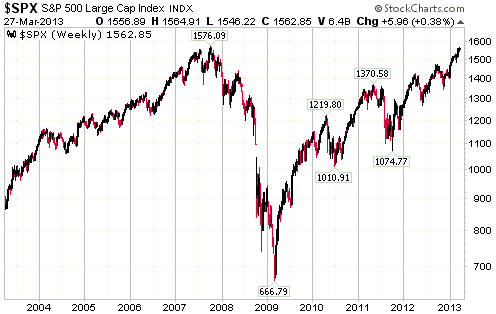
The following weekly chart of the S&P500 Index (SPX) shows that
the October-2007 peak (the all-time high) was 1576. Therefore, the SPX is now
less than 1% from its all-time high in nominal dollar terms.
With the SPX having already moved so close to its all-time high it would be
strange for it to reverse downward on a sustained basis without first making a
new all-time high. Having come this far it will probably exceed its 2007 peak by
a small amount before making a top of at least intermediate-term importance.
This would be similar to what happened in 2007, when the SPX moved 1.5% above
its previous all-time high (the high of March-2000) before commencing a large
decline.
In the 18th March Weekly Update we wrote the following about DXJ, an ETF that
tracks Japan's stock market:
"Everyone is bullish on DXJ because everyone knows that the Bank of Japan
(BOJ) is going to deviate from its practice of the past twenty years and inflate
the Yen to oblivion. Everyone knows that this will happen even though the BOJ
has a) not yet done anything different and b) stated that it will not do
anything different until at least early-2014. Everyone also knows that
aggressively inflating the Yen will boost the Japanese economy, even though
continued Yen depreciation would greatly increase Japan's energy-cost burden,
reduce productivity due to the price distortions caused by the inflation, and
lead to a sufficiently large rise in interest rates to bring about a government
debt default.
Will everyone be right for the first time in history? Perhaps, but that's not a
good bet.
We are becoming increasingly interested in taking a bearish DXJ position, either
by purchasing August put options or by going short. However, we haven't done
anything yet. Our preference would be to purchase August put options, but the
options are difficult to trade due to insufficient liquidity."
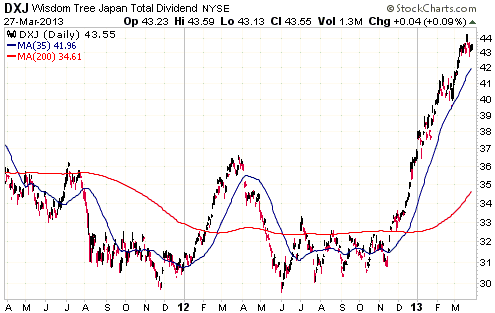
DXJ is in roughly the same position now as it was when we wrote the above. And
we still like the idea of taking a bearish DXJ position, although we still
haven't done anything about it. We will most likely do something over the next
several days.
In our opinion there are two equally-reasonable ways to take a position that
would benefit from a substantial DXJ decline over the next couple of months. The
first would be to take an initial position in out-of-the-money DXJ August put
options immediately with the aim of adding to the position on strength over the
next week or so. The second would be to 'short' the ETF after a clear downward
reversal and to then place an initial 'buy stop' just above this year's high. A
"clear downward reversal" could be defined as a daily close below the 35-day MA
(the blue line on the following chart).
The first method has the advantage of offering the potential for a much higher
percentage gain, but at the risk of incurring a percentage loss of more than
50%. With the second method the maximum reward potential would be a lot less,
but it would be possible to limit the maximum potential loss to less than 10%.
Our view is that the next 1-3 month downturn will take DXJ back to its 200-day
MA and could fully retrace the entire rise from the low-$30s.
Note that a bearish bet on DXJ is an indirect bullish bet on the Yen, because
the upward trend in Japan's stock market is tied to the downward trend in the
Yen. Also note that next week's BOJ meeting creates a high level of uncertainty.
The BOJ will probably announce an expanded debt monetisation program next week,
with the market reaction to this announcement being determined by how the new
level of debt monetisation compares with the expectations built into current
prices.
Gold and the Dollar
Gold
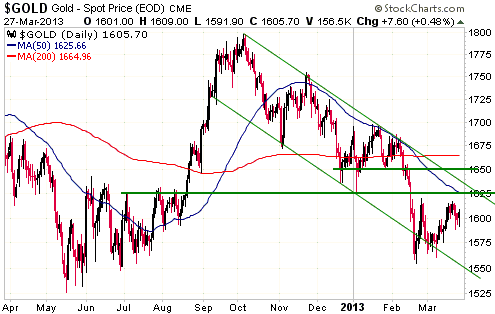
The US$ gold price is essentially in the same position now as it was a week ago.
As illustrated by the following chart, it has rebounded from its low but remains
below its channel top, its 50-day MA and its lowest lateral resistance of
significance ($1625).
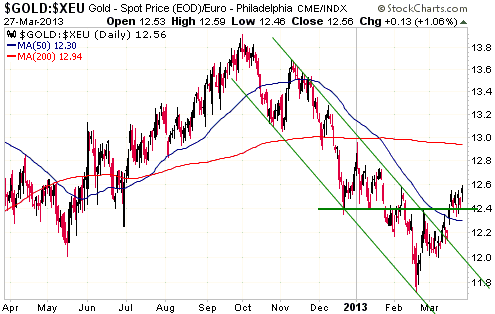
The euro gold price (gold/euro), however, has clearly broken above its channel
top, its 50-day MA and its lowest lateral resistance of significance.
Many gold bulls fixate on US$ issues as if a decline in the US dollar's foreign
exchange rate is a prerequisite for a large rally in the gold market, but as
we've mentioned in the past a large gold rally requires a loss of confidence in
the US$ and/OR the euro. Despite the Fed's profligacy, at this stage it looks
more likely that the primary impetus for the next major advance in the gold
price will be a loss of confidence in the euro.
Gold Stocks
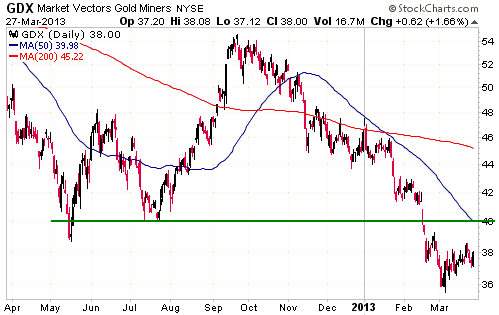
Nearby resistance for GDX, the Gold Miners ETF, extends from $38.70 to $40.00.
The most important resistance lies at $40, as this level coincides with the
July-2012 bottom, the 50-day MA and a big round number. Consecutive daily closes
above $40 would therefore be the first clear-cut evidence that the gold sector
has turned the corner on a sustainable basis.
Clear-cut evidence of a sustained upward reversal is taking longer than normal
to emerge, assuming that an intermediate-term bottom was, indeed, put in place
early this month.
Currency Market Update
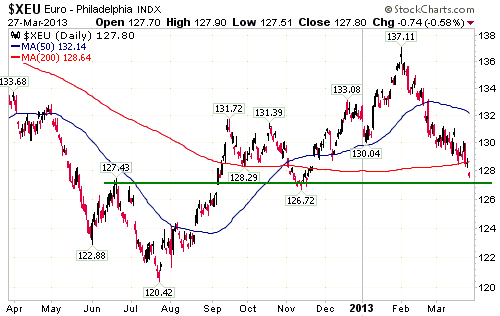
The euro is 'oversold' based on momentum and sentiment indicators. It is also
close to intermediate-term support at 126.5-127.5, which, by the way, is the
last support of significance between the current price and 120.This combination
of factors says that it is reasonable to expect a rebound to begin in the near
future. Note that a typical counter-trend rebound would take the euro back to
the vicinity of its 50-day MA.
While a rebound by the euro to its 50-day MA wouldn't surprise us, it's not
something that we would bet on at this time. One reason is that the senior
equity indices are very 'overbought' and at risk of suffering sharp downward
corrections over the weeks immediately ahead, even if the longer-term trend
remains up. This matters because the US$ usually benefits from material stock
market weakness. Another reason is that the euro-zone's banking industry is in
bad shape. It was in bad shape a few months ago, too, but 'nobody' cared back
then. For whatever reason, traders began to care in early-February and have
cared more over the past few weeks due to political uncertainty in Italy, weak
economic data from a number of European countries and the recent events in
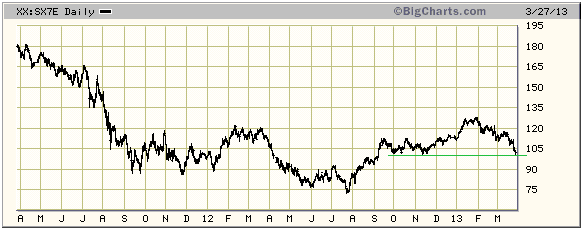
Cyprus. Like the euro, the EURO STOXX Banks Index (SX7E - see chart below) is
short-term 'oversold' and near intermediate-term support. And like the euro, the
Banks Index is possibly set-up for a counter-trend rebound. However, there is
also a possibility that moderate concerns about European bank solvency could
grow into outright panic sooner rather than later.
Update
on Stock Selections
Notes: 1) To review the complete list of current TSI stock selections, logon at
http://www.speculative-investor.com/new/market_logon.asp
and then click on "Stock Selections" in the menu. When at the Stock
Selections page, click on a stock's symbol to bring-up an archive of
our comments on the stock in question. 2) The Small Stock Watch List is
located at http://www.speculative-investor.com/new/smallstockwatch.html
Chart Sources
Charts appearing in today's commentary
are courtesy of:
http://stockcharts.com/index.html
http://bigcharts.marketwatch.com/

|









