- Interim Update 27th May 2015
Copyright
Reminder
The commentaries that appear at TSI
may not be distributed, in full or in part, without our written permission.
In particular, please note that the posting of extracts from TSI commentaries
at other web sites or providing links to TSI commentaries at other web
sites (for example, at discussion boards) without our written permission
is prohibited.
We reserve the right to immediately
terminate the subscription of any TSI subscriber who distributes the TSI
commentaries without our written permission.
The Stock Market
The US
Monday was a holiday in the US. On Tuesday there was a roughly 1% decline in the
S&P500 Index (SPX) and on Wednesday there was a roughly 1% advance in the SPX,
leaving the market almost unchanged and leaving us with very little to say.
As has been the case for the past two months, critical short-term support for
the SPX is defined by the March low of 2039. Interestingly, this support now
coincides with the rising 200-day MA, which means that a daily close below it
would now also result in a daily close below the 200-day MA.
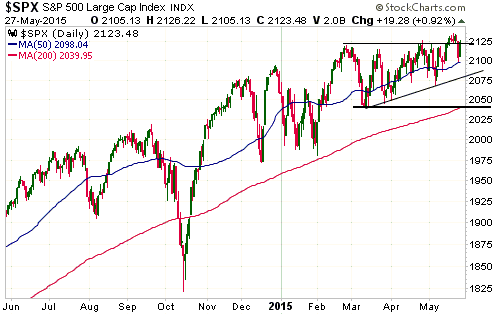
We continue to like the idea of scaling into a bearish US stock-market position
on days when the market is rallying, with the aim of either profiting from a
large decline over the next few months or quickly exiting with a relatively
small loss if the SPX makes a new weekly closing high after this week.
Europe
The Global X Greece ETF (GREK) is a proxy for the performance of the Greek stock
market in US$ terms. It is close to confirming an intermediate-term upward
reversal, in that it has sustained a break above its 50-day MA and has risen to
near the top of a downward-sloping channel that began to form more than 12
months ago. A daily close above US$13 would be a potentially significant upside
breakout.

GREK's performance suggests that the markets are expecting a continuation of
Europe's game of "extend and pretend" with regard to the Greek government's
impossible-to-service debt load.
Gold and the Dollar
Gold
In the latest Weekly Update, we wrote: "...the probability of new highs prior
to a short-term peak became much lower last Tuesday when the HUI/gold ratio
closed below its 40-day MA and has been lessened even further by the shift in
gold's COT data from supportive to neutral. Putting it another way, there's a
good chance that a short-term top for the US$ gold price was put in place about
a week ago."
Almost all remaining doubt that a short-term top in the US$ gold price was put
in place at the beginning of last week was removed on Tuesday of this week via a
daily close below $1200.
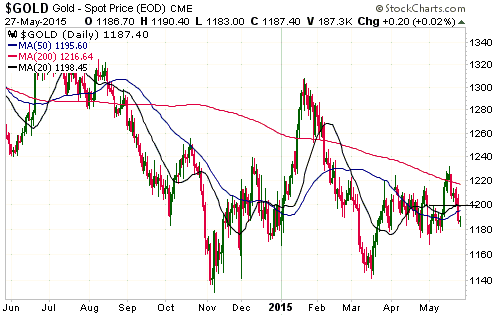
Gold's chart pattern and recent price action suggest that the November-2014 low
in the $1130s will be revisited within the next 1-2 months. This will remain the
case unless the gold price achieves a weekly close above $1220 and/or the HUI/gold
ratio closes above its 40-day MA.
A return to the November-2014 low would be consistent with the fundamental
backdrop, in that gold's fundamental drivers remain mixed and the S&P500 Index
hasn't yet signaled a downward reversal. As noted in our 2015 Yearly Forecast
and reiterated in February after the SPX made a new all-time high, additional
headway by the SPX over the first few months of this year would likely result in
gold dropping to test its 2014 bottom during the second quarter prior to a
long-term reversal.
Gold Stocks
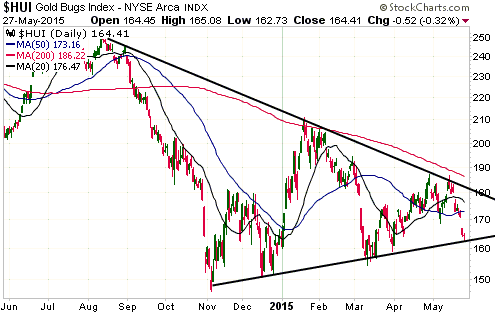
The HUI has extended its short-term decline. It is not yet 'oversold', but, as
illustrated by the following daily chart, it has reached an area of important
support in the low-160s. It would therefore not be surprising to see a rebound
over the next several days, even if the short-term decline hasn't run its
course. Note that a counter-trend rebound could push the price as high as the
mid-170s.
Our guess is that the HUI will test its November-2014 low within the coming 1-2
months. This guess will be proved wrong if the HUI manages to achieve a weekly
close above its 200-day MA.
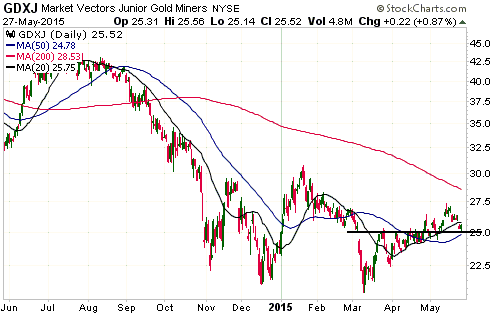
Remarkably, GDXJ is still managing to hold above $25.00. However, over the past
two trading days there was a minor sign of weakness in the form of a daily close
below the 20-day MA.
The performance of our own gold-stock portfolio has recently been a lot more
like GDXJ than the HUI. If we didn't know the level of the HUI and had to make a
guess based on the average performance of the gold stocks we own, our guess
would be "around 180".
That being said, it isn't reasonable to expect that GDXJ will remain above $25
and that the juniors will continue to be resilient if the HUI breaks below
support in the low-160s and begins to make its way down to major support at
145-150.
The Currency Market
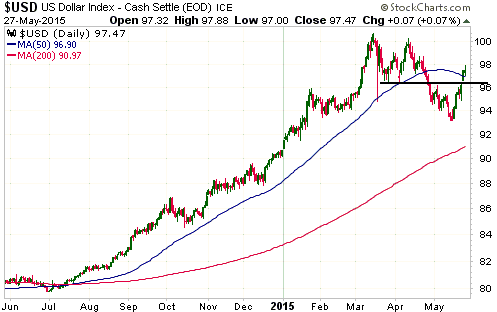
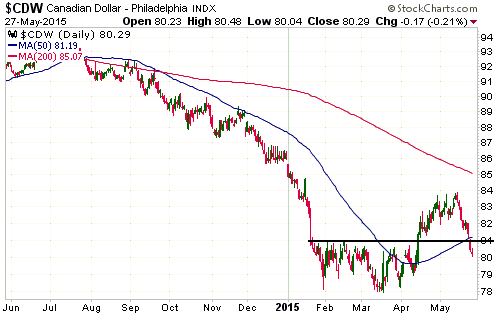
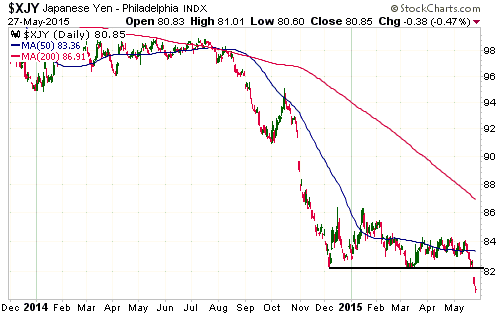
Some important support and resistance levels were breached in the currency
market during the first half of this trading week. In particular:
1. The Dollar Index broke above resistance at 96.
2. The Canadian Dollar (C$) broke below support at 81.
3. The Yen broke below the double bottom formed by lows in December-2014 and
March-2015, meaning that it has made a new low for its bear market.
The Dollar Index's upside breakout suggests that a short-term bottom (a bottom
that will hold for at least 1 month) was put in place during the week before
last. As long as Europe's monetary union isn't plunged into temporary chaos in
the near future by Greece choosing to exit or being forced out, we think that a
test of the March peak is the most that the Dollar Index will be able to
accomplish.
The C$'s downside breakout removes one piece of evidence that commodity prices
have begun to turn upward on an intermediate-term basis.
The Yen's downside breakout is difficult to fathom because it has no fundamental
justification. Long-term fundamentals such as purchasing-power-parity and
relative monetary inflation are Yen-bullish, as are short-term fundamentals such
as relative stock-market performance and interest-rate differentials (the US has
higher nominal interest rates, but the gap between US and Japanese interest
rates has recently moved in Japan's favour). However, the Yen's sharp decline
during September-December of last year also had no fundamental justification.
Updates on Stock Selections
Notes: 1) To review the complete list of current TSI stock selections, logon at
http://www.speculative-investor.com/new/market_logon.asp
and then click on "Stock Selections" in the menu. When at the Stock
Selections page, click on a stock's symbol to bring-up an archive of
our comments on the stock in question. 2) The Small Stock Watch List is
located at http://www.speculative-investor.com/new/smallstockwatch.html
 A
brief comment on every stock in the TSI List
A
brief comment on every stock in the TSI List
Not every stock in the TSI Stocks List is always a good candidate for buying,
but if a stock is in the List it means that the stock's intermediate-term
risk/reward looks attractive and that it is worth following closely. Also, we
remind you that the TSI Stocks List is not a recommended portfolio* and does not
encompass prudent money-management techniques such as scaling in/out of
positions. In particular, for stocks that have been in the List for a long time
we will probably have identified many short-term buying and selling
opportunities. These opportunities allow profits to be periodically harvested
and in some instances allow the average purchase price to be substantially
reduced, but none of this gets reflected in the 'official' performance record.
With the preamble out of the way, we'll get to the point. Since we didn't have
much in the way of new information to provide about the financial markets, the
economic situation or the monetary backdrop, we thought it would be worthwhile
to include a brief comment about every current TSI stock in today's report.
The comments are presented below, in two sections. Section A contains the stocks
that are either reasonable candidates for new buying at their current prices or
would become reasonable candidates for new buying following normal pullbacks.
Section B contains stocks that aren't well-suited to the current market
environment and should therefore not be on a 'shopping list' at this time. For
these stocks to again become 'buys' there will have to be clear-cut evidence of
an intermediate-term upturn in the associated commodity price.
Section A
*Almaden Minerals (AAU): This is one of the gold-mining stocks
that will rapidly become more valuable as the gold price moves higher. For
example, we calculate that at the current gold price the company's flagship
Tuligtic project is worth no more than US$0.80/share, but at a gold price of
$1320/oz our calculated fair value would rise to at least US$1.50/share. AAU
also owns a bunch of early-stage projects and royalty assets that will be spun
out into a separate company next month.
*Asanko Gold (AKG): As is the case with AAU, the value of AKG's
gold-mining assets will increase substantially in response to a relatively small
increase in the gold price. Specifically, AKG is fairly valued at
US$1.50-$1.70/share at the current gold price, but our assessment of fair value
rises to around US$3.00/share if we assume a gold price of $1300/oz.
*Dalradian Resources (DNA.TO): One of the best exploration-stage
gold-mining stocks in terms of project economics, project location and balance
sheet. The next important milestone will be completion of the PFS, which is
scheduled for late this year.
*Endeavour Mining (EDV.TO, EVR.AX): The best value in the world of
gold producers with more than 400K ounces/year of current production. The main
company-specific risk is the fact that all of the EDV's mines are located in
West Africa.
*Evolution Mining (EVN.AX): Due to the acquisition of the Cowal
gold mine announced earlier this week (to be discussed in the Weekly Update) EVN
has joined the ranks of mid-tier gold producers, a turn of events that will
invite comparisons with the much-higher-valued mid-tiers that trade in North
America. The acquisition stretches its balance sheet and will temporarily put
downward pressure on its stock price, but due to EVN's favourable relative
valuation and strong cash generation the stock price will probably move much
higher after the acquisition is put to bed.
*McEwen Mining (MUX): A junior gold-silver producer that is
marginally cash-flow positive at current metal prices and has a healthy balance
sheet. In addition to offering relatively low-risk leverage to upside in gold
and silver prices, it also offers significant leverage to upside in the copper
price via a large exploration-stage project in Argentina. At the moment,
however, the stock price can't seem to get out of its own way.
*Premier Gold Mines (PG.TO): The world's premier exploration-stage
gold-mining company. It has everything, including good management, valuable
assets in low-risk jurisdictions, a strong balance sheet, and intermediate-term
production potential (the newly-acquired South Arturo project could be in
production within 12 months).
*Pilot Gold (PLG.TO): A mine-finding company with one of the best
exploration teams in the gold-mining sector. It has made multiple high-potential
discoveries over the past 2 years, although none of these discoveries has yet
developed into the sort of asset that would be of interest to a mid-tier of
major producer. PLG is the only mining company we follow that is heavily reliant
on exploration success.
*Pretium Resources (PVG): A company in the process of
transitioning from the exploration/engineering phase to the construction phase.
Completion of the transition will require receipt of the final environmental
permit (due within the next few weeks) and the arrangement of debt financing. We
were hoping that an opportunity to exit PVG would present itself before the
start of mine construction, but it wasn't to be. The stock is now a lot closer
to the 'buy zone' than the 'sell zone'.
*Ramelius Resources (RMS.AX): An 80K-100K oz/year Australian gold
producer that has transformed over the past year from a financially-weak
cash-consuming company to a financially-strong cash-generating company. The
risk/reward is very attractive near the current price of A$0.13.
*Sabina Gold and Silver (SBB.TO): Another of the gold-mining
stocks that will rapidly become more valuable as the gold price moves higher.
Furthermore, the recently-completed FS indicates that SBB's flagship Back River
project is economically viable at a much lower gold price than indicated by the
2013 PFS.
*Timmins Gold (TGD): This is the stock that has given us the most
trouble over the past 6 months. With the benefit of hindsight, we should have
taken a loss on this one shortly after the company's management demonstrated its
incompetence last December by agreeing to buy the Caballo Blanco project (a
project that has almost no chance of ever being developed into a mine due to the
combination of local opposition and the virtual impossibility of obtaining all
the necessary permits). As things stand, we actually have two TGD positions in
the TSI List -- a long-term position and a short-term trading position. Both are
a long way underwater. Unfortunately or fortunately, depending on whether you
bought the stock at a much higher price or don't yet own it and are looking for
opportunities to buy financially-healthy junior gold producers at
bargain-basement prices, TGD's stock price is now at a level at which it makes a
lot more sense to buy than to sell.
*True Gold Mining (TGM.V): With construction having re-started at
its Karma gold project in Burkina Faso, TGM has again become a reasonable
speculation at the right price. As discussed in the latest Weekly Update, the
right price is the low-C$0.20s.
Section B
*Clifton Star Resources (CFO.V): CFO owns 10% of the Duparquet
gold project and 100% of the Duquesne gold project in Quebec. The Duquesne
project currently has a total gold resource (all categories) of 470K ounces at
an average grade of around 4.5-g/t. More importantly at this time and in today's
challenging market environment, CFO has about C$13M (C$0.27/share) of cash. Due
to this cash backing it makes no sense to sell CFO near its current price of
around C$0.20, but the present lack of value beyond the cash backing suggests
that the stock would be at least a 'partial sell' following a rebound to around
C$0.30.
*Energy Fuels (EFR.TO, UUUU): EFR can tread water by selling
enough uranium into high-priced long-term contracts to maintain a healthy
balance sheet for another 2 years if need be. However, while treading water at
an operational level reduces the risk of substantial additional weakness in the
stock price, it won't generate much in the way of new demand for the stock. Like
most uranium miners, EFR needs a higher uranium price.
*Energold Drilling (EGD): With a current share price in the
C$0.80s and per-share working capital of around C$1.30, EGD is most definitely
in the bargain basement. The stock market is effectively valuing its $100M/year
drilling business at less than zero. Consequently, a good argument could be made
that this stock should be in Section A. The only reason we put it in Section B
is that a sustained upturn in the minerals and energy drilling businesses could
be a long way off.
*Golden Star Resources (GSS): GSS recently did a "streaming deal"
that has greatly improved its balance sheet and given it some financial
breathing room, but at a sizable long-term cost. The aforementioned deal should
enable GSS's stock price to rally strongly after gold 'turns the corner'.
*UEX Corp. (UEX.TO): Like EFR and most other uranium miners, UEX
probably won't become a good candidate for new buying until evidence emerges of
an intermediate-term advance in the uranium price.
*Any newsletter writer who believes he can come up with a one-size-fits-all
portfolio is kidding himself. We don't kid ourselves. Instead, our primary goal
is for the TSI Stocks List to be a useful/profitable resource for stock
selection ideas. Nothing more, nothing less.
No trade in Midway Gold (MDW)
Under the heading "Is Midway Gold worth a punt?" in the 18th May 2015 Weekly
Update, we discussed the financial pressure on MDW and the recent dramatic
decline in its stock price. Our conclusion was that due to the uncertainty
regarding the company's ability to survive, buying MDW shares in anticipation of
a rebound was more like a Vegas-style gamble than a prudent speculation. It
didn't interest us.
It interests us even less now, with the company having been officially declared
in default by its senior lender earlier this week. There is still a chance that
a deal will be done that paves the way for a strong rebound in the stock price,
but the risk of the stock price going to zero is far too high for our liking.
Chart Sources
Charts appearing in today's commentary
are courtesy of:
http://stockcharts.com/index.html