|
- Interim Update 27th June 2012
Copyright
Reminder
The commentaries that appear at TSI
may not be distributed, in full or in part, without our written permission.
In particular, please note that the posting of extracts from TSI commentaries
at other web sites or providing links to TSI commentaries at other web
sites (for example, at discussion boards) without our written permission
is prohibited.
We reserve the right to immediately
terminate the subscription of any TSI subscriber who distributes the TSI
commentaries without our written permission.
China's economy is
probably shrinking
Many Western analysts and commentators parrot the economic growth numbers reported by China's government as if these numbers were true, but rational observers ignore the propaganda and try to figure out what's really happening. In their efforts to determine what's really happening these observers have tended to put a lot more emphasis on China's electricity consumption numbers than on the official GDP numbers, but there's a good chance that even the electricity consumption numbers are being fudged to create the illusion of higher growth.
It should first be noted that the official reports on electricity consumption suggest that economic growth is much slower than indicated by the GDP numbers. For example, the official reports point to last month's electricity consumption being up by only 3% from a year earlier. However, according to an
article posted in the New York Times on 22nd June:
"Record-setting mountains of excess coal have accumulated at the country's biggest storage areas because power plants are burning less coal in the face of tumbling electricity demand. But local and provincial government officials have forced plant managers not to report to Beijing the full extent of the slowdown, power sector executives said."
The article goes on to state:
"Officials at all levels of government are under pressure to report good economic results to Beijing as they wait for promotions, demotions and transfers to cascade down from Beijing. So narrower and seemingly more obscure measures of economic activity are being falsified, according to the executives and economists.
"The government officials don't want to see the negative," so they tell power managers to report usage declines as zero change, said a chief executive in the power sector.
Another top corporate executive in China with access to electricity grid data from two provinces in east-central China that are centers of heavy industry, Shandong and Jiangsu, said that electricity consumption in both provinces had dropped more than 10 percent in May from a year earlier. Electricity consumption has also fallen in parts of western China. Yet, the economist with ties to the statistical agency said that cities and provinces across the country had reported flat or only slightly rising electricity consumption.
Rohan Kendall, senior analyst for Asian coal at Wood Mackenzie, the global energy consulting firm, said coal stockpiled at Qinhuangdao port reached 9.5 million tons this month, as coal arrives on trains faster than needed by power plants in southern China. That surpasses the previous record of 9.3 million tons, set in November 2008, near the bottom of the global financial downturn.
The next three largest coal storage areas in China -- in Tianjin, Caofeidian and Lianyungang -- are also at record levels, an executive in China said."
In addition to the unusually high levels of coal stockpiles mentioned above, the article posted
HERE
notes that at least 30 large vessels of unsold coal cargoes are currently floating off China's coast because the traders who bought the coal have been unable to re-sell it to end-users.
The coal storage situation supports the idea that China's electricity demand is contracting. And if electricity demand is contracting then so, in all likelihood, is the overall economy.
What happens to China's nominal economic growth over the remainder of this year will largely depend on the government's monetary response to the current slowdown, but there's a high probability that even if the economy continues to contract the government will report 2012 growth of more than 7% at the end of the year. There's also a high probability that many Western analysts and commentators will point to this official statistic and say something like: "See, there's nothing to worry about; China is still growing rapidly." Coal
- a speculative buying opportunity in the making?
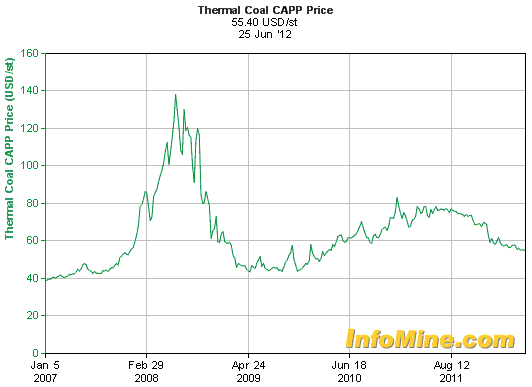
The price of thermal coal (the type of coal used in power generation) has been trending downward over the past 12 months. As far as we can tell, this downward trend has three drivers. The first is the slowing rate of growth in China's coal demand discussed above. The second is the recession in Europe. The third is the large fall in US coal consumption to a 20-year low due to the ultra-depressed natural gas price and the anti-coal regulatory environment.
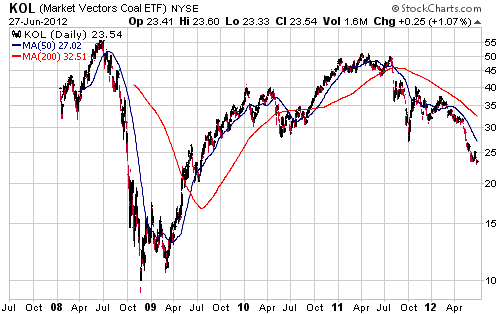
Not surprisingly, the downward trend in the coal price has adversely affected the stock prices of coal-producing companies represented by the Market Vectors Coal ETF (NYSE: KOL). As illustrated by the following chart, KOL has lost about 50% of its value over the past 12 months and early this week traded at its lowest level since July of 2009.
In the latest Weekly Update we suggested that a buying opportunity was emerging from the rubble in the Oil and Gas Services sector of the stock market. Our point was that drilling services stocks such as PDS had been beaten to a pulp even though they remained very profitable and appeared to have bullish long-term fundamentals. Could the same be true with regard to the pummeled coal stocks?
It's not clear that the same is true. The coal sector appears to be in the midst of a capitulation that will soon run its course, which means that a tradable rebound could begin at any time. However, coal fundamentals could get a lot worse before they turn around. We are therefore not inclined to wade in to the coal sector at this time, but this is one area that could very well be ripe for investment the next time the Fed and/or the People's Bank of China makes a concerted effort to inflate.
The Stock Market
Current Market Situation
The large decline in the O&G services sector discussed in the latest Weekly Update and the large decline in the coal sector discussed above are part of a broad sell-off in commodity-related equities that began more than a year ago. The rate of decline has accelerated over the past two months, which means that a bottom is probably close at hand. At this stage there is no way of telling whether the bottom will be the short-term or the intermediate-term variety, but valuations and the negative sentiment evidenced by the public's
current distaste for commodity-oriented investments
indicates that it could be the intermediate-term variety.
Measures of risk aversion to keep an eye on
A stock market decline won't become serious unless measures of risk aversion indicate a concerted shift away from risk. Here are some of the measures of risk aversion that we monitor:
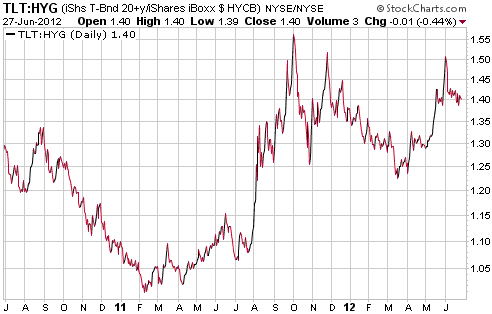
1. Credit spreads, as represented by the TLT/HYG ratio. Upward trends in the TLT/HYG ratio indicate shifts away from risk.
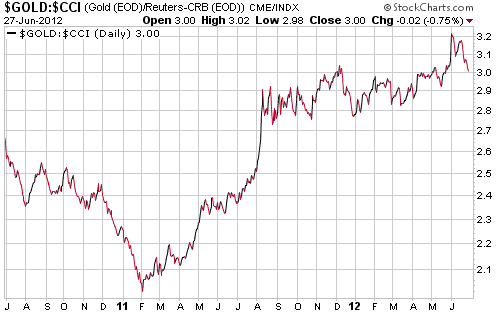
2. Gold relative to non-monetary commodities, as represented by the Gold/CCI ratio. Upward trends in the gold/CCI ratio indicate shifts away from risk.
3. The Yen/A$ exchange rate. The Yen tends to strengthen relative to the A$, leading to an upward trend in the Yen/A$ exchange rate, when there is a general shift away from risk.
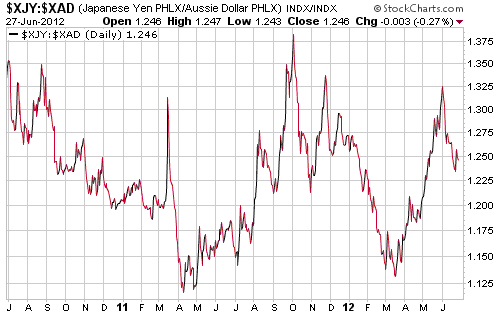
Each of the charts displayed above tells us that there was at least a temporary peak in risk aversion at the beginning of June. In other words, taken together the above charts suggest that a market-wide swing towards risk began about 4 weeks ago.
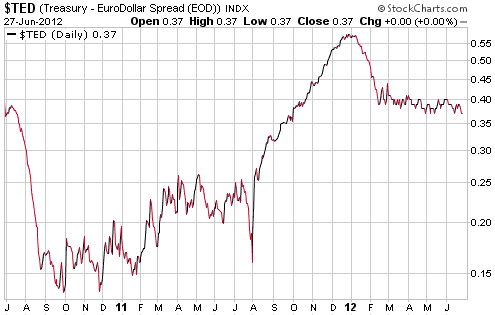
4. The TED Spread (the spread between the 3-month yield on eurodollars and the yield on the 3-month T-Bill). A rise in the TED Spread indicates increasing risk aversion.
The TED Spread has drifted sideways over the past few months. A decline to below 0.30 would confirm a pronounced shift towards risk while a rise above 0.45 would clearly point to greater risk aversion in the financial world.
5. Under normal circumstances the yield on Spanish government bonds
wouldn't be useful as an indicator of general market risk aversion, but under the current special circumstances it is.
Gold and the Dollar
Silver
In mid May silver's daily RSI was almost as low as it got during the 2008 crash, but silver's weekly RSI was still significantly higher than its 2008 low. Since then the silver price has experienced a minor rebound followed by a decline to a marginal new low for the year. As illustrated by the weekly silver chart displayed below, this price action was sufficient to push the weekly RSI down to within a whisker of its 2008 low.
After the weekly RSI bottomed in 2008 there was a price rebound and then a final price plunge to the ultimate correction low. A final plunge is possible within the next few months. Not likely, but possible.
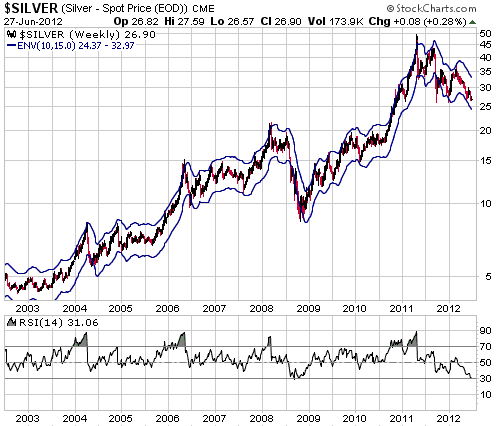
When silver rocketed above $40 on its way to $50 last April your primary focus should have been on downside risk. There was no telling how high the price would go before reversing, but the nature of the price action indicated that the coming correction would be brutal. Now, your primary focus should be on upside potential. It will probably still be a few months before silver's next major upward trend gets underway and there is still a possibility of a final plunge to the low-$20s, but the intermediate-term downside risk is low relative to the potential upside.
Gold Stocks
Current Market Situation
The following chart shows that the HUI is just below its 50-day moving average, which is where routine short-term corrections often end. Of course, this doesn't guarantee that the correction is about to end. If you are the type of person who needs or strongly desires such guarantees, then don't speculate or invest.
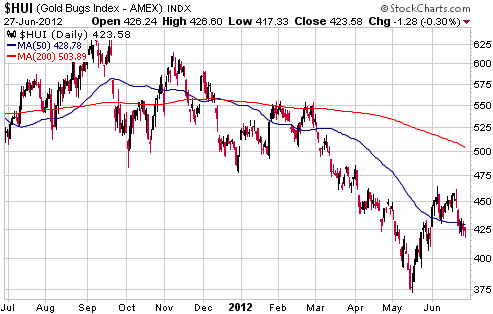
Patience is the key right now. The most likely outcome is that the HUI's correction will end within the next 6 trading days and new multi-month highs will be registered before the end of July, but it's advisable not to fixate on any specific near-term scenario. Instead, it's better to think along the lines of: The correction will take as long as it takes, and then the next rally will begin.
Windfall tax coming to South Africa's gold mining industry?
A 50% "windfall" tax on profits generated by mining companies is currently under discussion in South Africa.
So-called "windfall" taxes are one of the surest ways to kill investment in the mining industry. Large profit margins in the mining business are always temporary. Sometimes the large profit margins can last a few years, but rising supply and falling demand in response to high commodity prices eventually take their toll and profit margins shrink. Furthermore, often they end up shrinking to the point where many producers lose money and are forced to shut down. Mining is a notoriously cyclical business and the only thing that makes the risk worthwhile is the possibility of periodically generating very high profits. Take away that possibility by imposing a "windfall" tax and you eliminate the incentive to invest.
From our perspective, if the windfall tax currently under discussion in South Africa were to be implemented it would rule out SA-based mining companies as potential investments.
Currency Market Update
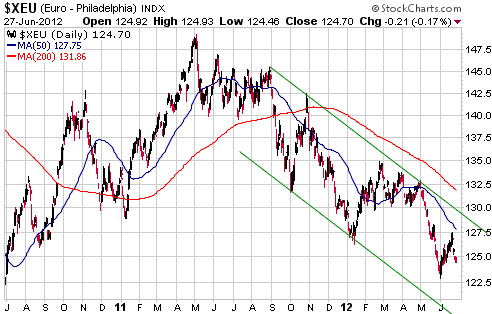
All eyes are now on the European Union summit scheduled for 28-29 June. This will apparently be the 20th crisis-management meeting of Europe's leadership since the sovereign debt problem bubbled to the surface in early 2010. Anyone believe that the 20th time's the charm? Anyone?
The majority view among financial market prognosticators is that Germany will eventually blink and take responsibility for a large chunk of the liabilities run-up by the lesser-lights of the EZ. This is a possibility, but in order for it to become a probability it seems that each member of the EZ will have to cede some control over its government budget. And even if it is something that will eventually happen, there's no way of pinning down the timing.
We get the impression that expectations regarding the likely outcome of this week's summit are low, which reduces the risk of big declines in stocks, commodities and the euro if/when nothing is achieved.
The euro remains extremely oversold on an intermediate-term basis and is likely to rebound strongly once Europe's sovereign debt crisis moves away from centre-stage. Due to the huge speculative net-short position in the euro futures market, it now takes a steady stream of euro-bearish news to maintain the currency's downward trend.
Update
on Stock Selections
Notes: 1) To review the complete list of current TSI stock selections, logon at
http://www.speculative-investor.com/new/market_logon.asp
and then click on "Stock Selections" in the menu. When at the Stock
Selections page, click on a stock's symbol to bring-up an archive of
our comments on the stock in question. 2) The Small Stock Watch List is
located at http://www.speculative-investor.com/new/smallstockwatch.html
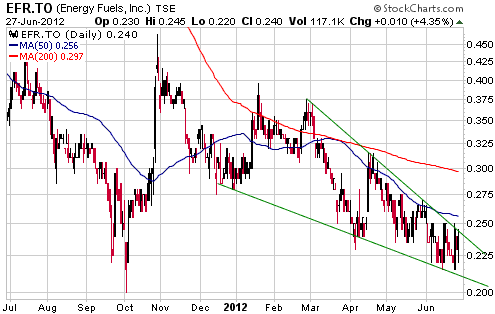
 Energy Fuels Inc. (TSX: EFR). Shares: 675M issued, 782M fully diluted (incl 36M-share equity financing + $22M CN financing + 425M-share White Mesa purchase in Jun-2012). Recent price: C$0.24 Energy Fuels Inc. (TSX: EFR). Shares: 675M issued, 782M fully diluted (incl 36M-share equity financing + $22M CN financing + 425M-share White Mesa purchase in Jun-2012). Recent price: C$0.24
EFR's purchase of Denison's White Mesa uranium mill and associated uranium mines is scheduled to be completed at the end of this week. At that point, EFR will be the only US-based uranium miner with significant current production.
The purchase of Denison's assets comes at a high cost (425M EFR shares). Whether or not it pays off will largely depend on what happens to the uranium price. The uranium price has spent almost the entire past 12 months moving sideways at $51/pound +/- $2. If it enters a new up-trend within the next 12 months then EFR's purchase should pay off handsomely.
EFR's price chart (see below) suggests that a break above short-term resistance at C$0.25 would be followed by a quick move up to the mid-C$0.30s. This is certainly possible, although a large supply of shares will potentially hit the market over the next couple of months. The reason is that 425M EFR shares will be distributed to the shareholders of Denison Mines, resulting in many people involuntarily ending up with EFR shares. We think that EFR offers very good value near its current price, but bear in mind that selling by these involuntary owners could cap the price in the short-term.
Batero Gold (TSXV: BAT). Shares: 63M issued, 82M fully diluted. Recent price: C$0.47
Despite its extremely low valuation, we haven't highlighted BAT.V as a candidate for new buying over the past two months. The reason is that companies with less-risky projects and much stronger balance sheets -- companies such as Sabina (SBB.TO), Keegan (KGN), Prodigy (PVG.TO) and Volta (VTR.TO) -- were just as cheap thanks to indiscriminate selling and a general absence of buying. The situation hasn't changed, in that the less-risky stocks are still dirt cheap. However, it's about time that we wrote something about BAT.
BAT's first big negative is that its Colombia-based gold project is low-grade. BAT's second big negative is that the company's management and consultants made the project's grade seem lower than it actually is by using an unrealistically low cut-off grade in the resource estimate in an effort to boost the reported size of the resource. This tactic backfired. It backfired because a 6M-oz gold resource that is blatantly uneconomic is worth a lot less than a 4M-oz gold resource that is potentially economic. Currently, BAT has a 4M-oz gold resource that could be economic despite its low grade.
We suspect that BAT's management has learned a lesson and that future exploration and engineering will focus more on resource grade than resource size.
BAT's price chart (see below) indicates that the stock probably bottomed in mid May and has been 'correcting' its initial rally over the past two weeks. Short-term resistance lies at C$0.60.
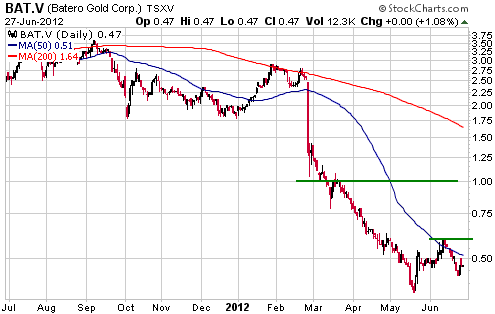
Chart Sources
Charts appearing in today's commentary
are courtesy of:
http://stockcharts.com/index.html

|









