|
- Interim Update 27th August 2014
Copyright
Reminder
The commentaries that appear at TSI
may not be distributed, in full or in part, without our written permission.
In particular, please note that the posting of extracts from TSI commentaries
at other web sites or providing links to TSI commentaries at other web
sites (for example, at discussion boards) without our written permission
is prohibited.
We reserve the right to immediately
terminate the subscription of any TSI subscriber who distributes the TSI
commentaries without our written permission.
A
reliable recession indicator won't work next time
There was an inversion of the US yield curve, meaning that
short-term interest rates moved above long-term interest rates,
ahead of every official US recession of the past several decades.
Consequently, a popular assumption is that there will be no need to
worry about a future US recession until after the spread between
short-term and long-term interest rates has shrunk to zero and the
yield curve is on the verge of becoming inverted. In our opinion,
this assumption will prove to be wrong. Due to Zero Interest Rate
Policy (ZIRP), the US economy's next transition from growth to
recession will almost certainly occur while the US yield curve
remains positively sloped.
"It's different this time" is usually a dangerous idea, but it
really is different this time. The Fed has recently taken
interest-rate manipulation way beyond anything it has previously
attempted. Given this fact, is it unreasonable to expect that
interest-rate relationships that worked in the past will not work in
the future?
When it comes to the ability of the yield curve to forecast
recessions, it is actually more reasonable to expect that the future
will be different from the past than it is to assume that past is
prologue. With the Fed committed to keeping its targeted overnight
interest rate at zero for at least 9 more months and highly likely
to move in 'baby steps' after a rate-hiking program eventually
begins, there is almost no chance of short-term T-Note yields moving
above long-term T-Note yields within the next two years. Moreover,
although the Fed's current stance is unprecedented, a precedent is
provided by Japan's experience.
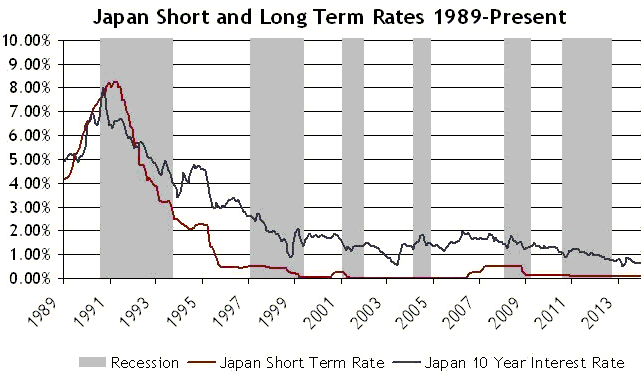
A yield-curve inversion was a reliable leading indicator of
recession in Japan until the mid-1990s, when the BOJ embarked on a
program involving near-zero administered interest rates. Since that
time, none of Japan's economic recessions (there have been five of
them) have been preceded by an inverted yield curve. This point is
discussed in the article posted
HERE and illustrated by the chart displayed below. With regard
to this chart, Japan's yield curve is considered to be positively
sloped when the black line is above the red line.
In summary, the extreme interest-rate manipulation being conducted
by the Fed makes it very unlikely that the next US recession will be
telegraphed by an inverted yield curve. Regardless of whether the US
economy is growing or shrinking or somewhere in between, it's a good
bet that the US yield curve will remain positively sloped for a very
long time to come. However, it will probably become flatter (less
positively-sloped) ahead of recessions.
Interest rate suppression stupidity
It is illogical to expect an artificially-low
interest rate to help the economy. This is because the best-case scenario
resulting from interest-rate suppression is a wealth transfer from savers to
speculators. In other words, the best case is a 'wash' for the overall economy.
The realistic case, however, is very much a negative for the overall economy,
because in addition to punishing savers an artificially low interest rate will
cause mal-investment and thus make the economy less efficient.
Furthermore, thanks to the Japanese experience of the past two decades there is
now a mountain of recent empirical evidence to support the logic outlined above.
Japan's policymakers have tried and tried again to propel their economy to the
mythical "escape velocity" by pushing interest rates down to absurdly low levels
and keeping them there, but every attempt has failed. Unfortunately, the fact
that interest-rate suppression has been a total bust in Japan has not dissuaded
other central banks from going down the same path.
The root of the problem is devotion to bad economic theory. If you are convinced
that lowering the interest rate, pumping money into the economy and ramping-up
government spending is beneficial, then from your perspective a failure of such
measures to sustainably boost the rate of economic growth can only mean that the
measures weren't aggressive enough. If the interest rate is reduced to zero and
the economy remains sluggish, then a negative interest rate must be needed. If
the economy doesn't become strong in response to 10% annual money-supply growth,
then 15% or 20% annual monetary expansion is obviously required. If a hefty
boost in government spending fails to kick-start the economy, then it must be
the case that government spending wasn't boosted enough.
The alternative is that the theory underlying the policy is completely wrong,
but this possibility must never be acknowledged.The Stock Market
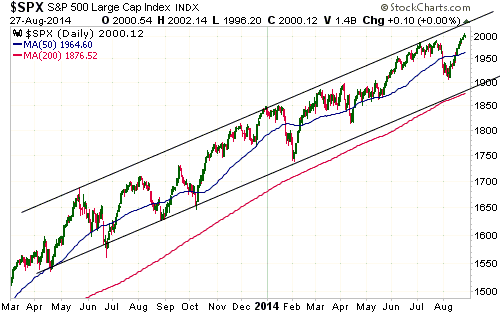
After becoming moderately 'oversold' on a short-term basis early
this month, the S&P500 Index is now moderately 'overbought' on a short-term
basis. At the same time, it is very 'overbought' on an intermediate-term basis,
having now gone 21 months without pulling back enough to touch its 200-day MA.
Although we wouldn't bet on it doing so, one thing that the recent rally hasn't
accomplished is a return to the very top of the intermediate-term price channel
drawn on the following daily chart. A touch of the channel top in the near
future would require a quick additional gain of around 30 points (1.5%), which
is not out of the question but isn't the most likely outcome. In our opinion,
the most likely outcome is a downward reversal from near the current level.
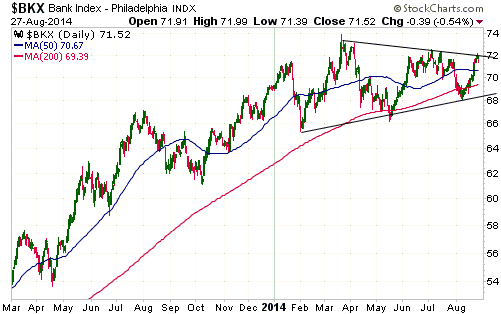
The Bank Index (BKX) has risen to resistance in the low-70s. Consequently, it is
about to either break out to the upside and signal that everything since the
March peak was a bull-market consolidation or reverse downward and keep alive
the possibility that a major top was put in place in March. The BKX's
performance over the days ahead should therefore be informative.
As far as the gold market is concerned, the BKX's performance relative to the
SPX is what counts. Relative to the SPX, the BKX has been trending downward
since July of last year and there is currently no sign of a trend change.
However, if the BKX were able to break out to the upside in nominal terms it
would remove one of the planks supporting the intermediate-term bearish case for
the broad stock market.
Gold and the Dollar
Gold
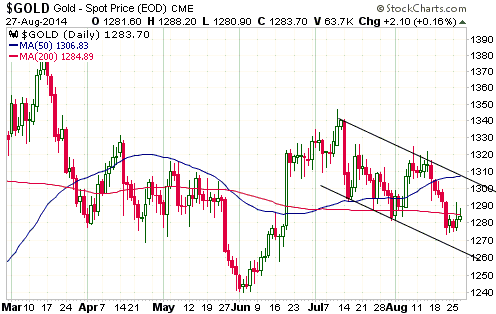
The US$ gold price closed below $1280 on Monday, but despite the SPX attaining
'the big round number' (2000) there was no follow-through to the downside in the
gold market. Instead, gold immediately reversed course and traded up to $1290
before pulling back to the low-$1280s. In doing so it remained below its 200-day
MA on a daily closing basis and maintained maximum short-term uncertainty.
The following excerpt from the latest Weekly Update remains applicable:
"It won't take much to shift our short-term gold outlook back to "bullish".
Consecutive daily closes above $1285 would probably do it, as would a spike down
to the short-term channel bottom (the high-$1260s -- see chart below) followed
by a reversal and a single daily close above $1285."
The only change is that the short-term downward-sloping channel, which is well
defined, would allow for a downward spike over the next few days to as low as
$1260.
Gold Stocks
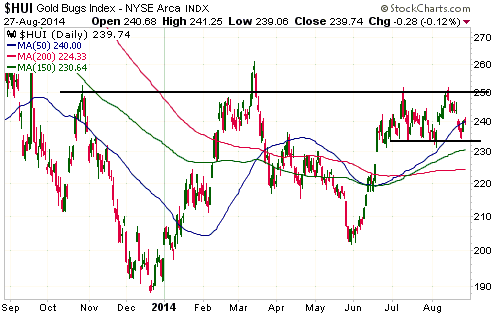
The HUI has short-term support at 233 and short-term (and intermediate-term)
resistance at 250.
There's a realistic possibility that the HUI will break below short-term support
at 233, setting in motion a quick decline to 215-220. This would be within the
context of a seemingly endless basing pattern and should therefore not create a
problem for long-term or intermediate-term bulls, but it would undoubtedly cause
many retail holders of gold stocks to throw in the proverbial towel.
A break below 233 and a quick decline to 215-220 is not a forecast. It's more
likely that short-term support will hold and that a rally to new highs for the
year will soon begin. However, based on the recent price action it is a
plausible outcome.
Keep in mind that short-term fluctuations are often not related to fundamental
factors. They are mostly driven by changes in sentiment.
We are more concerned about GDXJ's performance the HUI's performance, partly
because GDXJ is a better proxy than the HUI for the gold stocks that we are
focused on and partly because GDXJ's relative performance has been a reliable
leading indicator over the past few years.
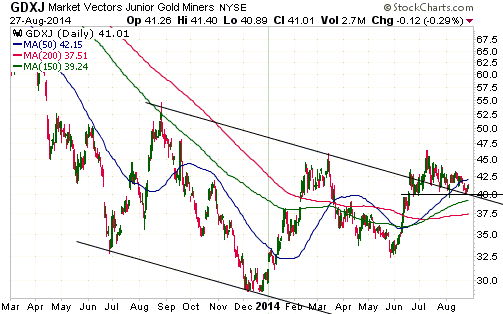
One way to interpret GDXJ's daily chart (see below) is that there was an upside
breakout from a major basing pattern in early July followed by a pullback to
test the breakout. Under this interpretation of the chart -- which, by the way,
is the interpretation we favour -- there have been multiple successful tests of
the breakout.
For this interpretation to remain valid, GDXJ must continue to hold above $40.00
on a daily closing basis and soon signal the start of a rally by closing above
$43.00. Alternatively, a daily close below $40 would suggest that the basing
process was not yet complete and that GDXJ was on its way back to around $35.
The Currency Market
As mentioned in the latest Weekly Update, the Dollar Index has short-term upside
potential to 83.5-84.0. We also mentioned that a routine pullback could take the
index down to around 81.0. We therefore thought that the short-term risk/reward
remained "neutral".
As a result of the market action of the past three days, however, we think that
the short-term risk/reward has shifted to "bearish", because there is now a
greater risk that the Dollar Index is about to commence something more negative
than a routine pullback. Here's why:
First, one of the reasons noted in the Weekly Update for shifting our
intermediate-term US$ outlook to "bearish" was that the stage had been set for
strength in large-cap European equities relative to large-cap US equities. This
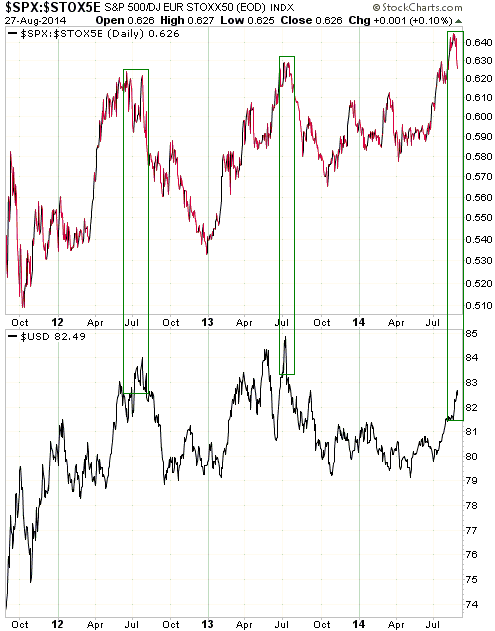
week's sharp downward reversal in the SPX/STOX5E ratio (a measure of US equity
performance compared to European equity performance) is an early warning that
the relative-strength trend has changed and that European equities have begun to
outperform. If so, then the euro is probably about to start strengthening
relative to the US$, leading to a downward trend in the Dollar Index.
The following chart shows the relationship between the SPX/STOX5E ratio and the
Dollar Index.
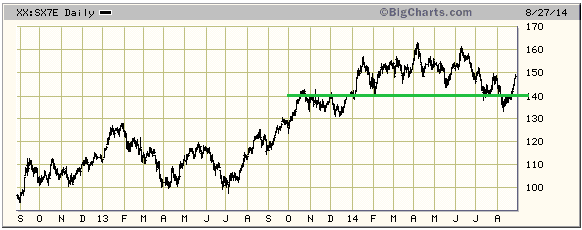
Second, the EURO STOXX Banks Index (SX7E) broke out to the downside in early
August, but then reversed course and has since gained enough ground to indicate
that the downside breakout was false. Refer to the following chart for details.
The euro has generally trended with the SX7E over the past few years, so the
SX7E's upward reversal suggests that a similar reversal is 'in the cards' for
the euro.
Updates
on Stock Selections
Notes: 1) To review the complete list of current TSI stock selections, logon at
http://www.speculative-investor.com/new/market_logon.asp
and then click on "Stock Selections" in the menu. When at the Stock
Selections page, click on a stock's symbol to bring-up an archive of
our comments on the stock in question. 2) The Small Stock Watch List is
located at http://www.speculative-investor.com/new/smallstockwatch.html
Chart Sources
Charts appearing in today's commentary
are courtesy of:
http://stockcharts.com/index.html
http://bigcharts.marketwatch.com/

|









