|
- Interim Update 27th October 2010
Copyright
Reminder
The commentaries that appear at TSI
may not be distributed, in full or in part, without our written permission.
In particular, please note that the posting of extracts from TSI commentaries
at other web sites or providing links to TSI commentaries at other web
sites (for example, at discussion boards) without our written permission
is prohibited.
We reserve the right to immediately
terminate the subscription of any TSI subscriber who distributes the TSI
commentaries without our written permission.
US Mortgage Mess Update
John Mauldin's latest Weekly Letter
contains an explanation of why US banks could collectively be facing
additional unplanned losses of more than 100 billion dollars as a
result of the way they put together Mortgage Backed Securities (MBS's).
It seems that banks deliberately and knowingly inserted many flawed
mortgages into the MBS's that they sold to investors, which could mean
that the banks will be forced to buy back hundreds of billions of
dollars of these products at the original sale value. The securities
are now worth a lot less than the original sale value, hence the
additional loss potential mentioned above.
The US mortgage market has evolved into the crisis that keeps on
giving. Just when it seems that every cockroach has been exterminated
(usually at taxpayer expense), a bunch more crawl out of the woodwork.
Since the start of the financial crisis the US government and the Fed
have teamed up to provide the US banking industry with direct support
of around 2 trillion dollars. There has also been indirect support
measured in the trillions. The alternative to providing this
taxpayer-funded support would have been to let some large and poorly
managed banks go bust, which would have resulted in the banks'
bondholders suffering massive losses. In other words, the choice was to
let bondholders suffer the consequences of their ill-conceived
investments or to shield the bondholders by effectively spreading the
losses across the entire economy. The latter option was chosen.
With more large losses now looming for the banking sector, the
Treasury-Fed combo faces a dilemma. Its loyalties clearly lie with the
large banks and their bondholders, but with public resentment already
at a troublesome level due to high unemployment and the earlier
bailouts it is probably not politically feasible to provide beleaguered
banks with more direct financial support. Fortunately for these banks
and their investors, there is almost no limit to the amount of indirect
support that can surreptitiously be provided by the Fed.
The next round of "quantitative easing", for example, will benefit
commercial banks because all the new money created by the Fed will
eventually end up in the private banking system (with the exception of
a small float (notes and coins in wallets, cash registers, etc.), all
the money in the economy is held in bank accounts). Perhaps more
importantly, the Fed is capable of supporting banks by maintaining a
steep yield curve indefinitely. An artificially steep yield curve
effects a transfer of wealth from a bank's depositors to the bank
itself (because the bank pays its depositors a below-market rate of
interest thanks to the Fed's efforts), but it has the political
advantage of being a wealth transfer that few people recognise. After
all, most people have been conditioned to believe that the central bank
helps the OVERALL economy by reducing interest rates, which effectively
means that they have been conditioned to believe that the Fed, via its
manipulation of interest rates, is able to provide the proverbial "free
lunch".
So, expect the banking industry to be handed more financial assistance
at the expense of the overall economy. Just don't expect the assistance
to be the overt kind.
Are you ready for QE2?
With
equity prices, commodity prices and inflation expectations having
ramped upward over the past two months, it would be dangerous for the
Fed to implement a large monetary injection in the near future. Doing
so could quickly push inflation expectations to an 'uncomfortably' high
level. On the other hand, with Bernanke having all but promised more
monetary inflation and with the markets having reacted to this virtual
promise, failure to follow through would likely cause the stock market
to tank. This means that it would also be dangerous -- from the point
of view of the average Fed governor -- to NOT formally announce the
second round of "quantitative easing" (QE2) at the conclusion of next
week's FOMC meeting. The Fed is therefore 'painted into a corner'.
We expect that the Fed will formally introduce QE2 next Wednesday, but
we doubt that there will be much in the way of actual QE over the next
few months. In effect, if our assessment is correct then the Fed is
about to put in place an inflation program that won't be activated to a
meaningful degree in the short term.
On a longer-term (6-24 month) basis there will likely be a lot of
additional monetary inflation (a.k.a. QE), the main reasons being that
a) the US economy will remain sluggish at best, and b) Bernanke labours
under the terribly mistaken belief that the economy can be helped by
boosting the money supply (Frank Shostak's 26 Oct article
explains why this belief is "terribly mistaken"). A Goldman Sachs
analyst recently estimated that QE2 would ultimately amount to a $4
trillion monetary injection, but this could easily turn out to be an
under-estimate.
The Stock Market
The
S&P500 Index (SPX) has closed within a 12-point range (1174-1186)
on each of the past 11 trading days, and over the past 4 trading days
its daily closing range has narrowed to only 3 points (1183-1186). In
other words, on a daily closing basis the US stock market has done
almost nothing over the past two weeks.
The recent loss of upward momentum could mean that the market is about
to roll over to the downside, but it's more likely to be a pause within
a continuing short-term upward trend. Our guess is that the SPX will
test its April high at some point over the next month, but this doesn't
imply interesting upside potential because the April high is only about
3% above the current level.
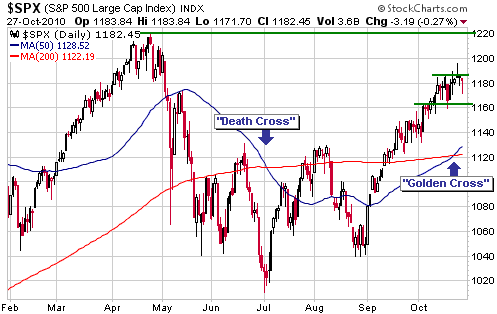
The following daily SPX chart shows intermediate-term resistance
defined by the April high and short-term resistance/support levels
(support lies in the low-1160s). It also indicates the early-July
"death cross" (the 50-day MA's cross from above to below the 200-day
MA) and the recent "golden cross".
When the moving averages crossed over in early July, we wrote:
"The stock market's
recent weakness has allowed the S&P500's 50-day moving average to
cross below its 200-day moving average, an event that technical
analysts commonly call a "death cross". The term "death cross" sounds
ominous, but such crossovers have no statistical significance in that
they are only followed by meaningful additional losses about 50% of the
time. Rather than being an indication of what lies in store, we
consider the S&P500's "death cross" to be one of several milestones
that had to be reached if we were correct to assume that an
intermediate-term decline began in April."
As it turned out, the so-called "death cross" coincided with an
important price low. This is actually not uncommon. It is also not
uncommon for a "golden cross" to occur at around the time of an
important price high. Why, then, do some technical analysts place a lot
of emphasis on these moving average crossovers, with "death crosses"
considered to be reliable bearish signals and "golden crosses"
considered to be reliable bullish signals? We don't know -- you'd have
to ask them.
It is now apparent that an intermediate-term decline began in April,
but as we first realised at the beginning of September it most likely
ended about three months sooner than originally expected. A test or
marginal breach of the April high could mark the next intermediate-term
turning point, but we'll cross that bridge when we come to it.
Gold and
the Dollar
Gold
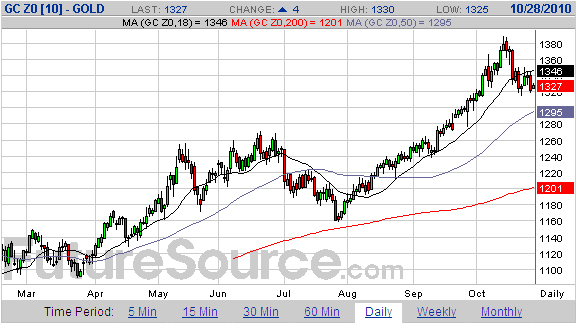
Our view continues to be that gold is immersed in a routine short-term
correction within a continuing upward trend. Counter-trend moves such
as this often take the price down to the 50-day moving average or a
little lower. As indicated by the following daily chart, this moving
average is now at $1295 (basis the December futures contract).
Below the 50-day moving average there is lateral support at around
$1260-$1270, which could come into play within the next several days.
Sentiment indicators
suggest that gold's correction will extend no further than the lateral
support mentioned above. For example, Market Vane's survey shows that
the percentage of bullish traders has dropped from 85 to 70 since the
October price peak. This is as much of a reduction in bullish sentiment
as we'd expect from a short-term correction. Also, Central Gold Trust
(GTU) ended Wednesday's session at a premium to net asset value (NAV)
of only 1.4% and traded at a small discount to NAV late last week. Last
week was the first time since September of 2008 that GTU traded at a
discount to its NAV.
With gold most likely within a few percent of a correction low, we are
upgrading our short-term outlook from "neutral" to "bullish".
Speculators wanting to 'get long' or add to existing long positions in gold should consider the following scaling-in plan:
- do some buying in the US$1320s
- do some more buying if the price drops to the US$1290s
- do some more buying if the price drops to the US$1270s
Gold Stocks
The HUI has tested support in the low-490s on 4 of the past 6 trading
days. The more times a support level is tested, the higher the
probability that it will be breached before a sustainable low is in
place.
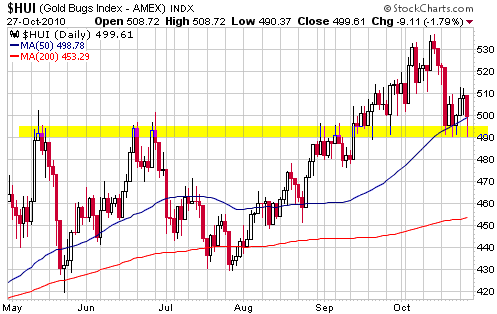
A breach of support
could lead to nothing more than an intra-day spike to around 480, but
the chart pattern is evolving in a way that suggests the potential for
a decline to as low as the mid-450s. Many gold-stock holders would no
doubt be worried by a decline to the 450s, but we would welcome it with
open arms because it would lower the risk of new buying.
Based on the gold sector's performance over the past decade, the most
likely time for a correction low is this week or next week.
Currency Market Update
Hong Kong's Hang Seng Index (HSI) is a good proxy for the global stock
market situation. This is perhaps because Hong Kong is an interface
between the developing world's most important economy and the economies
of the developed world. As a result of this interface role, HK's stock
market probably acts like a barometer of global economic growth.
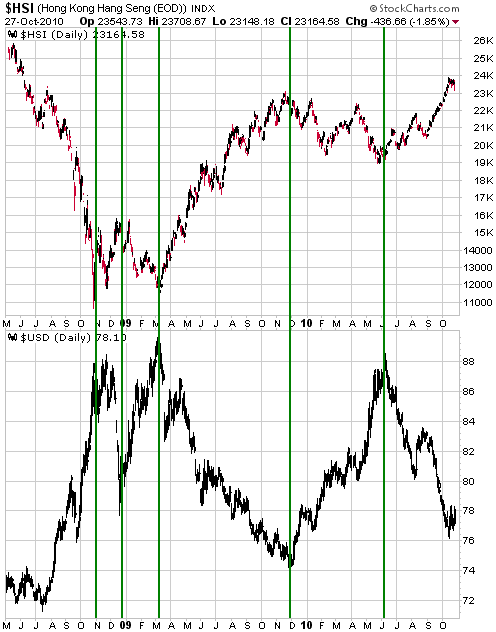
The following chart compares the aforementioned proxy for the global
stock market situation with the Dollar Index. Clearly, the strong
inverse relationship between the Dollar Index and global equities that
began in July of 2008 is still very much in effect.
The turning points in the HSI and the Dollar Index match up so closely
that it is impossible to tell, by looking at the chart, which market is
leading and which is lagging, or if there is any sort of lead-lag
relationship at work. We suspect that traders are simultaneously buying
equities and short-selling the US$, or selling equities and closing-out
US$ shorts, in response to swings in economic growth expectations.
As an aside, there is
also an inverse correlation between the global stock market situation
and the gold/silver ratio, the gold/GYX ratio (GYX is the Industrial
Metals Index), and the gold/CRB ratio. This means that gold has
generally been doing better than other commodities when the US$ has
been strengthening and worse than other commodities when the US$ has
been weakening.
As we mentioned at the time, there's a possibility that the Dollar
Index's "outside up-day" on Friday 15th October could have marked an
intermediate-term turning point. However, arguing against this
possibility is the absence, to date, of any evidence that an
intermediate-term stock market peak is at hand. It's therefore more
likely that the Dollar's current rebound will be followed by a decline
to at least a marginal new low.
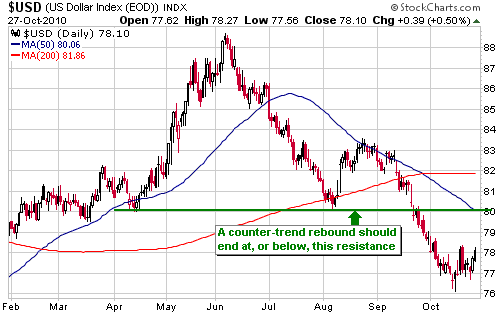
As noted on the following chart, a counter-trend rebound should end at, or below, 80.
Update
on Stock Selections
(Notes: 1) To review the complete list of current TSI stock selections, logon at http://www.speculative-investor.com/new/market_logon.asp
and then click on "Stock Selections" in the menu. When at the Stock
Selections page, click on a stock's symbol to bring-up an archive of
our comments on the stock in question. 2) The Small Stock Watch List is
located at http://www.speculative-investor.com/new/smallstockwatch.html)
 In Stock Selection Update #62,
sent to subscribers following Tuesday's trading session, we advised
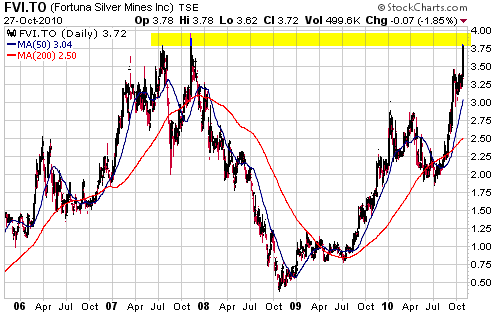
that we were exiting Fortuna Silver (TSX: FVI) at a profit of 76%. The
main reason was that at Tuesday's closing price of C$3.79 FVI was
within 5% of being fully valued. It is also worth noting that FVI is
technically 'overbought' (it is about 50% above its 200-day moving
average) and -- as illustrated by the following chart -- at long-term
resistance. In Stock Selection Update #62,
sent to subscribers following Tuesday's trading session, we advised
that we were exiting Fortuna Silver (TSX: FVI) at a profit of 76%. The
main reason was that at Tuesday's closing price of C$3.79 FVI was
within 5% of being fully valued. It is also worth noting that FVI is
technically 'overbought' (it is about 50% above its 200-day moving
average) and -- as illustrated by the following chart -- at long-term
resistance.
Franco Nevada $32.00 warrants (TSX: FNV.WT). Recent price: C$6.25
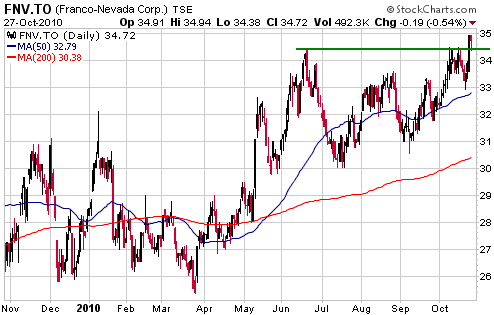
FNV appears to have acquired the 'leading indicator' status that Royal
Gold (RGLD) once held. If so, its move to a new all-time high on
Tuesday is a bullish omen for the overall gold sector.
Our main interest is
with the FNV C$32 warrants (FNV.WT). Our chart-based target for FNV is
C$40, and if the stock moves up to around this target over the next
couple of months then fair value for FNV.WT at that time will be
$11-$12. However, the stock market has consistently priced these
warrants at a sizeable discount to their fair value*, so it is quite
possible that a rise to C$40 in the stock price would only bring about
a rise to around C$10 in the warrant price. We have therefore decided
to exit the warrants if they trade near C$10.
*For example, at
Wednesday's closing price of C$34.72 for FNV, the fair value for FNV.WT
is about C$7.80; however, FNV.WT ended Wednesday's session at only
C$6.25.
Jaguar Mining (NYSE and TSX: JAG). Shares: 84M issued, 88M fully diluted. Recent price: US$6.24
In the realm of gold mining companies that are expected to produce more
than 200K ounces of gold next year, at current prices JAG is one of the
two most under-valued (ASX-listed RSG being the other). Disappointment
earlier this year relating to production problems and the consequent
failure of the company to achieve its growth plans eventually led to
what we view as a stock market over-reaction and an excellent buying
opportunity. The most recent production guidance announced by JAG again
disappointed the market and provided news-related justification for a
sharp pullback from the stock's channel top (see chart below). However,
the company's updated forecast for the current quarter was not far from
what we had expected and the updated forecast for 2011 was exactly in
line with what we had factored into our valuation analysis.
In our opinion, JAG is a strong buy at around US$6.00. Assuming no
significant change in the gold price, we think it has the potential to
rebound to US$9.50 over the coming 9 months based solely on the
achievement of a valuation closer to the industry average for a
producer of its size. Also, it is worth mentioning that the technical
(chart-based) objective following a break above resistance at
US$7.00-$7.50 would be $10.00-$10.50.
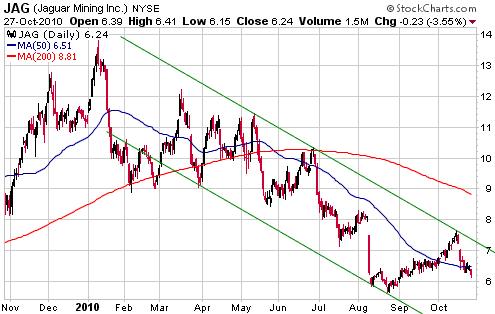
Chart Sources
Charts appearing in today's commentary
are courtesy of:
http://stockcharts.com/index.html
http://www.futuresource.com/

|