|
- 27 November, 2002
More thoughts
on inflation and deflation
We discussed the inflation/deflation
debate most recently in the 18th November Weekly Update, at which time
we made the following two points:
1. The money supply can only be expanded
via new borrowing/lending, so irrespective of what the Fed does it is likely
that the US will eventually experience deflation. There is, however,
no evidence that deflation will be a genuine threat over the coming 12
months.
2. It is senseless to try to predict
when a bubble - in this case the great US credit bubble - is going to end.
By their very nature bubbles always continue for much longer than a rational
observer would ever expect, so it makes more sense to wait for the signs
of failure to appear before writing-off a bubble. Provided you are paying
attention and don't get sucked into the bubble there is little danger that
you will be too late to recognise these signs of failure. This is because
a lot of time always passes between the bursting of a bubble and the realisation
of this fact by the majority of market participants. Witness the US stock
market. The stock market bubble was justified in the collective mind of
the majority by false beliefs that a) the US had entered an era of extraordinarily-high
productivity growth, b) inflation had been eliminated as a serious threat,
and c) the US Federal Reserve would always do the 'right' thing. It has
now been two-and-one-half years since the bubble burst and these beliefs
are still widely held.
We'll now take another look at the
first of the above points. Via its regular Open Market Operations the Fed
adjusts bank reserves in order to keep the Fed Funds Rate near the target
rate. For example, the current Fed Funds Rate target is 1.25%. If the actual
Fed Funds Rate (the rate at which banks borrow overnight money from each
other) moved up, to say 1.35%, then the Fed would add enough reserves to
the banking system to bring the actual rate down to the target rate. However,
if banks decide to reduce the amount of money they lend, or if the banks'
customers decide to increase their savings rather than increase their levels
of indebtedness, an increase in bank reserves will not result in an increase
in the total supply of money. In such a case the Fed would be powerless
to inflate provided it stuck to its routine Open Market Operations.
The Fed does, however, have powers
in addition to its abilities to alter short-term interest rates and bank
reserves. For example, the Fed could start buying private real estate with
newly-created Federal Reserve notes. In this way it could, if it chose
to do so, inject a huge amount of currency into the economy, thus devaluing
all the existing currency. The idea that it would act in this way, that
is, step outside its normal operating procedures and begin directly injecting
currency into the economy, seems farfetched. After all, the Fed's goal
is not to inflate, it is to inflate without the effects of inflation becoming
obvious to those who adhere to the absurd belief that inflation is an increase
in the CPI. In other words, to inflate without the inflation becoming
evident to the majority. Directly injecting a large amount of currency
into the economy would, however, make the inflation obvious to all and
destroy the illusion that a dollar is something of real value. It is extremely
difficult to rebuild confidence in the ability of a currency to maintain
its purchasing power once that confidence has been shattered. As such,
when it came down to a choice between experiencing genuine deflation or
destroying the value of the US Dollar, we thought the Fed would opt for
deflation. But, following comments by both Fed Chairman Alan Greenspan
and Fed Governor Ben Bernanke over the past 2 weeks we no longer have any
reason to think that this is, in fact, the case.
In a recent speech Governor Bernanke
made some interesting comments with regard to deflation (which he wrongly
defines as a fall in the general price level). For one thing, he said that
the structural stability and resilience of the US economy would act as
a protective shield against deflation. He then went on to point out that
even if the 'deflation monster' did rear its ugly head the Fed certainly
had the power to reduce the value of the Dollar to such an extent that
prices would have to move higher.
We found it amusing that he referred
to structural stability as a guard against deflation because if
the US economy really were structurally stable then deflation wouldn't
be something the Fed would have to fear. Deflation is only ever something
to be feared when the viability of the financial system is reliant on an
on-going increase in the total amount of debt, that is, in a structurally
unstable economy. Furthermore, falling prices (Bernanke's definition
of deflation) are a natural result of higher productivity. Therefore, in
a healthy economy with sound money there will be extended periods when
the general price level will fall. In the current situation, though, it
appears that an increase in the purchasing power of the currency (falling
prices for goods and services) is something to be feared. So, if US businesses
become more productive and this improvement in productivity causes prices
to fall, the Fed will try to offset this fall by depreciating the US$.
We found it interesting, to say the
least, that Bernanke spoke candidly about the ability of the US Government,
via the Fed, to "produce as many U.S. dollars as it wishes at essentially
no cost." According to Governor Bernanke, "by increasing the number
of U.S. dollars in circulation, or even by credibly threatening to do so,
the U.S. government can also reduce the value of a dollar in terms of goods
and services." This is true - if the Fed tried hard enough to reduce
the purchasing power of the US$ it would definitely be successful. The
thing is, the basis of US economic strength over the past 7 years has been
the ability to inflate the money supply whilst maintaining the purchasing
power of the US$ relative to those things that 'count' as far the popular
price indices are concerned.
At this time last year our view was
that the probability of the US experiencing genuine deflation over the
coming 12 months was so close to zero as to not be worth considering. The
'deflationists' were, at the time, strident in their calls for an imminent
deflation, but here we are with another year of inflation under our belts.
Looking ahead at the coming 12 months we still see almost zero chance of
deflation. And, the apparent willingness of the Fed to go down the 'printing
press' route rather than let the US experience deflation probably means
that we can expect several more years of inflation before deflation finally
becomes a legitimate threat. It certainly seems as though inflation
will have to be perceived as a life-threatening problem for the US financial
system before deflation will be permitted to occur.
The US
Stock Market
1932-1934
Below is a chart showing the Dow Industrials
Index (in blue) and the Advance-Decline Line (in black) during 1932-1934.
The stock market's major bottom occurred in July of 1932 (point D on the
chart), so the chart shows the final 6 months of the 1929-1932 bear market
and the ensuing rally.
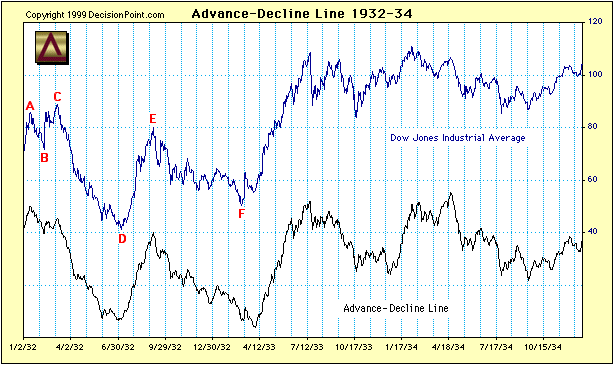
Referring to the above chart, the stock
market reached a short-term bottom at the start of 1932 then rallied for
a couple of weeks (to point A). It then dropped to a slightly higher low
(point B) before rallying to a higher high (point C). You can just imagine
that by the time the market reached point C there would have been a lot
of hope that a new bull market had begun. After all, the market had just
completed what must have appeared, at the time, to be a successful re-test
of the low, and had then rallied to a higher high. However, with the benefit
of hindsight we know that point C on this chart was one of the worst times
in history to buy stocks because the Dow dropped by more than 50% over
the following 4 months.
After bottoming in July of 1932 the
Dow surged by around 100% (to point E on the chart) in the space of only
2 months. It then spent 6 months grinding lower and by February of 1933
(point F) had given back about 75% of the initial rally. Also, the advance-decline
line was lower in February of 1933 than it was at the major bottom in July
of 1932. So, anyone who was lucky enough to have gone from 0% invested
to 100% invested in the stock market on the exact day of the major bottom
in July of 1932 would barely have been breaking even 8 months later.
We are reviewing the above chart of
1932-1934 for two reasons. First, to show that rallies during a major bear
market can be deceptive and can end with little warning (as per the rally
during the first two months of 1932). Second, to show that the best time
to make a large commitment to stocks might not be right at the long-term
bottom. In the 1932 situation anyone who tried to 'buy the bottom', but
who was a few weeks early, would have captured a large decline, while the
bottom-fishers who were a few weeks late to the party would have bought
near the peak of the initial surge. The best time to buy during the early-1930s
would actually have been about 8 months after the major bottom when sentiment
would probably have been even more bearish than it was at the bottom (especially
considering that the banking crisis reached its peak in early-1933).
Over the past few years the NASDAQ100
Index has followed a similar path to the Dow of 1929-1932. We could now
be close to the equivalent of point C on the above chart, but even in the
extremely unlikely case that the early-October low was THE bottom (the
equivalent of point D) there will probably be a much better entry point
for longer-term investors over the coming 12 months. In other words, there
is no reason why any investor should consider buying into the current speculative
mini-mania.
Current Market Situation
From the latest Weekly Update: "Over
the past few weeks we've included 2 trading positions in QQQ put options
in the Stock Selections List. We will probably add to this bearish position
in the future, but before we do so we will need to see either a) greater
evidence of universal belief in this rally, or b) evidence that the rally
has failed." At this stage there are no signs of either a) or b).
The sentiment picture has shown a marked
improvement over the past week. For example, since the close of trading
on Tuesday 19th November the NASDAQ100 Index has gained about 10%, but
the NASDAQ100 Volatility Index (VXN) is higher now than it was then. This
suggests that fear has increased as the market has moved higher, a bullish
development. Also, put/call ratios have remained elevated during the days
when the market has rallied (even during Wednesday's pre-holiday ramp the
CBOE equity put/call ratio was above 0.5 and the QQQ put/call ratio was
above 1).
Furthermore, market 'internals' have
recently taken a turn for the better. For example, in terms of the changes
in the major stock indices Wednesday's rally was almost the same size as
Tuesday's decline, but over this 2-day period during which the indices
made very little progress the number of advancing stocks was much higher
than the number of declining stocks.
The improvements in market sentiment
and market internals over the past week mean that the rally is probably
going to continue for much longer than we had previously thought. The most
constructive thing that could happen over the next 2-3 weeks, as far as
prolonging the overall rally is concerned, is for the market to pullback
while sentiment becomes very fearful. If this happens we would most likely
take the opportunity to exit our current put-option positions with the
aim of re-entering some time in January following another up-move.
If the market does pullback over the
next 2-3 weeks there are two main things we will be watching to determine
whether this is just a correction within a continuing short-term uptrend
or the start of another major decline. One is the ability, or otherwise,
of the NASDAQ Composite Index to hold above 1420. The other is the performance
of the Cisco stock price.
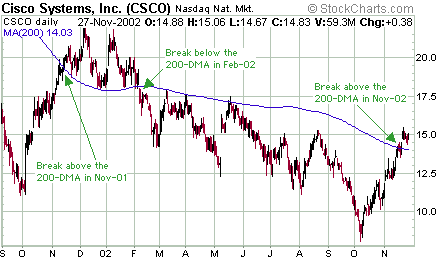
Below is a chart of CSCO covering the
past 15 months. Note that after CSCO broke above its 200-day moving average
in November of 2001 it held above this moving average during all pullbacks
until it (and the overall market) was ready to resume its bear trend in
February 2002. After the Feb-02 break below the 200-DMA every subsequent
rally failed at, or below, this moving average until November of 2002.
Therefore, any normal pullback in the market over the next few weeks should
result in CSCO holding at, or above, its 200-DMA. Conversely, if CSCO closes
below its 200-DMA we will have a sign that the bear trend has resumed.
By the way, the greater fear that has
recently become evident in some measures of sentiment might be associated
with the threat of terrorism. If there is going to be another dramatic
terrorist attack against the US then the coming 4 weeks are a likely time
for such an attack to happen because this is the period during which it
would do the most amount of damage, both psychologically and economically.
Terrorists always want to do the most amount of damage and therefore probably
have the desire to perpetrate, over the next few weeks, something that
a rational person would think of as senseless destruction, although they
might not have the capability. In any case, a heightened awareness of the
risk of attack might be behind the less-than-exuberant response by market
participants to the recent bullish price action.
Gold and
the Dollar
Current Market Situation
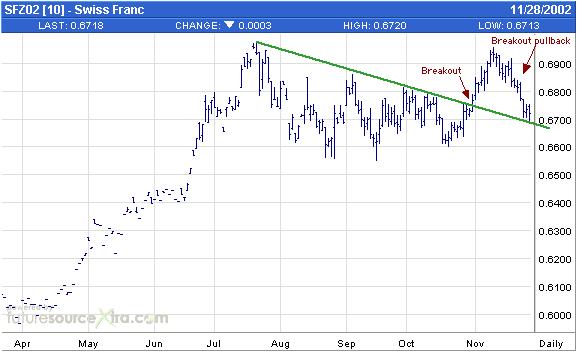
Below is a daily chart of the December
Swiss Franc. The SF broke above its medium-term downtrend towards the end
of October, rallied during the early part of November, and has since fallen
to near its previous downtrend-line. At this stage the recent decline appears
to be a normal breakout pullback, but if this is the case the SF must reverse
higher from near its current level. Last-ditch support for the short-term
bullish case is 0.66 - if the December SF trades below 0.66 then the SF
chart will take on the appearance of a 'double top'.
Below is a chart showing the gold price
in euros. The euro gold price has trended higher over the past 3 years
in a well-defined channel. It recently moved to near the bottom of this
3-year channel and turned higher.
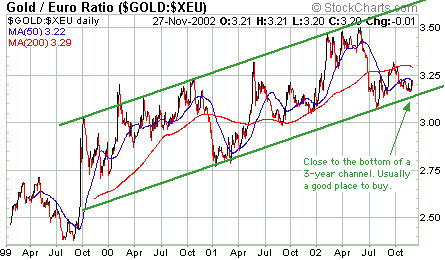
In a gold bull market the gold price
trends higher in terms of all currencies, not just the US$. As such, if
we are in a gold bull market then the gold price in euros should continue
to remain above the bottom of the channel shown in the above chart, regardless
of how strong the euro gets relative to the US$. To put this another way,
a decisive break below the bottom of the channel shown on this chart would
be a substantial blow to the bullish case for gold.
Below are charts of the Amex Gold BUGS
Index (HUI), Newmont Mining (NEM) and Harmony Gold Mining (HGMCY). On 27th
November Harmony began trading on the NYSE under the symbol HMY, but at
this stage the stockcharts.com web site hasn't been updated to reflect
the new symbol and the chart shown below therefore doesn't show Wednesday's
trading. HMY closed at $12.47 on Wednesday, slightly below its uptrend-line.
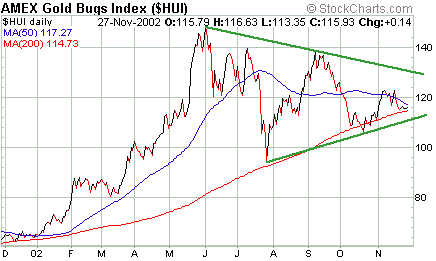
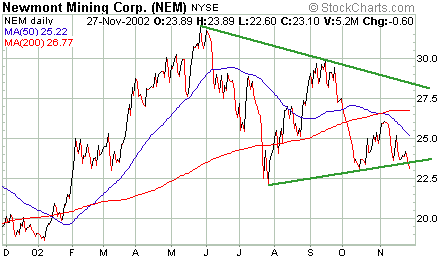
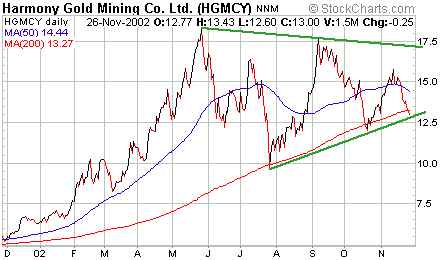
The HUI has continued to hold above
the bottom of its triangular consolidation pattern, but both NEM and HMY
broke-out to the downside on Wednesday. At this stage we are assuming that
the marginal breaks below support by NEM and HMY are 'head fakes' rather
than trend reversals. We are making this assumption because most of the
major gold stocks rebounded late in the trading day. However, we are clearly
now 'on the edge' and any significant weakness in gold stocks over the
next few trading days will tip the balance firmly in favour of the bears.
With the major gold stocks and the
gold stock indices so close to important support, now is a good time to
be doing some buying. This is not because the risk is low, but because
the close proximity to support allows risk to be well managed using sell
stops. At the same time, the potential rewards are great if support does
hold. For example, a reasonable approach would be to buy HMY at around
Wednesday's closing price of $12.47 and set a sell-stop at $11.95. If the
stop is hit then the loss on the trade will be about 4%, but if support
holds then the percentage gains will probably be substantial.
We bought some gold stocks in the Australian
market today and plan to do some buying in the US market on Friday. We
will, however, quickly exit these positions, as well as the trading positions
purchased near the lows in mid-October, if support is breached. As mentioned
in the latest Weekly Update, we will send out an e-mail alert if this happens.
Bonds
Bonds have done nothing over the first
3 days of this week to negate the 'crash setup' that we've discussed over
the past 2 weeks. The critical level for the December bond futures contract
is 107 (the October low). A drop to 107 by the end of this week would set
the market up for a crash during the first half of next week.
Update
on Stock Selections
For the first time in what feels like
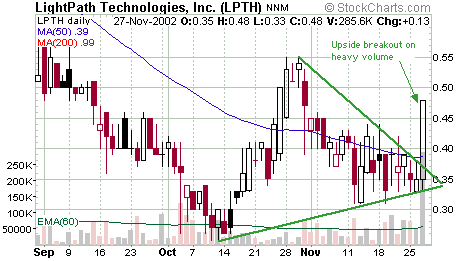
an eternity, LightPath Technologies (LPTH) has begun to show signs of life.
LPTH broke out to the upside on heavy volume on Wednesday.
The stock prices of LPTH's customers
- companies such as Lucent - have surged over the past few weeks. If business
really is going to improve for companies such as Lucent and Nortel (as
the recent stock market action seems to suggest), then the companies such
as LPTH that are further down the food chain will also benefit. We are
certainly skeptical that any improvement in business conditions is going
to occur next year. However, if the current stock market rally can extend
into January, as now seems likely, then the LPTH stock price could go for
a run (especially following the completion of any tax-related selling in
December).
Lihir Gold in Australia (ASX: LHG)
is not one of our current selections, but we think it is a reasonable speculation
at around today's closing price of A$1.11 with a sell-stop set at $1.05.
Chart Sources
Charts used in today's commentary were
taken from the following web sites:
http://stockcharts.com/index.html
http://www.decisionpoint.com/
http://www.futuresource.com/

|









