|
- Interim Update 28th January 2015
Copyright
Reminder
The commentaries that appear at TSI
may not be distributed, in full or in part, without our written permission.
In particular, please note that the posting of extracts from TSI commentaries
at other web sites or providing links to TSI commentaries at other web
sites (for example, at discussion boards) without our written permission
is prohibited.
We reserve the right to immediately
terminate the subscription of any TSI subscriber who distributes the TSI
commentaries without our written permission.
The Stock Market
2015 forecast for the US stock market
The biggest error we made last year was being bearish on the US stock market. It
was our biggest error because our other significant error (being bullish on
gold-related investments) was largely a consequence of our intermediate-term
bearish outlook for the US stock market.
At the beginning of last year we had two scenarios in mind for the S&P500 Index
(SPX), with the scenario considered the most likely involving some strength
during the first 4-5 months of the year followed by a rolling over into a 2-3
year bearish trend. Under both of our scenarios the S&P500 Index would end the
year with a decline of at least 10%, although the bulk of the anticipated bear
market's downside would wait until 2015-2016. Given the market's high average
valuation and the long duration of the cyclical bull, the decline from the
bull-market peak to the ultimate bear-market trough was expected to be at least
40%.
What actually happened was that the SPX began last year at 1848 and ended the
year at 2059 for an annual gain of 11%. This was a remarkably good performance
considering the high starting valuation, the weak earnings growth and the
gradual removal of Fed monetary support. However, with regard to future
prospects it has skewed the risk/reward even further towards risk.
The old bull market is now even 'longer in the tooth', the average valuation is
now even higher and the Fed's money-pumping has (temporarily) come to an end.
Furthermore, unlike this time last year we now have evidence that a major top is
either in place or will soon be put in place. We are referring to the downward
reversal in the SPX/USB ratio (most recently discussed in the 12th January
Weekly Update) and the inability of NYSE Margin Debt to exceed its February-2014
peak. On the equity-bullish side of the ledger: other important central banks
have ramped up their money pumps, ZIRP continues in the US and elsewhere, and
the pace of credit creation by the US commercial banking industry has
accelerated over the past 12 months.
Because monetary conditions remain very easy, the sort of stock market collapse
that occurred in 2008 is not a realistic possibility for 2015. A down year for
the US stock market is very likely, though.
Our best guess at this time (guess is another word for forecast) is that what we
had in mind for 2014 will happen in 2015. In particular, we expect the high for
the year to occur within the first few months (it's possibly already in place),
after which the market will gradually roll over to the downside. A choppy
decline that leaves the S&P500 with a loss of around 10% by year-end 2015 is far
more likely than a crash, with greater downside in store for next year if the
start of a bear market is signaled this year.
Lastly, as we've done in every yearly forecast beginning with the 2010 edition
we again state our belief that the S&P500's March-2009 low will never be
breached in nominal dollar terms. This is due to previous and expected-future
Fed-promoted depreciation of the US$.
A floor has effectively been placed under the US stock market's
dollar-denominated price by the virtual certainty that the Fed will be a lot
quicker to crank up the money pumps in reaction to stock market weakness in the
future than it was during 2007-2008. Based on the Fed's actions over the past
2-3 years a rational observer could no longer doubt that this is the case.
Current Market Situation
Europe
The elections in Greece came and went with a victory by the anti-"austerity"
Syriza Party. The victory was by a larger-than-expected margin, which paved the
way for the quick formation of a new government and removed some uncertainty.
However, Greece's stock market, represented on the following weekly chart by the
Athens General Share Index (ATG), has continued along its steep downward path.
The ATG is down by 15% since the end of last week.
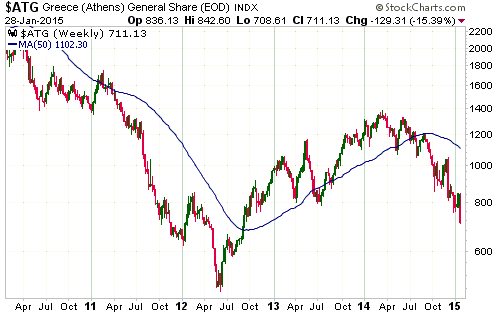
The above chart shows the performance of Greece's stock market in euro terms.
Clearly, in euro terms the market has been in a strong downward trend since
early last year. As evidenced by the weekly chart of the Global X Greece ETF (GREK)
displayed below, in US$ terms the decline from last year's high has been even
stronger.
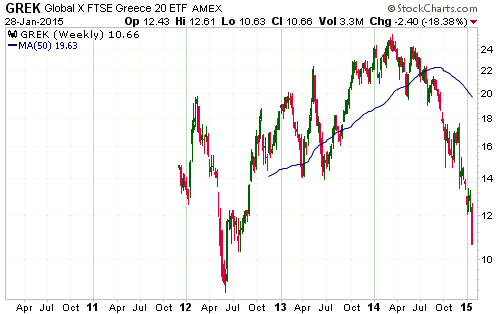
We don't know enough about the situation in Greece or the Greek stock market to
take a position, but given the steep price decline of the past 10 months and the
fact that Greece's stock market had the world's lowest Cyclically-Adjusted P/E
ratio (CAPE) prior to the start of this decline it occurs to us that it could
now make sense to buy GREK for an intermediate-term trade. We get the impression
that Greece's stock market has factored-in the worst-case scenario and then
some.
The US
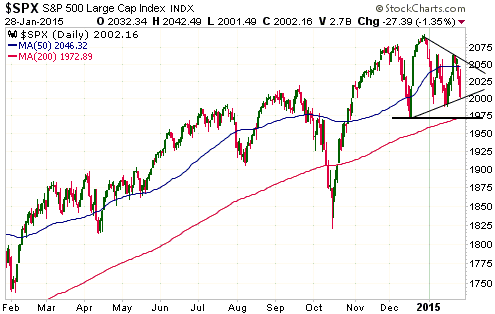
The S&P500 Index lost 50 points over the first three trading days of this week.
It is currently testing support at 2000 and has more important support at 1970.
A daily close below 1970 would provide the first piece of evidence that the
decline from the late-December peak is more than just a routine short-term
pullback.
Gold and the Dollar
Gold
Goldman Sachs (GS) updates its gold forecast
In the latest Weekly Update we explained why the 2015 gold forecast put out by
the analysts at GS had hopelessly flawed logic and therefore couldn't possibly
be right for the right reasons. It will either be right due to blind luck or it
will be wrong (most likely the latter). As if to underline their lack of
understanding of the gold market, at the beginning of this week the GS analysts
brought their short-term gold price forecast into line with the current spot
price and used spurious reasoning to justify reducing their end-2016 forecast to
$1000/oz.
According to the updated GS forecast, the gold price will fall to $1000/oz by
the end of 2016 due to "lower expected inflation in coming years and a declining
marginal cost of gold production." In the real world, however, the
financial/economic landscape in which a major gold rally is most likely to begin
will involve declining inflation expectations and low levels of what the GS
analysts mean when they use the word "inflation". This is largely because
declining inflation expectations and low "inflation" encourage the Fed and the
ECB to implement economically-destructive monetary policies. Also, in the real
world the cost of gold production FOLLOWS the gold price with a lag of 1-2
years, meaning that if the gold price falls to $1000/oz by end-2016 then the
cost of gold mining will also fall as an EFFECT (not a cause) of this price
change. And in any case, changes in gold production are always far too small
relative to the aboveground gold stock to have an effect on the gold price.
GS's analysts have left no doubt that they have a poor understanding of the gold
market, but note that even a good understanding wouldn't result in an end-2016
gold price forecast that had a high probability of being correct. Almost
anything can happen in the financial markets over a 2-year period, so anyone who
thinks they can come up with a high-probability forecast of where gold will be
trading 2 years from now is kidding themselves.
The non-US$ breakouts
Gold's recent impressive strength in non-US$ terms has bullish implications for
the US$ gold price. One reason is obvious: before gold can breakout to the
upside in terms of the strongest currency it must first breakout to the upside
in terms of weaker currencies. The second reason, which isn't so obvious, is
that upside breakouts in terms of the weaker currencies point to future upside
breakouts in terms of the stronger currencies. This is largely because the bad
theories that guide policy-makers in all countries ensure that currencies don't
remain strong for long. In particular, persistent and substantial strength in a
currency's exchange rate will usually prompt policy responses that weaken the
temporarily-strong currency, especially relative to gold.
Here are two charts that, considered together, illustrate what we mean.
The first chart shows the A$-denominated gold price (gold/A$) from the
late-1990s through to the present day. Notice that gold/A$ has recently broken
out to the upside from a multi-year base and is trading at a 2-year high. Also
notice the upside breakout from a multi-year base that occurred in early-2001.
The second chart shows the US$ gold price over the same period. Notice that in
the early-2000s an upside breakout from a long-term base in the US$ gold price
occurred about 18 months after a similar breakout in gold/A$.
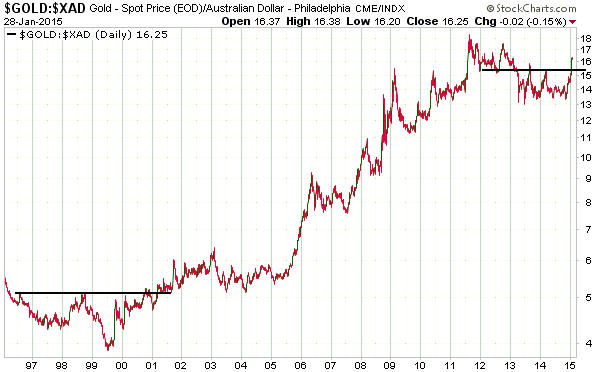
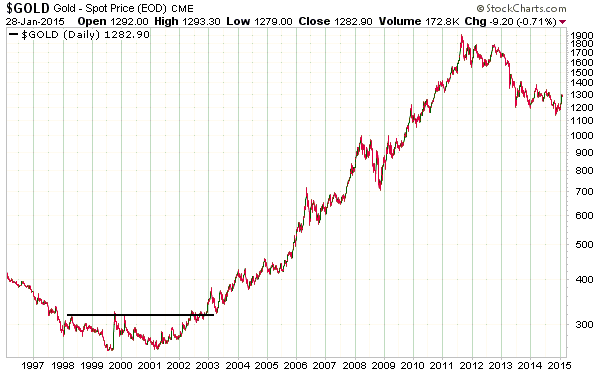
Based on what happened in the early-2000s, the performance by gold/A$ over the
past few months suggests that a) the bear-market bottom is in place for the US$
gold price, b) the US$ gold price will make some, but not much, upward progress
during 2015, and c) 2016 will be a very good year for gold in US$ terms.
Current Market Situation
Last week gold became short-term 'overbought' in US$ terms and intermediate-term
'overbought' in non-US$ terms. This set the stage for a multi-week correction in
US$ terms and a multi-month correction/consolidation in non-US$ terms.
However, the price action hasn't yet confirmed the onset of a significant
correction. Furthermore, gold's true fundamentals (you know, the ones that most
gold bulls ignore because they are too busy worrying about market manipulation
or
counting up the amount of gold being transferred from one part of the world
to another) have tilted more bullish this week due largely to stock market
weakness (stock market weakness caused real interest rates to fall and credit
spreads to widen). It therefore wouldn't be a shock if gold moved above last
week's high before beginning the anticipated correction.
In any case, the US$ gold price is likely to pull back at least as far as the
$1250s within the next few weeks regardless of whether or not it first rises to
a new high for the year.
Gold Stocks
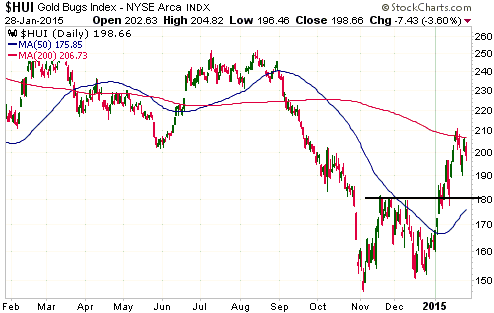
The HUI moved back up to its 200-day MA over the first two trading days of this
week and then pulled back on Wednesday. This price action is consistent with a
correction having begun last week, but, as is the case with gold bullion,
doesn't guarantee that a correction has already begun. Although it is not the
most likely outcome, there could still be a rise to a new high for the year
prior to the start of a multi-week period of 'corrective' activity.
A correction within a continuing upward trend should find support at or above
180. Consequently, from our perspective a daily close below 180 would be a
problem. It would suggest that a second test of the November low was in store,
the first test having taken place in December.
The Currency Market
The euro has rebounded a little since last Friday, but something more than a
minor rebound is likely within the next couple of months.
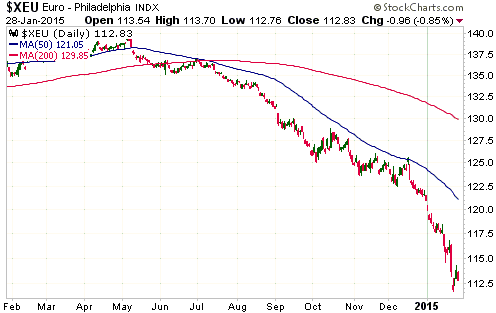
The early-January upward reversal in the VGK/SPX ratio (European equities
relative to US equities) projects a tradable euro rally. Also, it's difficult to
imagine that sentiment, which is a contrary indicator, could become any more
lopsided in the US dollar's favour. This is because on 26th January Market
Vane's bullish percentages for the Dollar Index and the euro hit 91 and 15,
respectively. 91% is probably an all-time high bullish percentage for the Dollar
Index and 15% is definitely an all-time low bullish percentage for the euro.
Updates
on Stock Selections
Notes: 1) To review the complete list of current TSI stock selections, logon at
http://www.speculative-investor.com/new/market_logon.asp
and then click on "Stock Selections" in the menu. When at the Stock
Selections page, click on a stock's symbol to bring-up an archive of
our comments on the stock in question. 2) The Small Stock Watch List is
located at http://www.speculative-investor.com/new/smallstockwatch.html
 Note
on Dragon Mining (DRA.AX) Note
on Dragon Mining (DRA.AX)
DRA trades on the Australian stock market. It is a former member of the TSI
Stocks List and a current member of the TSI Small Stocks Watch List.
At this time we have no intention of returning it to the TSI Stocks List,
primarily because it is too thinly traded. However, we wanted to point out that,
like Dalradian Resources (DNA.TO), DRA benefits from the strong rise in the
euro-denominated gold price. In fact, DRA's benefit from gold/euro's strong rise
is more direct and immediate than DNA's, because whereas DNA is an
exploration-stage miner with a project in the euro-zone DRA is a current
producer with projects in the euro-zone and Sweden (note that the Swedish Krona
has been even weaker than the euro, meaning that gold/Krona has risen even more
strongly than gold/euro). In other words, the theoretical economics of DNA's
project get a boost from a higher gold/euro whereas DRA gets an immediate
bottom-line boost from a higher gold/euro.
Despite the fact that DRA.AX stands to benefit more than most junior gold miners
from the changes in the gold and currency markets that have taken place over the
past three months, it hasn't rebounded far from its low and at the current price
of A$0.12-A$0.13 is trading well below its working capital (meaning: the market
is currently valuing DRA's cash-flow-positive gold-producing assets at less than
zero).
Chart Sources
Charts appearing in today's commentary
are courtesy of:
http://stockcharts.com/index.html

|









