|
- Interim Update 28th July 2010
Copyright
Reminder
The commentaries that appear at TSI
may not be distributed, in full or in part, without our written permission.
In particular, please note that the posting of extracts from TSI commentaries
at other web sites or providing links to TSI commentaries at other web
sites (for example, at discussion boards) without our written permission
is prohibited.
We reserve the right to immediately
terminate the subscription of any TSI subscriber who distributes the TSI
commentaries without our written permission.
Uranium
Of
all the "alternative" forms of energy, nuclear is probably the most
important. At least, for large-scale power generation nuclear energy is
currently the most economically viable alternative to fossil-fuel
energy. This is undoubtedly why a global shift towards nuclear energy
is taking place. Here is an excerpt from a recent Seeking Alpha article that discusses this shift:
"France generates about
80% of its electricity from nuclear plants and they have the cleanest
air of any industrialized country and the cheapest energy in all of
Europe. South Korea is increasing its number of reactors by 50% and
will eventually be generating over half of its electricity from nuclear
sources. Would you believe that even the United Arab Emirates, the
third largest oil exporter in the world, has proposed construction of
11 nuclear power plants? India currently has 6 plants under
construction and another 23 on the way. China has a major energy need
in the coming decade and nuclear power plants will play a major role
over there. Last month, China made a big public announcement that they
were going to buy a bunch of yellowcake this year and in the years to
come. They're planning to build at least 60 new nuclear reactors in the
coming decade and have proposals to build 120 more.
It takes a while to get a
new reactor built and fully operational. But that's a lot of additional
Uranium that the world is going to need. I think that the expectation
of future demand has put in something of floor in prices over the last
couple of years. The bubble euphoria has died out and the market is now
starting to look ahead towards the future with some sense of
rationality. Prices make sense again.
On the supply side there
was about 50,000 tons of uranium mined last year around the world. All
of that uranium already had demand from the current marketplace, from
existing nuclear reactors. To put China's plan into perspective, they
alone may be demanding an additional 20,000 tons/year of uranium by the
end of the decade. That new supply is going to have to come from
somewhere or the price of the existing supply will need to increase to
clear the market. It's simple economics, and quite beneficial if you're
in the business of mining uranium."
The obvious potential for nuclear energy -- and, therefore, uranium --
to be a big part of the long-term energy solution hasn't translated
into any strength whatsoever in the uranium price over the past year.
However, we've noticed that after lying dormant or drifting lower for
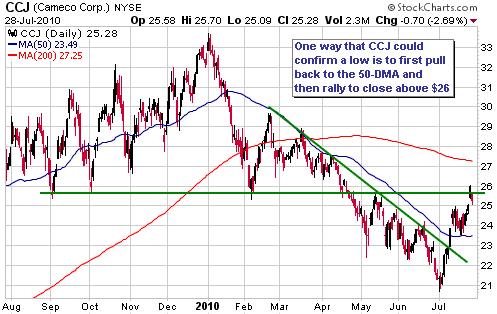
the past 6-12 months, uranium stocks have begun to strengthen. The
strength we are referring to is apparent in the following chart of
Cameco (CCJ). It's quite possible that the uranium sector of the stock
market is starting to discount a new upward trend in the uranium price.
In our opinion,
speculators with timeframes measured in years should take advantage of
periods of substantial market weakness over the next few months to
build exposure to uranium mining. Cameco and the Global Uranium Fund
(TSX: GUR) are good places to start.
The Stock Market
From the 27th July issue of Albert Edwards' Global Strategy Weekly:
"We are at the most
dangerous stage in the Ice Age - the 'post-bubble cycle'. For although
it is clear that leading indicators have turned downwards, the choir of
sell-side sirens is singing its song of reassurance. The lesson from
Japan was that once the cyclical rally is over, any downturn in the
leading indicators should find you stuffing beeswax in your ears to
block out that lilting melody so as to avoid the jagged rocks of
recession."
We agree that this is a dangerous stage. The model based on the
"Presidential Cycle" allows for the possibility of another three weeks
of 'choppy' price action, perhaps with an upward bias, before the
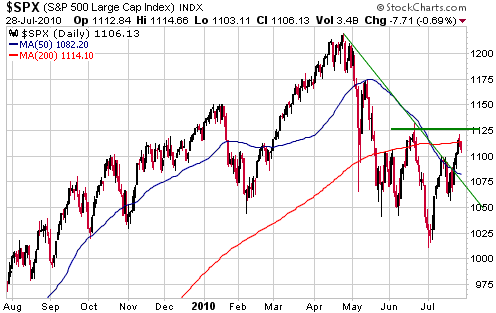
intermediate-term decline resumes. However, the following chart shows
that the S&P500 has just tested resistance defined by its 200-day
moving average and the June high, so we definitely wouldn't bet on
additional upside.
Even though the
downside risk appears to be much greater than the remaining upside
potential, we also wouldn't necessarily bet on a large decline. When
the risk is high the first and foremost consideration should be safety.
We've always found that it's more difficult to make money on the short
side during a decline than to make money on the long side during a
rally, so our main concern during bear markets or intermediate-term
declines in bull markets is to conserve our financial (and emotional)
resources to ensure that we will be in a position to take full
advantage of the subsequent upward trend. It may or may not be worth
trying to profit from an expected decline into an October low, but IF
the market does decline sharply to an October low then it will
certainly be worth trying to profit from the ensuing rebound.
Gold and
the Dollar
Gold
What is gold really worth?
Much of what the gold-manipulation devotees come out with ranges from
groundless to completely nonsensical, although it is usually harmless.
After all, it is true that governments regularly attempt to manipulate
the financial markets. The way we see it, the question revolves around
the methods, effectiveness and investment implications of the
manipulation. This is the area where we often find ourselves at odds
with GATA supporters.
The main reason that a large chunk of our latest weekly commentary was
assigned to debunking a recent piece by GATA's Adrian Douglas is that
in this case the manipulation-related analysis was not only
nonsensical, it was potentially harmful. In particular, apart from
painting a misleading picture about the supply of gold and the nature
of today's money, Douglas's conclusion that gold is worth $54000 per
ounce right now could cause some people to ignore a major gold selling
opportunity. By way of explanation, let's assume that there is a
massive escalation in the government debt crisis over the next 12
months, and in response the Dow Industrials Index plunges to 4000 while
the gold price surges to $4000/ounce. Based on 100 years of market
history, the drop in the Dow/gold ratio to 1 would represent a
wonderful opportunity to trade out of gold and into the stocks of
high-quality US industrial companies, but someone who had been swayed
by Douglas's analysis would still view gold as a strong buy on the
belief that it was still trading at less than 10% of its "true" value.
What, then, is our assessment of gold's "true" value?
We see no good reason to believe that gold is not fairly valued at
today's price. Relative to the CRB Index (CCI) gold tested its all-time
high in February of 2009 and is presently within 20% of its all-time
high. This seems reasonable given the economic and financial-market
backdrop. Relative to the Dow, gold's value has almost quintupled since
its 1999 trough. We expect that it will eventually rise a lot further,
but the current level of the Dow/gold ratio looks about right assuming
that the long-term equity bear market is not yet close to being over.
Relative to the US money supply, Paul van Eeden's work
suggests that gold is over-valued at this time (van Eeden calculated in
October-2009 that if gold's price had risen in proportion to the
increase in the supply of US dollars then gold would have been fairly
valued at $815/ounce in 2009). Note that we don't think it's reasonable
to calculate a "fair value" for gold based on the assumption that the
gold price will, over time, simply move in proportion to the change in
the US money supply; we just wanted to point out that applying a
simplistic "quantity theory of money" calculation leads to a lower
number than today's gold price.
Which prompts the question: Why are we intermediate- and long-term bullish on gold?
The reason we are very bullish on gold's prospects beyond the
short-term isn't that we think gold is a screaming bargain based on the
way things are today; we are bullish because we don't think that
today's gold price comes close to fully discounting the adverse FUTURE
effects of government and central bank policies. Also of consideration
is that we aren't aware of any long-term bull market of the past 80
years that stopped once the investment in question had become fully
valued. In all historical examples that we can think of, dramatic
upward acceleration occurred some time after full value was reached.
Gold Market Sentiment
These days it is popular and conventional to be a contrarian. It seems
that almost everyone tries to figure out what everyone else is
thinking/doing so that they can then do the opposite. Right now, for
example, it seems that almost everyone thinks that almost everyone else
is bullish on gold, and, therefore, that it's a good idea to lean the
other way. Of course, if the majority is either bearish or anticipating
a major bull-market correction on the basis that too many people are
bullish, then most market participants are actually NOT bullish.
Despite the fact that gold is the only high-profile market to make a
new all-time high over the past few months, objective indicators of
sentiment suggest that the general level of gold-related optimism is
relatively low. For example, the results of the latest Market Vane
survey show that only about 60% of traders are bullish on gold. This
bullish percentage is in the bottom quartile of the three-year range.
For another example, the premiums to net asset value for Central Gold
Trust (GTU) and Central Fund of Canada (CEF) dropped to 2.9% and 4.8%,
respectively, on Tuesday 27th July, which is near their lows of the
past two years.
Now, sentiment is just one piece of a large puzzle, so just because
sentiment is not particularly bullish -- contrary to the beliefs of
many pseudo-contrarians -- doesn't guarantee that the gold price won't
drop to much lower levels over the months ahead. It simply means that
sentiment is not a headwind for gold at this time.
Current Market Situation
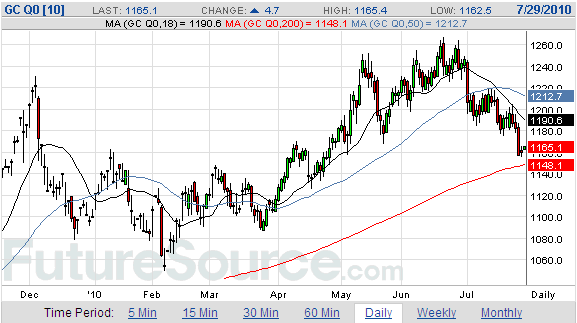
The following daily chart of the August gold futures contract shows
that Tuesday's sharp decline took the US$ gold price to within $20 of
its 200-day moving average. Does this mean that gold is now within $20
of a correction low?
Possibly, but the
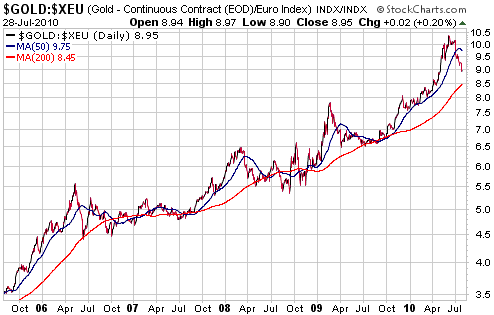
next chart shows that in euro terms gold is still about 6% above its
200-day moving average, and history tells us that this moving average
will likely be reached before the correction is complete. How close the
US$ gold price presently is to its ultimate correction low will
therefore be determined by the euro-denominated gold price (gold/euro)
and the euro/US$ exchange rate. It will also be determined by time. For
example, gold/euro's 200-day MA will be around 850 over the next three
weeks, so if gold/euro were to quickly drop to this moving average
while euro/US$ remained near its current level of 1.30 then the US$
gold price would drop to $1105, whereas a quick decline to gold/euro's
200-DMA would coincide with prices of US$1062 and $1147 at euro/US$
rates of 1.25 and 1.35, respectively. Taking another example,
gold/euro's 200-DMA is rising and could be near its current level of
895 by October, which means that gold/euro may be able to reach this
moving average by trading sideways over the next 2-3 months. Under this
scenario, the US$ gold price that coincided with gold/euro reaching its
200-day MA would be determined solely by the change in the euro/US$
exchange rate over the intervening period.
Sorry if the above
seems convoluted, but the fact is that there is a range of reasonable
downside targets for the correction's ultimate low. The top end of the
range is within a few dollars of this week's low and the bottom end is
about $120 lower.
Gold Stocks
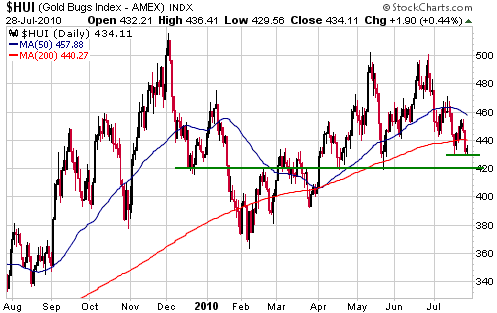
There was a positive divergence between the gold sector of the stock
market and gold bullion during the first three days of this week, in
that gold bullion dropped to a 3-month low while the HUI held above its
July and May lows. Also of note is that many of the junior gold stocks
we follow rose on Tuesday in the face of a >$20 decline in the price
of gold bullion.
It's too soon to draw any conclusions from this divergence.
Currency Market Update
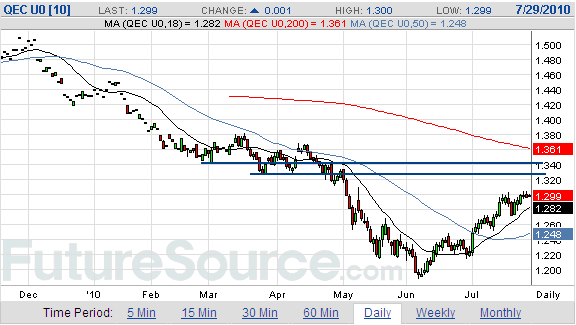
The euro fell by more than we expected during May-June and is now in
the process of rising by more than we initially expected. The following
daily chart shows that the September euro won't encounter significant
lateral resistance until 1.33-1.34, so a chart-based argument could be
made that it has a few points of additional upside potential.
As discussed in the
latest Weekly Update, there's a strong link between the currency market
and the stock market. Due to this link, if the stock market is now
close to a correction high then the Dollar Index should be close to a
correction low. To put it another way, the euro is rebounding with the
stock market and should resume its longer-term downward trend at around
the same time as the stock market reverses course.
Although we are bearish on the euro, we wouldn't bet against it at this
time. The reason is that while the euro is likely to decline against
the US$ over the next few months, it is likely to rise against the A$.
In other words, the A$ is presently a more attractive short-side
proposition than the euro.
Update
on Stock Selections
(Notes: 1) To review the complete list of current TSI stock selections, logon at http://www.speculative-investor.com/new/market_logon.asp
and then click on "Stock Selections" in the menu. When at the Stock
Selections page, click on a stock's symbol to bring-up an archive of
our comments on the stock in question. 2) The Small Stock Watch List is
located at http://www.speculative-investor.com/new/smallstockwatch.html)
 Something to put on your radar screen: Batero Gold (TSXV: BAT). Shares: 30M issued, 38M fully diluted. Recent price: C$0.80 Something to put on your radar screen: Batero Gold (TSXV: BAT). Shares: 30M issued, 38M fully diluted. Recent price: C$0.80
Angus Resources (TSXV: GUS.P), a Capital Pool Company (CPC),
recently completed its "Qualifying Transaction" (QT) and changed its
name to Batero Gold. Batero Gold (BAT) began trading on the TSXV on
Tuesday.
The main asset of this company is its right to acquire the Quinchia
gold project in Colombia. As most of our readers who are involved in
the junior gold mining sector would be aware, Colombia has been a 'hot'
location for junior gold stocks over the past 18 months due to a
180-degree shift in risk perception. Colombia is definitely not Quebec,
meaning that it shouldn't be considered low-risk for mining, but it is
on the road to becoming a relatively safe jurisdiction.
The change in the market's risk perception has led to large gains in
several exploration-stage Colombia-based gold miners, some of which are
extremely early stage and do not yet have anything tangible to support
their market capitalisations. BAT's Quinchia project, however, has
undergone sufficient drilling -- by Anglogold, its previous owner -- to
suggest that it hosts a large (multi-million ounce) low-grade
porphyry-style gold deposit. In fact, Anglogold came up with a
non-compliant resource estimate of 4.3M ounces for part of the project.
This estimate was based on the results of 15 drill holes, including:
- 277m of 0.75g/t
- 103m of 0.68g/t
- 126m of 0.53g/t
- 112m of 0.69g/t
- 216m of 0.75g/t
BAT's exploration will be led by Rafael Alfonso Roa, who until 2008 was
the exploration manager and vice president of AngloGold Colombia. He
led the discovery team at AngloGold's 12.9M-ounce La Colosa project and
some other projects (including Quinchia), and headed up the
politico-social strategies for the company during 2003-2008. He is also
the founder of the Colombian Chamber of Mining (known as Camara
Colombiana de Mineria-CCM).
BAT presently has about C$5M in the bank, much of which will be used to
fund an 18,000m drilling program over the next 6 months. When added to
AngloGold's historical data, the results of this drilling program
should enable the calculation of a sizeable resource to NI-43-101
standards.
We own BAT via participation in two private placements, the most recent
of which was done at C$0.50/share. The stock has attracted a fair
amount of attention and performed very well right off the bat (no pun
intended), so although we think it has a lot of additional upside
potential we wouldn't be inclined to jump in at Wednesday's closing
price of C$0.80. Instead, we are mentioning it as something to keep an
eye on over the next few months. For example, it would be a good
candidate for new buying if general market weakness or the freeing-up
for sale of shares issued in private placements were to knock its price
back to the mid-C$0.50s during October-November.
Resolute Mining (ASX: RSG). Shares: 545M issued (incl. 151.7M A$0.50 conv notes), 647M fully diluted. Recent price: A$0.79
Mid-tier gold producer RSG has taken a sizeable hit in the stock market
over the past few weeks. This is undoubtedly due in part to
commissioning hiccups at the Syama mine in Mali, but it is probably
also related to the 4.5M new shares issued by the company at the end of
June in payment of interest on convertible notes.
RSG is now trading at the exceptionally low (for a mid-tier producer)
valuation of $1500 per ounce of annual production and is a reasonable
candidate for new buying.
Orvana Minerals (TSX: ORV). Shares: 115M issued, 119M fully diluted. Recent price: C$1.47
Early this week Claude Cormier posted a good overview of the ORV story
at his web site (www.ormetal.com). With Claude's permission we are
re-publishing it here:
"We are adding Orvana Minerals Corp. to our list of favorites.
Orvana is a junior
producer that is in a transition year currently preparing two new
operations for production, one in Bolivia and one in Spain while it is
closing a former small mine in Bolivia. The company has a market
capitalization of C$173M (115M shares outstanding) with near US$41M in
cash and a small long term debt of $1.2M. It also just reached an
agreement on a term sheet with Credit Suisse AG for a $50-million
(U.S.) five-year term corporate debt facility. Orvana is fully funded
to bring into production two new gold mines.
After producing gold from
2003 to 2009 at its Don Mario high grade gold mine in Bolivia, Orvana
is closing down this one in the next quarter and simultaneously opening
a new facility, the Don Mario UMZ deposit which is expected to produce
11.7 million pounds of copper, 19,000 ounces of gold and 700,000 ounces
of silver per year for the next 9 years. Using current metal prices,
this is the equivalent of some 58,000 ounces of gold eq. Don Mario UMZ
has a resource of 6.2 million tonnes @ 1.43% copper, 1.4 g/t gold and
44 g/t silver.
Last year, Orvana
acquired the El Valle-Boinas/Carle (EVBC) mine complex in Spain after
taking over Kinbauri Gold Mines. The EVBC mine was in production from
1997 to 2006 and operated by Rio Narcea Gold Mines. Orvana expect to
bring back EVBC into production at a rate of 100,000 ounces of gold and
9 million pounds of copper starting in early 2011.
Within 12 months from
now, if all development goes as expected, Orvana should be producing
the equivalent of some 180,000 ounces of gold equivalent using current
gold, copper and silver prices. Resources at EVBC are good enough for
10 years and more and there is significant exploration potential.
Orvana has a third
project on which an economic study is ongoing. It is a copper project
in Upper Peninsula, Michigan USA. The copper measured and indicated
resources stands at 19.5 millions tonnes of 1.86% copper or 798 million
pounds of copper. This project could come into production in 2013.
On that basis, Orvana
appears to be heading into a period of sustained higher prices. Similar
mining companies are selling at market value in excess of $500 million
or near three times ORV's market value. ORV stock price made a new
6-year high last week and could correct in the coming months. It is
impossible to be sure of the short term path its stock price will take.
The chart looks like a possible cup and handle pattern and a return to
the $1.00-$1.20 is possible depending on what gold prices do in the
short term. So we view the next 3-6 months period as a great time to
accumulate Orvana stock."
Chart Sources
Charts appearing in today's commentary
are courtesy of:
http://stockcharts.com/index.html
http://www.futuresource.com/

|









