|
- Interim Update 28th September 2011
Copyright
Reminder
The commentaries that appear at TSI
may not be distributed, in full or in part, without our written permission.
In particular, please note that the posting of extracts from TSI commentaries
at other web sites or providing links to TSI commentaries at other web
sites (for example, at discussion boards) without our written permission
is prohibited.
We reserve the right to immediately
terminate the subscription of any TSI subscriber who distributes the TSI
commentaries without our written permission.
A positive trend
Gallup's 2011
Governance poll revealed that:
- 82% of Americans disapprove of the way Congress is handling its job.
- 69% say they have little or no confidence in the legislative branch of government, an all-time high and up from 63% in 2010.
- 57% have little or no confidence in the federal government to solve domestic problems, exceeding the previous high of 53% recorded in 2010 and well exceeding the 43% who have little or no confidence in the government to solve international problems.
- 53% have little or no confidence in the men and women who seek or hold elected office.
- Americans believe, on average, that the federal government wastes 51 cents of every tax dollar, similar to a year ago, but up significantly from 46 cents a decade ago and from an average 43 cents three decades ago.
- 49% of Americans believe the federal government has become so large and powerful that it poses an immediate threat to the rights and freedoms of ordinary citizens. In 2003, less than a third (30%) believed this.
It is very much a positive trend if, as this poll suggests, an increasing percentage of Americans are coming to view their government as the problem, rather than the solution. It is a reason to be hopeful. The Stock Market
Thanks to the continuing upward trend in AAPL, the world's most valuable company (according to the stock market), and strength in other technology bellwethers such as INTC, the tech-heavy NASDAQ100 Index (NDX) has recently been by far the strongest of the senior US stock indices. In fact, the NDX has probably been the world's best-performing senior stock index over the past two months.
There won't be a major stock market decline unless the leader (the NDX) breaks down. Therefore, if the S&P500 and the Dow Industrials break below their August lows (a likely occurrence within the next couple of weeks), we will be interested to see if the breakdown is quickly confirmed by the
NDX.

Gold and the Dollar
Gold
Scenarios
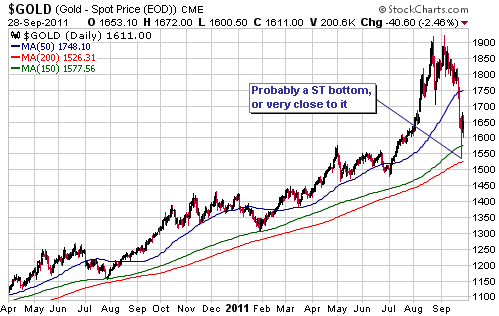
When the US$ gold price (basis the October futures contract) traded at $1532 on Monday 26th September, it was down by 20% from its peak and within $10 of its 200-day moving average. Given our view that the 200-day moving average defines gold's maximum downside risk, does this mean that gold won't trade significantly lower than it did on Monday?
Probably, but we can never be certain about the future performance of any market. The current downturn will probably turn out to be a steeper than average, but still routine short-term correction. However, we can't rule out the possibility that it will evolve into a larger-degree correction such as the one that occurred in 2008 (in 2008, the peak to trough decline was about 30%).
If the current downturn is destined to evolve into a larger-degree correction, the most likely course from here would encompass 1-3 months of consolidation in the $1500-$1800 range followed by a decline that takes out this week's low (or whatever marginal new low is put in place over the next couple of weeks). In other words, the odds are in favour of a short-term bottom being at hand even if the gold market has just commenced an intermediate-term (6-12 month) correction.
We would be remiss if we didn't mention one other possibility, which is that gold's long-term bull market has just ended. This possibility is extremely remote on both technical and fundamental grounds.
Technically, while gold 'went parabolic' during July-August the price action clearly didn't qualify as a major upside blow-off.
Fundamentally, a long-term gold top would require a 180-degree policy shift by the world's major central banks and governments, but there is no evidence that such a policy turnaround is in the works. On the contrary, the Fed's recently-announced attempt to boost the economy by "twisting" the interest-rate spread, and Obama's new plan to create jobs via a few hundred billion dollars of additional government spending, constitute evidence that total cluelessness continues to reign supreme inside the world's most important monetary and political institutions. A long-term gold top would also require a long-term bottom in the stock market's valuation (the secular bull market in gold is inexorably linked to the secular bear market in equities), but the stock indices are still a great distance from genuinely low valuation levels.
Central Bank Gold Sales
Judging by emails we have received, it seems that some gold investors are worried that the official sector (the combination of central banks and governments) will become an aggressive seller of gold in a desperate attempt to improve its financial position.
The reality is that due to increasing distrust and falling confidence within its ranks, the official sector is far more likely to be a net buyer than a net seller of gold over the next couple of years. In any case, the direct gold-market operations of central banks and governments have not been important drivers of gold's price trend over the past four decades and are not likely to be important drivers of gold's price trend in the foreseeable future.
The way that central banks and governments affect the gold price is via their policies. As neatly put by James Grant, it is appropriate to think of the gold price as 1/Trust (one divided by the general level of trust (or confidence) in monetary and fiscal policy-makers). The implication is that the only genuinely effective way for the official sector to put downward pressure on the gold price is to implement sound (non-inflationary, prudent) monetary and fiscal policies.
At some point in the future the fear of inflation could reach a high-enough level that the most politically feasible course involves stopping the inflation and reining-in the government, but we appear to be a long way from that point.
Current Market Situation
Objective indicators of sentiment support the view that a short-term price low was either put in place on Monday 26th September or will soon be put in place at not far below Monday's intra-day low. We note, in particular, that Market Vane's bullish consensus for gold, which was 88% as recently as 6th September, was only 64% on 26th September. This is the sort of level we would expect to see in the vicinity of a short-term price low during a long-term bull market.
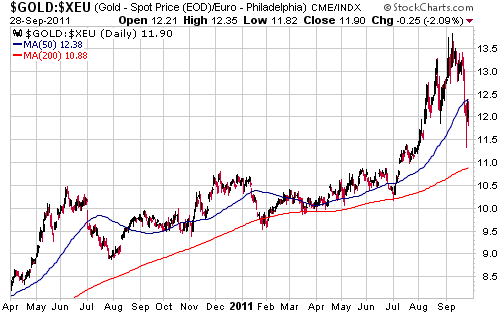
The first of the following daily charts shows this week's plunge in the US$ gold price to within $10 of its 200-day moving average. The second chart shows that the euro-denominated gold price (gold/euro) came within about 50 euros of its 200-day moving average early this week.
Over the past several years, the best opportunities to buy gold have often coincided with gold/euro dropping to its 200-day moving average. There's a good chance that gold/euro will trade at its 200-day moving average before the next major advance gets underway, but it could do so a few months from now at a price that's significantly higher than Monday's intra-day low. This is because the moving average is rising. The period from July-2010 through to February-2011 is an example of what we are talking about.
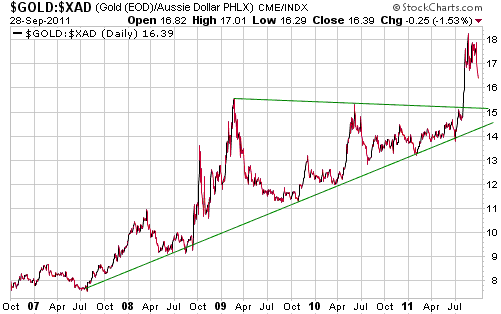
In Australian Dollar terms, gold broke out of a 2.5-year consolidation pattern in July. It has recently pulled back in what should prove to be a 'test' of the breakout.
Gold probably won't make new highs in US$ terms within the next three months, but it has a good chance of making new highs in A$ terms. If this were to happen it would be a very positive development for gold-mining companies that produce most of their gold in Australia. In fact, although you wouldn't know it by looking at stock prices, the fundamental backdrop for Australia-based gold miners is more bullish today than it has been in years.
Silver
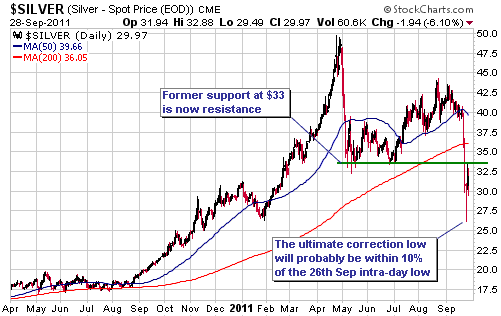
Silver traded as low as $26.15 on 26th September, meaning that it came within $4 of what we have said was its lowest realistic downside potential. On the same day, Market Vane's Bullish consensus for silver was 51%. This means that when silver was bottoming on Monday, both price and bullish sentiment were roughly half of their late-April highs.
The stage is now set for a correction low in the silver market, although it's reasonable to expect that Monday's intra-day low will be tested and at least marginally breached at some point over the next few months. To put it another way, it isn't reasonable to expect that silver's next major advance will begin in the near future.
Gold Stocks
The XAU made a new 52-week low on Wednesday. It is sufficiently 'oversold' to make a sustainable bottom, but there is no evidence that a bottom is in place.
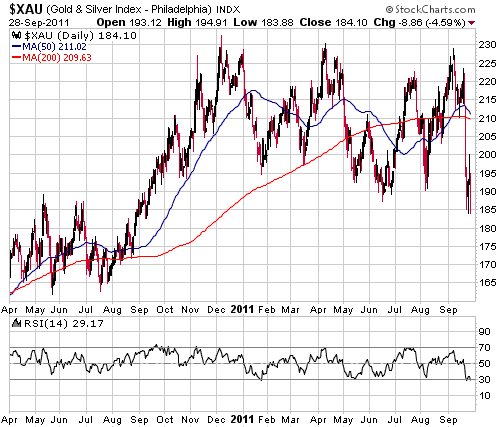
GLDX, a proxy for exploration-stage gold mining stocks, has continued to plunge. Its chart (see below) reflects panicked liquidation.

The good news is that the gold sector is trending downward into the most reliable time window for important turning points (October-November). This paves the way for a major turn from down to up at some point over the next two months.
Based on the speed of the recent decline and the extent to which the gold sector is now 'oversold', the first half of October is the most likely time for an important low.
Currency Market Update
Within hours of this Interim Update being posted, Germany's parliament will vote on the expansion of the euro-zone's bailout fund (the EFSF). The expansion, which involves increasing the fund's financial resources to 440B euros and giving it the authority to intervene preemptively in the sovereign debt market, was agreed to in July by Angela Merkel and other heads of state. However, it must be approved by the parliaments of the participating countries before it can come into effect. Approval by Germany's parliament is the biggest obstacle to overcome.
As we write, the odds are in favour of the EFSF's expansion being approved. However, a spanner was almost thrown into the works a couple of days ago when a CNBC commentator publicised a rumour that a plan to leverage the EFSF's capital was being concocted behind the scenes. According to the rumour, this plan would involve the following:
A chunk of the EFSF's money would go to the European Investment Bank (EIB), which would take a page out of Enron's book and create a Special Purpose Vehicle (SPV) designed to leverage the EFSF's money by issuing bonds. Specifically, the rumour had it that the SPV would issue $8 of bonds for every $1 of its capital, and that these bonds would be purchased by the ECB with new euros. In this way, 200B euros of funds from the EFSF could provide up to 1.6 trillion euros of buying power (1.6T euros that could be used to support the bonds of Italy, Spain, etc.).
The rumour, then, was that a plan was being hatched that would put euro-zone taxpayers on the hook for an additional 1-2 trillion euros without the inconvenience of having to get parliamentary approval.
We don't know if such a plan was ever really in the works, but in response to the rumour the German government categorically stated that leveraging the EFSF wasn't an option.
The euro appears to be in the early part of an intermediate-term decline, but it will likely rebound for a short while if the German parliament approves the EFSF expansion. This is despite the fact that expanding the EFSF would probably result in a greater supply of euros. For some strange reason the market usually responds to signs of increasing inflation by bidding up the euro against the US$, even when the inflation is in the euro.
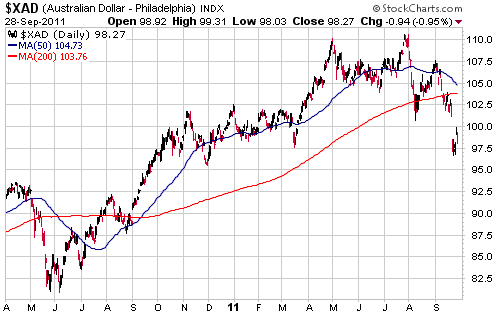
The Australian Dollar is the most over-valued of the major currencies. Since peaking at the end of July it has dropped by about 10%, but it would have to drop a lot more to approach fair value on a purchasing power parity basis. Whether it does drop a lot more will largely be determined by what happens to the stock and commodity markets, because speculative demand for the A$ tends to rise and fall with equity and commodity prices. In particular, when the stock and commodity markets are in upward trends the speculative demand for the A$ tends to rise by more than enough to offset the currency's over-valuation.
Further to the above, the A$ should reach a multi-month low at around the same time that the S&P500 Index and CCI reach multi-month lows, regardless of its relative valuation at the time.
Update
on Stock Selections
Notes: 1) To review the complete list of current TSI stock selections, logon at
http://www.speculative-investor.com/new/market_logon.asp
and then click on "Stock Selections" in the menu. When at the Stock
Selections page, click on a stock's symbol to bring-up an archive of
our comments on the stock in question. 2) The Small Stock Watch List is
located at http://www.speculative-investor.com/new/smallstockwatch.html
 Buying Opportunities Buying Opportunities
Every stock in the TSI List is currently at a level where new buying could be justified, but if we had to single out a few 'best buys' we would point to the following:
- Jaguar Mining (JAG) near Wednesday's closing price of US$4.88
- Keegan Resources (KGN) near Wednesday's closing price of US$5.25
- Sabina Gold and Silver (TSX: SBB) near Wednesday's closing price of C$3.31
- International Tower Hill Mines (THM) near Wednesday's closing price of US$5.00
JAG's results over the past two quarters indicated that its operations had 'turned the corner' and were set to generate substantial cash flow over the ensuing quarters. The current share price does not factor-in this turnaround.
KGN, SBB.TO and THM are cash-rich exploration-stage gold miners that are now trading at very attractive valuations. Also, the flagship projects of each of these junior companies are likely to be of interest to senior gold mining companies.
Chart Sources
Charts appearing in today's commentary
are courtesy of:
http://stockcharts.com/index.html

|









