|
- Interim Update 28th October 2009
Copyright
Reminder
The commentaries that appear at TSI
may not be distributed, in full or in part, without our written permission.
In particular, please note that the posting of extracts from TSI commentaries
at other web sites or providing links to TSI commentaries at other web
sites (for example, at discussion boards) without our written permission
is prohibited.
We reserve the right to immediately
terminate the subscription of any TSI subscriber who distributes the TSI
commentaries without our written permission.
Bank Reserves and Inflation
The
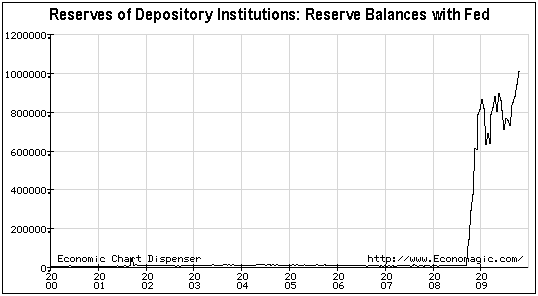
following chart shows that bank reserves held at the Fed have increased
100-fold over the past 14 months -- from around $10B in August of 2008
to around $1000B ($1T) today. It is important to understand that while
this explosion in the reserves of US depository institutions has
rightfully prompted much discussion and consternation, it hasn't
directly added to the total supply of US dollars (bank reserves are not
counted in monetary aggregates such as M1, M2, M3, MZM and TMS). The
reason that bank reserves aren't added to the money supply is that they
do not constitute money available to be spent within the economy;
rather, they constitute money that could be loaned into the economy or
used to support additional bank lending in the future.
Bank lending in the
US has declined on a year-over-year basis, so we know that the
spectacular increase in reserves has not YET contributed to monetary
inflation. Many analysts and economists view this as a problem, their
belief being that the banking industry should support the economy by
putting its excess reserves to work. To be more specific, they want the
banks to lend more new money into existence on the basis that more debt
is 'just what the doctor ordered' for an economy weighed down by the
highest debt levels in history.
Not surprisingly, we see things differently. We think it is fortunate
that banks have, to date, chosen to 'sit' on their reserves, because if
they decided to use the reserves to support trillions of dollars of
additional lending then the inevitable result would not only be an even
more troublesome debt burden; it would also be an inflation problem of
immensely destructive proportions.
Even with the decline in bank lending and the general de-leveraging
that has occurred within the private sector, the government-Fed tag
team has managed to increase the US money supply by around 14% over the
past year. If the private banks were to join the inflation party then
the risk of hyperinflation would greatly increase, and hyperinflation
-- leading to what Mises called a "crack-up boom" -- would be the worst
of all possible outcomes. In particular, it would be an order of
magnitude worse than the deflation that many people still seem to be
worried about.
So, let's hope that the banks don't start lending out their excess reserves. The situation is bad enough already.
The 'mysterious' lack of job growth
The following chart was extracted from an article in BusinessWeek and shows that there has been almost no increase in private-sector jobs within the US economy over the past decade.
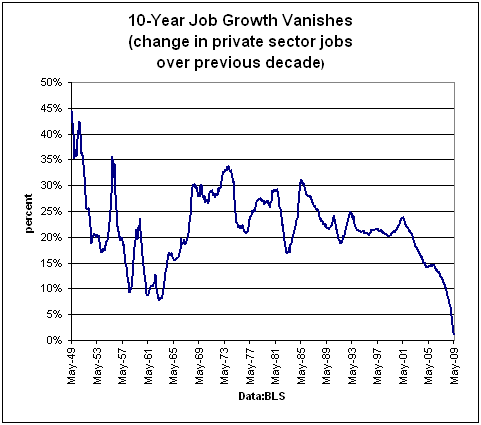
One of the strange things about the increased government spending and
central bank liquidity injections typically referred to as "stimulus
programs" is that when these programs fail to bring about sustained
improvement, or lead to an even weaker economy, it is usual for
mainstream economists, journalists and policymakers to conclude that
there just wasn't enough stimulus. Given that the average politician's
overriding objective is to remain popular enough to win the next
election, it might be asking too much to demand that politicians
acknowledge the reality that stimulus programs have only, and can only,
hurt the economy over the long run. However, economists are supposed to
be concerned with the long-term consequences of policies. Even though
most economists are hampered by the millstone of bad economic theory,
there is now more than enough empirical evidence to make clear the
injurious effects of interventionist policy. In this case you don't
necessarily need good economic theory to 'connect the dots', although
it certainly helps to have good economic theory in your arsenal.
The inability to 'connect the dots' is evident in the final paragraph
of the above-linked BusinessWeek article. The article explains that the
only job growth over the past decade has been in the government sector
(including the government-controlled/sponsored healthcare and education
sectors), and concludes that the labor market would have been flat on
its back without a decade of growing government support from rising
health and education spending and soaring budget deficits. It
apparently hasn't occurred to the author of the article that when the
government 'creates' jobs it sucks resources away from the private
sector, meaning that the absence of job growth within the private
sector is a natural consequence of "growing government support from
rising health and education spending and soaring budget deficits."
Oil Update
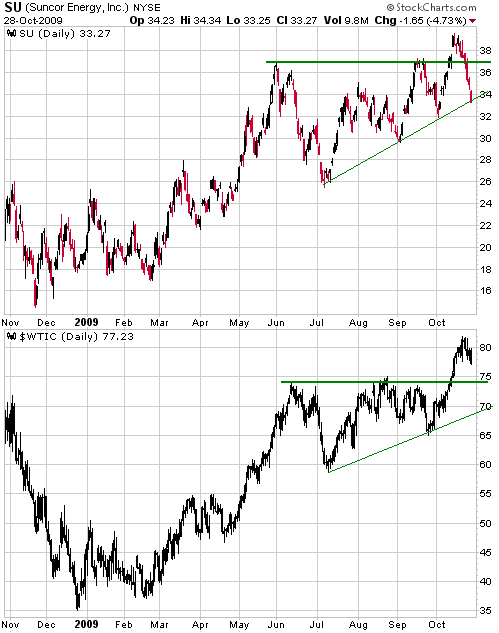
A chart comparison of Suncor Energy (SU) and the oil market is shown below.
When SU broke above resistance at $37 in early October we took it as a
warning that the oil market would soon follow suit, which it quickly
did. Oil's upside breakout projected a rise to around $90.
Oil's short-term upward trend appears to be intact, but notice that SU
has plunged over the past few days and is now well below its breakout
level. SU's downward reversal casts considerable doubt on oil's ability
to make it up to $90. We are therefore downgrading our short-term oil
view from "bullish" to "neutral".
The Stock Market
In the 5th October Weekly Update we showed a DecisionPoint.com
chart of the NYSE Composite Index and the NYSE Common-Stock-Only
McClellan Oscillator (MO). At that time the NYSE's MO had become as
'oversold' as it had been at the March-2009 bottom, even though the
NYSE Composite Index had experienced only a minor pullback from its
23rd September peak. This, we thought, was both interesting and strange.
We went on to say:
"A downward spike in the
NYSE's MO to an extremely low level (-80 or lower) does not usually
coincide with a significant price low. Rather, extreme lows for the MO
tend to occur in advance of price lows. And over the past three years,
the time from an extreme low in the NYSE's MO to a low for the NYSE
Composite Index has generally been 1-3 weeks. In other words, the MO's
message is that the stock market is probably 1-3 weeks away from a
short-term price low."
As things turned out, the MO's early-October negative extreme was an
exception to the rule in that it marked the low for the move and was
followed by a 2-3 week rally to a marginal new high. However, the
situation in which the market now finds itself is similar to that of
early October, but even more extreme. As evidenced by the chart
presented below, the 8-day pullback from the October peak has pushed
the NYSE's Common-Stock-Only MO to lower than where it was at the
March-2009 major bottom. This is extraordinary.
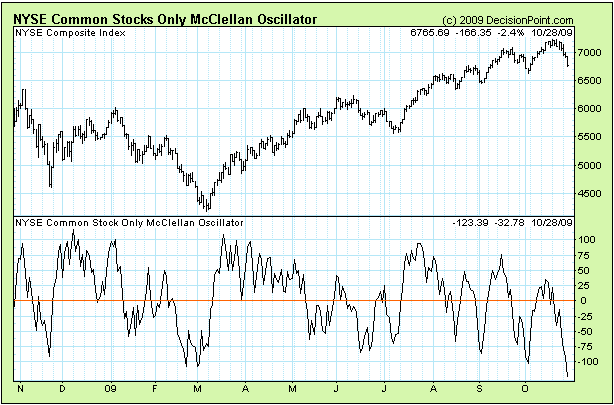
Perhaps this will be
another exception to the rule, but the odds favour some additional
downside over the coming 1-3 weeks. To be more specific, the odds are
in favour of the stock market experiencing a short bounce and then a
decline to a new low for the move. Furthermore, the MO's current
extreme indicates that a short-term bottom should be in place by mid
November.
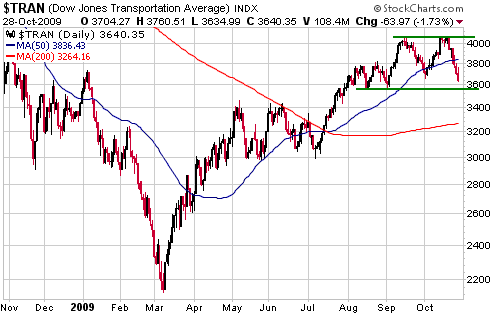
A daily chart of the Dow Transportation Average (TRAN) is displayed
below. Unlike the SPX, the NDX and the Dow Industrials, the TRAN didn't
make a new high in October. Rather, in the TRAN's case the October high
was a successful test of the September high. This means that the
transportation sector has been in correction mode since mid September.
TRAN has good support at 3550 and then at 3400.
Gold and
the Dollar
Gold Stocks
In last week's Interim Update we wrote:
"...the HUI is probably
experiencing nothing more than a routine consolidation within a
continuing short-term upward trend. If this assumption is correct then
it shouldn't do any worse than drop to the 420s before resuming its
advance. We point out, though, that there is more downside risk in the
gold-stock indices than in gold bullion, primarily because of the
current high level of general stock market risk.
We continue to believe
that the most likely scenario is that an intermediate-term top is not
yet in place, but will be put in place before the end of November."
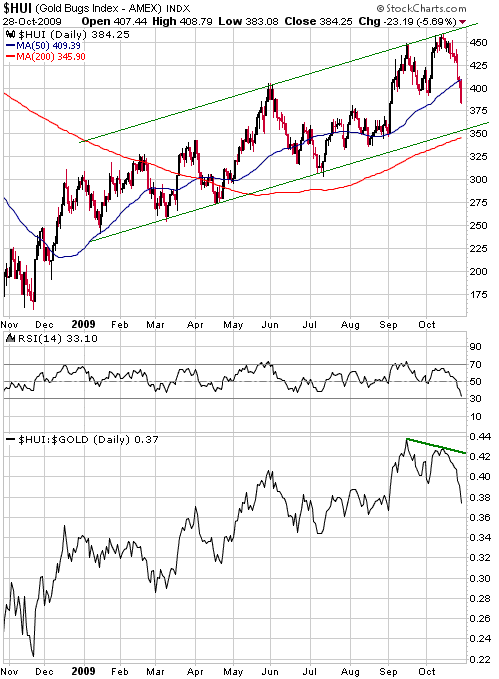
The HUI broke decisively below the 420s earlier this week, suggesting
that something more than a routine short-term correction was underway.
Also, the steeper-than-expected decline over the past week increases
the relevance of October's bearish divergence between the HUI and the
HUI/gold ratio (the HUI's new high for the year was not confirmed by
the HUI/gold ratio). The upshot is that an intermediate-term peak was
probably put in place in mid October -- about one month earlier and a
few percent lower than anticipated.
The following daily chart shows the current situation of the HUI, the
HUI's RSI (a momentum indicator), and the HUI/gold ratio. Note the
bearish divergence between the HUI and the HUI/gold ratio at the
October peak. Also note that the HUI's RSI has just hit its lowest
level of the past 12 months.
Although this week's
price action suggests that the HUI reached an intermediate-term peak
earlier this month, it hasn't significantly altered our
intermediate-term outlook for the gold sector. What it means is that
the next rally -- which should begin within the coming fortnight --
will more likely result in a test of the October peak than a new high
for the year. Moreover, we continue to expect that many junior gold
stocks will make new multi-year highs during the first half of 2010.
Our short-term outlook has, however, been altered. Even though the
HUI's next rally is unlikely to make a new high, the HUI has fallen far
enough and become sufficiently 'oversold' to materially IMPROVE the
short-term risk/reward. The additional downside potential from here is
probably no more than a few percent, whereas even a counter-trend
rebound back to the vicinity of the October peak would constitute a
gain of 15%-20%. We are therefore upgrading our short-term outlook from
"neutral" to "bullish".
Gold Bullion
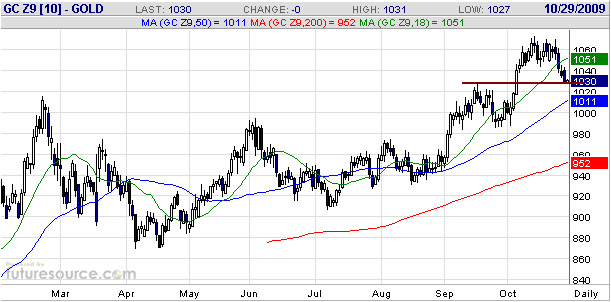
In recent commentaries we have identified $1025 (basis the December
contract) as an important short-term support level. A daily close below
this support would indicate that the current correction is of greater
significance than we currently believe.
The following daily chart shows that the aforementioned support level was tested on Wednesday.
We continue to expect that gold bullion will make new highs over the coming three months.
Currency Market Update
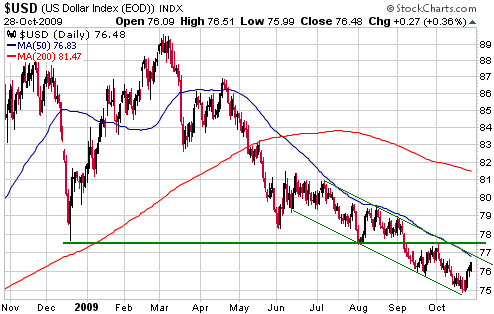
With the downturn in the stock market, the Dollar Index has begun to
rebound. However, there is no evidence, yet, that anything more than a
temporary bottom is in place.
With reference to the following daily Dollar Index chart, the most
important price level to watch over the weeks ahead is 77.5. A daily
close over 77.5 would break the Dollar Index above a) lateral
resistance defined by the December-2008 and August-2009 lows, b) the
50-day moving average, and c) the downward-sloping channel that began
to form in June. Such an event would be a clear sign that an
intermediate-term bottom was in place, although it wouldn't necessarily
mean that a consistent upward trend had commenced. We suspect that the
US$ will trace out a multi-month bottoming pattern while the US stock
market traces out as multi-month topping pattern.
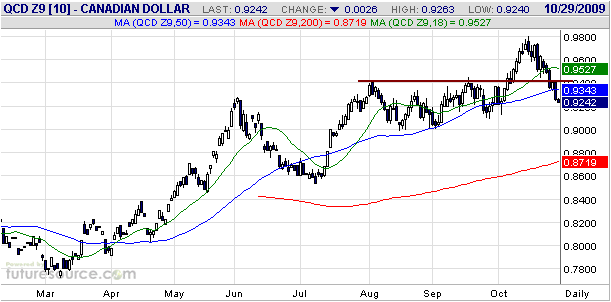
In last week's
Interim Update we stated that if the December C$ breached support at
0.94 then we would have evidence that it had peaked on an
intermediate-term basis. The aforementioned support gave way during the
first half of this week, the implication being that an
intermediate-term peak was most likely put in place earlier this month.
Update
on Stock Selections
(Note: To review the complete list of current TSI stock selections, logon at http://www.speculative-investor.com/new/market_logon.asp
and then click on "Stock Selections" in the menu. When at the Stock
Selections page, click on a stock's symbol to bring-up an archive of our comments on the stock in question)
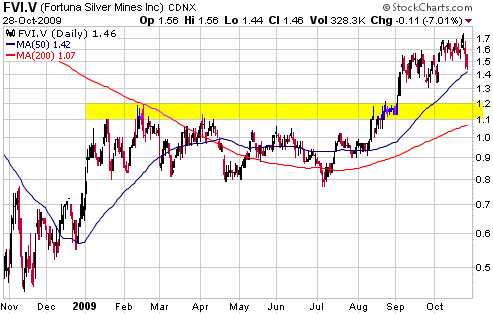
 Fortuna Silver (TSXV: FVI). Shares: 92M issued, 111M fully diluted. Recent price: C$1.46 Fortuna Silver (TSXV: FVI). Shares: 92M issued, 111M fully diluted. Recent price: C$1.46
Junior silver miner FVI made two significant announcements during the
first half of this week. First, it announced a resource upgrade at its
exploration-stage San Jose silver/gold project in Mexico. The resource
upgrade entailed the conversion of "inferred" ounces to
"measured-and-indicated" ounces. Second, it announced the receipt of
the environmental permit for the San Jose project.
Despite these positive developments, the stock was forced downward over
the past couple of days by the sector-wide sell-off. This could lead to
another opportunity to buy FVI at a very attractive price.
FVI has strong support at C$1.10-C$1.20, so the ideal area for new
buying would be C$1.15-C$1.25. There is certainly no guarantee that the
stock price will get that low, but a drop back to near the
aforementioned support will become achievable if small investors panic
(as is their wont).
New addition to the TSI Stocks List: Kinross Gold Series C Warrants (TSX: K.WT.C). Recent price: C$3.55
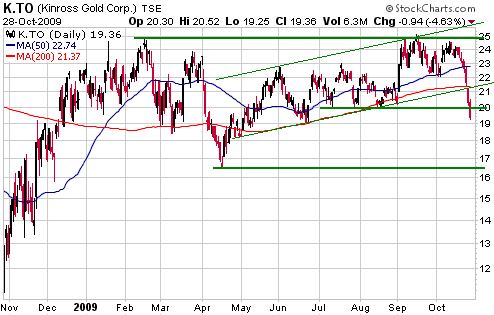
Kinross Gold (TSX: K, NYSE: KGC) has been pummeled over the past few
days, thanks to the combination of a sector-wide downdraft and lowered
production guidance. The following chart shows that on Tuesday it broke
below the bottom of a well-defined channel and on Wednesday it broke
below lateral support at C$20. The next important support level lies at
C$16.50, and in our opinion this lower support level defines the
stock's maximum downside potential.
We wouldn't invest in
the stock, primarily because the company's most valuable asset (the
Kupol project) is in a bad location (Russia). However, the Kinross
Series C warrants are an interesting speculation near their current due
to the leverage they offer.
The warrants have an exercise price of C$32.00, which is a greater
distance above the current stock price than we would prefer, but the
relatively high exercise price is more than offset by the fact that the
expiry date is almost 4 years into the future (September of 2013, to be
more precise). This means that the warrants should prove to be a very
profitable speculation as long as Putin & Co. doesn't steal the
Kupol project and there is a major gold rally some time within the next
3.5 years. The risk: if there isn't a big gold rally or if something
terrible befalls the company, then the warrants could become worthless.
With the stock trading near Wednesday's closing price of C$19.36 the
warrants would be fairly priced in the C$3.50-C$3.70 range (they closed
at C$3.55 on Wednesday). However, if the stock price dropped to support
at C$16.50 then the fair value of the warrants would drop to around
C$2.50.
Our suggestion is to view these warrants as a long-term speculation and to scale into a position over several months.
Chart Sources
Charts appearing in today's commentary
are courtesy of:
http://stockcharts.com/index.html
http://www.futuresource.com/
http://www.decisionpoint.com/
http://www.economagic.com/

|