- Interim Update 28th October 2015
Copyright
Reminder
The commentaries that appear at TSI
may not be distributed, in full or in part, without our written permission.
In particular, please note that the posting of extracts from TSI commentaries
at other web sites or providing links to TSI commentaries at other web
sites (for example, at discussion boards) without our written permission
is prohibited.
We reserve the right to immediately
terminate the subscription of any TSI subscriber who distributes the TSI
commentaries without our written permission.
When will the Fed hike
interest rates?
To the surprise of no one, the
Fed left its targeted interest rate unchanged near zero at the October FOMC
meeting. It also left the door open to a rate hike at the December meeting. If
this surprised anyone, it shouldn't have. The Fed's leadership has gone to great
pains to make clear that its future interest rate decisions will be "data
dependent". It can't very well state that what it does in the future will be
"data dependent" and then hint that it will take no action at a future meeting
regardless of what happens in the meantime. As a result, the question "when will
the Fed hike interest rates?" is going to remain a hot topic in the financial
press until the first rate hike takes place, but the relentless speculation
won't stop there because the Fed's second rate hike will also be "data
dependent". In other words, we can look forward to the current extreme focus on
the Fed's Keynesian circus continuing for a long time.
A better question than "when will the Fed hike interest rates?" is "when will
the Fed Funds Rate move back to the sort of level that would have seemed normal
prior to the past 6 years?" The answer is: when the markets become sufficiently
concerned about an inflation problem that the Fed is left with no choice in the
matter.
Unfortunately, there's no way to reliably predict the timing. The way things are
panning out, with dangerously-high debt levels, commodity prices in the toilet
and the broad stock market possibly rolling over into a cyclical bear, we could
be into the next decade before the inflation problem becomes sufficiently
obvious to force nominal interest rates back up to more 'normal' levels.
The Global Monetary
Inflation Indicator
We sum US and euro-zone True
Money Supply (TMS), with euro-zone TMS converted to US dollars using a long-term
average of the euro/US$ exchange rate, to arrive at what we call G2 TMS. The
annual rate of growth in G2 TMS has worked well as a global monetary inflation
indicator* over the past 16 years, in that it gave a timely warning signal ahead
of the 2001-2002 and 2007-2009 economic busts and a timely warning signal ahead
of the subsequent booms. Before we take a look at the current signal being sent
by G2 TMS, we'll briefly consider its two components.
In the latest Weekly Update we showed that the US monetary inflation rate (the
year-over-year rate of growth in US TMS) had been remarkably stable at 7%-8%
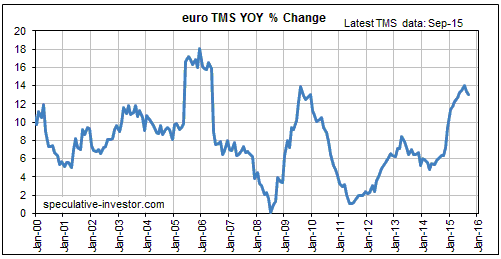
over the past two years. This contrasts with the euro-zone monetary inflation
rate, which over the same period started at 6.5% and then fell to 4.9%, rose to
14.0% and dropped back to 13.0% (where it sits today). Refer to the following
chart for details.
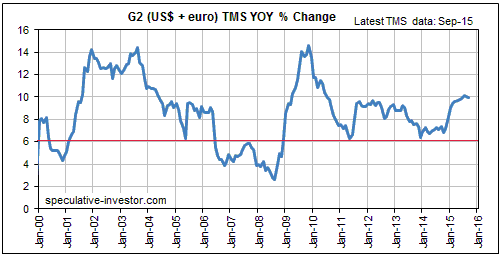
Turning to G2 TMS, the critical level appears to be 6%. What we mean is that
after rapid monetary inflation has fueled an artificial boom, a decline in the
G2 TMS annual rate of growth (the Global Monetary Inflation Indicator) to below
6% sets the scene for the inevitable bust to begin within the ensuing 12 months.
As illustrated by the following chart, global monetary inflation came close to
breaking below the critical level between late-2013 and late-2014. However, Fed
stability combined with ECB lunacy and a faster pace of US commercial-bank
credit expansion then boosted the inflation rate to the top of its 5-year range.
Just to be clear, a decline in the monetary inflation rate from a high to a
relatively-low level is never a problem; it only exposes a problem. The damage,
in the form of widespread mal-investment, is done during the boom in reaction to
rapid monetary inflation, but it is usually only after the monetary tide goes
out that it becomes apparent that many people were swimming naked. Furthermore,
the longer the boom is sustained by new injections of money, the more severe
will be the resultant bust.
One concern we've had over the past few years is that due to the structural
economic damage caused by earlier bouts of aggressive monetary stimulus, the
next bust could begin at a higher level (meaning: without a preceding drop to
below 6% in our global monetary inflation indicator). So far, however, the start
of the bust has been postponed by keeping the G2 TMS growth rate comfortably
above 6%.
*Note that adding the money supplies of other countries to
the mix to create a broader money-supply measure results in a global inflation
indicator with worse (less-useful) historical performance. It seems that when
assessing the world's major monetary trends, only the US$ and the euro are
important. Also note that (as far as we know) only TSI currently monitors this
particular indicator.
The Stock Market
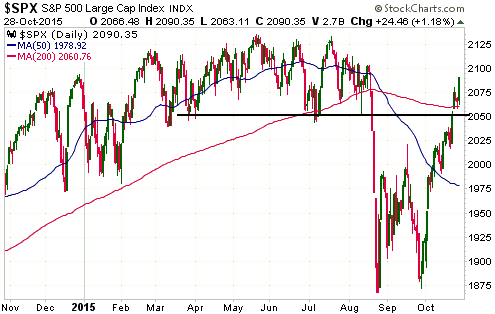
The S&P500 Index (SPX) has
extended its break above lateral resistance/support at 2050 and the 200-day MA.
This is a minor departure from the 2011 Model, but we expect that when the
Fed-related dust settles a significant pullback will begin. Furthermore, even in
a continuing-bull-market scenario the SPX would likely retrace half of its
September-October rebound during November.
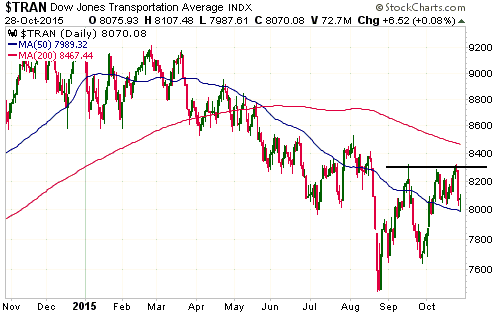
As has been the case over the bulk of this year to date, the Dow Transportation
Average (TRAN) is diverging bearishly from the SPX and the Dow Industrials
Index. Whereas the SPX and the Dow Industrials have broken above their 200-day
MAs and moved a long way above their September peaks, the following chart shows
that TRAN remains well below its 200-day MA and reversed lower over the past
three days after doing no better than testing its September peak.
If TRAN now closes below its 50-day MA it will be a short-term bearish omen for
the broad market.
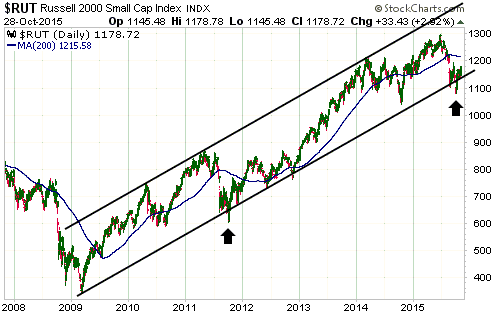
The small-cap US stocks represented by the Russell2000 Index (RUT) had a good
day on Wednesday, but over the past four months they have weakened considerably
relative to the large-cap stocks represented by the SPX. This relative weakness
has left the RUT in a precarious technical position, which is good because it
won't take much additional weakness from here to generate evidence of a bear
market.
We are referring to the fact that the RUT spiked below its long-term channel
bottom during September and, despite the rebound of the past month, remains near
the bottom of this long-term channel. The channel bottom should continue to hold
IF the bull market is intact.
Gold and the Dollar
Gold
Although no one should have been surprised that the Fed left the door open to a
December rate hike, judging by the price action many short-term speculators in
the gold market obviously were surprised. They bid gold higher during the hours
leading up to the Fed news and then dumped gold when the Fed reiterated what it
has been saying for months -- that it remains "data dependent" and therefore
that what it does at the next meeting will be determined by the data in the
meantime.
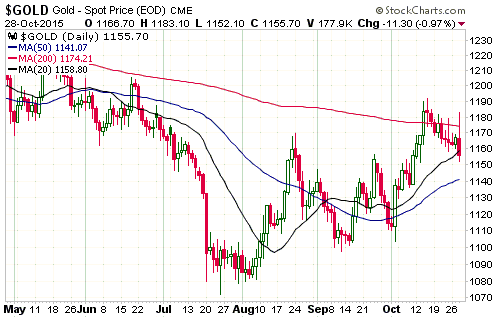
After Wednesday's pre-Fed surge and post-Fed purge, the US$ gold price ended the
day below its 20-day MA. This signals that a short-term top was put in place a
couple of weeks ago at around $1190. The signal is not infallible, but it means
that the chance of a near-term rise to above the mid-October high is now
significantly smaller than it was at the beginning of this week.
Note that if the US$ gold price were to move back above its 20-day MA over the
days immediately ahead it wouldn't negate Wednesday's signal. To negate
Wednesday's bearish signal the gold price will have to close above its 200-day
MA, which acted as resistance over the past eight trading days.
Gold Stocks
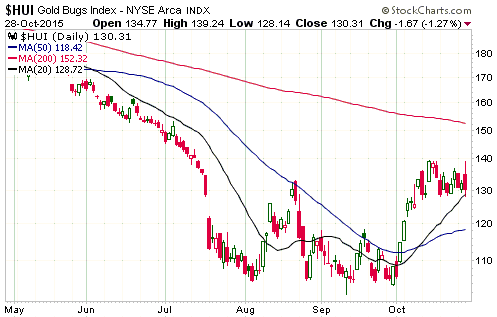
The HUI moved in sympathy with the gold price on Wednesday, first moving sharply
higher and then giving back all of its gains to end the day with a loss.
However, unlike the US$ gold price the HUI ended the day above its 20-day MA and
did not make a new multi-week low. In essence, the HUI suffered a bearish
reversal, but held up well enough to avoid confirming a short-term top. Also,
the recent positive divergence between the HUI and gold was maintained by
Wednesday's price action.
Prior to Wednesday 28th October we acknowledged the possibility that the HUI
made a short-term top (a top that holds for at least a couple of months) in
mid-October when it reached 140, but we thought it more likely that a quick rise
to a new 3-month high would precede a top of this nature. While the HUI held up
well enough to keep alive the prospect of a rise to a new 3-month high in the
near future, Wednesday's overall market action shifted the probabilities.
There's now a higher probability that a short-term top is already in place.
Note that a short-term top would now be confirmed by a daily close below 128.
The gold-mining sector will be helped during the final two days of this week by
the quarterly reports issued by Newmont (NEM) and Barrick (ABX) after the close
of trading on Wednesday. These reports showed that both companies achieved
significant cost reductions during the latest quarter, paving the way for
better-than-expected financial performance.
NEM and ABX are two of the largest components of both the HUI and the XAU.
Consequently, the performances of their stock prices can influence the
high-profile gold-stock indices. Also, the fact that these companies have
managed to reduce their operating costs to a meaningful extent is a positive
sign for the overall industry, since they are big enough and geographically
diverse enough to be general indicators.
We noticed that the quarterly results issued by New Gold (NGD) after the close
of trading on Wednesday also showed significant improvement on the cost front.
NGD isn't big enough to influence the gold-stock indices, but this is more
evidence that a bullish cost trend could be resuming in the gold-mining sector
after having stalled for a few quarters.
The Currency Market
At the end of last week there was some doubt as to whether or not the Dollar
Index had broken out to the upside from its intermediate-term consolidation
pattern. Most of this doubt will be eliminated if the Dollar Index can hold onto
the bulk of Wednesday's gain until the end of the week.
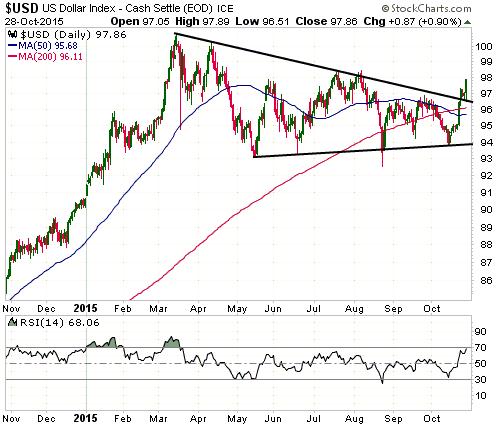
Regardless of whether or not the Dollar Index provides clearer chart-based
evidence of a breakout at the end of this week, it is now close to being
'overbought' on a short-term basis and will probably not make much additional
headway before retracing some of its recent gain. A normal pullback would take
the price down to near the 50-day MA, which is presently at 95.7 and is
beginning to rise.
Updates on Stock Selections
Notes: 1) To review the complete list of current TSI stock selections, logon at
http://www.speculative-investor.com/new/market_logon.asp
and then click on "Stock Selections" in the menu. When at the Stock
Selections page, click on a stock's symbol to bring-up an archive of
our comments on the stock in question. 2) The Small Stock Watch List is
located at http://www.speculative-investor.com/new/smallstockwatch.html
 Golden
Star Resources (GSS)
Golden
Star Resources (GSS)
Due to its weak balance sheet and
high operating costs, Golden Star Resources (GSS) is currently not suited to
being a long-term holding. That's why we (very belatedly) removed it from the
long-term holdings section of the TSI List in early September and recorded a
large loss. However, as long as it appears to be in no danger of going out of
business within the ensuing 6 months it could be appropriate to buy GSS for a
short-term trade at those times when a sector-wide rally is expected to boost
most gold stocks and give an extra boost to the higher-risk gold stocks. That's
why we also added GSS to the short-term trades section of the TSI List in
early-September.
As a trade it hasn't worked as well as expected, even though it has gained 21%.
Due to the increasing risk that the gold-stock indices made short-term tops over
the past three weeks, for TSI record purposes we are now going to take the
profit on this position and exit at Wednesday's closing price of US$0.23.
Depending on what happens to the stock price and the overall market, we might
return GSS to the TSI List as a short-term trade before year-end.
On a related matter, GSS reported its latest quarterly financial results after
the close of trading on 28th October. Although they were bad, the results do not
appear to be worse than expected and will probably not prompt a big change in
the stock price. However, if there is a big move in the stock price -- either
down or up -- during the first hour of trading on Thursday 29th October, we will
adjust our recorded exit price accordingly.
Chart Sources
Charts appearing in today's commentary
are courtesy of:
http://stockcharts.com/index.html