|
- Interim Update 28th December 2005
Copyright
Reminder
The commentaries that appear at TSI
may not be distributed, in full or in part, without our written permission.
In particular, please note that the posting of extracts from TSI commentaries
at other web sites or providing links to TSI commentaries at other web
sites (for example, at discussion boards) without our written permission
is prohibited.
We reserve the right to immediately
terminate the subscription of any TSI subscriber who distributes the TSI
commentaries without our written permission.
Note
We've devoted more space than
usual to updates on stock selections in today's report, leaving us with
less time to discuss the markets. However, we plan to devote almost the
entire coming Weekly Market Update to analyses of the various markets.
The Weekly Market Update will also outline our expectations for 2006.
The Stock Market
An important trend change within the stock market?
...every
secular bull market gets interrupted by one or two cyclical bear
markets and every secular bear market gets interrupted by one or two
cyclical bull markets.
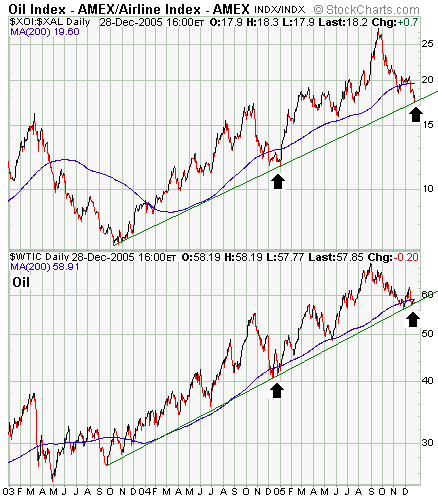
Below is an interesting chart comparing the XOI/XAL ratio (the AMEX Oil
Index divided by the AMEX Airline Index) with the oil price. As the oil
price has trended higher over the past 2 years the XOI/XAL ratio has
also trended higher, which is neither surprising nor particularly
interesting. What is interesting is that the XOI/XAL ratio and the oil
price have both just dropped to the upward-sloping trend-lines that
originated in October-2003 and have moved below their respective
200-day moving averages, which is exactly what happened at this time
last year. The question is: will the outcome be the same this time
around? That is, will the oil price and the XOI/XAL ratio commence
large advances in the near future, or are we about to get confirmation
of an important trend change?
At this stage there is no way of knowing the answer. What we can say is
that if XOI/XAL moves below its December low during January then an
important trend change is probably underway. On the other hand, if
XOI/XAL moves back above its 200-day moving average within the next
several weeks then the major trend of the past two years is probably
intact and what we've just witnessed is a fairly routine correction.
Now, the fundamentals
for the airline industry are absolutely terrible whereas oil industry
fundamentals are incredibly bullish. For example, most airline
companies have been hemorrhaging cash whereas the major oil companies
have been generating huge amounts of free cash flow. Furthermore, the
fundamentals aren't likely to shift in favour of the airline companies
in a material way at any time in the foreseeable future. The thing is,
there are few people involved in the financial markets who aren't aware
of how bad the airline business is and how good the oil business is. In
other words, the fundamentals are extremely well known and, it could
therefore be argued, fully discounted by current market prices.
In our opinion, the oil sector is in a secular bull market that's
likely to extend well into the next decade whereas the airline sector
is likely to be mired in a secular bear trend for many years to come.
However, every secular bull market gets interrupted by one or two
cyclical bear markets and every secular bear market gets interrupted by
one or two cyclical bull markets. Furthermore, the most likely time for
these 'interruptions' to begin is after the secular trend becomes
recognised by almost everyone. We therefore won't be surprised if the
XAL's relative strength persists for at least a few more months.
Current Market Situation
The yield on 2-year US Treasuries moved marginally above the yield on
10-year US Treasuries on Tuesday, creating a slight inversion of the US
yield curve. The mainstream financial press cited this slight yield
curve inversion as a reason for Tuesday's sharp decline in the US stock
indices, but this makes no sense at all given that an inversion of the
yield curve has been widely anticipated for many months. The consensus
view, as far as we can tell, is that the US yield curve WILL become
inverted over the next few months, but that unlike every other time
this has happened over the past 50 years the inversion will not, this
time around, presage a recession.
We think the consensus view is wrong, but the point is that the stock
market won't fall in response to an inversion of the yield curve when
a) most market participants have expected the inversion, and b) most
market participants do NOT expect the inversion to create a problem for
the economy.
With respect to the current stock market action, the fact that the
consolidation of the past few weeks has extended into the final week of
the year has probably improved the odds of getting a reasonably firm
market during Q1 2006. This is because the market will be commencing
2006 in a moderately oversold position.
Gold and
the Dollar
Gold Stocks
More Thoughts on Gold Bullion versus Gold Shares
...it
makes no sense for a long-term investor to take-on the additional risks
associated with gold shares UNLESS there is a high probability that
he/she will be well compensated for doing so, that is, unless there's a
high probability that the shares will handily out-perform the bullion.
In the 21st December Interim Update we used a chart of the BGMI/gold
ratio (the Barrons Gold Mining Index divided by the gold price) to show
that an investment in gold bullion out-performed an investment in major
gold mining shares during 1968-1980. We then explained why gold bullion
stands a reasonable chance of exceeding the performance of the major
gold shares over the next 10 years. This prompted some subscribers to
question whether our long-term outlook for gold shares was now less
bullish than it had been, which, in turn, has prompted us to provide
some additional thoughts and clarification on this topic.
First, the prospect of gold bullion out-performing the major gold
shares over the remainder of gold's secular bull market is not
something we've just introduced; rather, it has been a recurrent theme
of ours for some time. For example, in the 15th November 2004 Weekly
Update we wrote:
"The relatively poor
performance of gold shares during 1968-1980, which is illustrated on
the below chart of the BGMI/gold ratio, meant that investors would have
been better off owning physical gold than owning a portfolio of major
gold shares during the gold bull market of the 1970s, particularly on a
risk-adjusted basis.
...The current gold bull
market has, to date, followed a different pattern in that gold shares
have generally out-performed the bullion. We suspect, though, that
before the secular bull market comes to an end there will be a period
like 1976-1979 when the major gold shares lag the bullion by a wide
margin due to an increasing preference amongst investors for hard money
over financial claims to hard money."
We also dealt with the topic in the 25th March 2005 Weekly Update, when we wrote:
"We can think of a few
reasons why the major gold stocks under-performed gold bullion during
the 1970s. For one thing, by 1968 the stocks had been bid up to very
high levels in anticipation of a large upward move in the gold price.
For another thing, the supply of shares can be increased quickly and
cheaply to take advantage of a bull market whereas increasing the
supply of physical gold is a slow and costly process. Lastly, the
general shift away from financial assets and towards tangible assets
that occurred during the 70s would have favoured gold bullion over gold
shares. The point is, it is not difficult for us to imagine something
similar happening over the next few years because a) gold stocks were
bid up to very high levels relative to the gold price during 2001-2003,
b) brokerage houses and promoters will almost certainly be just as
quick in the future as they have been in the past to increase the
supply of shares to meet increasing demand, and c) there could well be
another shift towards the added safety provided by bullion."
And in the 11th July 2005 Weekly Update, at which time we said:
"...we won't be surprised
if the stocks of major gold producers such as Newmont Mining and
Goldcorp end up under-performing gold bullion over the remainder of
this decade because these stocks are generally quite pricey and because
such an outcome would be consistent with what happened during the
1970s. The below chart of the BGMI/gold ratio (the Barrons Gold Mining
Index divided by the gold price), for example, shows that the final
three years of the 1970s gold bull market were characterised by a
steady decline in the prices of the major gold stocks relative to the
price of gold bullion. We think it is very likely, however, that a
well-constructed portfolio comprising at least 10 junior gold miners
will out-perform gold bullion by a wide margin during the next
multi-year advance in the gold price. The reason is that a lot more
value and a lot more leverage can be found amongst the juniors."
We remain as bullish as ever on the long-term prospects for gold
stocks, but it is important to understand that gold shares are much
riskier investments than gold bullion. The shares of a gold mining
company can fall in price for many reasons that have nothing to do with
the price of gold, such as bad decisions by the company's management,
political issues, environmental issues, operational problems, and
reserve depletion. The shares are also liable to be pressured if, as we
expect, there's an across-the-board contraction in stock market
valuations over the next 5-10 years. On the other hand, the shares
offer opportunities for growth that a chunk of metal does not. The crux
of the matter is that it makes no sense for a long-term investor to
take-on the additional risks associated with gold shares UNLESS there
is a high probability that he/she will be well compensated for doing
so, that is, unless there's a high probability that the shares will
handily out-perform the bullion.
As things currently stand, we don't think there is a high probability
of the MAJOR gold mining shares handily out-performing gold bullion
over the next several years. We therefore think that bullion, or
bullion funds such as CEF and the like, might be better options for
long-term investors than large-cap gold mining stocks.
The more speculative end of the gold-share universe is, however, a
different kettle of fish. Over the past three years the TSI Stock
Selections List has been dominated by small-cap gold stocks -- junior
producers and exploration-stage companies -- because amongst these
stocks there exists plenty of value, plenty of leverage, and the good
potential for relative strength. We were too early in shifting our
focus because although 2003 was a terrific year for the smaller stocks
there has been a general lack of interest in this area of the market
over the past 12 months. However, this lack of interest has simply
widened the valuation gap between some of the high-profile
majors/mid-tiers and the relative unknowns at the other end of the food
chain, thus setting the stage for substantial out-performance by the
smaller companies in the future.
Current Market Situation
As mentioned above, there's a significant chance that gold bullion will
prove to be a better investment than most of the large and mid-tier
gold shares over the remainder of gold's secular bull market. However,
as far as the next 1-2 months are concerned we think the shares will
continue their recent out-performance IF there is stability or strength
in the broad stock market. Note that we currently expect the broad
stock market to be reasonably firm during the first quarter of 2006.
Yesterday's rally in the gold sector took the AMEX Gold BUGS Index
(HUI) to the top of a well-defined channel (see chart below), which
simply means that the HUI is extended on a short-term basis.
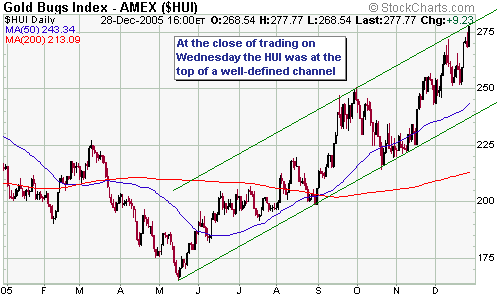
We've said that the
more speculative gold and silver stocks could really come to life
during the first quarter of next year, but the probability of such an
outcome would have been enhanced had the HUI pulled back to near its
channel bottom during the final week of this year. Instead, we are
entering the last few days of 2005 with the HUI at its channel top and
with several of the speculative gold stocks we follow having just moved
sharply higher.
There are still plenty of small-cap gold/silver stocks that are very
under-valued and that look good from a technical perspective. We think
newcomers to the gold/silver world should be accumulating these stocks
and we will continue to present relevant stock selection ideas in the
TSI commentaries. Those who already have substantial exposure should,
however, avoid getting carried away by the market's current upward
momentum. Our view continues to be that the periodic buying spikes
represent opportunities to take PARTIAL profits whereas the periodic
selling squalls provide the best opportunities to build positions.
Horses for Courses
Just in case some readers might find it useful we've included, below,
three lists containing gold/silver stocks from the TSI Stock Selections
page. Each list is arranged in alphabetical order and contains the
stocks that we currently think will perform the best over the time
period specified at the top of the list. Note that some TSI stock
selections appear in more than one of the following lists whereas
others don't appear in any of the lists. Also note that the stocks in
the "3 MONTHS" list are only likely to perform well if the overall
market environment remains positive.
3 MONTHS:
DRDGold (NASDAQ: DROOY), First Majestic Resource (TSXV: FR), Mines
Management (AMEX: MGN), Metallica Resources (AMEX: MRB), NovaGold
Resources (TSX and AMEX: NG), Nevsun Resources (TSX and AMEX: NSU),
Western Silver (AMEX: WTZ), Exeter Resource (TSXV: XRC)*
12 MONTHS:
Cumberland Resources (TSX and AMEX: CLG), Desert Sun Mining (TSX: DSM,
AMEX: DEZ), European Minerals (TSX: EPM), First Majestic Resource
(TSXV: FR), Metallica Resources (AMEX: MRB), NovaGold Resources (TSX
and AMEX: NG), Nevsun Resources (TSX and AMEX: NSU), Western Silver
(AMEX: WTZ)
3 YEARS:
Canarc Resource (TSX: CCM)*, Desert Sun Mining (TSX: DSM, AMEX: DEZ),
First Majestic Resource (TSXV: FR), Golden Queen (TSX: GQM)*, Metallica
Resources (AMEX: MRB), Metallic Ventures (TSX: MVG), NovaGold Resources
(TSX and AMEX: NG), Resolute Mining (ASX: RSG), Western Silver (AMEX:
WTZ), Exeter Resource (TSXV: XRC)*
*CCM, GQM and XRC are very small companies whose short-term performance is largely dependent on news.
Gold and Silver
We suspect that an intermediate-term peak was put in place in the gold
market earlier this month, but that silver will move to a new high
during Q1 2006.
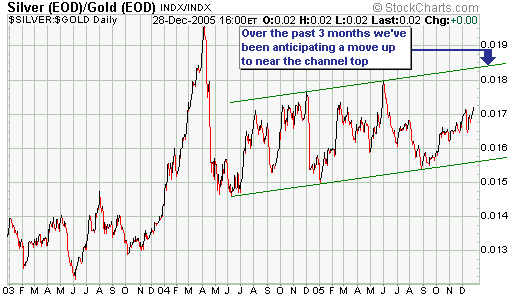
Over the past three months we've thought that the silver/gold ratio had
a reasonable chance of moving up to the top of the channel shown on the
following chart. A move up to the channel top would imply a silver
price of US$9.00 with gold at $500 and a silver price of $9.60 with
gold at $520. However, for silver to do what gold has recently done and
exceed its 1987 high the silver price would have to move above $10.
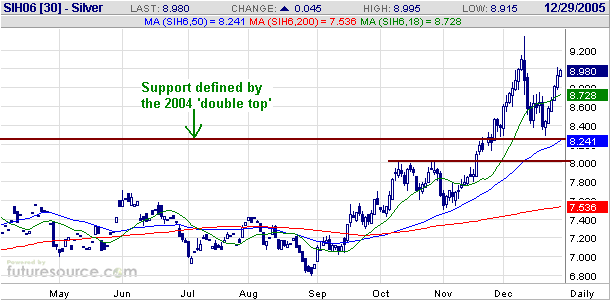
The recent pullback
in the silver market held above support defined by last year's high
(refer to the following daily chart of March silver futures), and
therefore looks like a successful test of November's upside breakout.
As long as the March futures contract holds above US$8.00 the prospect
of seeing new highs during the first quarter of next year will remain
alive.
Currency Market Update
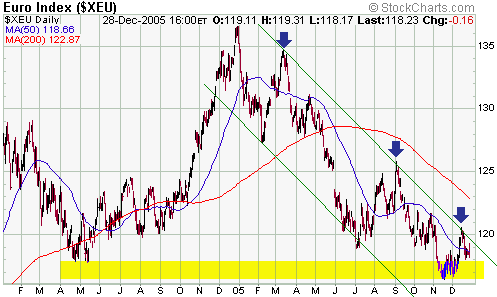
The euro commenced a cyclical bear market on the first trading day of
2005 and we expect this cyclical bear market to continue through much
of 2006. What we don't have a strong opinion on is whether the euro
will drop to new lows over the next couple of months or whether a
multi-month rebound got underway in November. We'd be inclined to lean
towards the latter possibility except that the euro reversed lower, in
early December, after hitting the top of its intermediate-term channel
(see chart below).
A daily close above 120 would be a clear sign that a multi-month counter-trend rebound had begun.
Update
on Stock Selections
 Coeur
D'Alene Mines (NYSE: CDE) was added to the TSI List in October as a
trade in response to our short-term bullish view on silver. We remain
short-term bullish on silver and expect the silver sector of the stock
market to do well during Q1 2006, but based on the way it has traded we
don't see a good reason to persist with CDE. We've therefore decided to
immediately exit the stock at a small profit of 4.5% based on
yesterday's closing price. Coeur
D'Alene Mines (NYSE: CDE) was added to the TSI List in October as a
trade in response to our short-term bullish view on silver. We remain
short-term bullish on silver and expect the silver sector of the stock
market to do well during Q1 2006, but based on the way it has traded we
don't see a good reason to persist with CDE. We've therefore decided to
immediately exit the stock at a small profit of 4.5% based on
yesterday's closing price.
We retain exposure to silver via First Majestic Resource (TSXV: FR),
Mines Management (AMEX: MGN), and Western Silver (AMEX: WTZ).
There is a lot of value to be found amongst the
exploration/development-stage metal stocks, but investors in these
stocks are also taking-on a lot of risk. As mentioned many times in the
past, the best way for an investor to mitigate this risk is to spread
his/her exposure over at least seven and preferably as many as ten
different stocks.
One way for an investor in speculative resource stocks to achieve some
diversification without actually buying many different stocks is to own
shares of Endeavour Mining Capital (TSX: EDV). This is because EDV's
primary line of business is to provide financing to junior mining
companies in exchange for equity; so when you buy EDV you are, in
effect, buying exposure to a portfolio of stocks selected by people who
have considerable expertise in this area. You are also getting the
exposure at a large discount to net asset value (EDV is presently
trading at a discount of about 25% to its net asset value).
EDV is a former member of the TSI Stocks List and a potential future
member of the List. It is, we think, a reasonable stock for investors
to average into over the coming 6 months.
There's a similar company to EDV that trades on the Australian Stock
Exchange. The company is Lion Selection Group (ASX: LSG). Like EDV, LSG
invests in exploration/development-stage mining companies, often by
providing financing to these companies in exchange for equity. Unlike
EDV, LSG typically trades near its net asset value.
LSG is also a reasonable stock for investors to average into.
The stock market's valuation of junior copper miner Taseko Mines (TSXV:
TKO, AMEX: TGB) mystifies us. The low valuation is partly explained by
the cost overruns and production delays that have occurred over the
past year as well as by management's decision to do two sizeable equity
financings at inopportune times. However, these factors don't come
close to explaining why the stock of a highly leveraged copper producer
has performed so poorly in parallel with such a strong copper market.
We thought it would be an interesting exercise to do a rough valuation
of Taseko assuming that it was mining gold and not copper. That is, to
convert Taseko's copper reserves and production to gold-equivalent
amounts and then apply typical gold stock valuation metrics. Here's
what we came up with:
- Taseko's Gibraltar copper mine in British Columbia, Canada,
contains 1.2B pounds of copper reserves and an additional 3.4B pounds
of measured-and-indicated copper resources. Using metal prices of
$510/ounce for gold and $2.00/pound for copper, the aforementioned
copper reserve is equivalent to a gold reserve of 4.7M ounces and the
aforementioned M&I copper resource is equivalent to a gold resource
of 13.3M ounces. Also, the mine is producing copper at the annual rate
of around 62M pounds, which is equivalent to 240K ounces of gold at
current metal prices.
- The reserves of most junior gold producers are valued by the
stock market at US$100-$200 per ounce, so if we are very conservative
and assign a value of US$100/ounce for Taseko's gold-equivalent
reserves, ZERO for Taseko's 13.3M ounces of gold-equivalent M&I
resources at Gibraltar and ZERO for Taseko's other projects (Prosperity
and Harmony), we get a market value for the company of US$470M. This
equates to US$3.80 per share, versus Wednesday's closing price for the
stock of US$1.16.
- Another way to come up with a rough valuation for a profitable
gold mining company is to assign a dollar value to the ounces of gold
it produces. The average valuation per ounce of production is presently
around US$2500, but let's be conservative and value Taseko's
gold-equivalent production at US$1500/ounce. When we do this we arrive
at a value of US$2.90 per share for Taseko's Gibraltar mine.
Base metal producers generally sell at significant discounts to gold
producers, which is why Goldcorp accounts for its share of the
Alumbrera copper mine as if it were a gold mine (Alumbrera is a copper
mine that produces gold as a byproduct, but due to the stock market
premium assigned to gold production Goldcorp accounts for it as if it
were a gold mine with a copper byproduct). Taseko's discount, however,
appears to be excessive to say the least.
We are intermediate-term bearish on copper, but strongly believe that
the metal is in a secular bull market and will trade MUCH higher before
the end of this decade. If our long-term view becomes more popular then
the huge discount at which Taseko is trading should shrink.
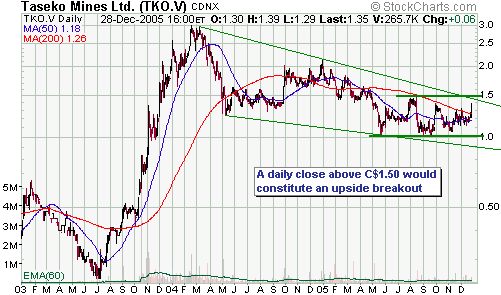
In our most recent write-ups of Taseko we've described the stock as a
'hold', but as a result of further consideration of the stock's
under-valuation and the way the price chart is developing we now
consider Taseko to be a buy as either a short-term trade (with an
appropriate protective stop) or a long-term investment.
Technically, the stock needs a daily close above C$1.50 to break it out
of the range in which it has traded over the past 8 months (see chart
below). A close above C$1.50 would also break a downward-sloping
trend-line that dates back to the early-2004 peak.
Northern Orion (TSX: NNO, AMEX: NTO) is another under-valued copper
producer, although using Ian Telfer (Goldcorp)-style accounting it
would be a gold producer with a negative cost of production. NNO owns a
12.5% stake in the very profitable Alumbrera copper/gold mine in
Argentina and a 100% stake in the huge Agua Rica copper/gold project
(Agua Rica is about 30km from Alumbrera). NNO's current market cap of
around US$650M is justified by its US$135M cash-on-hand and its cash
flow from Alumbrera, so buyers of the shares near the current price are
effectively getting exposure to Agua Rica for almost nothing.
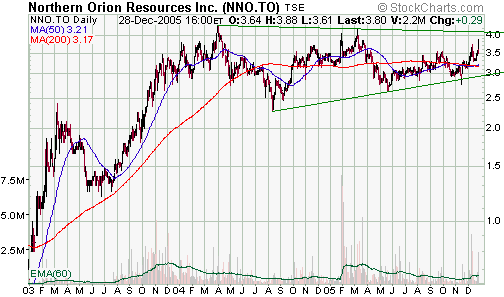
NNO's chart is similar to TKO's in that the stock peaked during the
first quarter of 2004 and has since been consolidating. As at the close
of trading on Wednesday it was about 9% below the top of its 2-year
range.
In our opinion, the two most likely intermediate-term outcomes for NNO are:
1. The stock peaks at around C$4.00, pulls back to the low-C$3.00 area
during the first half of 2006, and then embarks on a rally that breaks
it out of its consolidation range by the end of 2006.
2. The 2-year consolidation ends over the next few weeks and the stock
moves quickly up to around C$6.00 before beginning a multi-month
correction.
We have exposure to NNO in the TSI Stocks List via the Feb-2010
warrants (TSX: NNO.WT.A). At yesterday's closing price of C$0.65 the
warrants are significantly under-valued relative to the stock.
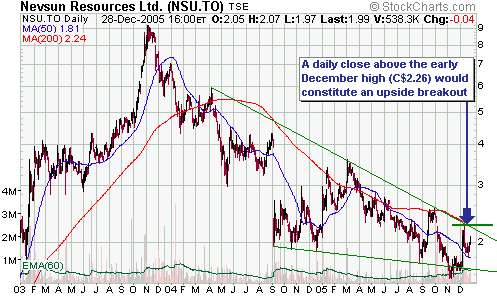
If there's a "January Effect" rally this year then a stock that stands
a good chance of participating is Nevsun Resources (TSX and AMEX: NSU).
There's considerable political risk associated with NSU's Bisha project
in Eritrea, but at its current stock price the company's market cap is
fully supported by its Tabakoto gold mine in Mali.
It would be reasonable for investors to accumulate NSU now, but traders
might want to wait for the stock to break its downtrend before
establishing a position.
Chart Sources
Charts appearing in today's commentary
are courtesy of:
http://stockcharts.com/index.html
http://www.futuresource.com/
http://www.decisionpoint.com/
http://bigcharts.marketwatch.com/
http://www.economagic.com/

|