|
- Interim Update 29th February 2012
Copyright
Reminder
The commentaries that appear at TSI
may not be distributed, in full or in part, without our written permission.
In particular, please note that the posting of extracts from TSI commentaries
at other web sites or providing links to TSI commentaries at other web
sites (for example, at discussion boards) without our written permission
is prohibited.
We reserve the right to immediately
terminate the subscription of any TSI subscriber who distributes the TSI
commentaries without our written permission.
Is the Fed a Failure?
"Is the Fed a Failure?" is the title of an article by Gene Epstein in the 27th February edition of Barrons magazine. The article draws on the work of economist George Selgin to argue that the answer to the question is yes, the Fed is a failure. Unfortunately, while this is the right answer the method used to come up with it is not persuasive.
According to Epstein: "It would be one thing to argue, based on some non-mainstream theory of the dynamics of money and credit, that a central bank is a bad idea. But Selgin forgoes such subtle arguments, preferring instead a simple before-and-after approach. He asks whether the economy, as measured by the central bank's own objectives, performed better after the Fed was created than it had before." Selgin apparently analysed pre-Fed and post-Fed data to show that even by its own yardsticks (price stability, employment, frequency and severity of recessions), the Fed had not been a success. Moreover, the Fed's lack of success is still evident if the Great Depression of the 1930s is excluded from the data comparison.
It is not the least bit surprising to us that the historical record doesn't justify the Fed's existence, but no definitive conclusions can be drawn unless the data are viewed through the lens of good economic theory. For example, in the absence of good theory Fed apologists could argue that although the historical record doesn't seem to validate the Fed, things would have been much worse without the Fed. The pro-Fed crowd could also argue that the concept of a central bank is good, it's just that the right people haven't always been in charge. It could even be argued that the Fed has been less effective than originally envisaged because it hasn't had enough power. In the absence of good theory, how could these arguments be refuted?
In other words, data showing that the Fed hasn't performed as advertised could just as easily be used to support giving the Fed more power as to support the abolition of the Fed. To make sense of the data you first need to know the right theory. The Fed doesn't work in practice BECAUSE it doesn't work in theory.
"Austrian" economic theory explains why the Fed hasn't achieved its publicised objectives*. This is obviously the "non-mainstream theory of the dynamics of money and credit" that Epstein is referring to in the above quote, since the Keynesians, the Monetarists, the Socialists, the Communists and the Fascists are all in favour of a central bank. A good economic theory will be consistent with the data, but it will often be possible to interpret the same data in different ways to fit multiple theories. That's why "Austrian" economists can point to the performance of the US economy over the past three years and say "see, we told you that the stimulus programs were a bad idea", and Paul Krugman in all seriousness can point to the same economic performance and say "see, I told you that the stimulus programs weren't big enough". Either the whole concept of government-funded economic stimulus is wrong or the stimulus didn't work as advertised because it was too small. You can't possibly determine which of these diametrically opposite points is correct unless you begin your analysis with the correct theory.
The futility of analysing the historical economic record without the aid of a good theory is highlighted by the second-last paragraph of the Epstein article. Here is the offending paragraph:
"There is also a good reason for believing that the Fed has done more harm than good: the much larger role of government and its counter-cyclical stabilizers post-World War II as compared with pre-1913. Due to that factor alone, mainstream economics itself dictates that the economy should have performed better in the more recent period. If instead it performed worse, what might be the cause? A chief destabilizing suspect: the Federal Reserve itself."
According to the above, IF we make the assumption that the government's expanded role and counter-cyclical stabilizers should have caused the economy to perform better during the more recent period, THEN the economy's deteriorating performance constitutes evidence that the Fed has made things worse. The only problem is, the assumption is completely illogical in that the expansion of government is the main reason for the long-term weakening of the economy.
It's absurd to argue that the Fed does damage by negating the good work of the government. The truth is that the Fed does damage by facilitating the government's growth, as it would be difficult for the government to grow and impossible for the government to grow rapidly if not for the Fed's ability to create an unlimited amount of money out of nothing.
The bottom line is that Epstein's article gets to the right place (the Fed is a failure) in the wrong way.
*We say publicised objectives rather than intended objectives, because we do not believe that the Fed was created by people with good
intentions. Interesting
and revealing quote
From the article at http://www.spiegel.de/international/europe/0,1518,817795,00.html#ref=rss:
"In an interview with SPIEGEL published on Monday, [Germany's Interior Minister Hans-Peter] Friedrich said: "Greece's chances to regenerate itself and become competitive are surely greater outside the monetary union than if it remains in the euro area." He added that he did not support a forced exit. "I'm not talking about throwing Greece out, but rather about creating incentives for an exit that they can't pass up." It was the first time a member of the German government called on Greece to leave the currency."
Translation: We aren't going to force the Greeks to leave the euro-zone, we are going to make them want to leave. For their own good.
The Stock Market
With most earnings reports out of the way it looks like the year-over-year (YOY) earnings growth rate for the S&P500 group of companies will be about 5.5% for the final quarter of last year. This is the slowest rate of earnings growth in more than two years. Furthermore, if the earnings reported by Apple and AIG are removed from the equation the YOY earnings growth rate drops to only 0.8%. Putting it another way, the S&P500 would have achieved almost no earnings growth in Q4-2011 if not for the contributions of Apple and AIG.
But the earnings picture gets worse, because:
1. As illustrated by the first of the following charts, the projected YOY S&P500 earnings growth for the first quarter of this year is now slightly below zero after being above 10% just five months ago. In fact, if we combine the messages of the first and second of the following charts we find that S&P500 earnings are now expected to be flat, on a year-over-year basis, during the first half of this year.
2. As illustrated by the third of the following charts, the projected earnings growth rate for all of 2012 has fallen from 14% five months ago to around 7.4% today. 7.4%/year earnings growth is still quite good, but if the current trend continues then a few months from now the earnings projected for 2012 will be a lot lower than today's projections. Moreover, implicit in the current forecasts of no earnings growth over the first half of the year and 7.4% earnings growth over the full year is a very strong second half. In our opinion, a very strong second half is a long-shot (we expect the second half to be weaker than the first).
(Note: The earnings growth information and charts are from Bianco Research).
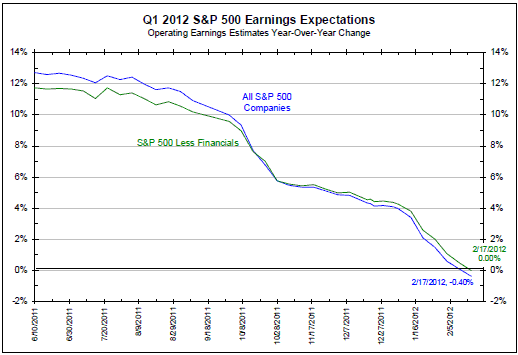
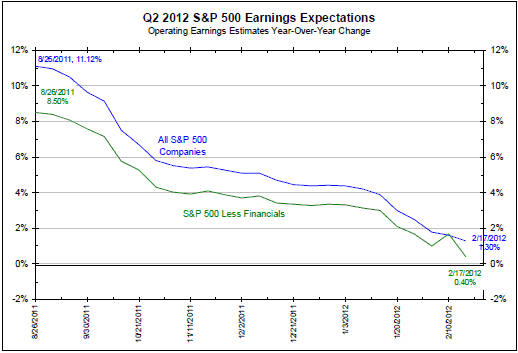
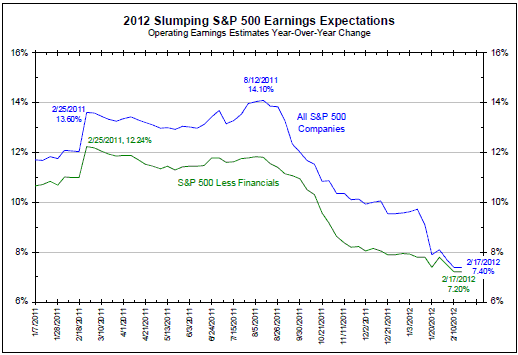
With earnings expectations having trended downward over the past few months, why has the stock market trended upward?
It is worth reiterating that there has historically been no correlation between earnings or the rate of earnings growth during a year and the stock market's performance during the same year. Still, it would be normal for a substantial reduction in the EXPECTED rate of earnings growth to put downward pressure on stock prices.
That the stock market has continued to rise in parallel with falling earnings expectations suggests to us that the market's earnings expectations were a lot lower than analysts' earnings expectations to begin with (the expectations referenced above are those of the average analyst, which aren't necessarily the same as those of the average market participant), and/or that the increasingly bullish monetary backdrop created by the ECB has more than offset the lowering of earnings forecasts. Whatever the explanation, we doubt that it will be possible for a downward trend in earnings expectations to coexist with an upward trend in equity prices for much longer. One of these trends will have to reverse. Our concern is that it will be the latter trend that does so.
Gold and the Dollar
Gold and Silver
The most popular explanation for Wednesday's plunges in gold and silver prices is that Bernanke dampened expectations for more QE. This explanation isn't totally implausible, but it doesn't ring true to us because a) the Fed's monetary policy is already extremely 'easy' and b) nobody in his/her right mind would have been anticipating more QE during the first half of this year. To provide the justification for more QE the US economy will have to get much weaker and/or the stock market will have to tank and/or the US banking system will have to get into a lot more financial difficulty. When one or more of these things happen there will be another round of QE, despite the overwhelming evidence that QE does more harm than good.
Here's a more likely explanation for Wednesday's action in the bullion markets:
Gold and silver had been bid up in anticipation of the ECB's 29th February LTRO, with many speculators planning to use a post-LTRO price surge to lock-in substantial short-term gains. Going into the LTRO announcement the gold and silver markets were 'overbought' (on a short-term basis) and close to important resistance ($1800 for gold and the intermediate-term channel top for silver). When the markets moved only slightly higher and then quickly reversed lower following the LTRO news, some short-term speculators decided to lock-in their gains at a lower price than originally planned. This selling drove the price lower and prompted selling by other speculators, which caused the price decline to accelerate. The accelerated price decline prompted more selling, and so on.
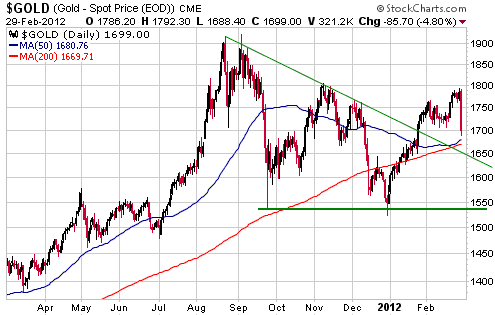
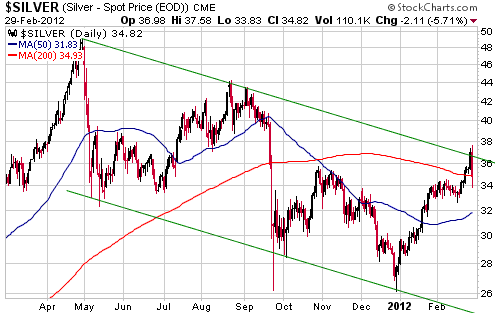
There's a good chance that multi-week tops have just been put in place for both gold and silver. If so, over the next few days we could either see follow-through to the downside or a partial retracing of Wednesday's decline. Each of these near-term outcomes is equally likely. A less likely, but still feasible, scenario is that gold and silver will retrace approximately 100% of Wednesday's declines before resuming their downward corrections.
Assuming that corrections have begun, it is reasonable to expect that gold and silver will fall at least as far as the $1650s and $32, respectively, before the corrections are complete.
We downgraded our short-term gold outlook from "bullish" to "neutral" in last week's Interim Update and are comfortable with that stance for now.
Gold Stocks
The HUI re-tested resistance in the 550s before reversing to the downside on Wednesday.
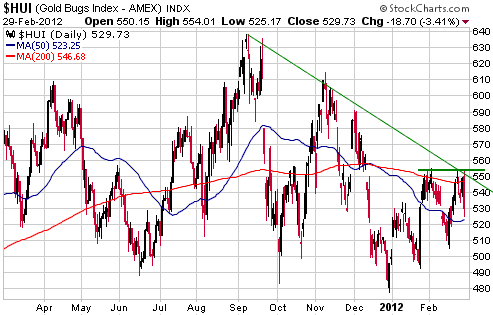
Prior to Wednesday's market action we thought that the HUI stood a good chance of moving up to around 600 during March, but a return to 600 isn't going to happen so soon IF the bullion markets have just commenced multi-week corrections. While it is certainly possible that we are attributing too much significance to a single day's trading, we get the impression that the gold sector's near-term prospects have worsened. Our guess is that a break above the 550s will still happen within the next two months, but not within the next month. Also, there is now a higher probability that support in the 480s will be re-visited before the next tradable rally begins. We have therefore downgraded our short-term HUI outlook from "bullish" to "neutral".
Currency Market Update
The ECB's latest injection of money into the European banking system (via "LTRO") was effected on Wednesday and amounted to 530B euros. This takes the cumulative LTRO total to around 1 trillion euros.
If stock and commodity markets had rallied strongly on this news then the euro would also have rallied, but it seems that a lot of the speculators who recently bought stocks and commodities in anticipation of a big LTRO number sold on Wednesday following confirmation that the number was, indeed, big (they bought the rumour and sold the news). The euro therefore pulled back.
Most markets that benefit from monetary inflation were 'overbought' and at resistance when the LTRO news hit the wires on Wednesday, so the failure to make additional upward progress in reaction to the news should not be a huge surprise. The euro, for example, was at the top of its intermediate-term channel at the start of trading on Wednesday, having been at its channel bottom just seven weeks earlier.
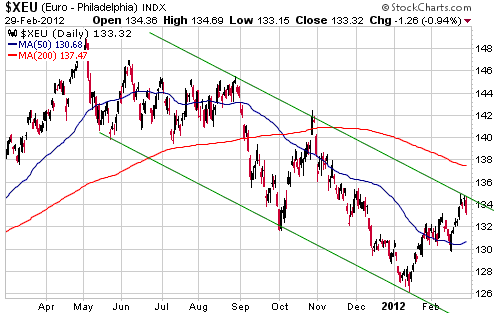
We suspect that the euro will do no worse than pull back to its 50-day moving average before resuming its rally.
Update
on Stock Selections
Notes: 1) To review the complete list of current TSI stock selections, logon at
http://www.speculative-investor.com/new/market_logon.asp
and then click on "Stock Selections" in the menu. When at the Stock
Selections page, click on a stock's symbol to bring-up an archive of
our comments on the stock in question. 2) The Small Stock Watch List is
located at http://www.speculative-investor.com/new/smallstockwatch.html
 Clifton Star Resources (TSXV: CFO). Shares: 36M issued, 40M fully diluted. Recent price: C$2.90 Clifton Star Resources (TSXV: CFO). Shares: 36M issued, 40M fully diluted. Recent price: C$2.90
CFO issued a press release on Tuesday 28th February that included revised resource estimates. The purpose of the press release and the associated revised estimates was to satisfy the regulators (the BCSC) and allow the stock to resume trading.
The revised estimates appear to be significantly lower than the earlier estimates, but that's only because the BCSC has forced CFO to be far more conservative than a junior mining company would normally be when reporting resources. For example, the earlier resource estimate for the Donchester portion of the project showed a total of 1.63M ounces using a 0.50-g/t cut-off, whereas the new estimate shows 1.05M ounces at a much higher 1.50-g/t cut-off. If the new estimate had used the same cut-off as the earlier estimate, the new resource estimate would have been considerably HIGHER than the earlier one.
Although the stock has been prevented from trading over the past 7 months, the company has continued its work on the ground (drilling, metallurgical testing, engineering). There are a lot of drilling results and some metallurgical test results to be announced. Additionally, another resource update is scheduled to be complete in April. The April resource update is being done by InnovExplo and will be a comprehensive NI 43-101 technical report covering all portions of the Duparquet project.
Nothing has been confirmed, but it's possible that CFO will resume trading within the next few days. When trading does resume it's a good bet that there will be a flurry of selling from disgruntled shareholders who have lost patience. It's also a good bet that there will be buying from value-oriented investors. The value-oriented investors will probably hang back initially, meaning that the stock's initial reaction upon the resumption of trading will be to decline sharply.
If you already have significant exposure to CFO then we suggest that you wait for the 'dust to settle' before deciding whether or not to add to your position, but if you currently don't have any exposure it could make sense -- provided that you can tolerate risk and volatility -- to do some buying if the stock drops to C$2.00 or lower.
We expect that CFO will do very well from whatever low it makes during the first two days following the resumption of trading.
Batero Gold (TSXV: BAT). Shares: 53M issued, 67M fully diluted. Recent price: C$1.33
In the email
sent after Tuesday's trading session we promoted BAT from the Small Stocks Watch List to the TSI Stocks List. As explained in the email, the market's over-reaction to a lower-than-expected initial resource estimate creates huge upside potential and limits the future downside risk. Also, the stock is now more liquid.
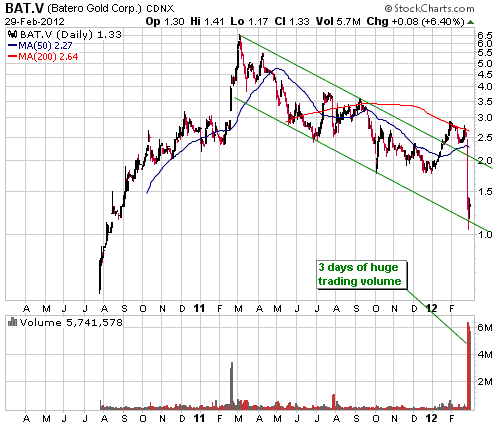
Two additional comments on BAT's disappointing resource estimate:
1. The company did itself a disservice by using an unrealistically low cut-off grade in an effort to increase the size of the headline resource. Analysts are now assuming a 6.1M-ounce resource with a very low average grade of 0.39-g/t, but what we really have is a 4.5M-ounce resource at a decent average grade of 0.53-g/t. By doing what they did Batero's managers made the resource look bigger, but they also made it look less economically viable.
2. The resource estimate reported earlier this week was the INITIAL resource following only one year of exploration. Very few companies have a 4.5M-ounce NI-43-101 resource after only the first 12 months of drilling.
Gold Explorers ETF (NYSE: GLDX). Recent price: US$11.51
Wednesday's downward reversals have prompted us to remove the short-term GLDX trading position from the TSI Stocks List. The profit on this trade was a disappointing 10.4%.
Chart Sources
Charts appearing in today's commentary
are courtesy of:
http://stockcharts.com/index.html

|









