- Interim Update 29th April 2020
Copyright
Reminder
The commentaries that appear at TSI
may not be distributed, in full or in part, without our written permission.
In particular, please note that the posting of extracts from TSI commentaries
at other web sites or providing links to TSI commentaries at other web
sites (for example, at discussion boards) without our written permission
is prohibited.
We reserve the right to immediately
terminate the subscription of any TSI subscriber who distributes the TSI
commentaries without our written permission.
For now, FOMC meetings
are irrelevant
The Fed has never been more
interventionist. At the same time, FOMC meetings have rarely been less
important.
There was an FOMC meeting over the past two days.
Considering the breathtaking scale of the Fed's recent efforts to prop up
prices and 'paper over' credit problems, you could be forgiven for
thinking that the meeting was important. However, the Fed's regular
meeting schedule is now irrelevant because the central bank is introducing
new schemes or expanding existing schemes on a weekly basis. For example,
two days prior to this week's FOMC meeting the Fed expanded its Municipal
Liquidity Facility (MLF) to enable it to purchase the debt of smaller
municipalities.
For the moment, the Fed is acting as/when it sees
fit and most economists/analysts/commentators are cheering it on. Much
later, many of these same economists/analysts/commentators will complain
that the Fed did too much, as if there is some right amount of price
manipulation that helps the economy.
Industrial
Commodities
Uranium Update
We explained in the 20th April Weekly Update that uranium is the one
industrial commodity for which the supply-demand equation immediately
became more price-bullish in response to the virus-related panic. The
reason is that uranium supply was reduced while the demand side of the
equation wasn't affected to a significant degree. The result, to date, of
the uranium market's improving fundamentals has been a bounce in the
uranium price from around US$24/pound to around US$32/pound. As mentioned
a couple of weeks ago, we suspect that this bounce could be the start of a
cyclical (1-3 year) bull market.
Due to the increasingly bullish
supply-demand situation for physical uranium and the recovery in the broad
stock market, the uranium mining sector enjoyed a strong rebound over the
past six weeks. As is the case with the associated commodity, there's a
good chance that this equity sector has commenced a cyclical advance. We
therefore want to add more uranium mining exposure to the TSI Stocks List
(the current TSI exposure to uranium is via the Uranium Participation Fund
(U.TO) and a Cameco call option expiring in January-2021), but we would
prefer to wait for a significant sector-wide pullback before doing so.
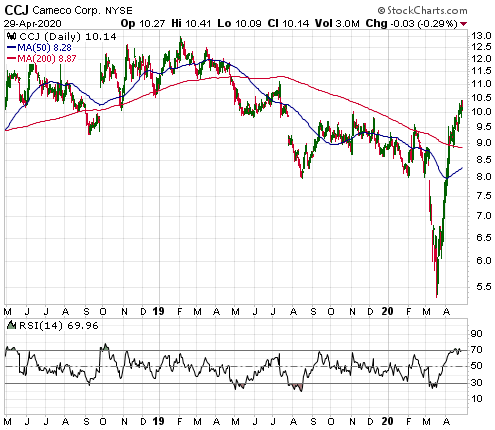
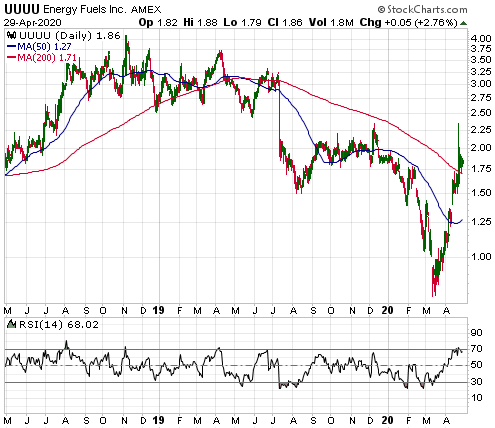
In general, once a bull market kicks off the first pullback to the
50-day MA is a reasonable place for new buying. For Cameco (CCJ) and
Energy Fuels (UUUU), daily charts of which are shown below, that currently
would involve pullbacks to around US$8.30 and US$1.30, respectively.
By the way, the market price of the Uranium Participation Fund (U.TO)
relative to its net asset value (NAV) is a reasonable indicator of
uranium-sector sentiment. This fund tends to trade at a sizable premium to
NAV when the public is bullish on uranium and at a sizable discount to NAV
when the public is not interested in uranium. We estimate that U's current
NAV is about C$5.75/share, so at its closing price of C$4.91 on 29th April
the fund was trading at a discount to NAV of around 15%. This suggests
that despite the 30% gain in the uranium price and the 100%+ gains in the
stock prices of uranium miners over the past several weeks, the public
remains uninterested in the investment potential of uranium. The general
perception must be that this is just another in a long line of bear-market
rebounds. Given that the public's sentiment is a contrary indicator, this
adds to the bull case.
Platinum Update
In
the 23rd March Weekly Update, we wrote: "...for all intents and
purposes the platinum market has bottomed for the year." At that time
the price was US$622/oz and a few days earlier the metal had traded as low
as US$562/oz (the lowest price since 2002). It was obvious at the time
that platinum demand was going to be substantially reduced due to the
lockdowns and the resulting global recession, but it was just as obvious
that the price crash had more than fully discounted the reduction in
demand. Therefore, at that point the price was set to rebound almost
regardless of new 'fundamental' developments.
The South African
government then announced a 21-day lock-down of the economy, encompassing
the closure of all mines, from midnight on 26th March. Since South Africa
(SA) accounts for about 75% of the world's newly-mined platinum, this
represented a very significant supply disruption.
The significant
supply disruption could have become a major supply shock if the closure of
South Africa's mines had been extended well beyond the initial 3-week
period. As it turned out, there was only a partial 2-week extension.
South Africa's mines are permitted to become fully operational from
1st May. This suggests that the platinum supply reduction will end up
being significant, but not major. That being said, it's likely that
additional safety measures put in place at the mine sites to limit the
spread of COVID-19 will reduce productivity, so we doubt that "fully
operational" means returning to near the pre-lockdown production rate.
Based on what has happened in South Africa we can make educated
guesses regarding platinum mine supply and total supply in 2020, but the
demand side of the equation is a big unknown. Therefore, when trying to
figure out platinum's risk/reward and likely price path we'll focus on the
chart pattern, inter-market relationships and sentiment. Immediately after
the price crash each of these factors was supportive.
Sentiment is
even more supportive now, because small speculators have become
increasingly pessimistic over the past few weeks. Inter-market
relationships (the short-term positive correlation with the stock market,
in particular) suggest that it is time for caution, while the chart
pattern (discussed below) is neutral.
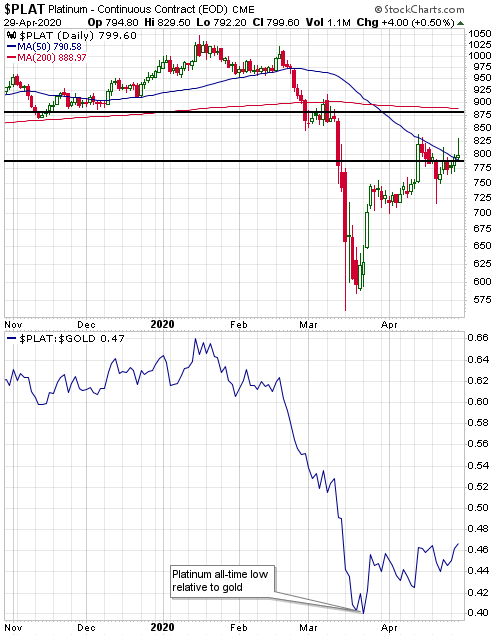
The following daily chart
shows that the post-crash rebound has been capped, to date, by the 50-day
MA. The price closed above its 50-day MA on Wednesday 29th April, but not
by enough to indicate a breakout. If it can get through the 50-day MA then
the next objective would be lateral resistance and the 200-day MA in the
$870s.
We suggest taking profits or tightening stops on platinum
speculations if the price moves up to around US$870 within the next four
weeks. This is because unless there's another widespread mine shut-down in
South Africa, at that point the short-term risk/reward would be bearish.
The Stock Market
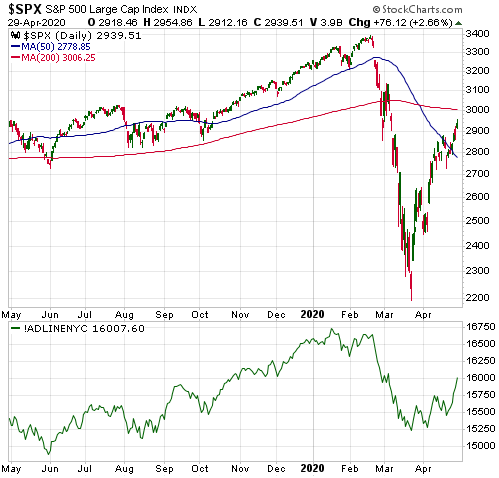
Prior to this week the SPX had
made a couple of failed attempts to break above its 50-day MA. The upper
section of the following chart shows that this week's attempt was
successful, while the lower section of the same chart shows that this
week's move to a new post-crash high was confirmed, in decisive fashion,
by the NYSE Advance-Decline Line (ADL). This week's new post-crash high
for the ADL removed a minor bearish divergence that had developed over the
preceding two weeks.
The market's strength over the first three days of this week was
broad-based, that is, the strength wasn't due primarily to the gains of a
small number of mega-cap stocks. This is evidenced by the sharp rise in
the ADL mentioned above and is also evidenced by the performance of the
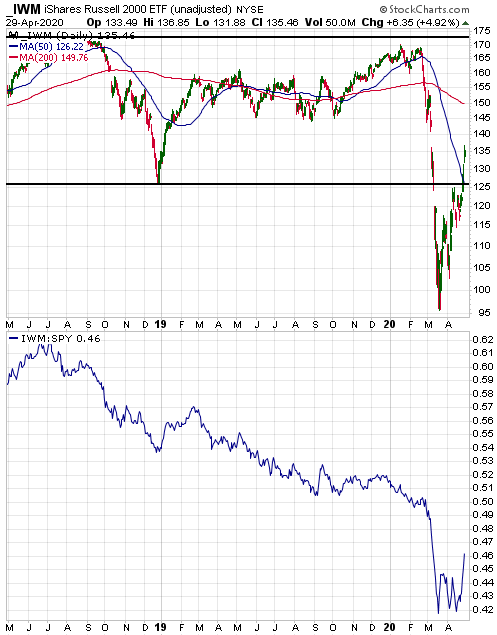
Russell2000 Small Cap ETF (IWM). As illustrated below, over the past three
days the IWM made a clear-cut break above resistance and the IWM/SPY ratio
made a new post-crash high.
This week's solid break by the SPX above its 50-day MA has simplified
things. It doesn't provide any clues regarding what the future holds in
store, but it does mean that a break below the 50-day MA now can be used
as confirmation that a short-term top is in place.
We shouldn't get
excited about the market's short-term downside potential until the 50-day
MA has been breached, but it's important to keep in mind that the overall
fundamental backdrop is still decidedly bearish and therefore that the
market is a long way from being 'out of the woods'. Consequently, don't
get lulled by the rising prices into thinking that risk has substantially
diminished. It has in the very short-term (the probability is low that
there will be anything more than a normal correction over the next few
weeks), but within the next six months the market will have to come to
terms with the reality that the economy will be very weak for years to
come due to the actions taken by governments and central banks during
H1-2020.
Gold and the Dollar
Gold
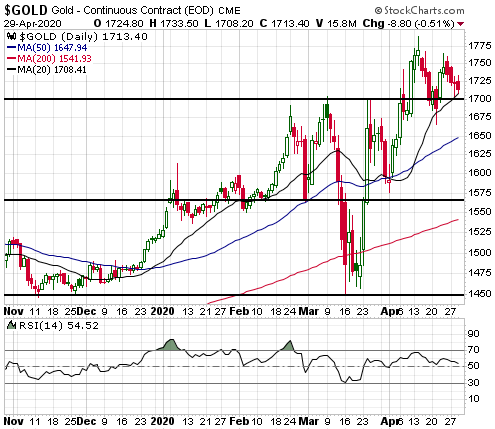
Over the past 8 months the US$ gold price has moved up/down in roughly
$125 increments. It went from around $1575 (Sep-19) to $1450 (Nov-19) to
$1575 (Jan-20) to $1700 (Feb-20) to $1575 (Mar-20) to $1450 (Mar-20). It
then went quickly from $1450 to $1575 to $1700. This was followed by a
pullback to $1575 and then a surge to/through $1700. This pattern suggests
that if gold can hold support at $1690, then the next top will be around
$1825.
The fundamental backdrop remains unequivocally gold-bullish (as per
our quantitative model, not a gut feel), which should be the main
consideration for long-term traders. However, the sentiment-related
short-term downside risk is high as we enter a period of the year when
gold-market turning points have occurred regularly in the past, albeit not
so regularly over the past five years. Specifically, there were
significant May-June turning points in the gold market almost every year
from 2001 through to 2014. This particular annual cyclicality then didn't
apply for a few years, but there was an important turn from down to up in
May of last year. Perhaps, therefore, the cyclicality that applied during
the last major bullish trend has returned.
Silver
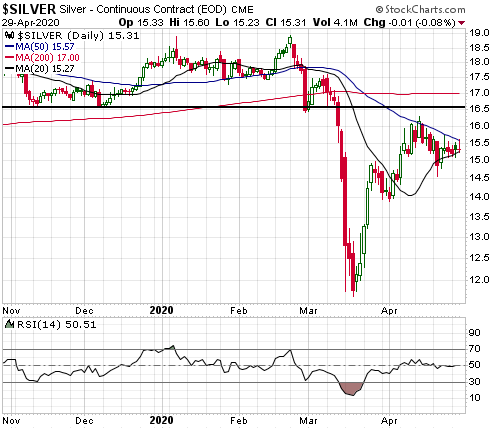
The US$ silver price is 'coiling' in preparation for a quick move up
to $16.50-$17.00 or down to $13.50-$14.00. We don't know which, although
if forced to make a choice we would select the former possibility.
Even if the silver price surges to US$16.50-$17.00 within the next
three weeks, there probably will be an opportunity to buy silver at $14.00
or lower within the next three months.
Gold Stocks
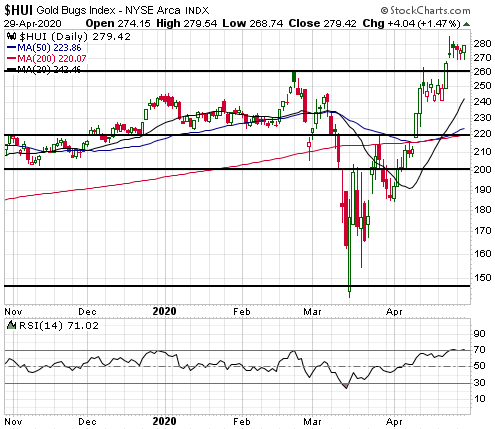
On a short-term basis the gold
mining sector, as represented on the following chart by the HUI, is
stretched to the upside in nominal price terms and relative to gold. This
suggests that the risk of a downward reversal is high. However, since
spiking up to its 2016 high (286) on Thursday 23rd April, the HUI has
drifted sideways. This means that a short-term trend reversal from up to
down has not been signalled, and, by extension, that a surge to a new
multi-year high could precede a reversal.
A daily close below 260
would be an early warning that a downward trend reversal was in the works.
A daily close below 240 would confirm the reversal.
As is the case with gold bullion, long-term traders (a.k.a. investors)
should maintain focus on the fact that the fundamental backdrop is
unequivocally bullish for the business of gold mining. The bullish
gold-mining fundamentals will be clear to many well-heeled speculators and
investors, so the gold sector shouldn't suffer another major decline
anytime soon even if the broad stock market tanks anew. However,
significant corrections happen in the face of bullish fundamentals after
the price becomes stretched to the upside and speculator sentiment becomes
overtly optimistic.
The gold mining indices/ETFs could surge to
new multi-year highs within the coming week or two, but the short-term
risk will be high until there is a significant correction.
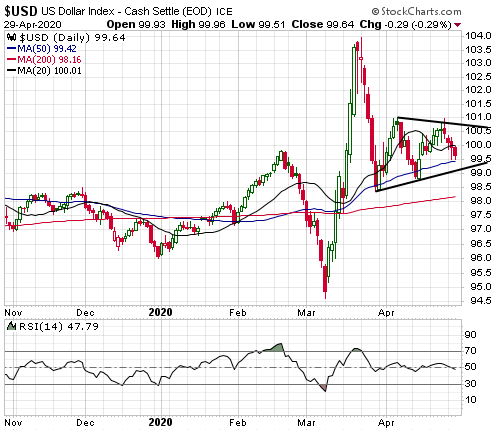
The Currency Market
The Dollar Index (DX) experienced some
wild swings during March, but volatility has been on the decline since the
start of April and its trading range has been steadily narrowing. As
illustrated below, the narrowing range has formed a triangle.
The
triangle is a neutral pattern, in that an upside breakout from this
pattern is as likely as a downside breakout. An upside breakout would be
signalled by a daily close above 101 and a downside breakout would be
signalled by a daily close below 98.7.
A downside breakout would
suggest a near-term target of 96 and an upside breakout would point to a
coming test of the March high (104).
Updates on Stock Selections
Notes: 1) To review the complete list of current TSI stock selections, logon at
http://www.speculative-investor.com/new/market_logon.asp
and then click on "Stock Selections" in the menu. When at the Stock
Selections page, click on a stock's symbol to bring-up an archive of
our comments on the stock in question. 2) The Small Stock Watch List is
located at http://www.speculative-investor.com/new/smallstockwatch.html
Chart Sources
Charts appearing in today's commentary
are courtesy of:
https://stockcharts.com/