|
- Interim Update 29th May 2013
Copyright
Reminder
The commentaries that appear at TSI
may not be distributed, in full or in part, without our written permission.
In particular, please note that the posting of extracts from TSI commentaries
at other web sites or providing links to TSI commentaries at other web
sites (for example, at discussion boards) without our written permission
is prohibited.
We reserve the right to immediately
terminate the subscription of any TSI subscriber who distributes the TSI
commentaries without our written permission.
Explaining the gold bull market
One of the simplest and best ways to ascertain gold's long-term
trend is to look at its performance relative to commodities in
general. This is because a genuine gold bull market will result in
gold making higher highs and higher lows relative to most other
commodities. Alternatively, if gold is trending higher in nominal
currency terms but not against most other commodities, then what we
have is a general inflation-fueled commodity bull market (all
long-term commodity bull markets are fueled by monetary inflation)
with gold going along for the ride. In this latter case, the rise in
the gold price is nothing more than an offset to the loss in
purchasing power of the currency. So, let's review gold's
performance against the Continuous Commodity Index (CCI).
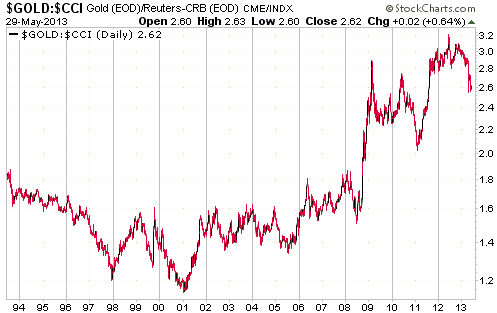
The following chart of the gold/CCI ratio makes it clear that a
long-term gold bull market commenced at the beginning of 2001. The
chart also makes it clear that gold's long-term bull market has
contained substantial intermediate-term swings as well as multi-year
periods of 'choppy' sideways movement. In other words, despite the
impression created by long-term charts of the US$ gold price, gold's
progress since its early-2001 major bottom has been anything but
steady.
While short-term fluctuations are often random, the major turning
points and swings in the gold/CCI ratio are intimately related to
important happenings on the monetary, economic and financial-market
fronts. Of particular note:
1) Gold's long-term (secular) bull market began several months after
the secular bull market in US equities ended. This was not a fluke.
Secular gold bull markets invariably coincide with secular equity
bear markets, where a secular equity bear market is defined as a 1-2
decade period during which equity valuations (not necessarily equity
prices) trend downward. A consequence is that gold's secular bull
market will almost certainly continue until shortly before or
shortly after equity valuations reach their nadir. It's reasonable
to expect that this point lies at least a few years into the future,
because valuations are now high and at no time over the past 10
years has the average equity valuation come remotely close to the
level at which previous secular bear markets ended.
2) There was a strong 18-month rise in gold/CCI from the beginning
of 2001 through to mid-2002. Not coincidentally, this period was the
main part of the economic and financial-market bust that inevitably
followed the inflation-fueled boom of the 1990s.
3) Another financial-market and economic boom got underway in 2003
and persisted, in fits and starts, until the first half of 2008.
During this 5-year period the gold price trended higher in US$
terms, but relative to most other commodities gold did no more than
hold its own. Hold its own is the best that gold can reasonably be
expected to do during the boom phase of the boom-bust cycle.
4) The 2003-2007 boom was fueled by aggressive 'monetary
accommodation' designed to mitigate the fallout from the 1990s boom.
Inevitably, it led to another bust. In fact, it led to an economic
and financial-market bust that dwarfed the 2000-2002 episode. Just
as inevitably, it led to a much stronger advance in the gold/CCI
ratio and an even more aggressive series of monetary measures
designed to mitigate the fallout from the artificial boom fomented
by earlier monetary measures.
5) The global financial crisis came to an end during February-March
of 2009, naturally resulting in an important peak for the gold/CCI
ratio at that time.
6) Gold/CCI then corrected for about two years while the financial
world breathed a collective sigh of relief and while rising stock
markets created the false impression that the 'monetary
accommodation' put in place to mitigate the latest bust would set
the stage for a genuine self-sustaining recovery.
7) In 2011, doubt about the economic recovery began to emerge and
the gold/CCI ratio resumed its bull market. In this case, the main
source of the doubt was the euro-zone. The markets began to discount
the possibility of government debt default and large-scale banking
failure within the euro-zone.
8) Fears of euro-zone government debt default and banking collapse
peaked in mid-2012, and so, understandably, did the gold/CCI ratio.
9) The financial world is now well into another period during which
rising stock markets create the false impression that 'monetary
accommodation' is setting the stage for a self-sustaining recovery.
We can be sure that the impression is false because the monetary
accommodation is the cause of the price distortions that in turn
cause the boom/bust cycle (the bust is nothing more than an attempt
to correct the distortions that arise during the boom). The more
aggressive the monetary accommodation put in pace to mitigate the
economic pain stemming from one bust, the bigger the next bust and
the next rise in the gold/CCI ratio are bound to be.
The current careening from bust to boom to greater bust will only
end after there is widespread understanding that it makes no sense
to suppress interest rates and create a lot of money out of nothing
in an effort to fix problems caused by suppressing interest rates
and creating a lot of money out of nothing. We seem to be a long way
from that point, which all but guarantees that we are a long way
from the end of gold's bull market.
The Stock Market
During the first half of 2007 there was a near-vertical rise in
the Dow Utility Average (UTIL). The index rose on 10 of the 11 weeks and 16 of
the 18 weeks leading up to the peak of around 540 in early-May of that fateful
year. The early-May peak was followed by a substantial 3-month correction, a
multi-month advance to a marginal new all-time high, and then a cyclical bear
market.
During the first half of 2013 there was a near-vertical rise in the Dow Utility
Average (UTIL). The index rose on 10 weeks in a row and 13 of the 15 weeks
leading up to the peak of around 540 in late-April of what could turn out to be
a fateful year. The late-April peak has, to date, been followed by an 11%
correction back to the 40-week moving average (the blue line on the weekly chart
displayed below).
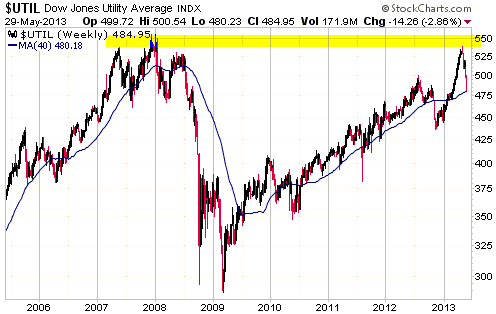
It is extremely unlikely that 2013 will turn out to be an exact replica of 2007.
However, the general 2007 pattern continues to be a realistic scenario for 2013.
The general 2007 pattern entails almost all of the gains for the year being in
place by June and the market gradually rolling over into a cyclical bear market
during the second half of the year.
Gold and the Dollar
Gold
One of the biggest short-term risks
Over the past several years there hasn't been a meaningful correlation between
the gold price and the amount of gold bullion held by the SPDR Gold Trust (GLD).
Furthermore, there's no good reason why there should be a meaningful
correlation, because the amount of gold held by GLD is not determined by the
change in the gold price; it is determined by the difference between GLD's
market price and its net asset value (NAV). In particular, GLD's bullion stash
gets boosted if the price of GLD rises by more or falls by less than the spot
gold price, and GLD's bullion stash gets reduced if the price of GLD rises by
less or falls by more than the spot gold price. That being said, the following
chart comparison shows that the amount of gold bullion held by GLD has fallen
sharply along with the gold price over the past three months. In other words,
over the past three months there has been a strong positive correlation between
the gold price and the amount of gold bullion held by GLD.

There is no way of knowing for sure if the recent decline in GLD's bullion stash
is a cause or an effect of the decline in the gold price. We suspect that it is
both, in that the owners of GLD shares are, as a group, apt to be relatively
quick to exit in reaction to signs of weakness in the gold market. It's likely
that they sold enough in reaction to the modest weakness in the gold price
during February-March to push the GLD price downward relative to the spot gold
price, causing GLD to cough-up some of its bullion, and then panicked after gold
broke below support at $1525-$1550, causing GLD to cough-up more of its bullion.
The total amount of physical gold dumped onto the market due to the aggressive
selling of GLD shares amounts to about 10.5M ounces since the beginning of the
year and 9.5M ounces since 19th February. Although this is not a substantial
quantity in the context of the overall gold market, it would certainly have
exacerbated the decline in the gold price. That's why we say that the reduction
in GLD's holdings was likely both a cause and an effect of the price weakness.
All of which brings us to the short-term risk that we want to highlight. If we
are to believe what he has said in the press, hedge-fund manager John Paulson
still controls 22M GLD shares (current market value: about US$3B). This is about
6.5% of the total number of GLD shares currently on issue. Paulson is a weak
hand, in that if his performance continues to flag he could be forced to sell
assets to meet redemptions from his fund.
The risk, then, is that Paulson's hedge fund could become a forced seller of GLD
shares at some point over the next few months, leading to more of GLD's physical
gold being dumped onto the market and possibly transforming a normal pullback in
the gold price into something more serious. A development such as this wouldn't
affect gold's long-term trend because it wouldn't change any of the important
long-term drivers of gold's real price, but it could lead to a better short-term
buying opportunity than would otherwise occur.
Current Market Situation
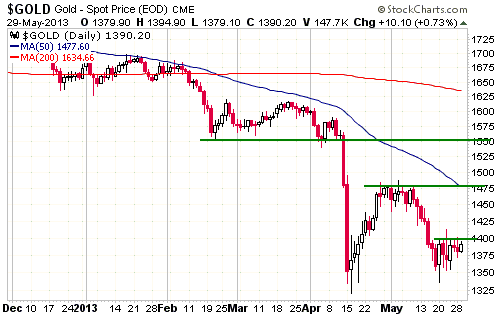
The US$ gold price has tested short-term resistance at $1400 on each of the past
seven trading days. A break above this resistance, a likely occurrence within
the next few days, will probably be followed by a rise to test the more
important resistance in the $1470s.
The price action continues to evolve as if the May low was a successful test of
the April low.
Gold Stocks
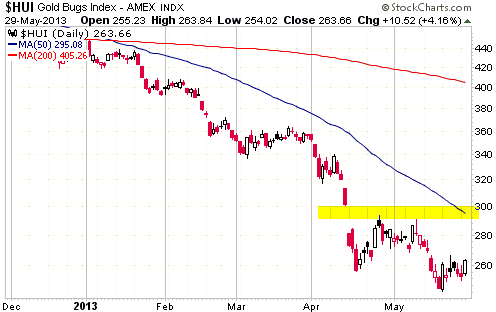
The HUI showed a modicum of strength on Wednesday 29th May, but it is still a
long way from confirming a trend reversal. Confirmation of a trend reversal will
sometimes happen immediately after a top or a bottom, but it's more common for
the confirmation to arrive well after the price extreme. In the HUI's case, it
would take consecutive daily closes above 300.
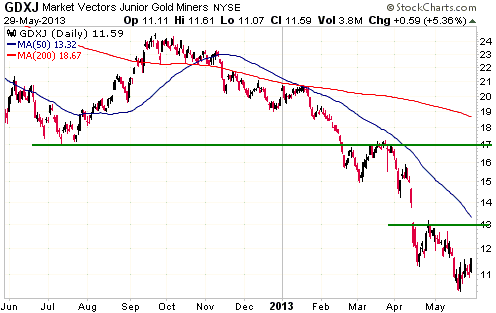
For GDXJ, a proxy for the junior end of the gold-mining sector, confirmation of
a trend reversal would come via consecutive daily closes above $13.00.
By the way, confirmation of a trend reversal from down to up will often not be a
buy signal. It all depends on how extended the price is to the upside when the
confirmation arrives. For example, a rapid rise to well above 300 over the next
few days would confirm a trend reversal and at the same time set the stage for a
pullback. Alternatively, if a break above 300 were preceded by a couple of weeks
of choppy price action in the 280-300 range then the upside breakout would
probably be 'buyable'.
Currency Market Update
During the six years prior to February of this year, intermediate-term rallies
in the US$ were driven by stock market weakness and/or euro-zone debt/banking
crisis, while periods of stock market strength and euro-zone stability were
accompanied by US$ weakness. However, since February of this year the Dollar
Index has been positively correlated with financial-system confidence, in that
it has rallied in parallel with stock market strength and dwindling worries
about heavily-indebted euro-zone governments and banks. Does this mean that
there has been a major change in the relationship between the currency market
and other markets?
At this stage we don't think so. Our view continues to be that a meaningful
(5-10 point) advance in the Dollar Index beyond last year's high (84) will
require a general flight to safety, which will likely be prompted by either a
gut-wrenching stock market decline or a panic away from the euro.
That being said, as far as the next few weeks are concerned the correlation of
the past 3.5 months will probably persist. One reason is that both the stock
market and the US$ are very 'overbought' and acutely vulnerable to downward
corrections.

Update
on Stock Selections
Notes: 1) To review the complete list of current TSI stock selections, logon at
http://www.speculative-investor.com/new/market_logon.asp
and then click on "Stock Selections" in the menu. When at the Stock
Selections page, click on a stock's symbol to bring-up an archive of
our comments on the stock in question. 2) The Small Stock Watch List is
located at http://www.speculative-investor.com/new/smallstockwatch.html
Chart Sources
Charts appearing in today's commentary
are courtesy of:
http://stockcharts.com/index.html

|









