|
- Interim Update 29th June 2010
Copyright
Reminder
The commentaries that appear at TSI
may not be distributed, in full or in part, without our written permission.
In particular, please note that the posting of extracts from TSI commentaries
at other web sites or providing links to TSI commentaries at other web
sites (for example, at discussion boards) without our written permission
is prohibited.
We reserve the right to immediately
terminate the subscription of any TSI subscriber who distributes the TSI
commentaries without our written permission.
Temporary change to TSI format
Due
to our travel schedule we will be unable to post the usual TSI reports
over the next two weeks. That's also why this week's Interim Update is
being posted a day earlier than usual.
The last time we were away from the office for an extended period we
kept subscribers updated regarding our thoughts on the financial
markets by posting comments in a "blog" format. This seemed to work
well, so we'll do the same this time round.
Over the next two weeks we will post regular market updates at http://www.speculative-investor.com/new/weekly120710.asp.
New comments will probably be added to this page every 2-3 days,
although the actual frequency of updates will depend on market action
and whether we have anything meaningful to say. We will notify
subscribers by email whenever new comments are posted.
The next regular commentary will be the Interim Update on Thursday 15th July.
Thoughts on the oil spill disaster
Unless
you have been asleep for the past two months you will be very aware of
the oil spill disaster in the Gulf of Mexico (GOM). The spill stems
from a sea floor oil gusher caused by the 20th April explosion of the
Deepwater Horizon drilling rig operated by British Petroleum (BP). The
gusher has already pumped tens of millions of gallons of crude oil into
the ocean and is now estimated to be flowing at 60,000 barrels per day,
although the exact flow rate is uncertain due to the difficulty of
installing measurement devices at that depth (about one mile below the
surface).
This oil spill appears to be an environmental problem of epic
proportions, but the most worrying aspect at this time is that the
extent of the problem is still open-ended. BP is attempting to stop the
flow by drilling relief wells into the original well, but it will be at
least mid August before it is known whether this approach has worked.
The BEST case, then, is that 60,000-100,000 barrels per day will gush
into the GOM for another six weeks. But what if the relief wells don't
work? According to Matt Simmons,
it is unlikely that the relief wells will work. He believes that
stopping the flow won't be possible short of detonating a nuclear bomb
to fuse the rock under the seabed.
Aside from the disastrous environmental consequences of the oil spill,
there will be major adverse economic consequences. Keynesian economists
generally view all spending as supportive of economic growth, even when
the spending is unproductive. For example, according to the playbook
used by Paul Krugman and other disciples of JM Keynes you could solve
the unemployment problem by paying half the unemployed to dig holes and
the other half to fill them in. Therefore, if the oil spill wasn't a
catastrophe for the environment we would probably now have the
Keynesians out in force talking about what a boon it was likely to
become for the US economy due to all the spending required to clean up
the mess. Good economists, however, will understand that a huge amount
of wealth (resources and savings) -- wealth that in the absence of the
spill could have been used to generate real economic progress -- will
be consumed in an effort to get things back to the way they were,
meaning that the "spill" will necessarily deplete an already-weak US
economy. We will see resources at work in the great GOM cleanup, but we
won't see how these resources would have been utilised in the absence
of the "spill".
Another economic consequence of this disaster will by the curtailment
of offshore drilling in US waters, although we doubt that this will
have a significant impact on global oil supply.
There will also be political consequences. For one, when a government
department fails in a big way, as was the case with the SEC in the
Madoff and Enron scams and is now the case with the Minerals Management
Service (MMS) in its supervision of offshore drilling, the department
is typically assigned more authority and more resources. In other
words, whereas a private company will generally be punished for poor
performance (unless it happens to be a large bank), government agencies
tend to get rewarded for it. We should therefore expect the MMS to
become a lot more powerful. For another, the current US administration
believes that no crisis should go to waste, meaning that every crisis
should be viewed as an opportunity to advance the overarching political
agenda. It is clear that 'the agenda' is to increase the government's
control over the economy and the general dependency on government.
Handicapping a "double dip"
We had a good laugh
earlier this week. First we read the "Economic Beat" section of the
latest Barrons Magazine, in which Gene Epstein quotes research from
Credit Suisse that puts the six-month probability of a "double dip"
recession at approximately zero. Then we turned to John Hussman's latest Weekly Comment, which begins with: "Based
on evidence that has always and only been observed during or
immediately prior to U.S. recessions, the U.S. economy appears headed
into a second leg of an unusually challenging downturn." In
other words, according to one set of evidence the probability of a
"double dip" is almost zero, but according to another set of evidence
the probability is close to 100%. Today's economic situation certainly
has something for everyone.
From our perspective, the question as to whether or not the US economy
will experience a "double dip" is irrelevant. Our take is that the US
economy never exited the recession that it entered during the second
half of 2007. Sure, the government was able to report some reasonable
GDP growth numbers during the second half of 2009 and the first quarter
of this year, but this reported 'growth' does not appear to have
coincided with real progress. Rather, it appears to be mostly a quirk
of the way in which GDP numbers are calculated. Due to the GDP
calculation methodology, if the government borrows and spends a huge
amount of new money into existence then it will usually be able to
report a positive GDP growth number, even if wealth is being destroyed
at a rapid rate.
As far as the official statistics are concerned, our guess is that the
recession that began in late-2007 will be declared to have ended in
mid-2009 and the next recession (the second "dip") will eventually be
declared to have begun between June and August of this year.
T-Bond Update
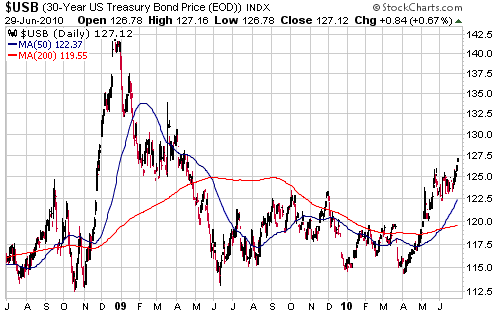
If the bond market's
"June cycle" is going to work this year then the T-Bond should now be
at, or very close to, an intermediate-term peak. Therefore, if we were
focused on cycles and nothing else we would now be building up a
bearish position in Treasury Bonds. However, rather than defer to
cycles we consider them to be just one piece of a large puzzle.
When a market trends strongly into a well-defined turning-point window
it is sometimes a good idea to lean the other way (to bet on a
reversal), but only if other factors also point to a trend change. In
the T-Bond there is now the possibility of another in a long line of
June turning points (a turn from up to down, in this case), but other
factors do not support leaning against the current short-term up-trend.
These other factors include the likelihood of additional weakness in
the stock market and the possible expansion of Europe's government debt
crisis. Also worthy of consideration is the realistic possibility that
the Fed, in yet another illogical attempt to boost the economy, will
begin to target long-term interest rates in the way that it targets the
overnight interest rate.
The Stock Market
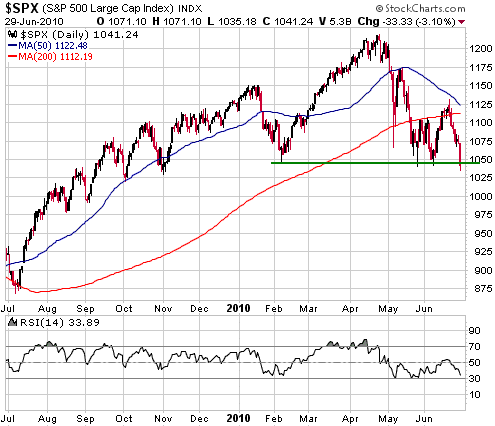
The
following chart shows that the S&P500 Index made a new low for the
year on Tuesday 29th June. The break below support defined by the
February and May lows is marginal at this stage, but it has left little
doubt that the S&P500's spike up to near its 50-day moving average
on Monday 21st June created the rebound peak. In other words, the next
leg of the intermediate-term decline is underway.
Our view has been that the short-term risk/reward became skewed towards
risk as of 16th June, but we thought there would be more consolidation
prior to a breakdown.
The RSI at the bottom of the following chart shows that the S&P500
is now almost as 'oversold' as it was at the lows reached earlier this
year. It should become a lot more 'oversold' before an
intermediate-term bottom is in place, but the RSI's current level along
with the fact that the next few days constitute a seasonally strong
period points to a partial retracing of the recent plunge.
It will be interesting to see just how much strength the market can
muster as it tries to rebound over the coming days. If the positive
'seasonality' is unable generate much of a rebound then a sharp decline
will likely follow.
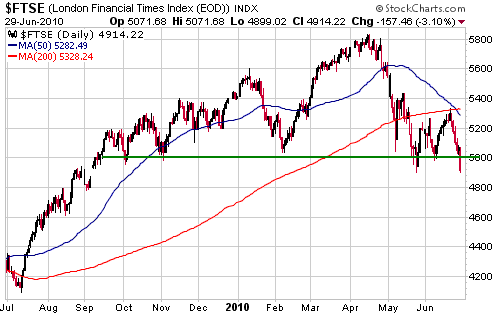
Unlike the S&P500
Index, Britain's FTSE100 Index breached its February low during May
(see chart below). As a result of Tuesday's decline it is now at its
lowest level since last September.
The topping pattern traced out by the FTSE100 over the past 10 months has created an initial chart-based target of 4200.
It is widely thought
that Herbert Hoover contributed to the Great Depression of the 1930s by
not doing enough to support the economy, but the reality is that Hoover
was a very interventionist president by the standards of the time. It
was what he did, rather than what he didn't do, that magnified and
extended the economic downturn. What he did was prop-up prices
(especially the price of labour), increase government spending and
increase taxes. We mention this because the British government and
several other governments around the world are now making one of the
biggest mistakes made by Hoover during the early 1930s, which is to
impose higher taxes. All the tax increases proposed by the British
government under the "emergency budget" announced last week are bad
news, but the one that will likely have the most negative effect on the
economy is the immediate hike from 18% to 28% in the capital gains tax
paid by high-income earners. At a time when the government should be
removing obstacles to private-sector investment, Britain's new
government is doing the opposite.
Gold and
the Dollar
Gold
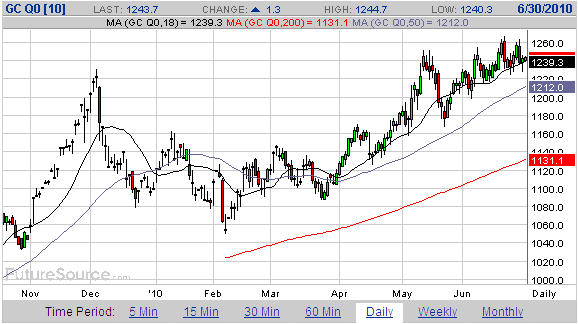
Gold successfully tested support in the $1220s again on Tuesday. As
previously advised, it will be reasonable to give the short-term
bullish case the benefit of the doubt as long as the nearest gold
futures contract remains above $1220 on a daily closing basis.
A daily close below $1220 would point to a drop to at least the $1160s and potentially to the low-$1100s.
Gold Stocks
While the broad stock market has just moved to a new low for the year,
the top half of the following chart shows that the gold sector of the
market (as represented by the HUI) is consolidating within 5% of its
year-to-date high. Tuesday's performance by the HUI wasn't exactly
bullish, but it did remain above support at 470 despite the carnage
going on around it.
The bottom half of the following chart shows that the HUI
under-performed gold bullion from mid September of 2009 through to
early February of this year and subsequently out-performed gold
bullion. When HUI/gold eventually moves above its May high it will be a
bullish omen for gold stocks and gold bullion.
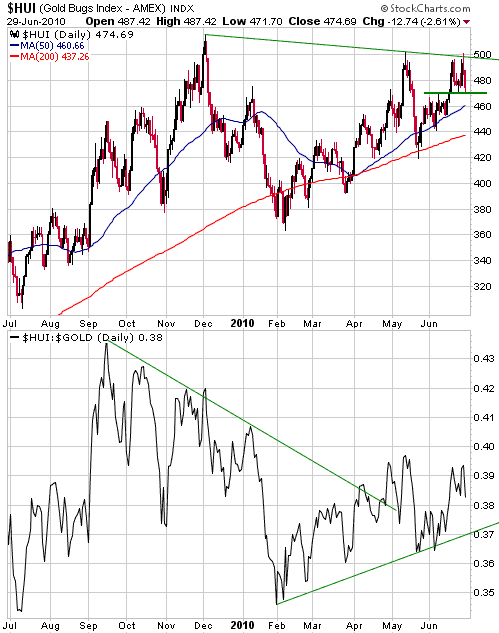
With the HUI
remaining between 470 and 505, this week's action hasn't given us
anything new to go on. A daily close below 470 would warn that a sharp
decline was probably about to occur, whereas consecutive daily closes
above 505 would point to significant additional short-term gains.
Currency Market Update
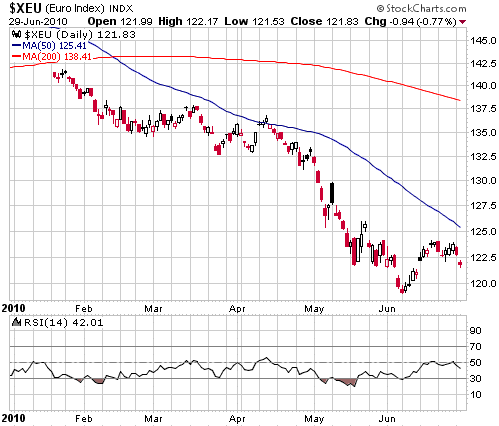
The currency market hasn't yet confirmed the S&P500's plunge to a
new low for the year in that the euro has retraced less than half its
June rebound (see chart below). However, if the stock market continues
its steep descent, either immediately or following a brief respite,
there's a good chance that the euro will soon be pushed back to its
early-June low.
That being said, we think the euro's short-term risk/reward is
"neutral" at worst. This is because the euro's negatives are well known
and largely priced into the market, as evidenced by the extent and
persistence of speculative short-selling in euro futures and by the
generally depressed level of euro sentiment. In our opinion, if the
stock market is now on its way to much lower levels then the greatest
downside risk lies with the commodity currencies.
Update
on Stock Selections
(Notes: 1) To review the complete list of current TSI stock selections, logon at http://www.speculative-investor.com/new/market_logon.asp
and then click on "Stock Selections" in the menu. When at the Stock
Selections page, click on a stock's symbol to bring-up an archive of
our comments on the stock in question. 2) The Small Stock Watch List is
located at http://www.speculative-investor.com/new/smallstockwatch.html)
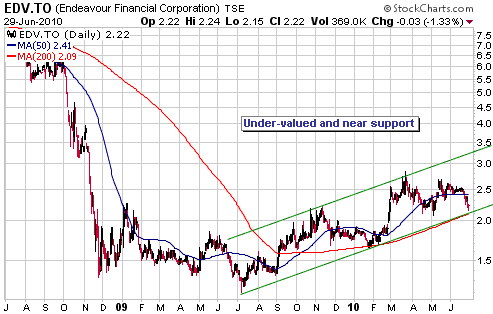
 Endeavour Financial (TSX: EDV). Shares: 111M issued, 146M fully diluted. Recent price: C$2.22 Endeavour Financial (TSX: EDV). Shares: 111M issued, 146M fully diluted. Recent price: C$2.22
EDV has made an offer to acquire the 45% of Etruscan Resources (TSX:
EET) that it doesn't already own. The offer is a combination of cash
and stock, and has been approved by EET's board. The $43M cash portion
of the acquisition will be funded using a $100M credit facility
recently arranged by EDV.
Assuming that EDV ends up with 100% of EET, its gold business (100% of
EET plus 43% of Crew Gold (TSX: CRU)) will have the following
equity-accounted production and resources:
- 189K-oz/yr production
- 3.7M ounces of M&I resources plus 1.0M ounces of inferred
resources (4.2M ounces total, assuming an inferred ounce is worth 50%
of a M&I ounce)
This means that at its recent price of C$2.22/share, EDV is being
valued by the stock market at around US$1622 per ounce of production
and US$73 per resource ounce. These figures are very low, and they
don't allow anything for EDV's non-gold investments and its merchant
banking business.
We expect that EDV's gold business will eventually be spun off as a
separate company, perhaps following one more acquisition. Putting the
gold assets into a separate company would be an efficient way to boost
shareholder value.
EDV and the EDV warrants (TSX: EDV.WT.A) are suitable for new buying
near their current prices of C$2.22 and C$0.78, respectively.
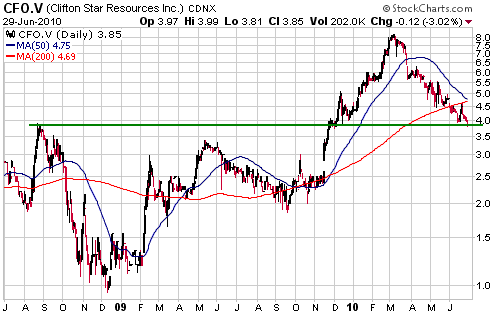
Clifton Star Resources (TSXV: CFO). Shares: 28M issued, 38M fully diluted. Recent price: C$3.85
CFO ended Tuesday's session at intermediate-term support (see chart below).
There is never any guarantee that support will hold, but you improve
your chances of making substantial gains if you scale into stocks
following pullbacks to important support levels.
Chart Sources
Charts appearing in today's commentary
are courtesy of:
http://stockcharts.com/index.html
http://www.futuresource.com/

|