- Interim Update 29th June 2016
Copyright
Reminder
The commentaries that appear at TSI
may not be distributed, in full or in part, without our written permission.
In particular, please note that the posting of extracts from TSI commentaries
at other web sites or providing links to TSI commentaries at other web
sites (for example, at discussion boards) without our written permission
is prohibited.
We reserve the right to immediately
terminate the subscription of any TSI subscriber who distributes the TSI
commentaries without our written permission.
Watch the 30th June
closes
The daily close on Thursday 30th
June will be interesting because a) it will also be a monthly and a
quarterly close, and b) multiple markets are trading near important
support/resistance levels. Here are the 30th June closings that we will be
most interested in:
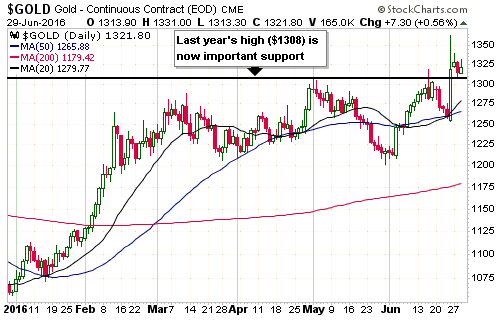
1) Gold relative to its 2015 high of $1308 (a
30 June close above this level would lend more support to the bull market
scenario).
2) The British Pound relative to its 2009 low of 136.2
(a 30 June close above this level would be an early-warning sign that the
Pound's bear market was over).
3) The Dollar Index relative to its
late-May high of 96 (a 30 June and a 1 July close above this level would
be evidence that an intermediate-term bottom was put in place in
early-May).
4) The T-Bond relative to its January-2015 and
February-2016 peaks near 169 (a 30 June close below this level would be
evidence that a trend-ending upside blow-off was complete).
5)
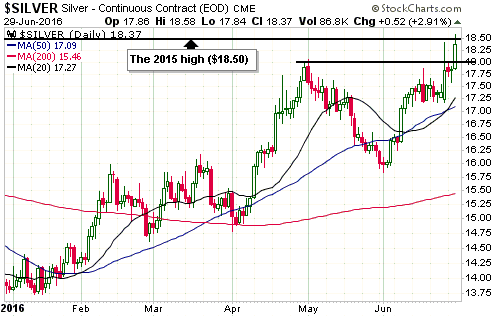
Silver relative to its 2015 high of $18.50 (a 30 June and a 1 July close
above this level would confirm gold's breakout and lend more support to
the bull market scenario).
Why Brexit is positive
for the UK
The extent to which the UK
benefits from "Brexit" will depend on the actions taken by the British
government from here on. Given that the leaders of the "leave" campaign
apparently were not expecting to win and therefore do not yet have
coherent plans as to the path that should now be followed, it's possible
that there will be no net gain. However, a political separation from
Europe would reduce economic risk and would require some huge missteps on
the part of the British government to result in a net loss for Britain.
Here's why.
Before getting to the positives of leaving the EU we'll
deal with some of the most commonly-cited negatives.
For starters,
let's dispense with the idea that Britain's exit from the EU is an
economic negative because it will result in London no longer being a
global financial capital. This is total nonsense on three different
levels.
First, London was never a financial capital by virtue of
Britain's membership of the EU. It was a financial capital for centuries
before the EU and whether it remains so will be determined by factors that
have nothing to do with EU membership.
Second, by removing the
obligation to follow EU dictates, London's popularity as a financial
centre is more likely to increase than decrease over the years ahead. For
example, if a financial transactions tax were implemented across the EU (a
very realistic possibility) then a lot of business that was conducted via
banks, brokerages and exchanges within the EU would shift to London.
Third, even in the extremely unlikely case that Brexit were to result
in the down-sizing of London as a centre for financial dealing, forex
traders working for the big banks in the City might make less money but
the vast majority of people would not be adversely affected.
Next,
let's dispense with the idea that there will be less trading of goods
between the UK and Europe post-Brexit. Trading of goods and services is
done by private individuals and corporations, not by governments. If
companies in the UK and, say, Germany believed it made economic sense to
trade with each other pre-Brexit then they will believe it makes economic
sense to trade with each other post-Brexit. There is a risk that the EU
bureaucracy will impose tariffs on British imports, but in this case the
EU would effectively be saying: "To punish British citizens for voting to
leave the EU we are going to impose additional costs on the people
remaining in the EU". This would almost certainly not fly.
Note
that tariff-free trade was the main benefit provided by the EU, but it is
just as much in the interest of the remaining EU members as it is in the
interest of the UK to continue the tariff-free trade. The apparatchiks at
the EU might not understand this and probably wouldn't care even if they
did, but the political leaders of some of the most influential EU
countries probably do understand and care.
Lastly, let's dispense
with the idea that the EU is a common market in the true meaning of the
term. Every country in the EU is a different market from the perspective
of manufacturers in the UK. The EU imposes a layer of regulations over the
top, but each country has its own language, its own customs and its own
set of government regulations to deal with.
Now to the positives.
The biggest positive is the removal of the obligation to follow EU
regulations, many of which are counter-productive (there are more than 12
thousand EU regulations governing only the production and sale of milk;
how many of these do you think are worthwhile?). This will potentially
make UK corporations more efficient, but of even greater consequence it
will reduce risk by not subjecting the UK to damaging measures that may be
implemented by the EU in the future. The UK will still be subject to the
risk that its own government will take actions that severely hamper
economic progress, but at least in such cases there would be a possibility
of setting the situation right at the next election. Such redress would
not be available with regard to actions taken by the EU, as all important
EU decisions emanate from an unelected bureaucracy.
Another
positive is the distancing of the UK from the major political -- and,
consequently, economic -- upheaval that could happen throughout Europe
over the years immediately ahead. There is clearly widespread
dissatisfaction with the economic, monetary and political situations in
many European countries, leading to demands for similar referenda to the
one recently held in the UK. However, current political leadership will be
under enormous pressure to NOT give citizens the option to exit Europe's
economic or monetary unions, which probably means that the pressure will
build until one of two things happens: there is large-scale rioting in the
streets or current middle-of-the-road political leaders are replaced by
those who are far more nationalistic and socialistic.
A third
positive is that an EU exit could create more separation between the UK's
banking industry and the banking crisis brewing in the euro-zone in
response to excessive leverage, bad loans and negative interest rates.
That being said, the large banks in Europe, the UK and the US are
inter-linked in such a way that a banking crisis in one area inevitably
causes major problems for banks in other areas.
The last positive
we'll mention is the gaining of control over immigration. Due to the
racial and religious prejudice that seemed to underpin the "leave"
campaign's immigration-related arguments, this was the most
emotion-charged and possibly the most influential issue in the propaganda
war waged in the lead-up to last week's vote. However, the issue is not
complicated and need not be emotional. The fact is that while an economy
will often benefit from immigration, it is not reasonable for a country to
relinquish control over immigration to unelected bureaucrats in some other
part of the world. This was always a problem with EU membership, it's just
that the problem wasn't apparent to most people prior to the
refugee/migration crisis of the past year.
If we had to provide a
one-line summary of the consequences of "Brexit" (for the UK) we would say
that it adds uncertainty and reduces risk. This could seem like a strange
turn of phrase because many people wrongly associate uncertainty with
risk, but they are actually very different things. In this case there is
now greater uncertainty due to there being more unknowns (for example: the
make-up of the UK's new political leadership, the details of the
separation from the EU, the new trade arrangements with European
countries, the effect on Scotland and Northern Ireland), but less risk of
the UK being adversely affected by the growing political and economic
problems of Europe. To put it a different way, had the UK stayed in the EU
there would have been greater certainty in that the UK would certainly
have been dragged down by Europe. There is now the possibility of a better
outcome, but the details are very much 'up in the air'.
In
conclusion, getting out of the EU doesn't guarantee a bright economic
future for the UK. Far from it. What it does is reduce the risk of a bleak
economic future.
The Stock Market
The US
In the latest Weekly Update, we wrote:
"There could be some
follow-through to the downside over the next couple of days, but there
could also be an immediate rebound. If there is an immediate rebound it's
likely that it would be followed by a decline to below last week's low.
Whether or not the market rebounds or continues to decline over the
next few days, we expect that a short-term bottom will be in place within
two weeks. What happens thereafter will largely depend on the level at
which the short-term bottom is formed."
In other words, we
came into this week expecting a decline to below last week's low,
regardless of whether or not there was an immediate attempt to rebound. As
it turned out, there was significant follow-through to the downside on
Monday followed by a Tuesday-Wednesday rebound.
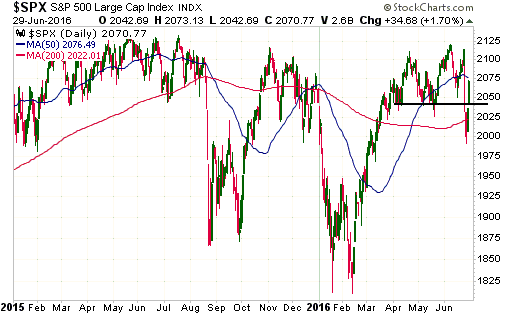
Due to the S&P500
Index (SPX) having dropped well below last week's low before beginning to
rebound and due to the rebound having been strong enough to take the price
well above the 2040 demarcation level, it's likely that a multi-week
bottom was put in place on Monday 27th June. However, it's also likely
that any remaining upside over the coming 1-2 weeks will be capped by
resistance at 2100-2115, which is within 2% of Wednesday's close.
The sharp Brexit-induced sell-off that occurred on Friday 24th June
and Monday 27th June created an opportunity to reduce exposure to bearish
speculations (as mentioned in the Weekly Update), but Brexit was unrelated
to our reasons for being short-term bearish prior to last Friday and -- as
also mentioned in the Weekly Update -- is not in any way a valid new
reason to be bearish. In particular, fair value for the SPX is no lower
post-Brexit than it was pre-Brexit.
As far as the US stock market
is concerned, the main consequence of Brexit was a temporary surge in
volatility. There was a downside breakout followed by the negation of the
breakout, with the overall situation essentially remaining the same. This
means that the short-term downside risk that we perceived two weeks ago is
still in place.
Our current view is that the immediate threat of a
substantial decline has passed, but that looking out over the coming 1-3
months the downside potential still appears to be much greater than any
remaining upside potential.
As an aside, Alan Greenspan sounds
extremely bearish in the article posted
HERE. This should be of some concern to anyone betting on a bearish
outcome, because Greenspan has been a reliable contrary indicator his
entire career.
Europe
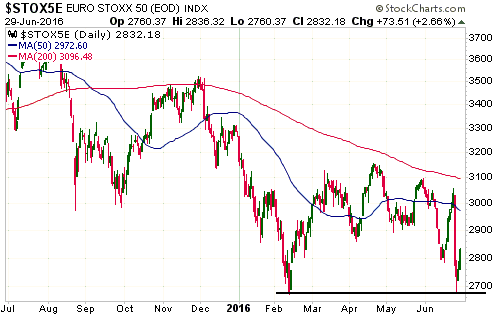
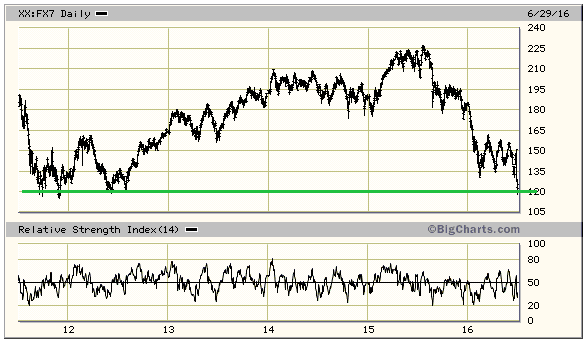
While the US stock
indices became only slightly 'oversold' during the equity sell-off
prompted by Brexit, it was a different story in Europe. As illustrated by
the following charts, on Monday of this week the EURO STOXX 50 Index
(STOX5E) tested intermediate-term support defined by its February-2016 low
and the Europe 600 Banks Index (FX7) tested long-term support defined by
its 2011-2012 sovereign-debt-crisis lows.
With major support
levels having been successfully tested, some consolidation with an upward
bias is likely over the coming 1-2 weeks.
Gold and the Dollar
Gold
Since last Friday's fireworks the gold market has been remarkably calm.
Gold speculators took Monday's equity sell-off and the Tuesday-Wednesday
equity rebound in stride, with the US$ price ending Wednesday's session
about $3 above last Friday's close.
At Wednesday's close the US$
gold price was just below channel resistance (the top of its 4.5-month
channel in the low-$1320s) and just above support defined by last year's
high ($1308). It could break either way over the next few days.
Silver
Silver is worth singling out in today's
report due to Wednesday's out-of-the-blue strength in this market.
With the London and New York markets closed in the early hours of
Wednesday, the silver price jumped from $17.80 to $18.30 while gold and
most other markets were doing very little. When this type of price action
occurs on the downside it is invariably held up in some quarters as
obvious evidence of manipulation, but when it happens on the upside it is
never said to be the result of manipulation. Why is that?
To be
clear, we aren't saying that Wednesday's surge in the silver price during
the 'wee hours' was due to manipulation. We have no idea whether it was or
wasn't and couldn't care less either way. We are just taking the
opportunity to point out an inconsistency in the 'analysis' of those who
view the gold and silver markets through manipulation-coloured glasses.
In any case, whatever its cause the sudden strength in this market on
Wednesday has put silver in a position where it could soon remove a minor
bearish non-confirmation by closing above last year's high of $18.50.
Furthermore, if it can close above $18.50 it will potentially set in
motion another multi-day wave of speculative buying.
Gold Stocks
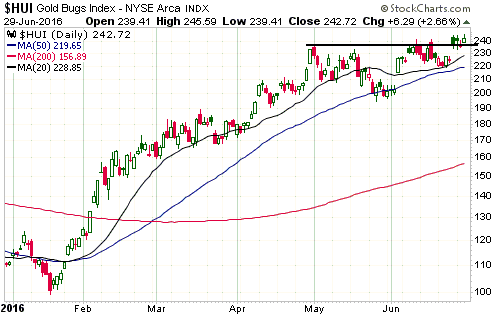
The HUI shifted from being right
at resistance to being marginally above resistance over the first three
days of this week, which means that there has been no significant change.
A spike up to 250-260 remains a realistic near-term possibility.
Away from the price action of the highest-profile gold-stock indices
and ETFs there were, however, two significant developments over the first
three days of this week.
The first is the many examples of
small/illiquid junior gold-mining stocks making big up-moves with no
company-specific news. Almaden Minerals (AAU) is the sole example from the
TSI List (AAU gained 11% on Wednesday and is up by 21% since the end of
last week), but there were several other junior gold stocks on our radar
screen that suddenly made double-digit percentage advances for no apparent
reason. This is a sign of indiscriminate speculation that often appears
near the end of an intermediate-term trend.
The second is the
flurry of sizable equity-financing announcements by junior gold miners.
Here are the ones we noticed, all of which were announced on Monday:
GUY.TO is raising C$130M, LUG.TO is raising C$83M, ORE.V is raising C$23M,
OSK.TO is raising C$25M, SSL.TO is raising C$65M and TMR.TO is raising
C$80M. This means that the demand for junior gold-mining shares is high
and that supply is quickly increasing to meet the demand. A more colourful
way to put it is that the ducks are quacking and they are dutifully being
fed.
The extra supply doesn't matter in the here and now, but it
will weigh on prices over the next few months.
The Currency
Market
The lines drawn on the following euro chart are
parallel. They show that the euro's multi-month rebound from its
December-2015 low proceeded at exactly the same pace as the euro's
multi-month rebound from its March-2015 low. Also, notice that both
rebounds started and ended at roughly the same levels.
If the
similarities between the post-March-2015 price action and the
post-December-2015 price action persist then the euro will work its way
down to around 106 over the coming month or so.
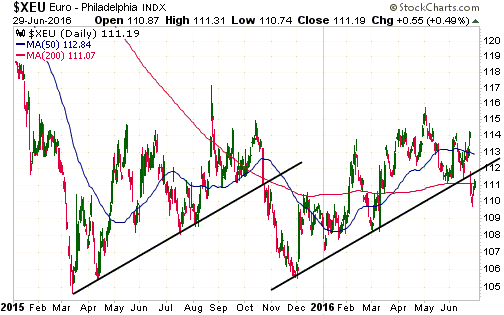
At some point the price action will change, because the euro is not
going to oscillate between 105-106 and 115-116 forever. At some point it
will have to break out to either the upside or the downside. At the
moment, however, it seems appropriate to use the performance following
last October's break below trend-line support as a roadmap.
Updates on Stock Selections
Notes: 1) To review the complete list of current TSI stock selections, logon at
http://www.speculative-investor.com/new/market_logon.asp
and then click on "Stock Selections" in the menu. When at the Stock
Selections page, click on a stock's symbol to bring-up an archive of
our comments on the stock in question. 2) The Small Stock Watch List is
located at http://www.speculative-investor.com/new/smallstockwatch.html
Chart Sources
Charts appearing in today's commentary
are courtesy of:
http://stockcharts.com/index.html
http://bigcharts.marketwatch.com/