|
- Interim Update 29th December 2010
Copyright
Reminder
The commentaries that appear at TSI
may not be distributed, in full or in part, without our written permission.
In particular, please note that the posting of extracts from TSI commentaries
at other web sites or providing links to TSI commentaries at other web
sites (for example, at discussion boards) without our written permission
is prohibited.
We reserve the right to immediately
terminate the subscription of any TSI subscriber who distributes the TSI
commentaries without our written permission.
TSI Vacation
The
Weekly Update will be posted as usual this Sunday (2nd January), after
which we will be taking a 1-week break. As a result, there will be no
Interim Update on Thursday 6th January and no Weekly Update on Sunday
9th January. However, if something that warrants an immediate comment
happens while we are away then we will send out a brief message by
email.
We wish you a very successful 2011 and thank you for your support during 2010.
The Stock Market
The Presidential Cycle Model
2011 will be the third year of the US Presidential Cycle, and on
average the third year of the cycle is the strongest. As reported by
Mike Burk in his free weekly letter:
"Over all years since
1928 the SPX has been up 67% of the time with an average gain of 7.3%.
During the 3rd year of the Presidential Cycle the SPX has been up 89%
of the time with an average gain of 14.9%. The last time the SPX had a
down year during the 3rd year of the Presidential Cycle was also1939
when it lost 5.5%.
The chart below shows the
average performance of the SPX over all years in red and average
performance during the 3rd year of the Presidential Cycle in green."
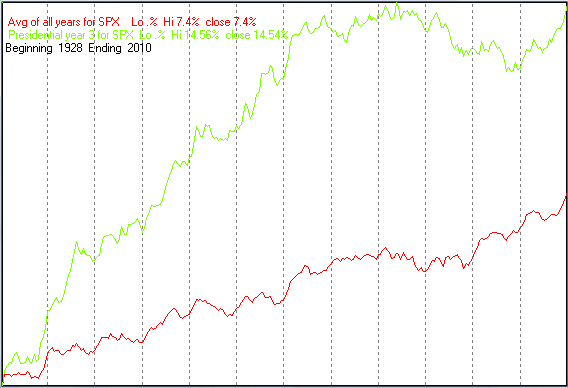
The chart displayed
above shows that the average third-year performance entails a strong
upward trend through to July and then 'choppiness' over the remainder
of the year. In other words, it shows that the market not only tends to
be strong during the third year, but also tends to make all of its
upward progress during the first 7 months of the year.
The stock market's average performance during the Presidential Cycle's
third year is undoubtedly one of the reasons why most investors and
commentators are optimistic about the year ahead. The question is:
given that the current situation is unprecedented in many ways, how
seriously should we take a model based on an historical average?
Last year we took the Presidential Cycle Model more seriously than we
normally would, due to the fact that it meshed with what we thought was
likely based on other considerations. As it turned out, the market
followed the cycle average very closely during the first eight months
of 2010, at which point it diverged markedly. This year the
Presidential Cycle should clearly be viewed as a plus given that the
fundamental basis for third-year strength should definitely be in
operation (the incumbents will almost certainly take steps to boost
prices during 2011 in an effort to create the illusion of a
strengthening economy in the lead-up to the 2012 elections). However,
we think that other fundamentals stand a good chance of overwhelming
the Obama Administration's price-boosting efforts.
Sentiment: as optimistic as it gets?
Most of the sentiment indicators we follow show that the investing
public's sentiment is now dangerously bullish. For one example, the TSI Index of Bullish Sentiment (TIBS)
ended last week at its highest level since the major market top of
October-2007. For another example, the AAII (American Association of
Individual Investors) Bull/Bear ratio just hit its highest level since
July of 2005 (according to last week's AAII survey, there were about 4
bulls for every bear).
Furthermore, while the public (the 'dumb money') appears to be
extremely bullish, the professional money-management community (the
'smart money') appears to be very concerned about downside risk. The
pros' concern about downside risk is evidenced by the 10-day moving
average of the OEX put/call ratio, which has been incredibly volatile
over the past several weeks and has just moved up to the uncommonly
high level of 1.87. It is now just below the three highest levels of
the past 20 years, which were reached in January-2000, September-2000,
and February-2007. Ominously, January-2000, September-2000, and
February-2007 were three of the worst times of the past 100 years to be
heavily invested in the US stock market.
Now, it should be noted that while important turning points always
coincide with sentiment extremes, sentiment extremes don't always mark
important turning points (all poodles are dogs, but not all dogs are
poodles). For example, the July-2005 extreme in the AAII Bull/Bear
ratio coincided with the start of a modest 3-month correction, not an
important turning point. Also, while the February-2007 extreme in the
OEX put/call was followed by a sharp multi-day decline, a major market
top didn't occur until about 8 months later.
The way we look at it, the sentiment picture doesn't definitively point
to a negative short-term outcome, but it does suggest that downside
risk is relatively high at this time. We therefore think that if you
haven't already done so, now is a good time to be de-risking your
portfolio by building up cash and shifting into stocks that have
relatively small downside risk. Those who are experienced in the field
of option trading should also give consideration to protecting core
positions via the purchase of put options.
Current Market Situation
Monetary inflation cannot possibly help the overall economy. In fact,
it can only hurt. However, it can -- and almost always does -- cause
some prices to rise, with the stock market often being one of the first
beneficiaries of faster money-supply growth.
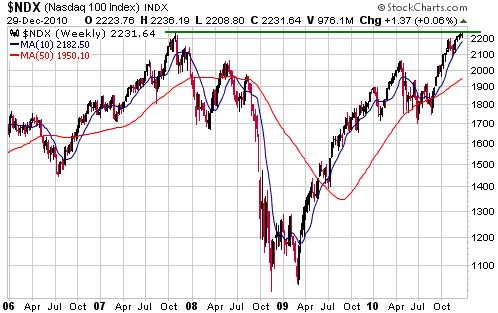
The following weekly chart of the NASDAQ100 Index (NDX) illustrates the
power of monetary inflation. Despite the US economy being 'in the
toilet' and unemployment being well into double digits, the NDX has
recouped all of its 2007-2008 losses and is likely to make a new 5-year
high in the near future.
If the NDX does move to a new multi-year high it will probably raise
the optimism of the 'dumb money' to an even higher level, thus further
increasing the downside risk.
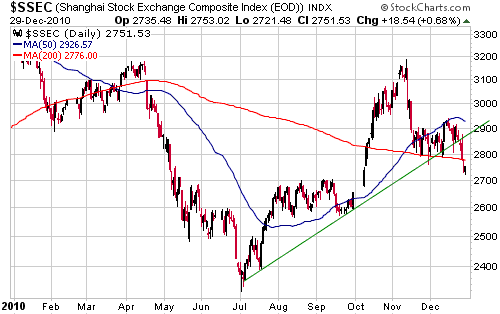
While the US stock
market has responded extraordinarily well to US$ inflation, China's
stock market has responded in a far less impressive manner to much
greater Yuan inflation. The Shanghai Stock Exchange Composite Index
(SSEC), for example, is currently about 50% below its 2007 peak and now
appears to be in the early part of a new intermediate-term decline
(refer to the following daily SSEC chart for further details). We
suspect that the main reason for the relatively poor response of
China's stock market to the rapid monetary inflation of the past two
years is that the effects of China's inflation have been concentrated
in the real estate market.
Gold and
the Dollar
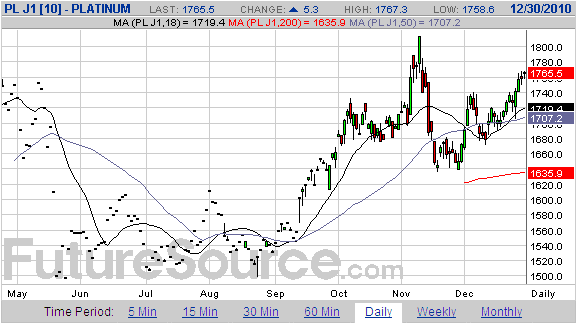
Gold, Silver and Platinum
In previous commentaries over the past few months we referred to
platinum as the "weak link" in the precious metals sector. Our view has
been that as long as the "weak link" was holding up, the stronger
markets (gold and silver) would not be in imminent danger.
In the 17th November Interim Update we said that platinum had quite
likely reached an intermediate-term peak in early November, but that it
would partially retrace the initial decline from its peak and that this
'retracement' could be accompanied by moves to new highs in gold and
silver. Gold and silver subsequently made marginal new highs in early
December as platinum rebounded, and at this stage platinum remains in
rebound mode.
If platinum's counter-trend rebound is not yet complete, then the
rallies in the stronger precious metals very likely have further to go.
This week's new
multi-year high in the silver/gold ratio supports the idea that the
gold and silver rallies have further to go. The silver/gold ratio
remains dangerously extended to the upside, but until it either
reverses sharply lower or diverges bearishly from the gold price it
will be reasonable to assume that new highs lie in the near future for
both gold and silver.
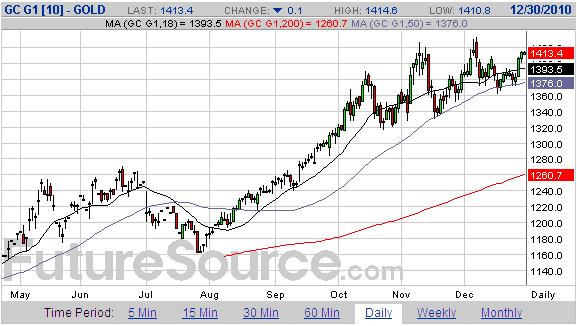
A daily chart of February gold futures is displayed below. Any pullback
over the days ahead will probably do no worse than take the price back
to the $1390s, although the price could drop all the way down to the
December low (just above $1360) without doing major technical damage.
To mitigate downside risk in short-term trading positions, it would be
reasonable to place a sell stop just under the December low.
Gold Stocks
Current Market Situation
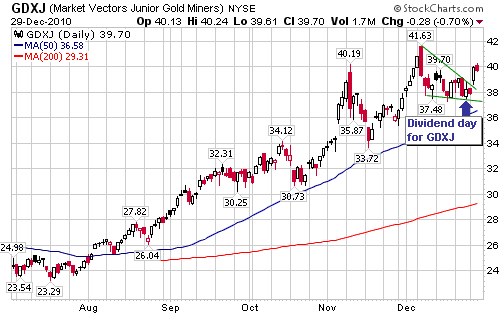
We have included a daily Stockcharts.com chart of GDXJ (the Market
Vectors Junior Gold Miners ETF) below, for two reasons: First, to make
the point that the decline from the early December peak has the look of
a routine correction within a continuing short-term upward trend.
Second, to make the point that Stockcharts.com and most other providers
of charts automatically adjust historical prices to account for
dividends.
With regard to the second of the above-mentioned points, GDXJ went "ex"
a $2.93/share dividend on 23rd December, and yet the chart shows a
small rise in GDXJ's price on that day. The reason is that on 23rd
December all prices prior to that date were adjusted downward by
Stockcharts.com so as to prevent the dividend from creating a large
decline that would, in effect, have been artificial. This is the
correct way to do it, but it could lead to some confusion in that the
pre-23rd-December prices shown on the chart are now different to the
actual pre-23rd-December prices. For example, the chart shows that GDXJ
peaked at $41.63 in early December, but the actual
(non-dividend-adjusted) peak at the time was about $3 higher.
At this stage it
looks like the junior end of gold sector, as represented by GDXJ, is
going to make new highs during the first half of January, and that the
senior end of the sector, as represented by the HUI and the XAU, will
do likewise. How high the prices of GDXJ, the HUI and the XAU go before
they top out will obviously depend to a great extent on how high the
prices of gold and silver go, which is anyone's guess. One realistic
possibility is that gold won't achieve much more than a marginal new
high (say, $1450), while another is that it will trade as high as $1600
in the near future. Although much less likely, there is also an outside
chance that the market will become sufficiently manic over the weeks
ahead to take the price up to $2000. The higher it goes, the greater
the ensuing correction will be.
A point worth reiterating at this time is that many junior gold/silver
stocks will probably reach intermediate-term peaks months AFTER the
gold-stock indices peak. The likely pattern involves the juniors
declining along with the seniors during the weeks immediately following
an intermediate-term top in the HUI, and then rallying to new highs
while the HUI rebounds to a secondary (lower) high. For example, if the
HUI were to make an intermediate-term peak during the first half of
January, it's quite possible that many junior gold/silver stocks would
wait until March-April before completing intermediate-term peaks of
their own.
Mine Development Risk Profile (MDRP)
A gold -- or any other type of metal -- mining project naturally
becomes much less risky after it has been developed to the point where
it is not only fully operational, but operating in accordance with its
design parameters. However, prior to this point being reached the
lowest risk period in a mining project's life is, in our opinion, the
period after exploration has uncovered a significant resource and
before the project enters the feasibility stage. We refer to this
period as the 'sweet spot', because it is the time-window when there is
the highest probability of good news and the lowest probability of
negative surprises.
The so-called 'sweet spot' is Stage 2 in our Mine Development Risk Profile (MDRP). TSI stocks that are presently in Stage 2 are CFO.V, KGN, SBB.TO and THM.
Stocks often fare poorly during the initial period of production (MDRP
Stage 5), but provided that the company gets through this stage without
being forced to dilute its stock to oblivion it generally gets a
substantial upward re-rating in the stock market upon entering MDRP
Stage 6. TSI stocks that are likely to shift from Stage 5 to Stage 6
over the next few months are CAH.AX, GOZ.TO, and MFN. Also, ATN.TO, JAG
and RSG.AX have the potential to shift from Stage 5 to Stage 6 in the
not-too-distant future.
Currency Market Update
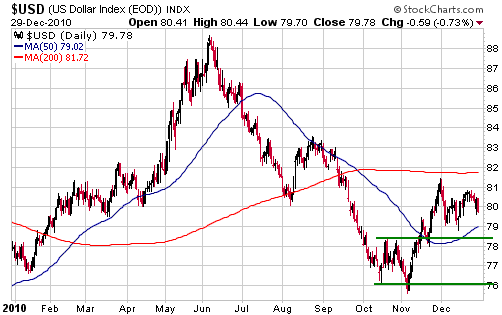
The Dollar Index looks like it could be rolling over to the downside.
If so, then support at around 78.5 would be a reasonable near-term
target.
Our view is that the Dollar Index made an intermediate-term bottom
during the first half of November, which means that we think the
November low of 76 defines the maximum downside risk from here.
Update
on Stock Selections
(Notes: 1) To review the complete list of current TSI stock selections, logon at http://www.speculative-investor.com/new/market_logon.asp
and then click on "Stock Selections" in the menu. When at the Stock
Selections page, click on a stock's symbol to bring-up an archive of
our comments on the stock in question. 2) The Small Stock Watch List is
located at http://www.speculative-investor.com/new/smallstockwatch.html)
 "January Effect" Candidates "January Effect" Candidates
There is a tendency for the US and Canadian stock markets to be strong,
and for small-cap stocks to be stronger than large-cap stocks, during
the first half of January. This is known as the "January Effect". It
results, at least in part, from the tax-related selling of losing
stocks prior to the end of December in order to offset capital gains,
and the subsequent ploughing of sales proceeds back into the market
during January. The effect is more evident amongst the small-caps
because these stocks are less liquid.
In general, the best candidates for a "January Effect" rebound are
small-cap stocks that experienced tax-loss selling during
November-December. With regard to the current members of the TSI Stocks
List, that points to Andina Minerals (TSXV: ADM), Atna Resources (TSX:
ATN), Duoyuan Global Water (DGW), Fairborne Energy (TSX: FEL), Gryphon
Gold (TSX: GGN) and Jaguar Mining (JAG) as probable candidates.
We think that each of these stocks has an attractive risk/reward ratio,
but we wouldn't buy any of them solely as a play on the fabled "January
Effect". The 2-3 week timeframe for such a trade is too short for our
liking. Instead, if we were already planning on buying shares in one of
the above-mentioned companies we would be inclined to do at least some
of the buying now, thus positioning ourselves to benefit from any
"January Effect" that happened to emerge without relying/betting on it.
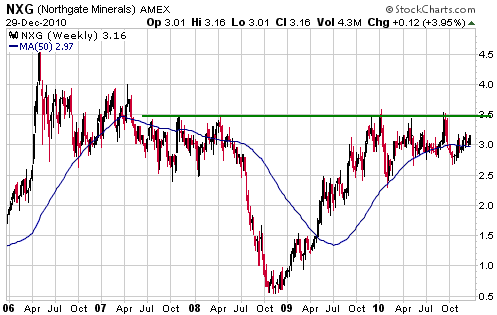
Northgate Minerals (AMEX: NXG, TSX: NGX). Shares: 290M issued, 297M fully diluted. Recent price: US$3.16
We mentioned earlier in today's report that this is an appropriate time
to de-risk one's equity portfolio. De-risking would generally entail
building up cash and favouring lower-risk stocks over their more
speculative brethren.
Within the group of junior and mid-tier gold/silver mining companies in
the TSI Stocks List, NXG is the stock that we think has the lowest risk
at this time. This is due to its spread of mining assets in politically
secure regions (Canada and Australia), its strong balance sheet, and
its relatively low valuation. It is also due to the weekly price chart
inserted below, which reveals that NXG has been in consolidation mode
for the past year and is close to its 50-week moving average. In other
words, NXG is not remotely close to being 'overbought'.
Chart Sources
Charts appearing in today's commentary
are courtesy of:
http://stockcharts.com/index.html
http://www.futuresource.com/

|