|
- Interim Update 30th January 2008
Copyright
Reminder
The commentaries that appear at TSI
may not be distributed, in full or in part, without our written permission.
In particular, please note that the posting of extracts from TSI commentaries
at other web sites or providing links to TSI commentaries at other web
sites (for example, at discussion boards) without our written permission
is prohibited.
We reserve the right to immediately
terminate the subscription of any TSI subscriber who distributes the TSI
commentaries without our written permission.
The Global Coal Shortage
A few months ago the upward trend in the price of coal already appeared
to be firmly entrenched due to inflation, China's shift from being a
net exporter to being a net importer of coal, the high oil price (the
higher the prices of other forms of energy the more cost-competitive
coal becomes), and the inability of coal miners to quickly ramp-up
production in response to rising demand. The outlook for the coal
market has since become even more bullish, however, due to a confluence
of factors that are restricting global supply of the energy source at a
time when global demand continues to rise.
First, coal production and transportation in Australia have been disrupted by heavy rains in Queensland. Refer to THIS
recent article for details. Additionally, the quantity of coal leaving
Australia's shores is being limited by inadequate port facilities. The
upshot is that Australia's largest coal producers are not being able to
take full advantage of the surge in the coal price.
Second, an important contributor to the recent power shortages in South
Africa has been heavy rain in that country's coalfields. The rain has
reduced both the quality and quantity of coal being transported to
power stations, leaving coal inventories at dangerously low levels. A
likely consequence is that South Africa's coal exports will decline as
domestic requirements take precedence.
Third, China's power stations are experiencing a serious shortage of
coal due to the effects of severe winter weather on transportation and
heating demand. Actually, the weather is just exacerbating a
coal-supply problem that already existed thanks to the government's
price controls. The issue, in a nutshell, is that the government caps
the price of electricity whereas the price of coal is largely
determined by the international market. This has led to the slashing of
power companies' profit margins as the coal price has moved sharply
higher, causing these companies to buy less coal than they need in
order to mitigate their losses. The government's solution? Ban coal
exports, order the coal producers to deliver more coal to the power
companies, and chastise the power companies for not being prepared to
lose money in the public interest. This is not only a totally
ineffective solution to China's power shortage, it will create a
problem for countries such as Japan, Korea and Taiwan that were banking
on receiving coal from China.
Fourth, Indonesia, the world's largest coal exporter, is building new
coal-fired power plants at a rapid rate to meet the needs of its
growing economy. It is therefore unreasonable to expect that Indonesia
will be able to plug the gap caused by reduced coal exports from China,
Australia and South Africa.
Large increases in the coal price make the in-ground resources of
exploration-stage companies such as Red Hill Energy (TSXV: RH) much
more valuable, but investors/speculators should not be totally focused
on coal-mining companies that are still years away from production.
Small-cap coal miners with large in-ground resources -- RH, for example
-- are good speculations because at some point in the future they will
very likely be acquired at multiples of their current prices by major
coal producers or consumers (there's a chance that coal consumers from
countries such as Japan will begin purchasing in-ground resources as a
way of guaranteeing future supply); however, it is important to also
have exposure to companies that see immediate bottom-line benefits from
a higher coal price. In this regard we continue to like Patriot Coal
(NYSE: PCX). PCX produces and sells within the US, and as the price of
coal rises on the international market the price of coal in the US must
follow because US-based consumers compete with consumers elsewhere for
the available supply. PCX was dragged down to the low-30s during last
week's stock market panic, but is still good value near Wednesday's
(30th January) closing price of US$39.81.
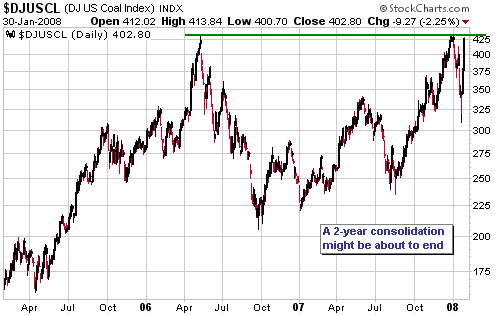
Given coal's worldwide supply/demand situation and the likelihood that
the price of this major energy source will remain at elevated levels
for a long time to come, it is not surprising that the Dow Jones US
Coal Index (DJUSCL) has a bullish-looking chart.
Fiscal and Monetary Follies
Go to http://www.mises.org/story/2859
for a concise explanation of why the stimulus package being proposed by
US policy-makers will, like all similar schemes that have been tried
over the decades, do more harm than good.
Having sliced 0.75% off its interest rate target just last week, the
Fed lopped off another 0.50% on Wednesday. This takes the Fed Funds
Rate target down to 3.0%. According to the Fed Funds futures, market
participants expect the rate to drop a further 0.50% -- to 2.5% -- by
the middle of this year.
Fed Chief Ben Bernanke is reputed to be an expert on the Great
Depression of the 1930s, but, unfortunately, this is not true. He spent
considerable time studying the Great Depression, but came away with the
wrong conclusions about what caused it and what should have been done
to prevent it. Instead of coming to the correct understanding that the
economic problems of that era stemmed from the rampant expansion of
credit sponsored by the Fed during the 1920s combined with the
disastrous "New Deal" and other interventionist policies of the Federal
Government during the 1930s, he came to believe that the debacle could
have been avoided if only the Fed had flooded the economy with more
money.
Plenty of money, but not enough credit
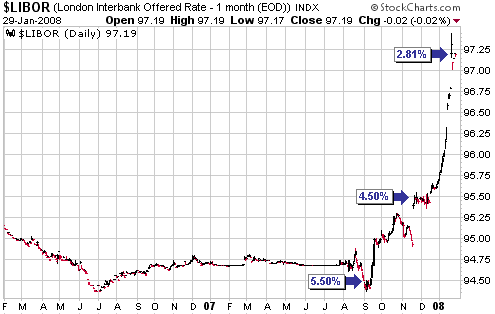
The following chart of the 1-month LIBOR (London Interbank Offered Rate)
Index indicates that the credit-worthiest banks are currently able to
borrow short-term money from each other in the London Interbank Market
at only 2.8% (the implied interest rate can be determined by
subtracting the index price from 100). This is down from 5.5% in early
September of last year and down from 4.5% as recently as mid December.
Furthermore, it is 0.2% below the Fed's new Funds Rate target.
The LIBOR chart tells us that cheap money is now plentiful IF you have
excellent credit. The problem, at the moment, is that people don't want
to lend money if there's even the tiniest amount of repayment risk
associated with the loan.
The Stock Market
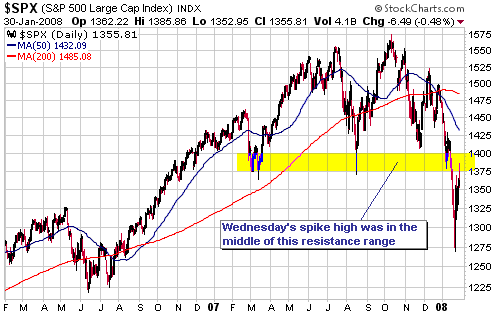
We
speculated in last week's Interim Update that the S&P500's initial
rebound from its 22nd January panic low wouldn't get any further than
former support (now resistance) in the 1375-1400 area. As noted on the
following chart, Wednesday's upward spike took the index to the middle
of this range.
We have no idea if the initial rebound ended on Wednesday or if there
will be some additional upside over the coming weeks. What we do know
is that the historical record clearly points toward a (successful) test
of last week's low at some point over the coming three months.
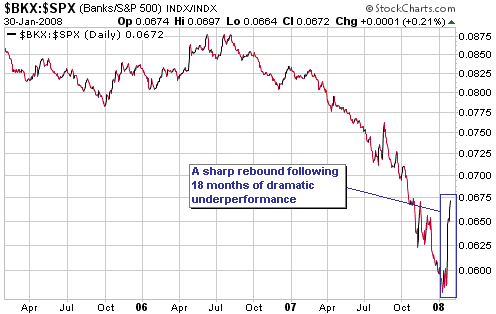
The recent sharp
rebound in the banking sector relative to the broad market, as
evidenced by the following chart of the BKX/SPX ratio, is a positive
sign. It is consistent with our expectation that last week's lows in
the senior stock indices will, for all intents and purposes, hold
during the first half of the year. Note, though, that the BKX/SPX ratio
is unlikely to embark on a lengthy advance because a few months after
the debt crisis ends or becomes fully discounted in the share prices of
the major banks, the banking sector should again come under pressure
due to rising bond yields.
Gold and
the Dollar
The Dollar
The Dollar Index's daily chart suggests that a drop to the low 70s has
a better-than-even-money chance of happening in the near future. It is
interesting, however, that over the past fortnight the currency market
has been forced to deal with a deluge of dollar-bearish news, including
idiotic "economic stimulus" plans and 125 basis points of rate cuts,
and yet the Dollar Index remains above its November-2007 low. When a
market refuses to make new lows in response to a barrage of bearish
news it is time for the bears to be wary.
Our view is that the dollar's downside risk has increased due to the
Fed's recent behaviour, but it remains fairly low. At the same time, it
is difficult to imagine the dollar doing anything more than bounce by
2-3 points prior to the ECB commencing its own rate-cutting campaign.
Our expectation is that the ECB will cut its interest rate target
several times this year, but probably won't make its first cut before
March.
Gold Stocks
Getting clues from history
There were more than 1100 new lows on the NYSE on Tuesday 22nd January,
something that had only happened on four previous occasions over the
past forty years. Last week we looked at how the broad US stock market
performed during the months following this rare event. Today we will do
the same for the gold sector of the stock market, with the aid of the
charts displayed below.
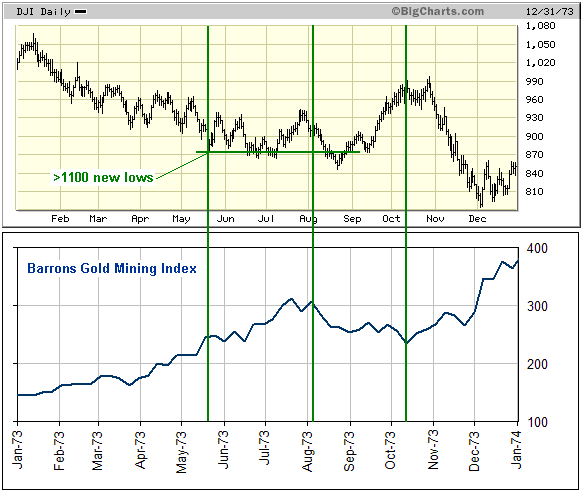
The first chart compares the performances of the Dow Industrials Index
(Dow) and the Barrons Gold Mining Index (BGMI) during 1973. Notice that:
a) The BGMI rallied for about two months after the 1100+ new-lows day
and hit a short-term peak just prior to the Dow completing the final
successful test of its panic low.
b) The BGMI then consolidated for about two months while the Dow rallied.
c) The BGMI resumed its upward trend at around the time the Dow reached the peak of its counter-trend rebound.
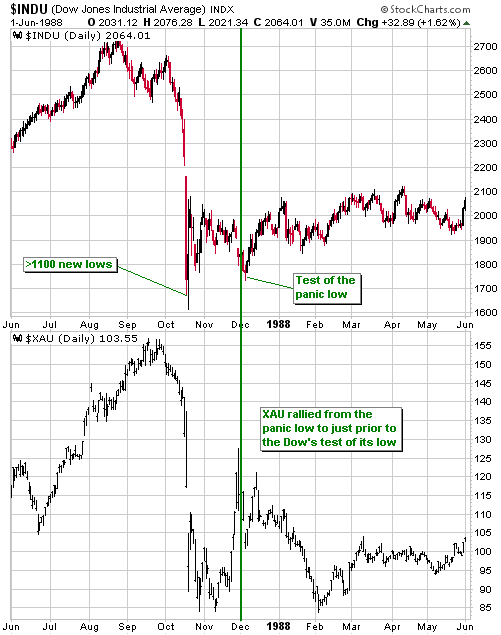
The second chart
compares the performances of the Dow and the XAU during the 12-month
period commencing 1st June 1987. Notice that the XAU rebounded strongly
from the time of the panic low (the 1100+ new-lows day) to just prior
to the Dow's successful test of its panic low. The XAU then became very
weak as the Dow returned to its long-term bullish trend.
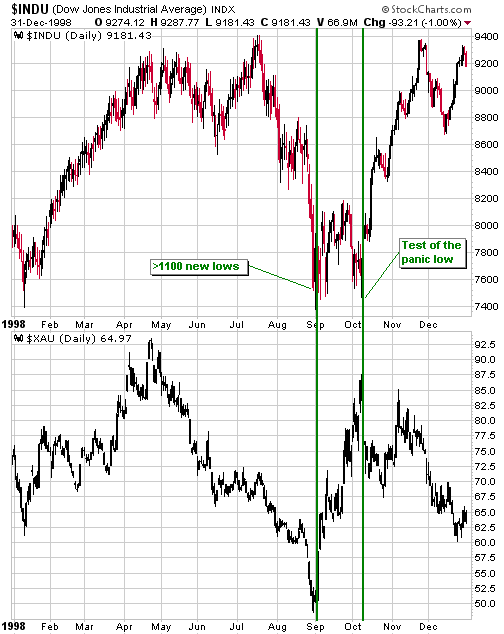
The third chart
compares the performances of the Dow and the XAU during 1998. Notice
that, as was the case in 1987, the XAU rebounded strongly from the time
of the panic low (the 1100+ new-lows day) to just prior to the Dow's
successful test of its panic low, and then became very weak as the Dow
returned to its long-term bullish trend.
The fourth of the
historical cases of 1100+ new NYSE lows occurred on the 16th of August
last year. The gold-stock indices were very strong for almost three
months following that event.
The bottom line is that over the past forty years the gold sector has
always rallied for at least 5 weeks following a panic that resulted in
the number of new lows on the NYSE exceeding 1100. Moreover, when the
gold sector has been in a secular bull market, as it is now, it has
rallied for at least two months following such an event. Bear in mind,
though, that the historical sample size is very small.
Current Market Situation
As noted in Sunday's commentary, the continuing upward trend in the
gold/SPX ratio points to new highs in the HUI within the next few weeks.
There's a lot of concern and frustration amongst the holders of
exploration-stage gold stocks due to the failure of most of these
stocks to respond in an appropriate way to the last six months of gains
in the price of gold bullion. During this period the value of
aboveground gold has risen substantially while the value of belowground
gold has barely moved.
We plan to discuss this issue again in the next Weekly Market Update,
but we'll note right now that it isn't just the juniors that have
failed to perform as expected. For example, five of the world's six
largest gold stocks remain below their May-2006 peaks despite the fact
that the gold price is now almost $200 higher than it was back then (of
the six largest gold stocks, only Barrick Gold has exceeded its 2006
peak). As we've noted in prior commentaries over the past several
months, the gold-stock indices have been propelled to new highs by an
unusually small number of gold stocks.
SA Power Outage Update
It looks like the South African gold miners that were forced to
shut-down their operations last Friday will move back to full
production levels over the coming week or so. However, the longer-term
issue of power-supply reliability has certainly not been resolved.
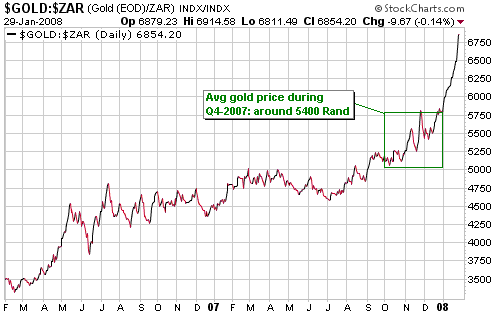
The following chart shows the rapid advance in the Rand-denominated
gold price since the beginning of this year. At this stage it looks
like the average gold price, in South African Rand terms, will end up
being at least 20% higher during the first quarter of this year than it
was during the preceding quarter. If this proves to be the case -- it
very likely will be the case because there doesn't appear to be much
chance of the Rand strengthening relative to gold -- then all the major
unhedged SA gold miners will become very profitable if only they can
obtain a reliable power source.
Update
on Stock Selections
(Note: To review the complete list of current TSI stock selections, logon at http://www.speculative-investor.com/new/market_logon.asp
and then click on "Stock Selections" in the menu. When at the Stock
Selections page, click on a stock's symbol to bring-up an archive of our comments on the stock in question)
 First Majestic Silver (TSX: FR). Shares: 63M issued, 77M fully diluted. Recent price: C$4.39 First Majestic Silver (TSX: FR). Shares: 63M issued, 77M fully diluted. Recent price: C$4.39
As a result of the updated resource estimate announced on Wednesday for
its La Parrilla silver mine, FR now has a total silver resource across
its three main Mexican projects of 175M ounces, 106M ounces of which
are in the "measured-and-indicated" category (the remainder are
"inferred"). Using the fully diluted share count of 77M, this means
that FR is trading at around $1.93 per in-ground silver ounce. This
would not be particularly low if FR were an exploration-stage company,
but it is low for a primary silver producer with current production of
around 5M ounces/year.
New Stock Selection: Northgate Minerals (AMEX: NXG). Shares: 255M. Recent price: US$2.96
This is what we wrote about NXG in the 31st October 2007 Interim Update:
"In the past we've looked
at NXG as a trading opportunity from time to time, but haven't thought
it was suitable as a longer-term investment because:
a) Its main producing
asset (the Kemess South gold/copper project) was going to be depleted
by 2010 and there was considerable doubt that the company would be able
to obtain the environmental permits needed to bring its main
development-stage asset (Kemess North) into production
b) Its other
development-stage asset (the Young Davidson gold project) was too small
to make up for the depletion of Kemess South
c) The company's senior
management has routinely locked in low prices for its copper production
by forward selling at inopportune times
The probability of Kemess
North ever being developed into a mine has since dropped to almost
zero, but NXG now has investment potential assuming that its
recently-announced friendly takeover of junior Australian gold miner
Perseverance (ASX: PSV) gets completed as planned.
PSV traded above A$0.40
earlier this year, but the shares subsequently slumped to as low as
A$0.08 because the company ran into some operational issues and didn't
have the financial wherewithal to sort them out. Moreover, it had
forward sold its gold production, so it was in the absurd position of
being a gold producer that was getting HURT by the rising gold price
due to the increasing mark-to-market losses associated with its hedge
book. This was an unfortunate situation because the company appeared to
have good assets and production-growth potential, and was achieving
some excellent exploration results.
It seemed that for PSV to
survive it would have to issue a huge amount of new equity at very
cheap prices, thus greatly reducing the value of the existing shares.
Enter the cash-rich NXG.
NXG has offered to pay a
grand total of US$275M in cash to purchase all outstanding PSV shares
at A$0.20/share, close-out the gold forward sales positions and pay-off
PSV's debt. For this $275M NXG will get the Fosterville and Stawell
gold mines in Victoria (Australia).
The combined in-ground
resource of PSV's two mines is 3.8M ounces, 1.4M of which are
classified at proven-and-probable reserves. NXG's cost per reserve
ounce is therefore quite high, but the exploration results achieved by
PSV suggest that the in-ground inventory is substantially greater than
the current official estimate. Of greater importance, though, is the
fact that the acquisition will immediately add about 200K ounces/year
of gold production to NXG at a cost of only US$1375/ounce. This is
around one-third the industry average.
With the addition of
PSV's assets NXG is expected to have annual production of around 430K
ounces at a cash cost of US$184/ounce and enough cash left over to
develop Young Davidson into a 175K ounce/year operation. Assigning a
value of $3000/ounce (about 25% below the current industry average) to
this production results in a valuation for NXG of around
US$5/share.
NXG offers reasonable
value at the current price and is a potential future addition to the
TSI Stocks List. We will probably add it to the List if it pulls back
to the low-$3 area."
Since writing the above the NXG stock price has dropped below US$3 and
there have been two significant positive developments. First, the PSV
takeover has been completed as planned. And second, the company has
eliminated its forward sales.
However, there has also been a negative development in that NXG has
been caught-up in the credit market problems due to the $72.6M the
company has invested in Auction Rate Securities (ARS). As we understand
it, these securities have maintained their AAA rating and are
continuing to make interest payments, but the market has become
illiquid. The lack of liquidity means that NXG currently isn't able to
sell these securities.
NXG may not lose anything on its ARS investment, but the worst case is
that it will lose 100% of its investment. A 100% loss would equate to
around $0.30 per NXG share, which is significant but not a 'deal
breaker' in our opinion.
Given that the Kemess South mine will be fully depleted in 2010 and
that the Young-Davidson mine will probably be brought into production
by 2010, we think it is reasonable to base our analysis of NXG's
prospects on the assumption that it will maintain a gold production
rate of around 400K ounces/year for the next several years. This means
that the US$5/share figure mentioned in our earlier commentary remains
a valid back-of-the-envelope valuation.
Further to the above, we will add NXG to the TSI List at Wednesday's
closing price of US$2.96. Ideally, readers who are interested in this
stock will accumulate a position in the $2.70-$3.00 range.
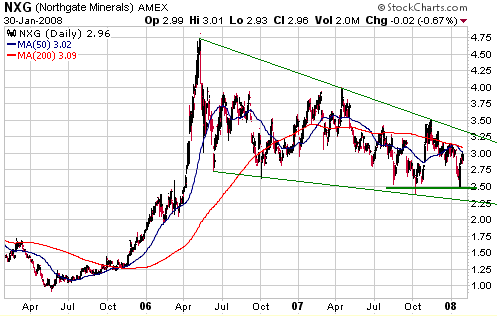
Chart Sources
Charts appearing in today's commentary
are courtesy of:
http://stockcharts.com/index.html
http://www.futuresource.com/
http://bigcharts.marketwatch.com/

|