|
- Interim Update 30th January 2013
Copyright
Reminder
The commentaries that appear at TSI
may not be distributed, in full or in part, without our written permission.
In particular, please note that the posting of extracts from TSI commentaries
at other web sites or providing links to TSI commentaries at other web
sites (for example, at discussion boards) without our written permission
is prohibited.
We reserve the right to immediately
terminate the subscription of any TSI subscriber who distributes the TSI
commentaries without our written permission.
Memorable Quote
"The definition of a robust society: where Paul Krugman could
exist without harming others."
- Nassim Taleb
Full Steam Ahead
The Fed reiterated on Wednesday that it was
pressing on with its open-ended QE and zero interest rate policies. It remains
convinced that by distorting price signals it can trick people into spending
more and going further into debt (true), and that this is just what the US
economy needs (false).
The Money Transfer Fallacy
A point we've made many times in TSI commentaries
over the years is that there is no such thing as "cash on the sidelines",
meaning there is no such thing as a pile of money waiting to go into one market
or another. Money never goes in to or out of any market. Apart from a relatively
small physical float of notes and coins, all the money in the economy always
resides within the banking system. When shares are bought, money doesn't go into
the stock market; it just gets transferred from the bank account of the share
buyer (or the bank account of the share buyer's money market fund) to the bank
account of the share seller. By the same token, when bonds are bought and sold,
money doesn't go in to or out of the bond market; it just gets transferred
between the accounts of buyers and sellers. Consequently, the change in the
amount of so-called "cash on the sidelines" is always just an indicator of the
amount of monetary inflation. If, for example, the Fed adds $1T to the US money
supply over the next 12 months then the amount of "cash on the sidelines" will
be $1T higher a year from now thanks to the Fed's actions. However, it's not
actually correct to think of the cash as being "on the sidelines", since all the
cash in the economy must always be held by someone. If one person decides to
hold less cash, then another person will have to hold more cash to make up for
it.
John Hussman makes the same point in his
latest weekly letter.
Actually, Hussman goes a step further and explains that money never goes from
one market to another. This was in response to the increasingly popular notion
that money is about to start flowing out of the bond market into the stock
market. For every bond seller there must be a bond buyer and for every stock
buyer there must be a stock seller, so again we are just dealing with transfers
between bank accounts. All the money in the economy must be held by someone, all
the bonds in the economy must be held by someone, and all the stocks in the
economy must be held by someone. An individual can reduce his exposure to bonds
and use the proceeds of the bond sales to increase his exposure to stocks, but
such a shift can't possibly happen on an economy-wide basis.
Hussman also notes that pension funds and other investors hold more bonds
relative to stocks now than they have historically simply because there are now
more bonds outstanding, relative to stocks, than there have been historically.
According to Hussman: "What is viewed as "underinvestment" in stocks is
actually a symptom of a rise in the gross indebtedness of the global economy,
enabled and encouraged by quantitative easing of central banks, which have been
successful in suppressing all apparent costs of that releveraging."
Exactly. When interest rates are held at an artificially low level for many
years, debt becomes relatively attractive. This is just another in a long line
of debilitating economy-distorting effects of central bank manipulation of
interest rates and money supply. In an example of breathtaking ignorance, the
Fed is systematically weakening the US economy by, among other things,
encouraging the expansion of debt in an effort to mitigate the difficulties
arising from the excessive indebtedness promoted by its earlier actions. Hardly
anyone can see what's happening, though, because the ignorance isn't confined to
the gaggle of bureaucrats responsible for setting interest rates.
So, when you read or listen to an argument that goes something along the lines
of "Market A is bound to rise due to money rotating out of Market B" or "Market
C is bound to rise due to cash coming off the sidelines", we suggest that you do
what we do: shake your head, roll your eyes, and switch your reading/listening
to something more edifying.
The Stock Market
The NASDAQ100 Index (NDX) has diverged bearishly from the S&P500
Index on both an intermediate-term basis and a very short-term basis. On an
intermediate-term basis the NDX has diverged bearishly by remaining well below
its September-2012 high while the S&P500 moved above its September-2012 high. On
a very short-term basis the NDX has diverged bearishly by remaining below last
week's high when the S&P500 made a new high for the year during the first half
of this week.
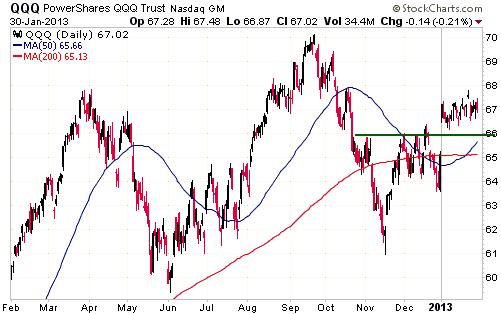
The following daily chart shows the performance of QQQ, an ETF that tracks the
NDX. QQQ moved sharply higher on the first trading day of this year (2nd
January) in reaction to the "fiscal cliff" deal and has since flat-lined. It
closed at $67.20 on 2nd January and at $67.02 on 30th January.
The 4-week period of going nowhere could be a routine consolidation within an
upward trend. However, due to the bearish divergence noted above and the extent
to which the broad market is 'overbought' there's a better-than-even-money
chance that it's a topping pattern. A daily close below $66 would confirm the
topping pattern interpretation, whereas a daily close above $68 would invalidate
the topping pattern interpretation.
If the recent sideways movement is part of a topping pattern then QQQ could
potentially trade as low as $59 within the next two months. Due to this
potential we began to accumulate some QQQ June-2013 put options during the first
half of this week. We consider this to be a hedge for our non-gold equity
exposure, as gold stocks are likely to rally after the broad stock market begins
to trend downward.
Gold and the Dollar
Gold
The
preliminary calculation of Q4-2012 GDP reported by the US government on
Wednesday morning showed an annualised growth rate of negative 0.1%. The GDP
number was much worse than most people were expecting, but it doesn't provide
any useful information about the US economy. The reason is that GDP doesn't
measure the health or real progress of the economy; it is simply a measure of
final spending. For example, an increase in government spending will boost GDP
in the short-term even though the spending is counter-productive, and a decrease
in government spending will lower GDP in the short-term even though the spending
reduction paves the way for the more efficient use of resources and a healthier
economy.
The GDP calculation is only significant to the extent that it affects monetary
policy. Like all Keynesians, the Federal Reserve's governors labour under the
false belief that consumption is the engine of the economy and, therefore, that
GDP is one of the most important indicators of the economy's progress. As a
result, the weaker the reported GDP numbers the 'looser' the Fed is likely to
become. That's why the 'oversold' gold market bounced and the 'overbought' US
stock market yawned in response to the surprisingly-low GDP number.
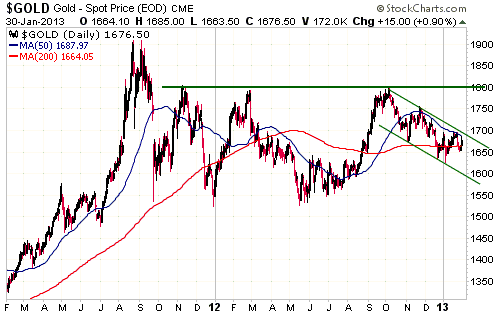
The gold price bounced on Wednesday, but not by enough to alter the price
pattern shown on the following daily chart. The price pulled back after rising
to just below resistance defined by the 50-day moving average and the channel
top.
Consecutive daily closes above $1700 would confirm that a short-term bottom was
put in place at the beginning of this year.
Gold Stocks
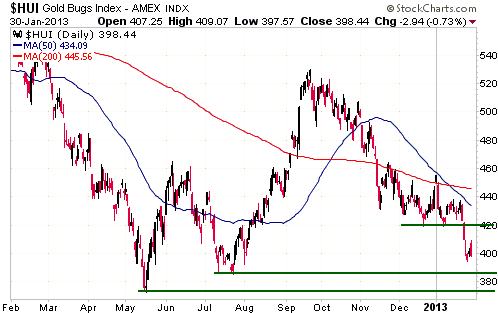
The HUI can't seem to get out of its own way. There was a good opportunity for a
rally to get underway on Wednesday 30th January thanks to gold moving higher in
reaction to weak economic data, the broad stock market pulling back and the Fed
confirming that aggressive money pumping would continue, but despite being very
'oversold' the gold-stock indices still managed to close lower on the day.
A full re-test of last year's low for the HUI (375-385) is probably coming up,
either within the next few days or following a multi-week rebound.
Note that a daily close above former support (now resistance) at 420 would be
definitive evidence that a short-term bottom was in place and a daily close
above Wednesday's intra-day high of 409 would be preliminary evidence that a
short-term bottom was in place.
Currency Market Update
The financial world is now bullish on all things euro-zone, including, of
course, the euro-zone's currency. This is even though the problems that everyone
was worried about last July haven't been eliminated; they've just been 'swept
under the carpet'.
The euro broke above resistance at 135 on Wednesday 30th January to a new
52-week high. It is 'overbought', but not dangerously so. We are in awe of the
almost 180-degree sentiment shift over the past 6 months, but at this stage we
have no desire to fight the trend.

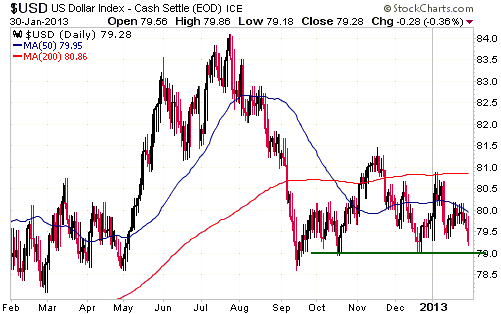
Although the euro has broken out to the upside, the Dollar Index hasn't yet
broken out to the downside. The Dollar Index needs to close below 79 to complete
a downside breakout of similar significance to the upside breakout just achieved
by the euro.
A daily close below 79 would undoubtedly generate much excitement within the
ranks of dollar bears and prompt forecasts of a continuing plunge to all-time
lows, but we think that the short-term downside potential is to no lower than
the 76-77 range and that the intermediate-term downside potential is to no lower
than the low-70s.
Our expectation is that by the second half of this year the financial world will
again be worrying about the euro-zone's government debt predicament and the
ultimate collapse of the common currency.
Update
on Stock Selections
Notes: 1) To review the complete list of current TSI stock selections, logon at
http://www.speculative-investor.com/new/market_logon.asp
and then click on "Stock Selections" in the menu. When at the Stock
Selections page, click on a stock's symbol to bring-up an archive of
our comments on the stock in question. 2) The Small Stock Watch List is
located at http://www.speculative-investor.com/new/smallstockwatch.html
 Gold
stocks that we are most and least comfortable with Gold
stocks that we are most and least comfortable with
In a speculative market environment for gold shares, such as the market
environments of April-2003 through to March-2004, June-2005 through to June-2006
and March-2009 through to February-2011, the lower-quality/higher-risk gold
mining stocks will generally be among the best performers. We are likely to get
a speculative environment like this within the next two years, because
inflationary monetary policy will eventually prompt speculators to focus on gold
mining and because during the current long-term bull market there has never been
more than 2.75 years between the end of one period of rampant gold-share
speculation and the start of the next (November-2013 is 2.75 years from the end
of the most recent speculative frenzy).
However, we aren't likely to get such an environment within the next 6 months,
the reason being that speculation usually begins to ramp up after indices such
as the HUI and the XAU have been in rising trends for several months. With the
HUI and the XAU having just returned to near the multi-year bottoms of May-2012,
the second half of this year now appears to be the earliest that we could
reasonably expect to see the sort of general enthusiasm for gold mining that
substantially boosts valuations within the ranks of the high-risk ventures. This
doesn't mean that junior gold mining stocks should be ignored for now, but it
means that for at least six more months most new buying should be directed
towards the juniors that offer relative safety and aren't reliant on rampant
sector-wide speculation for their success. By "offer relative safety" we mean
have strong balance sheets and projects in reasonable jurisdictions.
Considering the market environment that we are dealing with today and are likely
to be dealing with for at least another six months, the TSI gold stocks that we
are most comfortable with are Endeavour Mining (TSX: EDV, ASX: EVR), Evolution
Mining (ASX: EVN), Golden Predator (TSX: GPD), Golden Star Resources (NYSE: GSS),
Keegan Resources (NYSE and TSX: KGN), Pilot Gold (TSX: PLG), Pretium Resources
(NYSE and TSX: PVG) and Sabina Gold and Silver (TSX: SBB). Each of these stocks
is a) fully funded for at least the next 12 months, b) operating in an
acceptable location, c) positioned to do well (or at least not do poorly) even
if the gold market remains lacklustre, d) at least moderately well managed (we
are giving GSS's new senior management the benefit of the doubt), and e)
expected to be strongly cash-flow positive during 2013 if already in production.
Any new additions to the TSI Stocks List over the months ahead will have to meet
the same criteria.
By the way, although they currently aren't in the TSI Stocks List the two
prospect generators that we've written favourably about in the past (Almaden
Minerals (NYSE: AAU, TSX: AMM) and Eurasian Minerals (NYSE: EMXX, TSXV: EMX))
have the 'right stuff' for today's challenging market environment.
The TSI stocks that we are least comfortable with at this time are Jaguar Mining
(NYSE: JAG), Rio Novo Gold (TSX: RN) and Sandspring Resources (TSXV: SSP). The
remaining stocks are somewhere in between.
We are least comfortable with JAG, RN.TO and SSP.V due to their balance sheets.
JAG's balance sheet is precarious because of the company's large debt load,
small amount of working capital and high production costs. RN and SSP aren't in
financial trouble, but they will probably need to raise more money within the
next couple of months.
Chart Sources
Charts appearing in today's commentary
are courtesy of:
http://stockcharts.com/index.html

|









